Thoughts of an Aging Birder
I’m standing on a boardwalk through a wet woodland: deciduous trees, damp soil, emerging plants, ephemeral ponds. Superficially, it’s not so different from the boardwalk through wet woodland I was standing on less than two weeks ago. One on the eastern side of the Atlantic, a kilometer from the North Sea; one on the western side, 1500 km inland. Different ecosystems, certainly, but what I notice today is the difference in the soundscapes.

My photo.
Recognizing all but the most common bird songs is a skill that has eluded me for fifty and more years. But at sixty-six, my vision a little compromised both by vitreous detachment and its resultant floaters, and by incipient cataracts, I’ve been trying harder to sort out the songs, to identify by sound. (My aging and arthritic spine also appreciates not having to hold up even my light Swarovski 10 x 32s as much, too.)
My hearing remains good, thankfully. In On the Marsh, Simon Barnes writes of friends who can no longer hear the high contact calls of goldcrest; the screams of swifts overhead, he tells us, are inaudible now to Sir David Attenborough. That day will no doubt come for me, but it’s not here yet. I can still pick out goldcrest in England, and its almost-doppleganger cousin the golden-crowned kinglet, here in Canada.
In the first week of April, the soundscape at RSPB Titchwell was dominated by onomatopoeic chiff-chaff calls. European robins sang from low bushes; a blackcap added its melody from a higher perch. Wood pigeons, endlessly cooing, added a bass line, punctuated by the equally endless screaming of black-headed gulls and the occasional explosive chatter of a Cetti’s warbler.
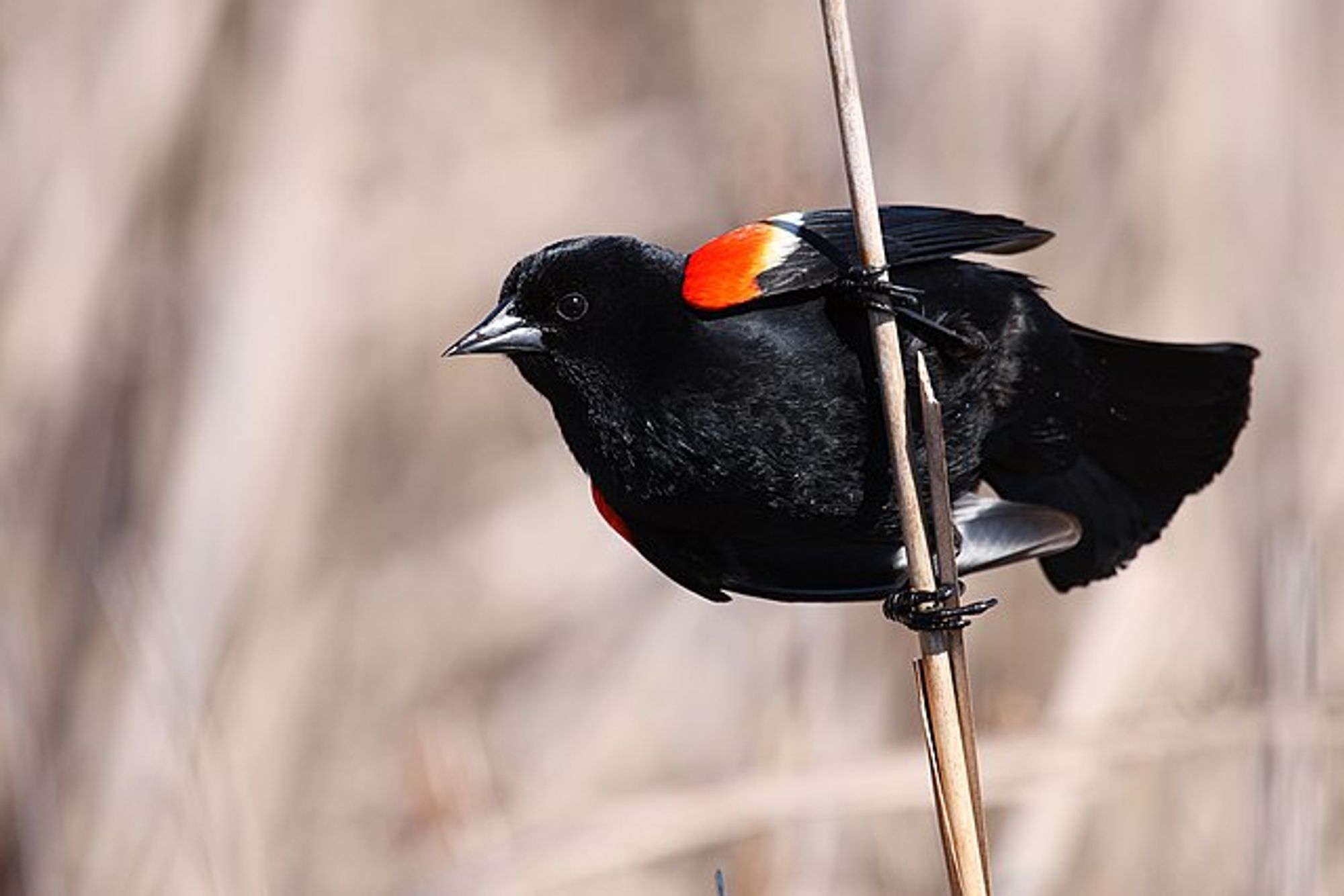
Here in Guelph, on the boardwalk through Wild Goose Woods a few hours after dawn, the dominant sound is the chirr of red-winged blackbirds, the screeching laughter of northern flickers a close second. Another bird calls its own name: fee-bee, fee-bee. American robins sing cheerily from mid-level branches, and from the nest on the light standard over the playing fields I hear an osprey’s plaintive cry.
I’d know where I was—roughly—from either soundscape. While I’m focusing more on what I’m hearing through necessity and a wish to understand more of the landscape I’m moving through, looking at all the parts of the whole and not just on birds (I can identify a phoebe by song at the same time I’m looking at a bloodroot flower unfurling, for example), I’m also thinking about it in terms of my other life, that of the writer. Of the seminar on worldbuilding I’ve offered to give here in Guelph in the autumn, and all the things that are part of a convincing fictional world or will evoke a real one. Soundscapes are one of them: part of the whole which both characters and the reader, one hopes, inhabit.
Whether any writer can separate entirely the slice(s) of the world in which they live from their created worlds, I don’t know. I can’t. In this, I can only write what I know. There’s a circularity to this: writing has made me pay attention to aspects of the world I might have not noticed; a lifetime spent outdoors whenever I could informs what I write. The Titchwell soundscape? It has a place in the story that’s beginning to unfold, and perhaps that book will be just a little richer because my aging eyes have made me listen more and look less. I’m fairly sure my life is richer, too.
 Random Ramblings
I’m grateful too that my ears seem to be younger than the rest of me. If only I had the energy to walk more! But there’s incentive to listen even from the house where I’ve occasionally heard screech owls, scarlet tanagers, and once a whip-poor-will.
LikeLike
I am envious of the whip-poor-will. Haven’t heard one in Ontario since I was a teenager!
LikeLike