Words to Live By

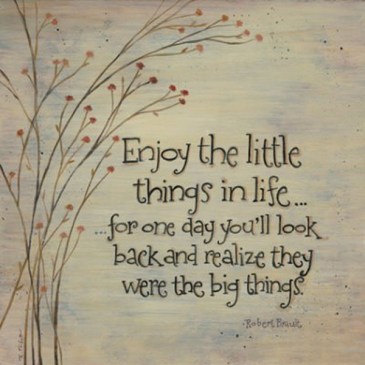
Not all of us can do great things. But we can do small things with great love.

This quote, apparently wrongly attributed to Mother Theresa, remains one of my favourites.  It doesn’t matter who actually said it – it remains a valid and validating statement.

I can’t, for example, paint a masterpiece.  But I can create art for handmade birthday cards, the image usually one I think will have some extra meaning for the person receiving it.

I will never write a best-seller.  But my first novel has been enjoyed by quite a few people, and has been well reviewed.

I will never be a master chef, but I can create meals from scratch that are enjoyed by friends and family.

I am no design guru or master renovator, but I have mudded and caulked and painted and wallpapered and laid tile with care to help create a home we love.

At the end of my career I received a provincial award for contributions in my field of education, completely unexpectedly.  I had never done anything huge, just a lot of small things over many years.

In a recent article in the New York Times, OpEd writer David Brooks asked readers how they found purpose in life.  He writes  “a surprising number of people found their purpose by… pursuing the small, happy life.”

Small things with great love.  Words to live by, at least for me.

Finding Space

Vacations, for me, are about finding space. I mean this literally. If a trip doesn’t include time spent in at least one of grassland, salt-marsh, range land, moorland or desert then I’m not getting what I need from it. Wide open skies in a huge blue bowl above me; views that go on for miles, the song of birds somewhere in the air.

So when BD’s cousin Liz and I went west for ten days we spent some of the time in the Rockies (almost obligatory when showing a visitor from Scotland the west of Canada) but we spent more of it in the prairies. I have no idea why I need space the way I do. I grew up in flat farming country, mostly untreed, and I carry the genes of generations of fen and salt-marsh dwellers. Is that enough to explain it? All I know is that places that others find bleak, or boring, are the places I love the most.

This love of grassland is the only part of Lena, the protagonist of my novels, that I took directly from myself. Her reaction in the excerpt below was mine, the first time we drove east from Denver and looked down on the High Plains.

Two days later, in mid-morning, we rode up from the bowl of a grassy valley between two ridges of land. We urged the horses up to the crest. As Clio came abreast of the larger horses, I reined her to a stop and looked out. I gasped.

Beyond this final ridge, the land fell away quickly in a series of declining hills. A sea of grass extended far beyond sight toward the horizon. From this height, we could see the roll of the land and the sweep and ripple of the pale, sere grasses. The sky soared above us, and the boundary between land and air looked like a hazy blur on the distant edge of vision. As I gazed at the space and enormity of the grasslands, an unrealized tension eased. I felt an inner expansion, the loosening of constraint. I could live down there, I thought, suddenly, fiercely, wanting it. I could lose myself in that land, below that sky, in all that emptiness.

This time we flew to Calgary, and drove from there, and I felt exactly the same way again at the point the land changes from the mountains to the grass and cereal lands of the prairies. I’ve walked on a few of the world’s great open spaces – the Tibetan Plateau, the Kalahari, the moorlands of northern England and Scotland, the tundra of the Canadian Arctic and the snowfields of the Antarctic – and my reaction is always the same.

BD is good about this. Papua New Guinea? he suggested, to look for birds. (It’s forest.) You go, I said, I’ll go to North Dakota. Peru? he tried, another time. He went; I spent the week in Texas birding the salt-marshes. I’ve spent my time in the forests of the Amazon, and Malaysia, and northern Canada, and I have wonderful memories. I don’t regret those trips, but thinking about them doesn’t soothe my soul the way the memories of sky and wind and space do.

What speaks to you, soothes your soul, loosens your constraints?

Staying Focused

An all-too-common question for retirees is ‘what do you do all day?’  And there is the occasional day I think ‘what did I do today?”  But those are infrequent, because I’ve learned that my days need structure, and the discipline to keep to that structure.

Self-regulation isn’t a strong point for me, or didn’t used to be.  Now, I’m fairly good at it.  That is in part what this blog is about; by writing it every morning just after I get up, it focuses me on the things that matter to me, and reminds me why I do some of the things I do.  I guess, in a way, it makes me more accountable to myself.  And I love getting out of bed, making coffee, doing some stretches (often while emptying the dishwasher – dishes are good light weights), and then settling down with a mug of coffee to write for a while.

There are four things I expect of myself every day:  eat properly, stay hydrated, exercise, spend time with BD.  Food shopping and preparation, and exercise, take up about three hours each day.  Time with BD is variable; occasionally there are days when it’s just mealtimes; other days we’ll spend all day together.  Then there are the high-priority daily activities: the on-going house renovations; writing – not just this blog but also work on Empire’s Hostage; the necessary work of daily living – the budget,  housework, lawn care, laundry.

I have stopped multi-tasking, except for listening to music while I drive or cook.  I’m far more productive this way, giving my whole mind to what I’m doing.  I try to structure my time in roughly one-hour chunks, alternating as best I can between a sedentary activity – writing, doing the accounts, watching a game with BD, playing Scrabble – and active ones, mindful of the studies of the negative effects of sitting too long on our health.  So, each morning, generally after I write the post for Two Simple Lives, I map out my day – not just what I want to accomplish, but when.  Do I always stick to it?  No. Sometimes the piece of the house renovation project turns out to need longer that day.  Sometimes errands take longer than I scheduled; sometimes I walk or bike longer than an hour just because the day is so beautiful. Sometimes BD suggests something to do together over breakfast. The code is more what you’d call “guidelines” than actual rules*.

Once self-discipline is in place in one area of your life, it’s easier to extend it:  it becomes a habit.  It makes the goals of mindfulness, of sustainable practice and of frugal living easier.  The map of my day doesn’t restrict me – I can change it at any time – but it does provide check-in points, times to look at what I’ve accomplished and what I haven’t, and review why. It also helps me not overdo something – I may want to keep writing, or keep walking – but should I?  I know there are limits on both my creativity and my energy at any given time.  Going beyond those limits generally isn’t wise. It’s a bit like coffee – I may want that third cup, but it’s going to make me jittery, and less productive. So two cups, and I’m done.

It’s a rare day I get to bedtime and aren’t satisfied with how I’ve spent the day.  And sometimes, all my day plan says is ‘read, relax, have a glass of wine.”  We all need those days, too.

* my favourite line from the Pirates of the Caribbean series.

MOOCing along: The Pleasure of (Free) On-Line Learning

This is an expansion of a post on my writer’s blog, Wind and Silence, so if you read that too, you’ve pretty well read this post, although there are a few differences.

In an earlier post, I wrote about how I sought out community and intellectual stimulation during my house-bound period last winter, following surgery, through becoming involved in Project Feederwatch. In that post, I mentioned there were other ways I found what I needed, and, because this also relates to one of my themes of being frugal, I decided it was worth writing a post about.

I subscribe to a site called Lifehacker on my Facebook newsfeed. Originally I started reading it because it often had technology-related reviews, ratings and ideas,which I needed for work. But then some time last summer, there was a post about free, on-line education.  Intrigued, I looked at it, and found a link to FutureLearn. Associated with the Open University in the UK, this completely free educational site offers dozens of courses on subjects as diverse as Global Food Security, The Works of Gabriel Garcia Marquez, and The European Discovery of China.  Universities from around the world are involved in the design and teaching of the courses. All you need to sign up is a computer and the internet.

I browsed through the course offerings, with, of course, an eye to courses that would increase my understanding of the Roman Empire, the historical template upon which the world of Empire’s Daughter rests. As I wrote in an earlier post on Wind and Silence, my understanding of my created world needs to be thorough, or I can’t write about it convincingly.   Two caught my eye: Hadrian’s Wall:  Life on the Roman Frontier, and, Archaeology of Portus:  Exploring the Lost Harbour of Ancient Rome. These looked promising, and the Hadrian’s Wall course’s timing was perfect – it would start soon after the surgery, but not immediately, so I had time to be able to handle sitting with my laptop again.  So I signed up for the it – we’d been to the Wall a couple of times, the most recent just over year before, and in that case specifically for research for the book and its upcoming sequel. I’d learned a lot from visiting the museum at Vindolanda, as well as just walking the Wall and thinking about what it was like to be a soldier there in the second century A.D., on a cold, damp, windy March day, waiting for your relations to send you more socks.

I’d taken on-line courses before, in relation to my work, so I was prepared for the basic format of readings, videos, questions to be answered and on-line discussions to occur. The course was well-designed and fun; I learned a lot, but the (for me) unexpected benefit was the literally hundreds of viewpoints that were expressed.  These courses are what are known as a MOOC – a Massive Online Open Course – and can have many, many participants.  Not everyone is very vocal, of course, but the wide range of experience, background, imagination and world-views of the participants who did express ideas made me think – not just about Roman Britain, but about my imagined world, and, some of my own preconceptions. It was rich discussion. The result is that some of what happens in the next book(s?) has been directly influenced by this community of learners (in both courses) who were willing to share their knowledge, ideas, and expertise with each other. I hope I remember to thank them all in the author’s notes!

There are, of course, lots of other opportunities for free or low-cost learning (the Lifehacker link is a good place to start) and I’d be interested to hear what others have found.  FutureLearn is just one place you can find free courses, and I’m waiting to hear if another on-line course that looked intriguing is to be offered again, this time through a different provider, Coursera.  My local Senior’s Centre…(yes, it appears I qualify, being over 55, although there is part of me that doesn’t believe this…) offers a number of no-cost face-to-face programs this winter. I am, actually, overwhelmed by choice, and have to be mindful, to stay focused on courses that will inform my writing…and leave me time to actually write.

Free Expression

Unlike some of my other posts, this one is about some of the practicalities of reducing costs, specifically, software costs.  As my retirement day approached, one of the very few things we agreed I needed to buy was a laptop.  Prior to that, I’d had one provided through work – more than one, actually, as a large part of my job was centred around the provision of technology in an educational setting, and I was constantly trying out new devices for compatibility with software, our system, student needs.  So there was always one I could use, and I was violating no employment rules by using them for personal as well as business needs.

Because of my work, I’d had the opportunity to try netbooks, chromebooks, ipads, other tablets…and what I wanted was a regular laptop.  My needs were this:  a screen and keyboard that would be big enough for aging eyes and arthritic shoulders – I’d found with the smaller devices, I leaned forward too much to look at the screen and the smaller keyboards made my shoulders and upper back hurt; I needed it to run an office program, primarily a word-processor for my writing and a spreadsheet program for budgeting; some digital-editing software for my artwork, and to do email, and that was just about it.  Oh, and i-Tunes, which I use occasionally.

I bought the laptop itself in February, for about three hundred dollars, a discontinued (I think) Acer Aspire running Windows 8.  I can bounce between just about any operating system without too many problems, so that was ok, even though it was new to me.  It came with a thirty-day trial of Microsoft Office, but I really didn’t want to spend more money on software.  I considered using only Google Docs, but our rural internet isn’t that good, and in experimentation I found the upload speeds just couldn’t handle it reliably.

Again, based on prior experience, I knew that Open Office, (which is open source freeware) would meet my needs, so that’s what I went with. (I could have used LibreOffice, too, and I’m sure there are others out there just as good. This isn’t a plug for Open Office per se, just a post about freeware.)  It’s met all my needs; all the final work on Empire’s Daughter was done on Open Office, including the last submission and conversion to e-book formats.  I still need to ask the Help menu how to do certain things…but to be honest, I found that I was doing that constantly with the last release of Microsoft Word too.  I think I just can’t hold as many things in my brain any more.

Then there was the artwork.  I’d been using Adobe Photoshop Elements, but I wanted to see if I could get by without it.  The quick answer was no, I couldn’t, not entirely.  Paint is a reasonable basic program, but it wouldn’t do what I wanted when it came to digitizing and modifying my pen-and-ink-and-watercolour originals.  I sometimes create entirely in Paint, though, if I’m looking for a simple, folk-art look, shown in the image that accompanies this post.  I couldn’t find a freeware to do the job, so in this case I gave in and bought Photoshop Elements.  But even then, with a bit of judicious on-line shopping, I ended up paying much less than the Adobe download price, and from a reputable office-supply store, so I could be confident it wasn’t pirated.  I just had to wait a few days for the disc and serial number to arrive in the mail.

Another piece of freeware I use on something resembling a regular basis is my tax software.  BD did the taxes up to two years ago, and by the old-fashioned method of pencil and paper and mailed-in returns.  And usually in November. Revenue Canada always owed us money, because of retirement plan and charitable contributions, so they didn’t really care he was seven months late (they even pay interest)…and he always made mistakes, which they always fixed.  Finally (after thirty-five years) I took them over, and immediately went looking for tax software that would do the calculations and e-file for me. Nicely, Revenue Canada lists several, including freeware, on their website.  I couldn’t see paying thirty or forty dollars (every year) for software…so I read up on the freewares, and picked one, and bingo – the taxes get done on time, no calculation errors, e-filed, and the returns deposited in our bank account in about three weeks.

Finally, there is anti-virus software.  From my sister, who was a systems analyst for thirty-five years (after abandoning law, but that’s a story for another day, about why she did so) I learned about Avast, which is the anti-virus freeware she uses.   I haven’t used it yet; I had a Norton subscription I could switch over to the new laptop, so I’m still using that.

But here is where my sense of community responsibility and justice kicks in.  These softwares are the result of hard work, usually by many people, who are offering them to the public for free.  But I can afford to pay at least something for them; I just don’t feel like putting more money in the hands of big corporations than I need to. (But I’m not technologically talented enough to use Linux, or I probably would.) There’s an option to pay something for all of them, but you get to try them out first, and even then you pay only if you wish.

Now here’s the caveat:  do your research!  There’s a lot of free stuff on the internet which is just a method of getting malware into your computer.  I had years of experience and access to a IT department that would help me solve issues when I – or my staff or the students which I worked with – made mistakes. I know how to restore my computer to its previous safe state if I do screw up (and I’ve had to do it).  Make sure your anti-virus is up to date before downloading anything, and if it’s got a website checker, use it.  Freeware isn’t worth it if you have to pay a tech to fix the problems it caused.  (I’m the unpaid computer tech in this household, and BD’s made some major mistakes over the years which ate up quite a few Saturdays…sigh.  I still can’t make his laptop find his printer in the control panel, although it communicates with the printer without issue otherwise.  Puzzling…)

What freewares have you used?  Do you have experiences to share, good or bad?  I’d be interested in hearing your thoughts.
Walking, Health and Wholeness

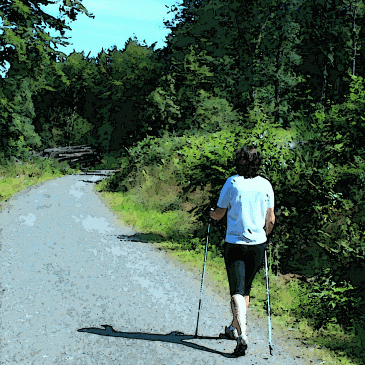
When I began this post, I wondered how I would tag it:  #health  #mindfulness, #sustainability, #writing #frugal #community.  All those reflect what walking means to me, and all are components of something larger, something I am going to call wholeness.  I am not whole if I do not walk.

From my earliest years I have learned by walking, dreamed of walking, found solace and healing in walking, tapped creativity by walking.  My memories of all the places and countries and continents I have been to are memories of walking, of the way one soil feels different underfoot than another, of the contours and smells of the land around me, the flow of rivers, the flight of birds, the shape of trees.  I learn new places by walking them, and once I have done so I am never lost.

I was the youngest by some years in our family, and was frequently solitary.  But I had fields and woods and farm lanes to roam, and those were different days.  I explored further and further afield, usually on foot, sometimes by bicycle, and with the dog for company.  I learned to look, at wildflowers and trees, at birds and mammals, snakes and frogs, at insects.

Then I went to university a long way from home, choosing the university in part because it was not in a town, but set some miles out of town, on a large expanse of land.  But a new reality faced me there:  girls – women – were warned not to walk alone beyond the lighted and paved campus, and none of my new friends wanted to walk.  I stayed a year, became depressed, gained too much weight, and changed universities.  This one too had a large open area, an arboretum with trails that linked to other trails extending out beyond and through the town, and I met friends who wanted to go walking, to look at trees and rivers and birds.  I lost the weight, stopped being depressed, and fell in love with a man who walks more than I do.

Walking informs almost all my writing, either as a theme (sometimes transmuted into other forms of travel through a landscape) or as how I tapped into whatever it is in my brain or the cosmos that creates fiction.  I will go walking with a problem to solve, one of plot or motivation or background, and after a good walk or two, even if I haven’t been directly chewing over the problem as I walk, the solution will appear.  I find letting the problem swirl around in the back of my mind, not looking at it directly, while I focus on watching birds, or fish, or searching through a stand of milkweed for Monarch butterfly caterpillars, often produces the quickest results.

When I start walking I’m stiff, sometimes sore, depending on the day, the weather, and the vagaries of arthritis.  That will pass after the first ten minutes.  Some days, I’m out of sorts, or worried, but being back in touch, physically and spiritually, with sky and land and wind provides perspective, and calms even my most persistent or serious concerns. Most days I walk for an hour or two; at this time of year, when the mosquitoes and deerfly of summer are still active, I walk at the university arboretum.  As summer winds down, I’ll go back to the conservation area trails that surround us.  Only when the weather is at its worst – heavy snow, torrential rain, extreme humidity – do I resort to indoor walking, either at the local shopping mall, or on my treadmill.

Walking together fosters community, whether its the community of our marriage – BD and I talk best when walking together, and face our most difficult challenges that way; the community of friends you’re sharing a walk with; the more casual community of people met on the shared paths and trails, or the neighbours you meet walking down to the mailbox. It’s also a pretty frugal way to exercise: good shoes are recommended, especially for aging feet, but otherwise there aren’t too many places where you can’t find somewhere to walk without paying an entrance fee.

I wonder, sometimes, who I would be, had I not been that youngest child, free to roam a safe rural environment, touching, tasting, watching the wild world, letting my mind and imagination run freely along conscious and unconscious channels, an experience unstructured and unguided. Would I – could I? write?  How healthy – mentally and physically – would I be? Questions that can’t be answered, because every choice of path, every turn we take or don’t take, every hill we do or don’t attempt, changes us, in ways we can’t begin to imagine.

Serendipity

As I’ve written earlier, I don’t buy a lot of books any more, for reasons of both economy and a concerted effort not to buy what I don’t need. Libraries provide me with most of what I read.  But I will buy a book if I need it for research, and I can’t get it any other way, or, it falls into a category I call ‘contemplative books’:  books I will read several times, books that make me think about my relationship to the world.  Mostly these are books like The Wild Places, by Robert MacFarlane, or Four Fields, by Tim Dee, thoughtful, insightful books written about the relationship between nature and humans.  Mostly British, as this is the country I love best of all the world.

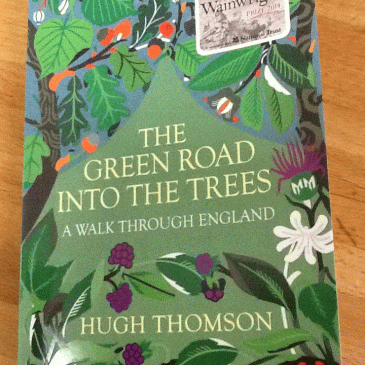
So when Amazon.co.uk sent me their most recently generated list of ‘books recommended for me’, one stood out.  (By the way, I don’t understand the algorithms they use, but they get it right 95% of the time.  I want to buy almost all of them.  I resist.)  The Green Roads into the Trees:  A Walk through England, by Hugh Thomson, ticked enough of the boxes. My libraries didn’t have it  and weren’t interested in getting it – too specialized.  I was pretty certain I would read it more than once.  So it became one of the rare books I bought.

I was busy, so I didn’t look at it for a few day after it arrived.  But when I opened it….call it grace, call it serendipity…but it ticked a box I hadn’t realized it would.  The book is about the author’s walk from Dorset to Norfolk on an ancient trackway called the Icknield Way, a route and an experience I need to research, not for the Empire’s Legacy series, but for another novel which is in the very early planning and research stage.  I was absolutely delighted. And if I know the way of things, there is a good chance that somewhere in this book there will be a line, a comment, that will inform and change that novel in a way I can’t foresee, if I read mindfully, open to what it has to tell me.

This is a shared (and slightly modified) post from my writer’s blog. I don’t plan to overlap the two very often, but this one I felt was appropriate.  

The Love of Libraries

As both a writer and a reader, I love libraries.  I learned to read at a very early age, thanks to my retired-teacher grandmother, who lived with us.  Money was scarce and there was no bookstore in our tiny little town, but there was a library, remarkably well-supplied for rural Ontario.  I read my way through the children’s section, and at about eleven, switched to the adult books. This wasn’t allowed – I was far too young – but my mother fought for my right to read what I wanted, and won.

In high school we swapped books around in a small group of geeky science fiction and fantasy fans, and I read Verne and Lovecraft and Eddison as well as Tolkien and Dunsany and Lewis. Somewhere in my late teens I learned libraries would order books for you, if they didn’t have them, and this opened up another source of new worlds and new thoughts. I read the Beat poets and writers, and Kesey and Tom Wolfe, and Toni Morrison and Alice Walker – new voices for me.  Then I went to university – on student loans and summer wages – and discovered used bookstores, where I spent far too much money.

Meanwhile I continued to use local libraries, reading four or five books a week, fairly indiscriminately.  I’d stopped using the hold or request functions, though, because if I really wanted a book and it wasn’t available, or, I saw one and liked the cover and the blurb, I just bought it.  Bookstores were a destination most weekends, and I rarely came away without at least one book, and as we moved from undergrad to grad school, and then to working, and disposable income increased steadily – I (we, actually) bought more and more books.

During this time, I also came to appreciate the library – in this case the university library – as a place of calm and quiet, a place where I could write.  First my M.Sc. thesis, written on the exceptionally quiet fifth floor, and then, over the years but in the same place, other works – poetry, short stories, and quite a bit of my first novel.   It’s also the same floor and  the same study carrel where I’m writing this blog right now, and where frequently I’m working on Empire’s Hostage, the sequel to Empire’s DaughterIt’s a space both low on distractions – no cats wanting attention, no husband commenting on the game he’s watching, no house or garden chores nagging at me – and high on acquired discipline.  When you’ve been writing in one place for thirty years,  habits of productivity are reinforced by the environment.

While I was working, I only used the university library on weekends.  What little bit of writing I did do during the working week was done at home in my study/library, but in comparison with the university setting I found it hard to work there, even when I was alone in the house.  Gradually I came to realize that the visual distractions in my study – mostly the overflowing shelves of books and the piles of papers on the desk – were in complete counterpoint to the spare and organized university space.  All those books were working against me, love them as I did.  So we culled, donating to book sales, and I moved papers into files on the shelf space freed up.  Suddenly I had a home environment much more conducive to work. (If you are interested in my writer’s blog, please visit it at https://marianlthorpe.wordpress.com/).

But I need new books, for research, for pleasure, for contemplation. Slowly the shelves began to fill up again….and then we retired early, and our income fell by sixty percent.  I looked at what we spent on books each year, and blanched.

These are our book buying parameters now:  first, see if it’s available from the library, including interlibrary loans and purchase requests.  This works about 80% of the time, although there is often a considerable wait.  I once hated waiting for books; now I appreciate the anticipation, the pleasure or learning I know is going to come.  If the library doesn’t have it and can’t get it, look for used, especially on-line when it’s a book I need for research.  Again, waiting a few months often yields the book from these sources.  But if all else fails, and either of us are absolutely certain the book is needed for research OR that it will be read multiple times, as I do with books I buy for contemplation – then it is bought.

And the books I used to buy on impulse, because I liked the cover?  Now I pick those up from the new book shelves at the library.