A Long(ish) Walk

November 10th, and the forecast says warm and sunny. It is, I suspect, the last warm day of the year, and I’m not going to waste it. The wind gusts are forecast to be 35 – 40 kph, however, so it’s not a biking day. I decide, on the spur of the moment, to walk to Riverside Park along the river trails.

Brian joins me for the first part of the walk through the Arboretum to the Eramosa River trail. We follow the paths through Wild Goose Woods, then the old gravel pit and on to Victoria Woods. It’s quiet, aside from the drumming of a hairy woodpecker, the occasional chirp of a junco, and the familiar, cheery call of chickadees. We cross College Avenue, walk up the gravel road, and turn off onto the new Arboretum Side Trail that links the Arboretum trails with the river trail. Where it comes out on Victoria Road, just north of the bridge, we part company: Brian to walk the eastern trail section out to Stone Road, I to head west towards the confluence and the Boathouse.

Lots of dog walkers out, as usual, on this part of the trail. But good dogs, ignoring me. At Lyon Park I leave the river, cross York Road, and walk up through the Ward along Ontario Street to downtown. I’m cheating a little, not staying on the river, but it saves me a couple of kilometers—and anyhow, I like the Ward. We used to live here, and its eclectic mix of houses, old stores that are now houses (some with the signs, painted on the brick, still visible), big vegetable gardens, and old factories being converted to apartments still feels a bit like home.

St George’s bells are ringing ten o’clock when I reach downtown. I’ve been walking nearly two hours; it’s time for a coffee break. My favourite café is closed for renovations, so I choose another on the other side of St George’s Square and settle down with a café latte and an almond croissant. Not too long a break, though, or I’ll stiffen up.

So it’s not too long before I’m up and moving again. Down to Goldie’s Mill Park, and now I have a choice. The paved trail that parallels the railroad tracks out to Speedvale, or the Rapids Side Trail, a hiking trail that drops down to the banks of the Speed? It’ll be rougher, and a bit rugged in places…but it’s right at the river. If there are going to be birds anywhere, they’ll be at the river. I turn onto the blue-blazed side trail.
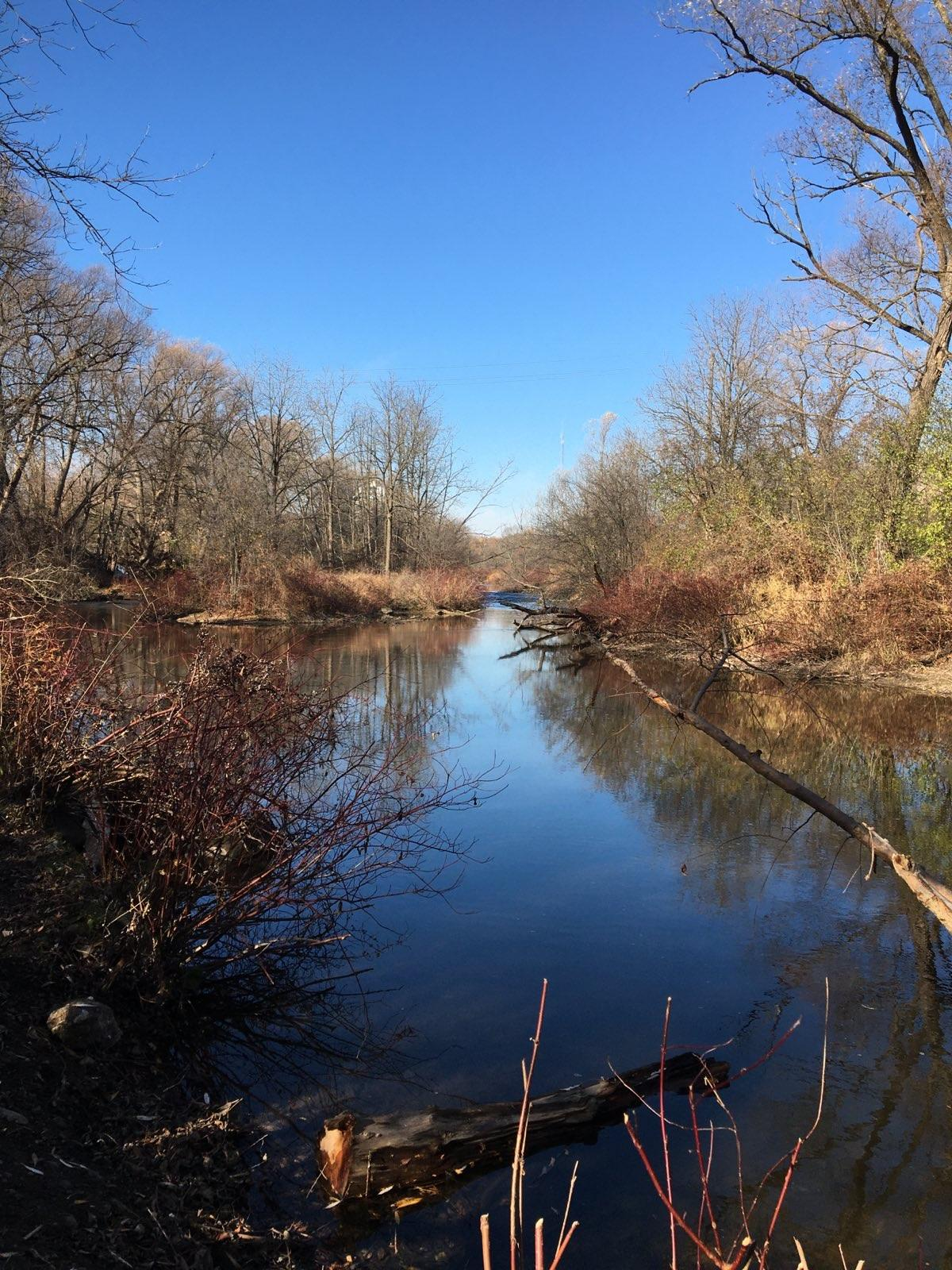
Speed River from the Rapids Side Trail

There are juncos and chickadees, and two squabbling downy woodpeckers, and a host of Canada geese and mallards on the river. It’s hard to believe I’m in the middle of Guelph. It’s a lot more interesting than the paved trail it parallels (as much as I like biking that one!) At a marshy area a few hundred meters before Speedvale, the path turns back to meet the paved trail.

I cross Speedvale in a break in the traffic, and now I’m in Riverside Park. Slowly, because my feet hurt by now, I walk along the bank of the river, looking at the gulls and waterfowl. There can be unusual ducks here, but not this year. I make my way up to the footbridge, cross the river, and find a bench to sit on for a while. I’ve walked about 10 km, on a whim.

But I take the bus home!

(P.S. -regardless of what Google Maps shows, it took me a bit over three hours, not including breaks.)

Walking Downtown

The past two Sundays I’ve had writer-group meetings downtown in the early afternoon, and on both days I’ve chosen to walk. It’s about 4.5 km (2-3/4 miles) by the most direct route; it takes me about an hour, and it’s a walk I’m growing to love again: we used to do it all the time, back in our university days, but those were thirty-five years ago.

The first part of the walk takes me through the university campus, on its bricked walkways, walking between buildings that range in age and architectural style from the limestone houses of the 1870s to the concrete, wood and glass of the twenty-first century. Only a few students are out and about so the wide walkways aren’t crowded, unlike Monday to Friday. I cross College Avenue and follow a minor path behind MacDonald Hall, in all its red-brick and terra-cotta glory, to University Avenue – and then down a footpath that joins two dead-end streets that more-or-less parallel the main road to downtown. The footpath follows the road allowance, it’s unmarked but partially stabilized with pavers, and I have never known if it’s an official city path or not, but I’ve been walking it for over thirty years and there are no signs to tell me not to.

This brings me out onto Gordon Street, the main road, a steep-ish downhill and busy, but the sidewalk is wide and I only have to use it for 600 m or so. At the bridge over the Speed River I stop to look at the waterfowl: Canada Geese and mallards at the confluence with the Eramosa, and a few ring-billed gulls. Just beyond the bridge is the Boathouse, home to ice-cream and canoe rentals in the summer months, afternoon tea well into December, and the point at which I turn and walk along the gravel driveway to the covered footbridge over the river.

I remember the bridge being built: in 1992, the Timber Framers Guild held a conference in Guelph, and 400 volunteers built this bridge to an 1880’s design, raising it by hand. It was an impressive project, and an important one, because it meant the river trails on either side of the Speed were now continuous. We lived for a decade or so at the far east end of the river trail, and I would walk home from work at the university down Gordon Street and across the bridge, along the trail and home. And vice versa, in the morning.

But now I cross the bridge and turn left, away from the river and towards downtown. I walk up past the Armoury and into downtown proper, find the cafe where the meeting is, buy a coffee and start talking.

Two hours later and it’s time to come home, after a short detour to buy a loaf of bread from one of the downtown bakeries. I have two choices: I can re-trace my steps from earlier, or, at the covered bridge, I can turn east and walk along the river trail to Victoria Road, watching the river for bird life, greeting the dogs out for walks, and avoiding tiny children learning to walk or ride bikes along this safe trail. At Victoria, I turn south, up the hill, walking here on a wide road shoulder for a few hundred meters until a trail turns west into the University’s Arboretum. From here I can follow the trails and gravel roads back to the University gates on Stone Road, and cross the road to home. It’s longer: it takes me about ninety minutes to walk that way, but it’s a lovely walk.

Last Sunday I came home through the longer way; today I chose to retrace my steps. Another day I may go downtown by the long route and come back up Gordon Street hill. There is always something to see: I can stop to look at architectural detail on campus, or watch a soccer practice; on the walk down Gordon the spires of the Basilica dominate the skyline. The downtown itself I never tire of. And if I choose the river-and-arboretum walk, I’m guaranteed some birds, even if it’s just a flock of friendly chickadees. Yes, it takes me two hours at a minimum. But I plan to walk for at least two hours every day, and if some days that walk is in the city rather than the fields and woods of the Arboretum and the river, well, it fills a different need. And not just because I can stop at the Boathouse for a pastry!

Seven Things – no, Eight – I Love about Our New House


We’ve been here two months next week. Here’s what I love about the new house.

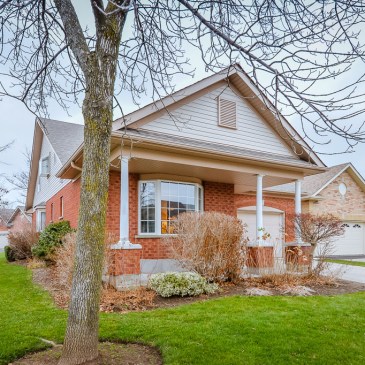
front3

  1. Its location. I’ve written about this before, so I’ll keep this short. I can walk or bike to the university’s arboretum, which alone gives me a 6 km walk if I do the perimeter paths alone, and a lot more if I wander the interior trails…and it’s an easy connect to the city’s multi-use trail system, which takes me downtown, or up to the big north-end park, or further out to the lake. Or along the river system, east, west, or north. I can also walk or bike easily to grocery stores, two butchers, a seasonal local-produce stand, and all the shops and services I could want.
  2. The recreation centre that’s about 250 metres away. Which includes a 25 metre pool, where I’m learning to swim again; a fitness centre, an excellent library, billiard rooms, bocci and tennis courts, concert and theatre venues, and lots of other activities to participate in, should I choose to.
  3. Air conditioning! It’s a hot and humid summer. The previous house didn’t have air conditioning; it kept cool with huge old shade trees and windows open at night, but it would have struggled this summer. We use it judiciously, but we appreciate having it here.
  4. The natural gas barbecue. No propane tanks to buy and change and take back. We’ve barbecued more here in the last month than I think we did in the last house in the past five years. (This is related to reason 6, too.)
  5. New construction. Our previous house was built in 1911. This one was built in 1998. Its windows fit, its doors fit. Floors are flat. It has good insulation. I dusted today for the first time in two months, whereas the old house – well, you dusted, and a few hours later you wondered why you’d bothered.
  6. No mosquitoes! OK, it’s a very dry summer. But it hasn’t stopped the mozzies at the other house, which is rural and in an area with a lot of maple swamps. Here, there’s the occasional one, but I can go outside to pick herbs and tomatoes without insect repellent, which wasn’t the case before.
  7. The city it’s in. I’m hugely biased: I lived here for sixteen years, between 1978 and 1994, before we moved a bit further south to make our commutes do-able. I always wanted to come back – but there was good reason for that. I’ve talked about the trail system, but to that I can add beautiful parks along the rivers, a good arts centre, one of the best bookstores in the world with welcoming writers’ community, some wonderful old architecture, the university’s library, music performances and theatre, the year-round farmer’s market, the best-behaved off-leash dogs I’ve met outside of Paris, and a strong local-food movement. All the things that make a city livable, for me.
  8. The community-within-the-city. Friendly, welcoming neighbours who balance that friendliness with respect for personal space and choices about lifestyle and involvement in community activities.

The biggest thing we’ve had to get used to (again) is paying for water. We’ve been on our own well for the last twenty-two years, and while we were always careful during other drought summers, the water was, essentially, free, although of course there was pump maintenance and replacement, as well as water-tank replacement in those years, and the electricity to run the pump. (Sometime I’ll do the arithmetic on that and see which one was, in the long run, more expensive!) Here, not only do we pay for water use, but we are bound by water restrictions – the city uses groundwater, and in a dry summer like this one we are limited to which days and which hours we can water flowerbeds; lawns are out of the question. I have no problem with that at all – essentially it’s no different than what we did with our own well. I’m not complaining about either paying for water (we should) or the restrictions (necessary and responsible): it’s just the one thing that wasn’t on our radar for the last twenty-two years.

So, when people ask me do I miss the old house, the honest answer is no. It was time to move. I’m glad we did.

The Moving Diaries: Clearing the Attic

This was the weekend of the attic. Fairly typical of American Foursquare houses, our attic is large, a big square space with two dormers front and back. With a total floor space of about 400 square feet, and a ten-foot ceiling, it’s a space with promise. We always thought we might turn it into a studio for me…but it never happened. So it became a place to store things, as attics do.

Friday I spent a couple of hours sorting: garbage, thrift store, keep. Three piles. Then I lugged boxes and bins and bags up the steep stairs and consigned the piles to containers. And that was enough, for one day.

Saturday, I brought the containers holding the ‘keep’ items down one floor to the spare bedroom, which is becoming the box repository. Then I left BD watching soccer and went to a friend’s open barn day,

kid
Adorable Angora Kid

where she shows off her spring crop of angora goat babies, and gives tours of her woolen mill and shop. Angora kids are adorable, and the colours she dyes the wool are enough to make me want to start knitting again. After we move.


Sunday – today – I started the day with a good two hour walk, birding the woodlands and open spaces of the university arboretum. Spring migration is just starting, resident birds are defending territory and building nests, and the air was loud with song and the drumming of woodpeckers. I needed scarf and gloves for most of the walk, but by ten it was warm enough to shed both – but it was also time to head for home and finish the attic.

I surveyed the spare room, and realized my first step was to move the ‘keep’ items – or most of them – from the blue plastic bins to boxes. The plastic bins are meant for taking items to the new house that we’ll unpack immediately, the bins returning to the car for another trip. So I packed boxes, carefully labelling them: “Board game, desk lamp, miscellaneous” one box says. “Various winter things,” another says. Sometimes what goes into a box is determined by the size of the items and the box, not the relatedness of the items. But since this was all in the attic, none of it is needed immediately we move, and these boxes will be relegated to the basement shelves.

Then I took the boxes back up to the attic, and packed up the items for the thrift store, carrying them all to the attic stairs landing. Now, the stairs are narrow, steep, and have a bend part way down, and I’m not what you might call agile. BD was out birding. So I carefully stepped backward down the stairs, bumping a box from one step to the next, until I was on the bedroom floor landing and could stand up with the box in my arms. Eight times. Then down the next flight of stairs, and out to the car, where I put the boxes in the back seat.

That left about eight largish pictures in frames, and two large mirrors that were in the attic when we moved in twenty-two years ago. Plus two portable baseboard heaters. These were beyond me. When BD came home, he, much more agile, carried them down the stairs and stowed them in the trunk of my car. The thrift store has a nice young man of about twenty who will take them (and the boxes) out of my car tomorrow.

What is left up there? Six garbage bags, which we’ll bring down in stages for curbside pickup – we’re limited to three bags every second week. A desk and a bookshelf which will wait for the professional movers. The painting equipment that is still in use. I think that’s it. BD will finish painting the space in the next week or two….and then the people that view the house, and the eventual buyer(s), can dream about what they will do with it: a studio? A nanny flat? A playroom? The wide pine boards under the carpet could be sanded and finished. A skylight or two could be installed, along with a spiral staircase to replace the awkward existing stairs. All things I thought about. But I went to Antarctica and Tibet and the Himalayas, to the Amazon and the Serengeti and the jungles of Borneo instead, leaving the promise of the attic space to someone else, in the end.

The Moving Diaries, April 15th

I packed the first boxes this week. I started with the spare room, which holds my out-of-season clothes, a cupboard full of wrapping paper, gift bags, and related items, a couple of bookshelves, and not much else other than the futon-sofa-bed, the ironing board, and the wireless router. I thought this would be a fairly simple room to begin on.

I wasn’t far wrong. I ended up with one stuffed garbage bag, three boxes for donation, three for moving, two for paper recycling. The hardest part was sorting the books. I don’t buy a lot of books, and so what I have are ones I will tend to re-read. So, not surprisingly, I ended up keeping most of them, sending a dozen or so to the thrift store and another dozen or so (collapsing, yellowed paperbacks) to recycling.

What surprised me is how it made me feel. Two winters ago, not working due to health issues but with a fair bit of energy much of the time, I cleaned and culled almost every room in the house. That was actually fun: I was focused on de-cluttering my life, and it gave me something to think about that wasn’t my health. This process now isn’t depressing, but it does make me a little bit sad. As much as I like our new house and just about everything about it – the layout, the neighbourhood, the city it’s in – I’m still a little bit sad to be leaving this house and this village after twenty-two years. I suppose that’s normal.

We’re leaving because it’s time to, because the new house and its location is better for my health and BD’s, easier for me to walk and bike every day, less stress for both of us in driving back and forth to town for everything we need. It’s also only twenty years old, not a hundred and twenty, and won’t need the constant and sometimes exhausting maintenance this one does. But while the neighbourhood is nestled between the university’s arboretum and its nature reserve, and attached to the city’s multi-use trails – all good things, and the defining reason for buying there – we won’t be looking out on twenty acres of woodland, as we do now. (On the other hand, we’ll actually be able to sit on our new deck and not be eaten by mosquitoes between April and October.) We won’t have foxes running through the garden, and red squirrels beating up the larger black ones, and the wild turkeys coming to the feeders…but I also won’t be paying a small fortune to have a nest of raccoons removed from my fireplace chimney, as I am on this coming Monday. Compromises.

The three boxes have gone to the thrift store, the boxes to be moved are taped and labelled. Garbage and recycling waits till next Thursday. The spare room is basically done. Tomorrow I’ll start on the bathroom – just the cupboards there, really, to be done.

And while part of me is sad, part of me is excited. I mull over paint colours and window treatments as I drive. I think about light fixtures. But mostly I think about what my daily routine will look like, about being able to walk or bike into nature from my front door, but also bike to the grocery store and the public library. To attend plays or hear speakers or listen to concerts at the university and walk home in fifteen minutes. To access the university library seven days a week, instead of only weekends when the parking is free. All of that makes me smile. Sad and happy, an end and a beginning, goodbye and hello.

Eating (semi)well on the road.

We’ve just returned from a two-week road trip through California and southern Arizona, a trip booked long before the idea of buying a new house entered our minds. Nothing was going to happen with the house purchase in those weeks anyway, so there was no reason not to go.

Since the days of our six-and-seven week road trips, where we mostly camped, took a cooler with us, and bought groceries, several things have changed. One, of course, is that we were flying and renting a car. Secondly – and most importantly – are the food allergies/sensitivities BD has developed. It’s really difficult to find food he can eat, and even more difficult to find restaurants he can eat at. His allergy is to a specific fatty acid – lauric acid – which is found in red meats, most fats, coconut and palm products, all dairy, and some spices. It makes him break out in hives, big nasty hives which even extra-strength Benadryl only somewhat controls. So we need to be very careful about what he eats.

We could have bought a cooler in California, shopped for groceries, and eaten at parks and picnic stops. But there were a couple of strikes against this: one is that, for the most part, it was too cold to do this comfortably – we had snow in the foothills in Arizona! – and the second strike was just that we wanted more ease. We’ve done our share – more than our share – of eating in wind, rain, cold, searing heat and annoying insects, or perched on the side of the bed in a hotel room. Frankly, I’ve had enough of that.

Subway is one chain we know is safe for BD, if he sticks to chicken or turkey, but a constant diet of Subway grows old quickly, plus the sodium content is pretty high. We decided to try Denny’s, the classic diner chain: their available nutrition information is good, and they have something extremely difficult to find in US restaurant chains: reasonably sized meals, if you order carefully.

For dinners, we mostly stuck to the 55+ meals, eating a salad (with no cheese or dressing for BD), fish or chicken with broccoli and another vegetable – corn for me, squash for BD – every night. With unsweetened iced tea, the calorie count was around 650, the sodium, fat, and sugar content low for restaurant food, and there was nothing in the spices or preparation that triggered BD’s allergies. Breakfasts were fairly easy too: ordering a la carte, BD ate poached eggs on dry toast, oatmeal, and fresh fruit every morning; I had the same, or sometimes yogurt instead of the oatmeal. Again, the meals ran in the 650 calorie range, and it was easy to avoid the dairy and oil that would have been a problem. And we both appreciated comfortable booths and table service, especially after a long day, and in the morning when I’m not human before that first coffee.

It was also quite a bit of food. Neither of us were terribly hungry at lunch time, even after hikes of several hours most days. We’d found an energy bar by KIND that BD could eat without problems, so lunches tended to be an energy bar and an apple. BD would add a handful or almonds or peanuts; I’d add a latte if there was one to be had. If we walked a lot, sometimes we had a second energy bar, or more nuts.

Not every meal was eaten at Denny’s or Subway. We ate a couple of breakfasts at little cafes at Morro Bay and Cayucas. We drove to Oxnard (twice) specifically for fish and chips at Sea Fresh, which fries in peanut oil (BD had a double order of chips, it was such a treat.) Only something at Olive Garden triggered any reaction in BD, and it was mild, so a trace of oil or spice, most likely.

I celebrated my 58th birthday while on this trip. We debated a special dinner, but I didn’t particularly want that: what I did want was ice cream, as it was an unseasonably hot day (the only one of the trip) at Point Reyes National Seashore north of San Francisco. I usually avoid eating ice cream in front of BD – it seems cruel, when he can’t eat it any more – but I made an exception for my birthday. And in the little general store in Inverness, California, not only did I find my favourite Haagen-Daas chocolate-coffee-almond bar, but a lime gelato bar with no dairy that BD could eat (and he loves lime). We sat at a picnic table overlooking the bay and ate our treats, enjoying every frozen bite.

We were pleased with the trip – not only did we find the two birds we went to see around San Francisco, ones that have been eluding us for thirty years (because they are found by call, and they only call during breeding season, and that was always while we were working) – but we ate fairly nutritious food and didn’t trigger BD’s allergies. We went for long walks, watched dolphins and sea otters and seals along Highway 1, heard coyotes singing in the dusk at Yuma and watched the sun rise over the mountains. A good holiday. Now back to the realities of packing up this house for the move. Stay tuned!

Changes

It’s been a while since I posted anything, and that’s because life has moved very quickly in the last three weeks.

One of the things our two months in England confirmed for us was that we want to live somewhere where we’re less dependent on the car to run errands.  The second thing was that we could quite happily live in a bungalow, and the third was that we really liked not being responsible for the lawn and garden.  We’d thought it was time to leave this old two-storey rural house, with its quarter-acre of lawn and garden, 10 miles from anywhere: what England told us is that we were right.

We always said we’d move before it was too late, when we could make the choice. We came home, spent some time wandering around neighbourhoods in the university town north of us that we know well and love.  We narrowed it down to two, and then to one.  And yesterday, we bought a house.

It’s not quite a bungalow, in that it has a bedroom and ensuite on a second floor, but we don’t need to use those except for guests, or, for the foreseeable future, as BD’s study.  It’s a 10 minute walk to the university’s arboretum, for walking and birding; a 15 minute walk (or 5  minutes on the bike) to the university library, where I like to work, a ten-minute walk to a grocery store, on quiet back roads. We can bike downtown, to movies, to lunch, to the arts centre, to the bookstore, to the summer outdoor concerts.

While we own the house, and can do what we like with it, indoors and out, we don’t own the land it sits on: the university does.  So we pay, effectively, condo fees – and for that we get the lawn and garden taken care of, the snow ploughed and shovelled to our front steps, and the use of a large and well-equipped recreation centre. Or, as BD put it yesterday, to be permanently on vacation.

It’s ours in just less than two months, assuming all goes well with the inspection and the bridge financing – we have to get the existing house on the market, but there’s a bit of work to be done yet.  The new house needs its interior walls painted and a few other cosmetic bits and pieces.  One thing for sure, this adventure over the next couple of months – as we try to do this as mindfully as possible, fitting what we already own into the new house, figuring out what we really need (like a new bed), disposing of what we don’t – will give me plenty to write about!


Belonging

Growing up as a child of immigrants, the stories you hear of ‘home’ are usually tinged with nostalgia, seen through the rose-coloured glasses of memory. I can’t say this was true of all my parents’ stories – they had lived through the depression and World War II in Engand- but the ones that stayed with me the most were their stories of long childhood walks through the countryside, roaming footpaths and hedgerows, free and unsupervised.

My own childhood in Canada was as free as most childhoods fifty years ago were, and living at the edge of a village there was freedom to roam the farm lanes close to us, the farmers turning a tolerant eye to our activities, and we certainly bicycled the quiet roads around us. But at the back of my mind, it just wasn’t the same. I had grown up on Enid Blyton and Arthur Ransome, and I wanted footpaths and moorland, quiet hedged lanes, little villages hidden in folds of the hills…and as I grew older, a welcoming pub to stop at.

So here I am, nearly fifty-eight, writing in the sitting room of our holiday cottage that we’ve taken for January and February, back from a walk that ticked just about every box on that list. We set out just after nine this morning, turning right up the lane at our front door. A few hundred meters up the hill a gate opens onto a field and footpath, climbing further up the hill, skirting field margins to bring us out onto a quiet lane. A barn owl is hunting in the field to our west. At the top of the lane, the wide Norfolk views open out; to our west is the broad expanse of the Wash, its flocks of waders and waterfowl visible even from here, the coast of Lincolnshire shimmering in the distance. To our east, fields: field peas and sugar beet, wheat stubble, autumn-ploughed fallow, cut with hedgerows and lanes.

We walk in a northerly direction, following paths and bridleways, along field margins and old drove roads through farms, coming out into villages. The sky is changeable, clouds scudding in the strong westerly winds, patches of blue winking in and out. Hedges, green with ivy, keep the worst of the wind off us except when we the route takes us due west. Grey partridge scatter in front of us, calling their distinctive rasping cry.

After about six kilometers the drove we’re on swings west, past a substantial farm, and then south again for a few kilometers, coming out by a magnificent medieval church perched high on the greensand ridge that runs up the coast here. On a bench outside the church wall we sit for a snack, looking down over the village. It doesn’t do to sit too long, though: we’ve another three or four k to go, and tired muscles ‘set’ all too easily. We walk through the village streets, past the old watermill, and on to the footpath that is the last leg home. In a field to the west about a hundred curlew are feeding, beside jackdaws and wood pigeons, and where the footpath enters a woodland long-tailed tits chatter their high-pitched greeting.

We’re home in time for lunch, just after one o’clock. All this walk was missing was the pub, and that’s just up the road: the well-deserved pint can wait until a bit later this afternoon. I have soup to make for dinner and bread to bake. In all my months of recovery from major surgery and post-surgery treatments in 2014 and 2015, it was the thought of walking under this quiet corner of Norfolk’s skies, along these footpaths and lanes, that kept me going. It was the first place we came when my doctors gave me the green light to travel last spring: in the month here then, I went from being able to walk for less than an hour to managing a couple of hours with sufficient breaks. Now I can walk for four, with a five minute break, and it’s only the arthritis in my hip and foot that keeps me from going further, not a lack of energy.

Spread out on the sitting room floor at my feet is the Ordnance Survey map for this area. In a couple of minutes I’ll sit down with it and start planning another walk. Out to the castle ruins towards the Wash? Due east, to the village with the working windmill? Across the fen to look for short-eared owls and woodlark?

This is not Blyton’s or Ransome’s England, if those ever really existed. It’s not the England of my parents’ childhoods, nearly a hundred years ago. It’s not even the England we started to return to thirty years ago, when my family’s pub still stood where the village’s grocery store does now. But it still offers me footpaths and heathland, quiet hedged lanes, little villages hidden in folds of the hills, skies and birdlife and wind and space, and long walks from my front door. My experiences and memories build on and continue from my childhood stories, the ones my grandparents told, and my father (this was his childhood village), and those of his one surviving cousin, who lives a dozen miles from us here, and whose ninety-fifth birthday we are celebrating later this month. I study and explore these villages and fields as part of my landscape archaeology courses, I write about it in my non-fiction work-in-progress, Reverse Migration, and there is a certain place in the fictional land from Empire’s Daughter that is, simply, here. I belong to this land, this little piece of west Norfolk, and it to me, unlike any other place I know or have lived.

Quiet

For the worst two months of Ontario’s winter we’ve escaped to a small English village in the still mostly rural county of Norfolk; it’s winter here too, but here that means the occasional overnight frost and daytime temperatures anywhere between 4 and 12 degrees C. There are flowers out, snowdrops and winter aconite and primula. It rains a bit, but we also have beautiful sunny days, and it rarely rains hard enough, or long enough, to mean we can’t get a good walk in every day.

This morning, in glorious 7 degree C sunshine, we were standing on a high point on Roydon Common, a large expanse of heathland a few miles from our village. It’s about 2 km square (a bit more than a square mile), inhabited by birds and roe deer, netted with walking paths, grazed by some Dartmoor ponies, and mostly empty of humans except a few dog walkers. We were looking north-east: to the west is the market town of King’s Lynn and the bay of the North Sea called The Wash; in all other directions, it’s farmland.

We have something here we didn’t realize we were missing even in our rural home in Ontario: quiet. The Ontario house is 4 km or so north of the major highway into Toronto (the equivalent of an interstate or a motorway) and it is never quiet: truck and car traffic is heaviest morning and evening but it is constant, all day, every day. Even 4 km away, with the prevailing winds bringing the sound to us, the highway is a background noise to all we do, in or out of the house. A railway runs through our home village: it’s a spur line, with trains two or three times a day, but it’s still noise. We’re on the flight path for take offs and landings at Pearson International Airport. All of this adds up.

But here…our rental cottage is as quiet as can be, even in its village location. During the day, walking the footpaths and lanes, there is farm equipment, the sounds of livestock, a few cars. The major road is a couple of kilometers a away, and has less traffic than my commuter route from when I was working. We sleep deeply here, undisturbed by background noise that we didn’t even realize was affecting our sleep. The first sound I hear most mornings is the call of the pink-footed geese as they fly over the cottage, moving from The Wash to the fields where they feed.

Quiet is a luxury in our world, and one I suspect many people don’t know they don’t have. I didn’t…compared to many places, our Ontario home is quiet…it’s just not this quiet. I’ve experienced quiet before, camping in remote places, travelling through the highlands of Scotland, but I’ve never lived in it for an extended time since childhood. It’s been an added blessing in our winter escape. Along with flowers in January, wide skies, and skylarks singing.

Spaces in Togetherness

I haven’t been writing much recently – either in the blogs or on my novel, or in any other genre – and it’s taken me a while to work out why.  For a number of reasons – mostly to do with house renovation work – when I’ve gone walking, I’ve gone with BD.  And as much as I love my husband, and like walking with him, it’s a different experience than walking alone.

BD’s a talker.  I’m not.  So while walking with him is a good time to talk out issues, or brainstorm ideas, it’s not conducive to the half-daydreaming, let-the-thoughts-swirl workings of my creative mind. Sooner or later (sooner, I think) I’m going to get bitchy.  I need to write.  To write, I need alone time, preferably walking-alone time.

It seems so silly, to take two cars in different directions to walk separately.  (We may live in the country, but the roads are busy enough, and hilly, and there are no sidewalks and no real shoulders, so walking from the front door is unwise except early on weekend mornings.)  If I add a walk to my errand trips to town, all well and good; I’m there anyway.  But I am having trouble giving myself permission to not walk with BD, when it’s the more sustainable/less consumptive option on any given day.

But, of course, I must, or I won’t write.  And it’s not like this is new revelation.  The title of this post is a paraphrase of a quote from Kahil Gibran, and was part of the reading I did at our wedding, thirty-four years ago.  I knew then I needed that alone time.  We’ve had twenty-five years of summers off together to practice what retirement life would be like, and this issue has come up then too.  It’s not even really a ‘problem’: unless we haven’t seen each other for some days, BD is completely happy to walk without me – in fact, he mostly prefers it, as he acknowledges that my presence means he is less observant of his environment, and therefore he sees fewer birds.

So the real problem is my unconscious falling into patterns of behaviour because they are familiar, or appear superficially easier, or satisfy an immediate need rather than a long-term one.  Problems almost all of us confront, daily or weekly.  The problems that remind us that life isn’t to be lived on automatic pilot, but should be considered, contemplated, parsed.  That give us opportunities to outgrow habits and behaviours that are not healthy, and grow towards ones that are.