Chili and Corn Bread

One of the aftermaths of the surgery and treatment I had last fall and winter was to leave me with what is best described as acquired irritable bowel syndrome. It might pass with time, I was told by my doctor; meanwhile, eat a good sugar-free live-culture yogurt every day, and re-introduce foods high in fibre – especially insoluble fibre – slowly.

This meant a few adjustments to our meal-planning. Legumes – kidney beans, white beans, black beans and lentils – whether in salads, stews, soups, curries or chili – were a large part of our dinners. But the effects of eating them were far too unpleasant to ignore the doctor’s advice!  So for the last eight months they’ve been gone from our dinner table. We just ate more poultry to replace them, and hoped it wouldn’t be a permanent situation.

I went back to eating raw apples, skin and all, and raw cabbage and carrots, in the past six weeks. When there were no ill effects from those, I decided it was time to reintroduce legumes.  So this week I tried black-bean chili, served with corn muffins…and happily, all went well.  It wasn’t quite my usual chili – I used half the beans I normally do, and added some spicy turkey sausage to round out the protein, but next time I’ll add a few more beans, and leave out the meat.

It will be good to get back to eating less meat.  For all our relationship BD and I have tried to eat meat or fish (now because of his allergies only poultry meat) three times a week, choosing eggs, legumes, or cheese-based meals for the other four. Once he could no longer eat cheese, that ratio moved up to four meat-or-fish to three non-meat; and then my issues moved it to six meat-or-fish to one egg-based dinner a week.  It bothered us – there are a myriad of good reasons, for both personal health and the health and sustainability of the planet – to eat less meat.

But now I can start planning legume-based meals again, once a week to start, and we have recently re-introduced small amounts of cheese to BD’s diet without problems.  Home-made vegetarian pizza is on the menu again!  And lentil soup…and dhal…and baked beans.  Just in time for fall!

Black Bean Chili and Cornbread for Two

Two cups de-skinned and chopped Roma tomatoes (or one 19 oz can)

¼ c diced onion

½ c diced red, orange, or yellow pepper

1 c black beans, cooked (or ½ c beans and the meat from one spicy turkey dinner sausage)

½ c corn niblets – fresh or frozen

3 Tbsp chili powder

1 rounded tsp chopped garlic

Oil for browning

Brown the onion and garlic in 1 Tbsp of oil in a heavy frying pan. Add 1 further Tbsp of oil and the chopped pepper, and the sausage meat if using. Cook until the meat is brown throughout.

Put the tomatoes, the onion mix, and the black beans in a oven-proof pot or a slow cooker. Add the chili powder and stir well.

Cook in a 300 degree oven for two hours. If using the slow cooker, I cook on low for 6 hours.

Before serving, taste and adjust chili seasoning. Add the corn a few minutes before serving – it should be cooked but not mushy.

Serve with cornbread/muffins:

1 cup soymilk (or regular milk)

1 egg

2 Tbsp corn oil

¾ c flour

1 ¼ c corn meal

1 Tbsp baking powder

3 Tbsp sugar (optional – I leave it out, especially if I’m using sweetened soymilk.)

1 ½ tsp chili flakes (also optional).

Mix together the milk, egg and oil. Blend the dry ingredients together and add to the liquid. Spoon into either a greased 8″ pan, or greased muffin tins (I use silicon, so no greasing) and bake at 425 for twenty minutes. Makes 8 medium muffins if you use the muffin tins.

Hanging Laundry

This is one of my earliest memories.  It is the summer I am three; I know this because of the house in the memory, and where the trees are.  It is the summer of 1961, and I am helping my mother hang laundry outside.  My job is to hand her clothes pegs.  I want to play with them, make them into little people – these are the pegs that are one split and shaped piece of dowel, with rounded heads, not the sprung ones. My mother lets me play; I am being kept quiet, and not wandering, which is all that matters.

Fast forward fifty-four years.  I am standing outside in our garden, not long after dawn on an August morning, hanging laundry.  A red squirrel chitters and scolds at me from the tall Norway spruce, and a crow announces my presence to the wide wild world.  A breeze ruffles my hair.  I am wearing rubber boots against the dew, and long sleeves against the mosquitoes.

Hanging laundry is pure pleasure for me.  I shake out each piece and pin it to the line, listening to birdsong, and the sounds of cattle and geese from the farm beyond the woods that border our garden.  The day smells new, and there is still a pinkish glow in the sky, reflected on the trees.

To be out here at dawn, or just after, I have put the laundry in the washer the night before, at bedtime, and let it finish its cycle and sit until morning.  This both gives me the maximum drying time, and uses electricity at an off-peak time. Small frugalities; habits of thrift.  Even now, in mid-August in Ontario, I can need all day for things to dry – it was cool today, and cloudy, and the drying line is in the shade for much of the day.

Memories.  Hanging laundry on a rope line in a campground in Arizona, where the cotton shirts and underwear were dry almost before I hung them.  Another campground – Texas, I think – where hummingbirds came to investigate the blue plastic clothes pegs.  A line in Botswana, where all items must be ironed after drying to kill the eggs of a fly, laid in the damp cotton.  Ecuador, where things take three days to dry, in the humidity of the rainforest.

We don’t hang everything.  Tree pollen is my worst hay-fever antagonist, and our garden is full of trees, not even counting the woods behind us, so bedding goes in the dryer in the spring.  BD’s cotton shirts come in damp and are finished in the dryer for ten minutes to prevent wrinkles (and ironing).  The outdoor drying season is only about five months long, six in a year of early spring and late fall; the rest of the year we use the dryer.

Outdoor drying means being mindful, paying attention to the weather forecast, and then to the skies, because the weather forecast isn’t reality.  It takes a bit of planning.  But when I went out, this time in shorts and sandals, to get today’s laundry in at five-thirty, the towels smelled like sun and grass.  The water – our well water – that they had held had evaporated off, to become part of the water cycle and return as rain.  I think about cycles and continuity:  women have been hanging laundry in this garden since this house was built in 1911. The robin that is singing and the red squirrel that is chattering are probably descendants of the ones that were singing and chattering a hundred and four years ago. The water from our well has evaporated off wet clothes, condensed as clouds, rained, become ground water, filled our well….how many times?

My mother lived to ninety-three.  She stopped hanging out laundry somewhere in her late sixties, when arthritis and stairs to the back garden made it impossible for her.  But she missed it; missed being in the garden, being out in the sun, chatting with the neighbour across the fence, hearing birds. She hung laundry for much of her life because she had to; I do it for reasons of sustainability and thrift, but for both of us, the pleasure was, and is, greater than the chore.

Walking, Health and Wholeness

When I began this post, I wondered how I would tag it:  #health  #mindfulness, #sustainability, #writing #frugal #community.  All those reflect what walking means to me, and all are components of something larger, something I am going to call wholeness.  I am not whole if I do not walk.

From my earliest years I have learned by walking, dreamed of walking, found solace and healing in walking, tapped creativity by walking.  My memories of all the places and countries and continents I have been to are memories of walking, of the way one soil feels different underfoot than another, of the contours and smells of the land around me, the flow of rivers, the flight of birds, the shape of trees.  I learn new places by walking them, and once I have done so I am never lost.

I was the youngest by some years in our family, and was frequently solitary.  But I had fields and woods and farm lanes to roam, and those were different days.  I explored further and further afield, usually on foot, sometimes by bicycle, and with the dog for company.  I learned to look, at wildflowers and trees, at birds and mammals, snakes and frogs, at insects.

Then I went to university a long way from home, choosing the university in part because it was not in a town, but set some miles out of town, on a large expanse of land.  But a new reality faced me there:  girls – women – were warned not to walk alone beyond the lighted and paved campus, and none of my new friends wanted to walk.  I stayed a year, became depressed, gained too much weight, and changed universities.  This one too had a large open area, an arboretum with trails that linked to other trails extending out beyond and through the town, and I met friends who wanted to go walking, to look at trees and rivers and birds.  I lost the weight, stopped being depressed, and fell in love with a man who walks more than I do.

Walking informs almost all my writing, either as a theme (sometimes transmuted into other forms of travel through a landscape) or as how I tapped into whatever it is in my brain or the cosmos that creates fiction.  I will go walking with a problem to solve, one of plot or motivation or background, and after a good walk or two, even if I haven’t been directly chewing over the problem as I walk, the solution will appear.  I find letting the problem swirl around in the back of my mind, not looking at it directly, while I focus on watching birds, or fish, or searching through a stand of milkweed for Monarch butterfly caterpillars, often produces the quickest results.

When I start walking I’m stiff, sometimes sore, depending on the day, the weather, and the vagaries of arthritis.  That will pass after the first ten minutes.  Some days, I’m out of sorts, or worried, but being back in touch, physically and spiritually, with sky and land and wind provides perspective, and calms even my most persistent or serious concerns. Most days I walk for an hour or two; at this time of year, when the mosquitoes and deerfly of summer are still active, I walk at the university arboretum.  As summer winds down, I’ll go back to the conservation area trails that surround us.  Only when the weather is at its worst – heavy snow, torrential rain, extreme humidity – do I resort to indoor walking, either at the local shopping mall, or on my treadmill.

Walking together fosters community, whether its the community of our marriage – BD and I talk best when walking together, and face our most difficult challenges that way; the community of friends you’re sharing a walk with; the more casual community of people met on the shared paths and trails, or the neighbours you meet walking down to the mailbox. It’s also a pretty frugal way to exercise: good shoes are recommended, especially for aging feet, but otherwise there aren’t too many places where you can’t find somewhere to walk without paying an entrance fee.

I wonder, sometimes, who I would be, had I not been that youngest child, free to roam a safe rural environment, touching, tasting, watching the wild world, letting my mind and imagination run freely along conscious and unconscious channels, an experience unstructured and unguided. Would I – could I? write?  How healthy – mentally and physically – would I be? Questions that can’t be answered, because every choice of path, every turn we take or don’t take, every hill we do or don’t attempt, changes us, in ways we can’t begin to imagine.

Considering Diderot, IKEA, and Furniture

Two pieces of ‘mail’ this week got me thinking.  One was e-mail – I subscribe to Joshua Becker’s blog Becoming Minimalist, and an e-mail came in telling me of a new post.  The second was traditional mail – a new IKEA catalogue.  I realize those two things seem pretty unrelated, but bear with me.

Becker’s post, Understanding the Diderot Effect (and How to Overcome It) refers to an essay I read in my late teens by the French philosopher Denis Diderot, about how his comfort with his worn surroundings disappeared when a friend gave him a beautiful new dressing gown, which contrasted with the shabbiness of his rooms.  The IKEA catalogue reminded me of Douglas Copeland’s description of the lives of three ‘twenty-somethings’ in his novel Generation X, which included the term ‘semi-disposable Swedish furniture’, and I thought about how we are pressured to constantly replace things – our dishes, our clothes, our furniture.

And then I took a mental step back, and considered our house and our furnishings.  We bought this place – a four-square built in 1911 – in 1984, as a near-wreck, and after a long weekend doing some basic patching and painting of the interior, we moved in with the furniture from our much smaller previous house, much of which had come from IKEA.

Twenty-one years later (and another coat of paint), we still have that IKEA furniture.  And it’s not in the basement.  It’s in our living room, and our sun-room, and the bedrooms, and the library.  The cushion covers on the three chairs and two couches have been replaced,  three times, I think, in the last thirty years – twice by my amateurish upholstering, and once, most recently, professionally. Over that time we’ve added to our furniture:  some came from one aunt’s house, some from another; some was bought second-hand, a very few things bought new, and the rest built by BD.  It’s often a combo:  BD built the dining room table, but the chairs came from IKEA, and the two china cabinets came, one each, from my aunts’ houses.  He built the desk at which I write, but bookshelves from IKEA line the walls of the library; I bought the library rug at a yard sale, and my desk chair came from Staples.

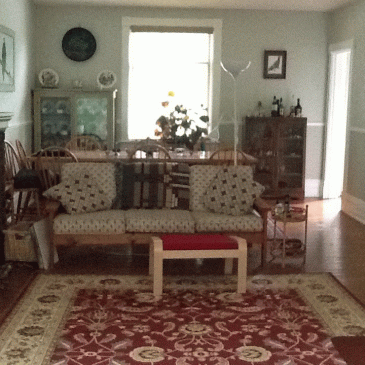
The picture that accompanies this post is a shot into our living/dining room. The rug in this photo is new, bought just last summer, replacing two large hand-braided rugs, made by a friend of my mother’s, that after about seventy years of good service had finally just fallen apart. It’s the piece that could have (should have?) set off the Diderot effect. Everything else – except the footstool and lamp – is at least thirty years old. (You can’t see BD’s armchair, off to the right side, but it’s the same as the couch.)  But somehow, there was no Diderot effect (at least for us – you may think differently!). Perhaps it’s just that I’m comfortable with things not matching, perhaps its the associations I have with each piece of furniture. But whatever the reason(s), I like the way everything looks together.

In the end, furniture is functional, and as long as you like it and it’s comfortable, that should be all that matters.  It doesn’t need to match; it doesn’t matter if some things are more worn than others, and, it’s only ‘semi-disposable’ if you choose to view it that way.  As with just about anything and everything in our lives, if we value our furniture, are mindful of keeping it in a safe and useful state – tightening bolts, working wax into wood, fixing fraying seams – it will serve us well, often for more than one generation.

Sustainable or frugal?

Living on roughly half of our previous income, even though we are not by any stretch of the imagination impoverished, still presents some challenges. In the months previous to retiring, I analyzed our spending each month down to the penny, to ensure that we would continue to have a decent quality of life.  For us, quality of life includes being true to our belief in buying local, ethical, and sustainable food whenever possible.

But such food is not inexpensive.  I can buy a dozen factory-farmed eggs for just about half what I pay for eggs from traceable, ethically housed, local free-run chickens.  California greens, even with their drought , are still currently cheaper than the ones from the organic farm up the road.  Food is our biggest single monthly expense, and were I to further change my buying habits, I probably could reduce it by about thirty percent.

I’m not going to, though.  The value of buying the food we do goes well beyond satisfying our own tastes.  A much larger percentage of the money I spend goes directly to the local economy, into the pockets of my neighbours, than if I bought the equivalent products at grocery store.  Animal welfare is improved.  Farming remains viable, which means land remaining productive, and supporting, in the field margins and fence-lines, a healthier bird and wildlife population than would exist if the same land became a housing development.  I can ask the producers of my eggs and meat what they feed their animals, which matters not just in terms of general health for both the animals and us, but because of BD’s allergies.

I am fortunate to be able to afford to buy food like this.  I am fortunate to live in a place that supports, within a ten-mile radius, five seasonal farmers’ markets and one year-round, and innumerable farm stands.  Local food maps are published yearly.  Later today I will go out to buy sweet corn and tomatoes for tonight’s dinner from a farm stand up the road, which sits among the fields where the corn and tomatoes grow.

Frugality has a different meaning for us, when it comes to food.  It means ensuring food is not wasted – broth is made from chicken bones, older fruits and vegetables go into baking (I’ll write about my ‘garbage loaf’ at another time), portion sizes of meats are small.  Vegetarian meals make up half our dinners.  We buy almost nothing prepared; we have the luxury of time, and the skills, to cook from scratch (for which I perpetually thank my parents, who, living through both the depression and the rationing of WWII in Britain, were both frugal and creative with food).

And that sweet corn, tonight, lightly steamed and brushed with olive oil, then sprinkled with salt and pepper, will taste like the essence of earth, water, and summer sunshine in every bite.