Reasonably Well-Off in Early Retirement: How Did We Get Here?

Instead of responding to individual questions, I’m going to write one post about our journey to being sufficiently well-off in early retirement. First off, let me define early retirement: I retired six weeks after my 57th birthday; BD, who retired on the same day, was six months short of his 60th birthday. So this isn’t retiring at forty, but nor is it retiring at sixty-five or seventy.

Secondly, let me say that I know we were fortunate in many ways, and this is simply our story. Some of it was luck, and some of it was planning.  I don’t want to sound smug, or patronizing, or that I’m telling anyone how to do this. This is simply how it played out for us.

Thirdly, if you don’t want to read the story-telling version, and just cut to the chase, I recapped in the third-last paragraph!

BD and I met in university in 1978, in my second year and his last year of our respective undergraduate degrees (Now, for both the sake of my non-Canadian readers, and those younger than us, let me explain two things. One is that Canadian universities all cost more or less the same for undergraduate programs; there are not the private universities costing multiples of ten thousand a year vs. less-costly state universities that there are in the U.S.  Secondly, when we were in university, tuition was a smaller percentage of a year’s costs than it is now, so overall university wasn’t as expensive.  We were, I seem to remember, spending about $1000/yr on tuition each and a few more thousand each to buy books and to live, versus about $6000 a year on undergraduate tuition in Canada now.)

Both BD and I had been brought up by frugal immigrant parents. Neither of our sets of parents paid for our university educations. Both of us took a year off to make money before going ahead with university. He’d had very good factory jobs in his year off and in the summers and had no student loans at all; I had one smallish loan from my first year and after that had been able to make good enough money in the summer to not take out any further loans, although I did qualify for some grants, and both of us for some scholarships. BD had enough money saved, in fact, to buy a car (used and very small) at the end of his last undergraduate year; I had gone home for the summer (since I had a very good job waiting) and he wanted to be able to come to see me – and he lived 200 miles away.

We lived for the next six years on part-time work and graduate student stipends, and with hand-me-down furniture and little else. But all our friends were in the same boat, so it was just normal, and we had a lot of cheap fun playing cards, occasionally visiting somebody’s parents’ summer cottage, and going for $0.99 all-you-can-eat spaghetti at a local chain on Tuesday nights. But we actually also tucked away a little bit of money over those years into a special savings program that existed at the time to allow young people to save for a house and gave them a tax break. So the day we learned the little house we were renting had been put up for sale, we could actually, just, buy it, with a 95% mortgage. But, the mortgage payments were cheaper than the rent had been, and we were gaining equity in a rising market.

Grad school ended with a Ph.D for BD and an M.Sc. for me — we defended our theses two weeks apart – and then we did research at the same university for a few years, our tiny salaries being paid from successful grant applications we had written. (Talk about incentive to write a good one!) Somewhere around turning thirty (me, not BD) we realized while this was lots and lots of fun, it wasn’t exactly stable and the long-term prospects didn’t look rosy. So we did some hard thinking and talking about what to do next.

We already knew we didn’t plan to have children. We wanted to do something useful for society, but that would provide us with reasonable salaries and a decent pension. We weren’t interested in getting rich or being entrepreneurs. One of the things we’d both really liked about grad school was being teaching assistants – teaching the seminar or lab portions of classes to undergraduates. High school teaching (we both couldn’t see ourselves with smaller children) ticked all the right boxes.

(Another explanation here…the vast majority of kids in Canada are in public schools, not private or charter schools; in Ontario (all I can comment on) school districts pay their teachers respectably well once you get to the top of the salary grid, there are only minor differences in salary from one school district to another, and the pension plan is defined-benefit:  a guaranteed pension based on years of service and salary, with built-in cost-of-living increases. The result of a respectable, respected (mostly), and well-compensated education system is that is extremely difficult to get into a Faculty of Education to get your teaching degree. You need very high marks, lots of teaching-type experience, and, probably, luck.)

But lucky we were (plus all that grant-application writing stood us in good stead) and in consecutive years (we couldn’t afford to both go in one year) spent the requisite year becoming qualified. And got jobs, with the same school district.  So finally, at thirty-three and thirty-one, we entered the world of real salaries.

So, from 1991 to 2015, we taught – or to be precise, BD taught all those years; I taught for ten and then moved into a regional central-office position, but still directly involved with students and teachers. The pension plan took 13% of our gross salaries, and we put away on top of that every penny we were legally allowed to (it wasn’t much) into Canada’s Registered Retirement Plans, plus we paid off our mortgage by using weekly payments as well as yearly lump-sum payments. By 1993 we were free of mortgage debt, and that was the only debt we had – and we did it by not changing our grad-school life style (except for buying some teaching clothes) for those first two years.  We even only had one car – BD dropped me off at my school and then drove on to his, fifteen miles further south.

Then we took another look at finances and our lives. We sold the little house for twice what we’d paid for it, bought a fixer-upper closer to our schools for double the money we’d got for the little house – but we put 50% down on it, so the mortgage was easy to carry, and a second (used) car. Until this mortgage was paid (it took six years) all our holidays were in tents – some of them for six weeks at a time. BD had learned woodworking and construction from his father, so he (with me as barely-competent help) did the vast majority of renovations to the house.

That first car BD bought back in grad school was a tiny sub-compact, and we’ve never driven anything else except for one – my first used car, a $1000 Chevy Impala I drove for four years. Those sub-compacts – Civics, Escorts and Accents – were all driven to 300,000 km before being traded in; they’ve taken us up the gravel Dempster Highway through the Yukon and Northwest Territories to the furthest northern point you can drive in Canada, and across the US three times (and not on interstates), loaded with camping and hiking equipment.  A standard transmission, decent tires, and front-wheel drive will take you most places in North America.  And we’ve never paid more than $15,000 for any one of them, even new.

We never ever carried credit-card debt, but we put everything possible onto our credit cards in exchange for rewards:  first the Driver’s Edge rebates, which paid for big chunks of several of our cars, and more recently, once we began travelling more, a frequent flyer program which has taken us to many many places.  It’s worth paying $150 a year for a card that means you can both fly to Australia for just the taxes, while it pays for the insurance on the rental car while you’re there, and recompenses you for all your expenses when a delayed flight means a missed connection.

So, when my health took a turn for the worse in 2014, and I realized the stress of my job wasn’t helping anything, we discussed options again, and decided that early retirement was the best thing for me. It didn’t seem fair for me to retire if BD didn’t, so, we crunched numbers and decided we could do it.  The mortgage had been paid for fifteen years; our rural taxes are low; and we’d never forgotten how to be frugal.  What we were giving up was travel, but we had chosen not to wait for retirement for that – we’d seen too many people get to retirement and get hit by heart disease or cancer or diabetes, so we’d spent the last fifteen years travelling, every chance we could – spring breaks, Christmas holidays, summers.  We’d been to all seven continents, most of them more than once.   We had chosen to live on BD’s lower salary, and use mine for savings and travel.  And our combined pension incomes would be almost exactly equal to BD’s salary.

(Now, again, remember, this is Canada.  Health care is free (well, no, but paid for from our taxes), and I am alive and healthy today because it’s also, in my experience,  excellent, as are all our other friends and family who’ve been hit by the nasty and sometimes obscure diseases of middle age.  So health care costs, such a huge concern and expense in some countries – don’t significantly enter into our calculations. That is not to be underestimated.)

Here’s the recap. We got here, after only twenty-five years of actually working at real jobs with real salaries, by the following means:  we never lived above our means, and when we had to defer something – university, a car – we did.  We targeted employment in a field that would be personally rewarding but also pay us sufficiently and had a defined-benefit pension, choosing the long-term view over the possibilities of higher pay, bonuses, or entrepreneurial success (and were lucky enough to find employment in it.) We use credit cards to gain rewards that have real value to us.  As our salaries grew, we didn’t give in to ‘life-style creep’, but instead put the money into the mortgage and retirement savings, again deferring expensive travel until we could afford it.  We didn’t buy “starter” houses with granite and ceramic tile (nor do we have those things now) but instead bought older houses that needed work and put a lot of ‘sweat equity’ into them.  We still drive sub-compact, fuel-efficient cars.

We took a pension hit by retiring early, especially me, as I retired two years before my eligibility for a 50% unreduced pension, based on a formula of age plus years of service.  BD took a much smaller hit, as he was actually eligible to retire at the end of this year. As well, our pensions, by our choice, carry 75% survivor benefits and are set so in the first ten years of pension benefits, the survivor gets 100% of the deceased’s pension to the end of that ten years. We chose those benefits, and they cost us a bit each month, but we wanted to ensure whoever outlived the other had a good quality of life.

This isn’t going to work for everyone.  There is an element of luck in it, and what was possible to do in the 1980s when we were in university isn’t necessarily what is possible today. Not having children is a very personal choice, but one that also significantly affects finances.

Our next (probable) step is to realize the equity in this house by taking advantage of a healthy market in this part of Ontario and moving to the area where I grew up, where my sister and her husband live, and where housing costs are one-half to one-third of what they are here.  We’ll probably then use that available cash to continue to travel, but we’re still analyzing this in more detail.  And keeping an eye on what happens if China devalues its currency again.  Meanwhile, we’re enjoying our (frugal) life -and that’s what really matters.  And that’s what I’ll go back to writing about, after this.
Cheap Dates

BD and I like to go out once a week or so.  Not so much for meals any longer because of his allergies, but for music, or a movie, or to spend time with friends. But there is a budget to consider, so we’ve worked hard (no, let’s re-word that, I’ve worked hard…) to find things to do that are cheap, or better, free.

Luckily, it’s not difficult.  We have a cinema a reasonable drive away that shows first-run films for $5 on Tuesdays, all day, matinees and evening performances; they’ve just recently opened, but already they are pretty busy on Tuesdays.  Their popcorn is the usual over-priced stuff, so we skip that, but my waistline doesn’t need it anyway!  Our other movie option is our local art-house cinemas – two of them – where a yearly $15.00 membership means the films are $8.00, and at one of them, also gives 15% off at the attached bookstore and restaurant.  (And both of these have cheap, good, popcorn.) When you go to a movie a week, as we tend to, the membership pays for itself pretty quickly, even when I do buy popcorn.

In the summer, free music abounds.  The two towns we live half-way between both have (on different days) free concerts-in-the-park on weekday afternoons.  The musicians are up-and-coming local artists, and are generally all pretty mellow, ranging from country to jazz and folk to pop.  But we’re wide-ranging in our musical tastes, and it’s a pretty good way to spend an hour or two, sitting in the shade on a lawn chair, snacks in the cooler, listening to music.

Come the fall and winter, we turn to the university.  Here they run a free concert series on Thursday at lunch time, sometimes student performances from the Faculty of Music (but not usually).  Again, it’s wide-ranging – this fall’s line-up includes Cuban jazz, Celtic harp, and even rock’n’roll.  Parking on the campus is pricey, so we go early, find a side street with free parking, and walk or bike over to the university.

The churches in both towns also host free or very inexpensive concerts – I happen to particularly love Renaissance church music and choral performance – and it’s not necessary to be a church member (or even a believer) to go.

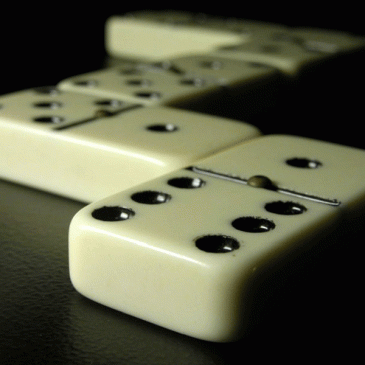
But perhaps our times with friends are the best.  With a simple meal (usually, unless one of us is trying out a fancy new recipe) either before or after our get-together, we sometimes just talk, but our most frequent activity is a board game.  Right now we’re heavily into playing dominoes, but it varies: sometimes cards, sometimes a trivia game, sometimes an obscure geography game called Ubi.  Or we’ll go for darts, or skittles, or a really obscure (for North America) English bar game called shove half-penny (pronounced shove-ha’penny.)  I have the board my grandfather made about a hundred years ago, and every so often we bring it out.

And of course, there’s always the afternoon watching the game on tv, with a large bowl of home-popped popcorn and a beer.

MOOCing along: The Pleasure of (Free) On-Line Learning

This is an expansion of a post on my writer’s blog, Wind and Silence, so if you read that too, you’ve pretty well read this post, although there are a few differences.

In an earlier post, I wrote about how I sought out community and intellectual stimulation during my house-bound period last winter, following surgery, through becoming involved in Project Feederwatch. In that post, I mentioned there were other ways I found what I needed, and, because this also relates to one of my themes of being frugal, I decided it was worth writing a post about.

I subscribe to a site called Lifehacker on my Facebook newsfeed. Originally I started reading it because it often had technology-related reviews, ratings and ideas,which I needed for work. But then some time last summer, there was a post about free, on-line education.  Intrigued, I looked at it, and found a link to FutureLearn. Associated with the Open University in the UK, this completely free educational site offers dozens of courses on subjects as diverse as Global Food Security, The Works of Gabriel Garcia Marquez, and The European Discovery of China.  Universities from around the world are involved in the design and teaching of the courses. All you need to sign up is a computer and the internet.

I browsed through the course offerings, with, of course, an eye to courses that would increase my understanding of the Roman Empire, the historical template upon which the world of Empire’s Daughter rests. As I wrote in an earlier post on Wind and Silence, my understanding of my created world needs to be thorough, or I can’t write about it convincingly.   Two caught my eye: Hadrian’s Wall:  Life on the Roman Frontier, and, Archaeology of Portus:  Exploring the Lost Harbour of Ancient Rome. These looked promising, and the Hadrian’s Wall course’s timing was perfect – it would start soon after the surgery, but not immediately, so I had time to be able to handle sitting with my laptop again.  So I signed up for the it – we’d been to the Wall a couple of times, the most recent just over year before, and in that case specifically for research for the book and its upcoming sequel. I’d learned a lot from visiting the museum at Vindolanda, as well as just walking the Wall and thinking about what it was like to be a soldier there in the second century A.D., on a cold, damp, windy March day, waiting for your relations to send you more socks.

I’d taken on-line courses before, in relation to my work, so I was prepared for the basic format of readings, videos, questions to be answered and on-line discussions to occur. The course was well-designed and fun; I learned a lot, but the (for me) unexpected benefit was the literally hundreds of viewpoints that were expressed.  These courses are what are known as a MOOC – a Massive Online Open Course – and can have many, many participants.  Not everyone is very vocal, of course, but the wide range of experience, background, imagination and world-views of the participants who did express ideas made me think – not just about Roman Britain, but about my imagined world, and, some of my own preconceptions. It was rich discussion. The result is that some of what happens in the next book(s?) has been directly influenced by this community of learners (in both courses) who were willing to share their knowledge, ideas, and expertise with each other. I hope I remember to thank them all in the author’s notes!

There are, of course, lots of other opportunities for free or low-cost learning (the Lifehacker link is a good place to start) and I’d be interested to hear what others have found.  FutureLearn is just one place you can find free courses, and I’m waiting to hear if another on-line course that looked intriguing is to be offered again, this time through a different provider, Coursera.  My local Senior’s Centre…(yes, it appears I qualify, being over 55, although there is part of me that doesn’t believe this…) offers a number of no-cost face-to-face programs this winter. I am, actually, overwhelmed by choice, and have to be mindful, to stay focused on courses that will inform my writing…and leave me time to actually write.

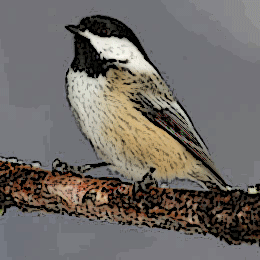
In Praise of Chickadees

It’s a hot, sunny August morning, and there is probably something else I could be doing, but instead I’m sitting in the sun-room, watching the ruby-throated hummingbirds at the feeder.  There are at least two:  a male, and then one or more juvenile/female-plumaged ones, which could be his offspring or mate.  I think offspring, because he keeps driving them away. There is another feeder, around the corner, situated to be seen from the kitchen window, and occasionally the male flies off to patrol it, letting the juvenile beeline in to feed.

In mid-August, other birds are beginning to appear, landing on the feeder pole and investigating all the arms, looking for the seed feeders they know were there last winter.  Chickadees and goldfinches, mostly, and the occasional blue jay.  We’ll put the seed feeders back up October first; there is plenty of wild food around for these birds, including the sunflowers planted along our fence.

I’ve walked on every continent on Earth to see birds, and I’ve seen literally thousands of species. Some stand out over others:  the Adele penguins on the Antarctic peninsula; Siberian cranes on the Yangtze wetlands in winter; the California Condors over Big Sur; the huge, shy, Great Argus of the Malay peninsula.  I’ve birded in places you wouldn’t think there would be birds:  in the heart of Paris, on the hills above Hong Kong, in downtown Buenos Aires.  I’ve seen the wonder of the sandhill and snow goose migration on the Platte in March; the dance of prairie chicken on the hills at dawn, the mating flight of woodcock in the wet fields at the edge of our village.  But while these have been wondrous, and I am filled with nothing but gratitude and awe that I have been able to see them and so much more, nothing quite makes me smile like a chickadee.

They are such cheerful, curious optimists.  Yes, I know this is anthropomorphism.  Yet there they are in August, landing on the feeder poles, buzzing their questioning chick-a-dee-dee-dee.  If I go out, they won’t fly away; I’ve had them land on me in the garden as if I were a moving tree.  On a minus twenty February morning, as soon as the light begins to filter through the darkness, they’ll be there.  If the feeders are empty, believe me, they tell us, and they’ll fly around my head while I fill them, landing on the hanging feeders before I’ve even put them up again.  The cats – who are strictly indoor cats – sit at the windows and chatter, tails lashing.  When the chickadees come to sit in the bushes under the sun-room windows, Pye and Pyxel are balls of pent-up, frustrated energy.  (But can these two catch the odd white-footed mouse that finds its way into the house?  Of course not.  They are the cat equivalent of armchair quarterbacks.)

Last fall, after major abdominal surgery, and through the weeks of recovery, further treatment and more recovery, the bird feeders – or more precisely the birds at them – were one of my joys.  Prior to my weeks off work, I’d only been able to watch the feeders on weekends once daylight savings time ended, since I left for work in the dark and got home in the dark, and weekends were inevitably filled with chores and errands, so we got brief glimpses here and there of what we were feeding. Sunday brunches were the only times we’d really get to watch.

To focus my watching, I signed up for Project Feederwatch, through Cornell University.  A huge, on-going citizen science project, my part in it was to watch the feeder for at least part of two consecutive days a week, and record the species and numbers I’d seen.  It was great fun, as well as being informative and producing a few surprises, like the flock of nineteen wild turkeys who appeared mid-morning every day to pick up the seeds scattered by the small birds.  More than that, though, for the weeks before my surgeon permitted me to drive, and the weeks before BD felt comfortable letting me go for a walk on my own, it was my daily connection to nature, to the change of the seasons and the living, breathing, wild world.

It was also two other things: community and intellectual stimulation.  One of the things I worked on during my weeks ‘home alone’ was about creating, or rather recreating, both of these, in a different form than they had taken before. My friends were hugely supportive, driving me to doctor’s appointments before I could drive myself, taking me out for lunch, just visiting.  BD, of course, was there evenings and weekends. But I was used to a work environment, where there was always someone who needed to talk to me, or I needed to talk to, in person, by phone, by e-mail, and there was always a problem to be solved, a situation to be mediated, new hardware or software to be reviewed, tested, analyzed.  And so I set out to recreate a smaller version of that – I didn’t want the constant interactions; even at work I had long ago learned to close my door, or drive out to the furthest site I was responsible for, to find some solitude and thinking time. Nor did I want to pursue anything that looked like the work I had been doing – it was a vocation, not an avocation, and I knew I was retiring.  But I did need to use my mind, and to talk to people. All the edits on Empire’s Daughter were done, so the frequent e-mails to and from my editors had ended.  The new book was just an outline, and on my best day I can only write for about three hours.  I was determined to find other ways to use my mind and be connected to people, and I was, temporarily, housebound.

By finding a place in on-line communities – not just through Project Feederwatch but through other means (which perhaps I’ll write about another time) – I satisfied both the need for interaction and the need for intellectual stimulation.  Everything I worked on last winter was time-limited; I knew that once I’d recovered, I’d likely want to spend less time on these projects; I can sign up for Project Feederwatch again this winter, or not, depending on how we decide to spend the winter.  But the project gave me more than either community or intellectual stimulation, and perhaps this last thing is the most important.

I’ve been watching birds for about forty-five years, but this was the first chance -or at least the first opportunity I’d taken – to watch in a different way; to watch the details of how the birds interacted with each other; to sort out the apparent pecking orders within and among species; to note the fine differences between how a chickadee and a goldfinch picks up seed.  I learned to identify specific birds through minor variations in plumage, and I studied the gradations and differences that sorted out the species of redpolls, before the boffins decided, on the basis of DNA, that they’re all one species, regardless. Just when I’d got good at it, of course.

Learning to watch the birds differently, paying attention differently, is a distillation of much of what I have been working towards – to be more mindful of what is important to me, to slow down and see, to live here, now, understanding the landscape and ecosystem and community in which I live and am part of.  T.S. Eliot said it far better than I ever could, in his magnificent poem Little Gidding:

We shall not cease from exploration
And the end of all our exploring
Will be to arrive where we started
And know the place for the first time.

Perhaps I have just begun to know chickadees.

My Love Affair with Thrift Stores

Before I retired this year, my closets were overflowing with business clothes.  Living in a four-season climate meant business wear appropriate for a range of outdoor temperatures from -35 degrees C to +35 degrees C, (or roughly -30 to 90 degrees F), and because my office’s heating/cooling didn’t always work well, and because my work involved a lot of driving and visiting sites, clothes for each season were actually needed.

Shortly after my last day of work, I purged the closets.  I bagged up the vast majority of my business clothes, keeping a few to wear to nice restaurants, weddings, funerals, and whenever else I might need something that wasn’t denim, khaki, fleece, or a t-shirt. As I was loading them into the car, BD (who was helping) said “Are they going back to where they came from?”

Well, yes.  At least for a good number of them.  Because even before retirement, I was a thrift-store shopper, and quite a lot of these clothes had come from my favourite thrift store, Value Village.  Or from consignment shops, which I also love. Partly because there is something about department stores that makes me physically uncomfortable – whether it’s the lighting, the crowded rows, the cavernous spaces – I’m not sure.  But I’ve never liked them, even as a kid.  But mostly because I believe strongly in the idea of not buying new, and re-using good things.

I probably am lucky that my Value Village is in a university town; I suspect the quality of clothes I can find may be better than average. I’ve done best with tailored pieces, skirts and jackets and coats.  But over the years I’ve found as well the lovely multi-coloured Indian jacket in the picture (I kept it, it goes well with jeans), several summer dresses, and all the shorts I own.  Plus my gardening jeans, my favourite sweatshirt, and a collection of heavy shirts I wear in the fall and winter.

From consignment stores have come another lovely, hand-made quilted jacket (which also goes well with jeans, so it stayed too), the absolutely beautiful colour-blocked, lined, wool dress I wore to my father’s funeral this year, my long trench coat, and the dress I can crunch into a ball, shove in a suitcase, and it comes out unwrinkled at the other end even after three weeks of bouncing around in the back of a Land Rover in Uganda.  I’ve had that one ten years, had it shortened to knee-length a couple of years back to look a bit more current, and am constantly being complimented on it.

These stores are the first place I go for kitchenware as well.  Not that we need much, but my arthritic hands do occasionally drop things, and even with a cork floor in the kitchen not everything bounces.  I seem to go through wine glasses the fastest, and half my coffee mugs have had the handles glued back on.  The cats occasionally add to the breakages, too; they’ve been known to send glasses, mugs, and side plates flying while playing chase.

As long as the mugs or plates or bowls are in some shade or mix of green, blue and brown they blend with everything else we own, and wine glasses are clear.  I’d like to think we could get by with just a couple of everything, washing them every time, but we entertain quite a bit, casual dinners, brunches…so I do need more than a set for BD and a set for me.  (I did, however, donate our ‘banquet set’ for twenty to an environmental club at the university that was looking for reusable dinnerware. We’ve given up on formal meals for twenty.  Mind you, I’d only paid $100 for the whole thing – dinner plates, side plates, bowls, two sets of glasses, mugs, and cutlery, in the first place, twenty-odd years ago.  It wasn’t fine china, but it wasn’t plastic, either.)

Everything we purge that is worth re-using goes to a thrift store, Value Village or Goodwill or the like, unless it meets the needs of a post on our local Freecycle or my flea-market vendor friend wants it.  I like the sense of being part of a larger, re-using community; I give what I don’t need away, I buy for a very few dollars the very few things I do need.  There are exceptions:  footwear, our wind-and-waterproof outdoor hiking clothes, needed locally in the winter and for several of our past trips to very cold places.  These are specialized items, though, not everyday needs, and they last a long long time.

September is approaching, and with it colder mornings and evenings….and when I looked at my favourite red sweatshirt last, I realized the neck and cuffs are fraying.  I will fix it  (I don’t sew well, but I can manage some basic repairs), but it might be getting past wearing out to a movie or a casual meal.  My other one was originally given to BD the first Christmas we were going out, by my sister, who didn’t yet know he doesn’t like things that pull over his head.  That was in 1978.  I’m still wearing it, but only around the house and out hiking.  If I really think I need another one, my first stop will be a thrift store.  It might take me a visit or two, but I’ll find one that I like, and fits, and another good piece of clothing will be reused.

Free Expression

Unlike some of my other posts, this one is about some of the practicalities of reducing costs, specifically, software costs.  As my retirement day approached, one of the very few things we agreed I needed to buy was a laptop.  Prior to that, I’d had one provided through work – more than one, actually, as a large part of my job was centred around the provision of technology in an educational setting, and I was constantly trying out new devices for compatibility with software, our system, student needs.  So there was always one I could use, and I was violating no employment rules by using them for personal as well as business needs.

Because of my work, I’d had the opportunity to try netbooks, chromebooks, ipads, other tablets…and what I wanted was a regular laptop.  My needs were this:  a screen and keyboard that would be big enough for aging eyes and arthritic shoulders – I’d found with the smaller devices, I leaned forward too much to look at the screen and the smaller keyboards made my shoulders and upper back hurt; I needed it to run an office program, primarily a word-processor for my writing and a spreadsheet program for budgeting; some digital-editing software for my artwork, and to do email, and that was just about it.  Oh, and i-Tunes, which I use occasionally.

I bought the laptop itself in February, for about three hundred dollars, a discontinued (I think) Acer Aspire running Windows 8.  I can bounce between just about any operating system without too many problems, so that was ok, even though it was new to me.  It came with a thirty-day trial of Microsoft Office, but I really didn’t want to spend more money on software.  I considered using only Google Docs, but our rural internet isn’t that good, and in experimentation I found the upload speeds just couldn’t handle it reliably.

Again, based on prior experience, I knew that Open Office, (which is open source freeware) would meet my needs, so that’s what I went with. (I could have used LibreOffice, too, and I’m sure there are others out there just as good. This isn’t a plug for Open Office per se, just a post about freeware.)  It’s met all my needs; all the final work on Empire’s Daughter was done on Open Office, including the last submission and conversion to e-book formats.  I still need to ask the Help menu how to do certain things…but to be honest, I found that I was doing that constantly with the last release of Microsoft Word too.  I think I just can’t hold as many things in my brain any more.

Then there was the artwork.  I’d been using Adobe Photoshop Elements, but I wanted to see if I could get by without it.  The quick answer was no, I couldn’t, not entirely.  Paint is a reasonable basic program, but it wouldn’t do what I wanted when it came to digitizing and modifying my pen-and-ink-and-watercolour originals.  I sometimes create entirely in Paint, though, if I’m looking for a simple, folk-art look, shown in the image that accompanies this post.  I couldn’t find a freeware to do the job, so in this case I gave in and bought Photoshop Elements.  But even then, with a bit of judicious on-line shopping, I ended up paying much less than the Adobe download price, and from a reputable office-supply store, so I could be confident it wasn’t pirated.  I just had to wait a few days for the disc and serial number to arrive in the mail.

Another piece of freeware I use on something resembling a regular basis is my tax software.  BD did the taxes up to two years ago, and by the old-fashioned method of pencil and paper and mailed-in returns.  And usually in November. Revenue Canada always owed us money, because of retirement plan and charitable contributions, so they didn’t really care he was seven months late (they even pay interest)…and he always made mistakes, which they always fixed.  Finally (after thirty-five years) I took them over, and immediately went looking for tax software that would do the calculations and e-file for me. Nicely, Revenue Canada lists several, including freeware, on their website.  I couldn’t see paying thirty or forty dollars (every year) for software…so I read up on the freewares, and picked one, and bingo – the taxes get done on time, no calculation errors, e-filed, and the returns deposited in our bank account in about three weeks.

Finally, there is anti-virus software.  From my sister, who was a systems analyst for thirty-five years (after abandoning law, but that’s a story for another day, about why she did so) I learned about Avast, which is the anti-virus freeware she uses.   I haven’t used it yet; I had a Norton subscription I could switch over to the new laptop, so I’m still using that.

But here is where my sense of community responsibility and justice kicks in.  These softwares are the result of hard work, usually by many people, who are offering them to the public for free.  But I can afford to pay at least something for them; I just don’t feel like putting more money in the hands of big corporations than I need to. (But I’m not technologically talented enough to use Linux, or I probably would.) There’s an option to pay something for all of them, but you get to try them out first, and even then you pay only if you wish.

Now here’s the caveat:  do your research!  There’s a lot of free stuff on the internet which is just a method of getting malware into your computer.  I had years of experience and access to a IT department that would help me solve issues when I – or my staff or the students which I worked with – made mistakes. I know how to restore my computer to its previous safe state if I do screw up (and I’ve had to do it).  Make sure your anti-virus is up to date before downloading anything, and if it’s got a website checker, use it.  Freeware isn’t worth it if you have to pay a tech to fix the problems it caused.  (I’m the unpaid computer tech in this household, and BD’s made some major mistakes over the years which ate up quite a few Saturdays…sigh.  I still can’t make his laptop find his printer in the control panel, although it communicates with the printer without issue otherwise.  Puzzling…)

What freewares have you used?  Do you have experiences to share, good or bad?  I’d be interested in hearing your thoughts.

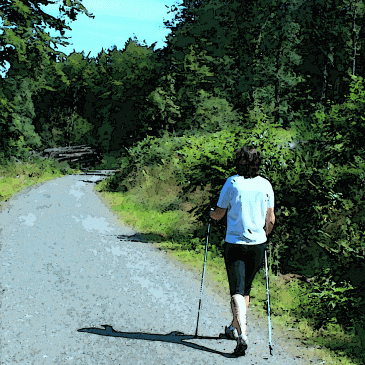
Walking, Health and Wholeness

When I began this post, I wondered how I would tag it:  #health  #mindfulness, #sustainability, #writing #frugal #community.  All those reflect what walking means to me, and all are components of something larger, something I am going to call wholeness.  I am not whole if I do not walk.

From my earliest years I have learned by walking, dreamed of walking, found solace and healing in walking, tapped creativity by walking.  My memories of all the places and countries and continents I have been to are memories of walking, of the way one soil feels different underfoot than another, of the contours and smells of the land around me, the flow of rivers, the flight of birds, the shape of trees.  I learn new places by walking them, and once I have done so I am never lost.

I was the youngest by some years in our family, and was frequently solitary.  But I had fields and woods and farm lanes to roam, and those were different days.  I explored further and further afield, usually on foot, sometimes by bicycle, and with the dog for company.  I learned to look, at wildflowers and trees, at birds and mammals, snakes and frogs, at insects.

Then I went to university a long way from home, choosing the university in part because it was not in a town, but set some miles out of town, on a large expanse of land.  But a new reality faced me there:  girls – women – were warned not to walk alone beyond the lighted and paved campus, and none of my new friends wanted to walk.  I stayed a year, became depressed, gained too much weight, and changed universities.  This one too had a large open area, an arboretum with trails that linked to other trails extending out beyond and through the town, and I met friends who wanted to go walking, to look at trees and rivers and birds.  I lost the weight, stopped being depressed, and fell in love with a man who walks more than I do.

Walking informs almost all my writing, either as a theme (sometimes transmuted into other forms of travel through a landscape) or as how I tapped into whatever it is in my brain or the cosmos that creates fiction.  I will go walking with a problem to solve, one of plot or motivation or background, and after a good walk or two, even if I haven’t been directly chewing over the problem as I walk, the solution will appear.  I find letting the problem swirl around in the back of my mind, not looking at it directly, while I focus on watching birds, or fish, or searching through a stand of milkweed for Monarch butterfly caterpillars, often produces the quickest results.

When I start walking I’m stiff, sometimes sore, depending on the day, the weather, and the vagaries of arthritis.  That will pass after the first ten minutes.  Some days, I’m out of sorts, or worried, but being back in touch, physically and spiritually, with sky and land and wind provides perspective, and calms even my most persistent or serious concerns. Most days I walk for an hour or two; at this time of year, when the mosquitoes and deerfly of summer are still active, I walk at the university arboretum.  As summer winds down, I’ll go back to the conservation area trails that surround us.  Only when the weather is at its worst – heavy snow, torrential rain, extreme humidity – do I resort to indoor walking, either at the local shopping mall, or on my treadmill.

Walking together fosters community, whether its the community of our marriage – BD and I talk best when walking together, and face our most difficult challenges that way; the community of friends you’re sharing a walk with; the more casual community of people met on the shared paths and trails, or the neighbours you meet walking down to the mailbox. It’s also a pretty frugal way to exercise: good shoes are recommended, especially for aging feet, but otherwise there aren’t too many places where you can’t find somewhere to walk without paying an entrance fee.

I wonder, sometimes, who I would be, had I not been that youngest child, free to roam a safe rural environment, touching, tasting, watching the wild world, letting my mind and imagination run freely along conscious and unconscious channels, an experience unstructured and unguided. Would I – could I? write?  How healthy – mentally and physically – would I be? Questions that can’t be answered, because every choice of path, every turn we take or don’t take, every hill we do or don’t attempt, changes us, in ways we can’t begin to imagine.

Considering Diderot, IKEA, and Furniture

Two pieces of ‘mail’ this week got me thinking.  One was e-mail – I subscribe to Joshua Becker’s blog Becoming Minimalist, and an e-mail came in telling me of a new post.  The second was traditional mail – a new IKEA catalogue.  I realize those two things seem pretty unrelated, but bear with me.

Becker’s post, Understanding the Diderot Effect (and How to Overcome It) refers to an essay I read in my late teens by the French philosopher Denis Diderot, about how his comfort with his worn surroundings disappeared when a friend gave him a beautiful new dressing gown, which contrasted with the shabbiness of his rooms.  The IKEA catalogue reminded me of Douglas Copeland’s description of the lives of three ‘twenty-somethings’ in his novel Generation X, which included the term ‘semi-disposable Swedish furniture’, and I thought about how we are pressured to constantly replace things – our dishes, our clothes, our furniture.

And then I took a mental step back, and considered our house and our furnishings.  We bought this place – a four-square built in 1911 – in 1984, as a near-wreck, and after a long weekend doing some basic patching and painting of the interior, we moved in with the furniture from our much smaller previous house, much of which had come from IKEA.

Twenty-one years later (and another coat of paint), we still have that IKEA furniture.  And it’s not in the basement.  It’s in our living room, and our sun-room, and the bedrooms, and the library.  The cushion covers on the three chairs and two couches have been replaced,  three times, I think, in the last thirty years – twice by my amateurish upholstering, and once, most recently, professionally. Over that time we’ve added to our furniture:  some came from one aunt’s house, some from another; some was bought second-hand, a very few things bought new, and the rest built by BD.  It’s often a combo:  BD built the dining room table, but the chairs came from IKEA, and the two china cabinets came, one each, from my aunts’ houses.  He built the desk at which I write, but bookshelves from IKEA line the walls of the library; I bought the library rug at a yard sale, and my desk chair came from Staples.

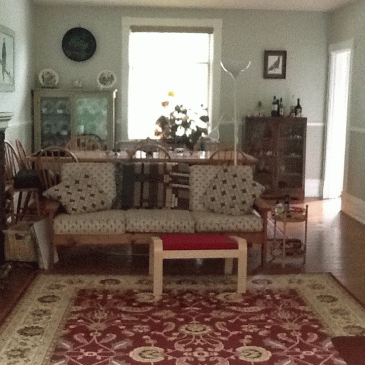
The picture that accompanies this post is a shot into our living/dining room. The rug in this photo is new, bought just last summer, replacing two large hand-braided rugs, made by a friend of my mother’s, that after about seventy years of good service had finally just fallen apart. It’s the piece that could have (should have?) set off the Diderot effect. Everything else – except the footstool and lamp – is at least thirty years old. (You can’t see BD’s armchair, off to the right side, but it’s the same as the couch.)  But somehow, there was no Diderot effect (at least for us – you may think differently!). Perhaps it’s just that I’m comfortable with things not matching, perhaps its the associations I have with each piece of furniture. But whatever the reason(s), I like the way everything looks together.

In the end, furniture is functional, and as long as you like it and it’s comfortable, that should be all that matters.  It doesn’t need to match; it doesn’t matter if some things are more worn than others, and, it’s only ‘semi-disposable’ if you choose to view it that way.  As with just about anything and everything in our lives, if we value our furniture, are mindful of keeping it in a safe and useful state – tightening bolts, working wax into wood, fixing fraying seams – it will serve us well, often for more than one generation.

Garbage Loaf

A week or two ago we had friends over for dinner, a simple post-movie meal of cold chicken and salads, followed by local raspberries, fruit loaf and ice cream.  After everyone had finished, there were a few raspberries left.  “Eat them, BD,” one of our friends said, “otherwise, they’ll just go to waste.”

As I assured her they would most certainly not go to waste, but be eaten the next day, probably as part of my breakfast, I reflected on the amount of food that is thrown away.  According to The Guardian, thirty percent of all food produced in the world is wasted, and in western countries a large portion of that waste is in the home – food we buy, don’t eat, and throw out.

Why?  Well, a very small bit of spoiled food occurs – the tomato sauce that gets shoved to the back of the fridge and forgotten, and has grown a lovely blue mold when you do find it, the cracked egg in the dozen. But those are not that common in the western world of refrigeration and freezers.  I think food is thrown out because of a lack of planning; a lack of cooking skills in some cases, and because we don’t value food enough.  We want it to be cheap and easy.  We forget the purpose of food – to transform the light and warmth of the sun, the nutrients of the earth, the molecules of water – into nourishment for our bodies, through the labour of many hands.  When something is that fundamental, that miraculous – and can I say it, as a secular person? – that sacred – how dare we waste it?

We try to be mindful about food, and that means planning.  Once a week or so, we draw up a menu, and from that menu a shopping list.  And then we stick to it.  This takes time, every week, but it’s time well worth it, and not just because it will mean less money spent; it means BD and I talk about what we’re eating, what recipes to try, how long we’ll need to make supper, where to buy the produce. We are, as a result, perhaps more conscious – more mindful – of what food is in the house, and what it’s for.

I shop twice a week for grocery-store perishables like milk and yogurt, in part because our fridge just isn’t that big.  (Which in itself is a good thing, since it does mean that there is less chance that half-jar of tomato sauce will get shoved to the back and forgotten.)  I shop almost daily for fruit and vegetables during the summer, when the farm stands are open and the produce is freshly picked.  But for meats, I shop, roughly,  monthly, or perhaps every six weeks, buy in moderately large quantities, divide into portion sizes, and freeze.  All this significantly reduces the chances that food will be overlooked or wasted.

But don’t think I’m a paragon of planning.  I keep a freezer inventory, and I mean to cross off what is used, but it doesn’t always happen.  And so, yes, every so often I find some chicken in the freezer that’s looking a bit freezer-burned. Sometimes the only zucchini I can get at the farm stand is too big for just the meal I want it for.  Sometimes one of the apples has too many bruises, or BD forgets to eat his raw carrots and they go soft.  So what then? I can’t bring myself to throw out food unless it’s truly gone off.

Freezer-burned chicken, like the carcass when we have a roast chicken, is saved to make soup, a mainstay of colder-weather meals.  (I’ll wait until the colder weather arrives before writing more about that – I can’t get excited about soup recipes in the summer.)    Soft, over-ripe, or just plain excess fruits and vegetables that don’t freeze well, though, go into ‘garbage loaf’, basically an adaptation of a banana loaf recipe with the same amount of just about any vegetable substituted for the banana.  I even mix them – but be sensible about that:  tomato and zucchini work together, as do apples and carrots, but I wouldn’t do strawberries and tomato.  BD will eat almost any baking, but even he’d draw the line at the last one!

So here’s the recipe for ‘Garbage Loaf’ as I make it. (I probably should have called it Leftovers Loaf, but at least in our house, it’s too late now – Garbage Loaf it is.)

Wet ingredients:

1 cup just about any fruit or vegetable, diced, shredded, or cooked and mashed..  If using carrots or parsnips, grate and steam slightly first.

1/4 cup applesauce (to reduce the fat; if you don’t have it, or don’t want to use it, double the amount of oil.)

1/4 cup light oil – I use safflower, but sunflower, corn or soy works too.

2 eggs, beaten

1 tsp vanilla

4 Tbsp fruit juice (not tomato juice)

Dry Ingredients:

1/2 c brown sugar (this suits us; you may like it sweeter.  It also depends on whether or not you add chocolate chips or dried fruit.)

1 and 3/4 cups flour:  I use whole wheat.

1 tsp baking powder, rounded

1 tsp baking soda

Optional Ingredients 

1/2 cup of any of:

nuts

chocolate chips

raisins or other dried fruits

Preheat your oven to 375 degrees.  If using a glass or metal loaf tin, grease it; a silicon one should not need it.

In a bowl, combine the fruit or vegetable mash, oil, eggs, sugar, vanilla and fruit juice.  Mix with a heavy fork or a hand mixer until well blended.

In a separate bowl, combine the flour, baking powder, and baking soda, and any optional ingredients you are using.

Pour the liquid ingredients into the dry, and mix with a heavy fork or a hand mixer on low; do not over-mix.

Spoon into the loaf pan and bake for 55 minutes or until a skewer inserted into the centre comes out clean.

As I’ve said in an earlier post, BD is a tall and highly-active man, so this loaf doesn’t tend to last long – but it freezes well, and, if by some miracle there is a slice or two left after a couple of days, it also toasts well.

I’ve also added shredded carrots and apple to bread:  it makes a denser, moist bread that won’t keep as long – after the first day we slice it and freeze it, and toast the slices; but it’s good with cheese (for me) or hummus.

And dessert at that dinner that prompted this post?  The fruit loaf was indeed Garbage Loaf, made with over-ripe bananas and a slightly suspect apple, and it complemented the raspberries and ice cream very well.

Sustainable or frugal?

Living on roughly half of our previous income, even though we are not by any stretch of the imagination impoverished, still presents some challenges. In the months previous to retiring, I analyzed our spending each month down to the penny, to ensure that we would continue to have a decent quality of life.  For us, quality of life includes being true to our belief in buying local, ethical, and sustainable food whenever possible.

But such food is not inexpensive.  I can buy a dozen factory-farmed eggs for just about half what I pay for eggs from traceable, ethically housed, local free-run chickens.  California greens, even with their drought , are still currently cheaper than the ones from the organic farm up the road.  Food is our biggest single monthly expense, and were I to further change my buying habits, I probably could reduce it by about thirty percent.

I’m not going to, though.  The value of buying the food we do goes well beyond satisfying our own tastes.  A much larger percentage of the money I spend goes directly to the local economy, into the pockets of my neighbours, than if I bought the equivalent products at grocery store.  Animal welfare is improved.  Farming remains viable, which means land remaining productive, and supporting, in the field margins and fence-lines, a healthier bird and wildlife population than would exist if the same land became a housing development.  I can ask the producers of my eggs and meat what they feed their animals, which matters not just in terms of general health for both the animals and us, but because of BD’s allergies.

I am fortunate to be able to afford to buy food like this.  I am fortunate to live in a place that supports, within a ten-mile radius, five seasonal farmers’ markets and one year-round, and innumerable farm stands.  Local food maps are published yearly.  Later today I will go out to buy sweet corn and tomatoes for tonight’s dinner from a farm stand up the road, which sits among the fields where the corn and tomatoes grow.

Frugality has a different meaning for us, when it comes to food.  It means ensuring food is not wasted – broth is made from chicken bones, older fruits and vegetables go into baking (I’ll write about my ‘garbage loaf’ at another time), portion sizes of meats are small.  Vegetarian meals make up half our dinners.  We buy almost nothing prepared; we have the luxury of time, and the skills, to cook from scratch (for which I perpetually thank my parents, who, living through both the depression and the rationing of WWII in Britain, were both frugal and creative with food).

And that sweet corn, tonight, lightly steamed and brushed with olive oil, then sprinkled with salt and pepper, will taste like the essence of earth, water, and summer sunshine in every bite.