On Being a Tortoise

I have become somewhat sloppy in some of my practices of mindful living this past month. Somehow, I got out of my habit of shopping only twice a week, and have been running in to town to pick up a few items almost every day. (We live twelve miles outside of town, in a tiny village with no shop.) This needs to stop, not just because it’s wasteful of gas and time, but because it’s just not how I want to live my life.

I shopped Monday this week, but Tuesday and Wednesday, except for picking up fresh corn and tomatoes, I didn’t (and that doesn’t involve going in to town). Instead, I went walking, good two-hour hikes both mornings through woods and fields. Today I need to go into town again; but I have a plan. I’m going to put my bike on its carrier, park at the store I buy the most at, and then bike to the other places I need to go. I have both a basket and panniers for my bike, and the university town has both bike lanes and an extensive network of off-road multi-use trails, making it easy to get around.

To be fair to myself, I haven’t just been being lazy by not using them. I didn’t have the core strength to ride my bike with the added weight, especially the panniers, which I find also affect the balance of the bike. Following major abdominal surgery thirteen months ago, I was forbidden to do anything except walk or swim for six months, to allow complete healing. (And I can’t swim.) That took me to January, and the middle of the coldest winter on record for many years here. I kept active, but mostly inside, and mall walking, painting woodwork, and using the treadmill or exercise bike wasn’t enough to strengthen the core. (A lot of the regular abdominal exercises are also contraindicated after the type of surgery I had, so I couldn’t just do crunches, either.)

But then spring finally arrived, and I started walking seriously again, and biking, My balance was bad for a while.  I kept at it, and finally this last ten days I have been walking without my Nordic poles; first for half an hour, then for an hour, and for the last two days for two hours each day, on hiking trails with all their ruts, roots, and rocks.  I think I can safely say I don’t need the poles any more, at least on fairly level ground.  This means my core is stronger.  A small but significant victory.

So I’ll put the basket and panniers on my bike, and park in town at the grocery store, and after shopping there plan a circular route that will take me to the specialty poultry store, and the library, and back to the car.  I could walk it, and carry the chicken and the books, but biking works different muscles and I like to do both. If it goes well, then this will be how I run errands in town, at least until snow makes it too dangerous.

There have been times in this past year when I have felt like a tortoise:  slow, ungainly, and dependent on an external support system.  But ‘slow and steady’ did the trick.  I didn’t rush anything; I built on small gains in small increments. Sometimes I did push myself too hard, thinking I was ready for a distance or a difficulty of terrain I wasn’t, but I backed off immediately once I realized I’d misjudged.  I didn’t let either pride or the desire for a quick fix to result in injury, which in turn could have meant more surgery.  (That was quite the incentive to not overdo it, by the way.)

My healthier body means I will drive less, which benefits the environment as well as our gas budget.  I can do my share of the heavier chores, which BD’s bad back will definitely like!  I’m less likely to use (more) health-care resources, more likely to stay creative, happy, and useful in the community, and I’ll be living my life in a manner closer to my ideal.

*****

A later-in-the-day update….the plan worked.  I learned the following:  I have to make sure I have my balance completely right before I take a hand off the handlebars to signal a turn, or I wobble, especially after I had made my purchases and was carrying some weight.  I also learned that choosing to try this out on the hottest and most humid day of the entire summer wasn’t the best choice; normally I bike on rail trails and bike paths, and the additional heat radiating off the paved road surface was more than I had expected…and it was ten-thirty in the morning.  But I did it!

Kitchen Gadgets I Wouldn’t Want to be Without # 1: the Mouli-Julienne

home

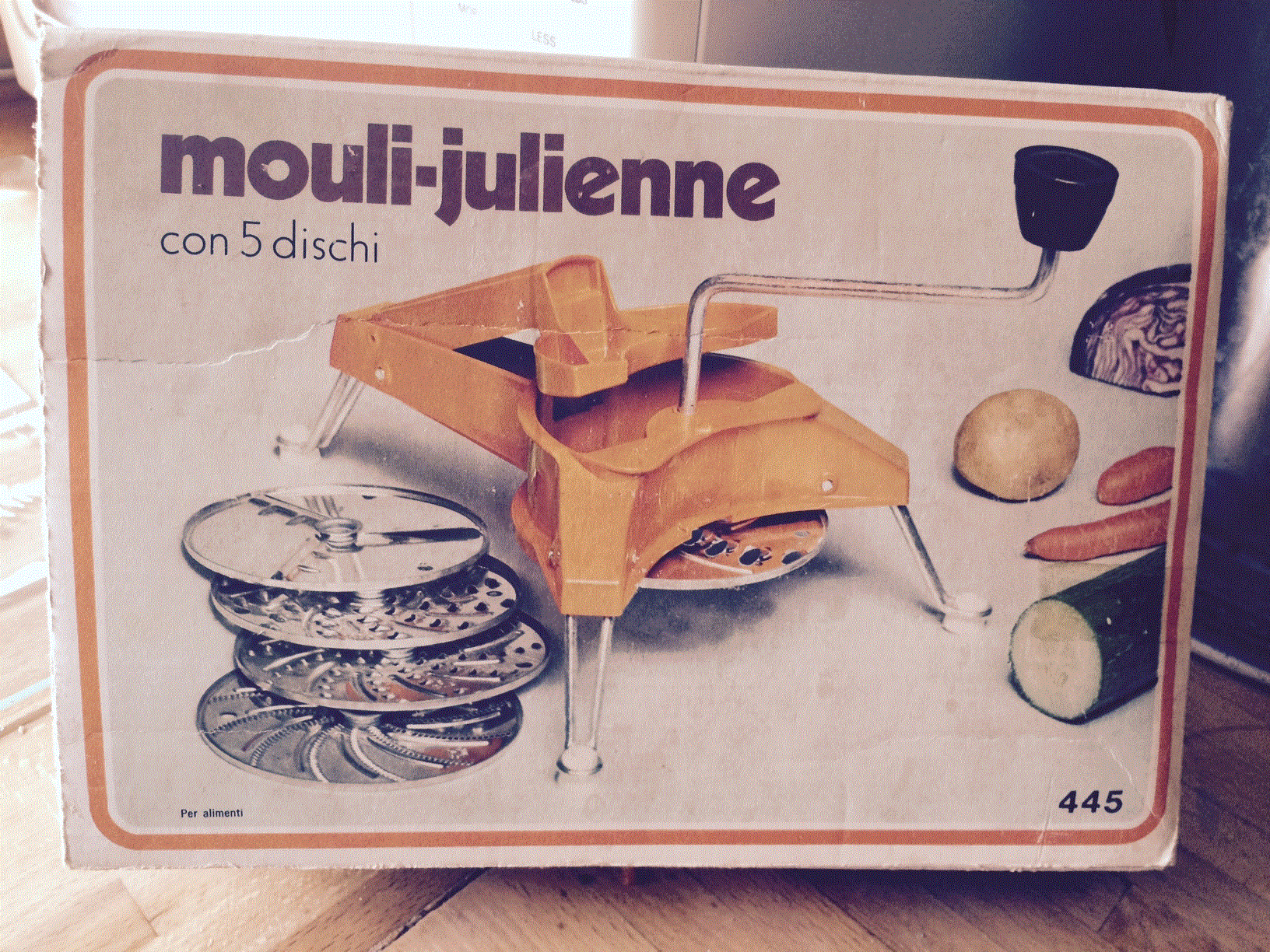
I’ve had this little manual food processor for at least thirty years.  Surprisingly, I still have both the original box and all five of the processing discs, but not the manual – not that it’s needed. It’s only got three parts: the body, the handle, and the disc. This is one of the simplest but effective tools I use in the kitchen.

Today I used it to make just enough carrot-and-broccoli slaw for lunch.  It took two minutes, I used up part of the broccoli stems I’d saved from making a stir-fry earlier in the week, and the slaw was, of course, super-fresh and therefore very tasty.  Stuffed in a kamut wrap with a bit of sliced sharp cheddar, it was a darned good lunch, along with iced green tea and greek yogurt and blueberries.

Over the years I’ve used it to grate cheese, slice radishes, cucumbers, and just about any other sort of vegetable you can think of, shred potatoes for potato cakes…even grate frozen butter for pastry. It cleans up easily:  if I’ve grated cheese, I usually put it in the top shelf of the dishwasher – the whole thing, not just the wheel; if I’ve been doing vegetables, I just hand wash it.  The wheels haven’t rusted or significantly discoloured, and they remain sharp.

I went on-line to see if they are still available; there are a few on e-bay (one described as ‘rare, vintage’ (!)) and a similar product by Westmark on Amazon.  I no longer remember where mine came from; it might have been a present from my parents, as I know they also had one.

It’s easy to use, does what it’s supposed to, has lasted a very long time, and uses no electricity.  Four stars in my book!

What are your favourite kitchen gadgets, the ones you can’t imagine cooking without?

Senior’s (and other) Discounts

Am I a senior?  Well, that depends on whose definition you use.  For some organizations – the American Association of Retired Persons (AARP), for example, it’s 50, so I certainly am.  For some other places, it’s 55, so again, I am.  Sixty is quite common, and sixty-five remains the norm in some place, and I haven’t got there yet!

Due to genetics and nothing else, my hair is still 95% brown at fifty-seven. I had it cut yesterday, and was not offered the senior’s discount! (I don’t qualify, there.)  BD’s had grey hair since his 40’s, and now is almost pure white at fifty-nine.  He gets senior discounts everywhere, no questions asked, so he does the shopping at the bulk food store that offers 10% for seniors on Wednesdays, and the pharmacy that does the same on the last Tuesday of every month.

When we retired, we bought supplemental health insurance – it covers dental and opthamalogical costs, travel insurance, and drugs, plus health services such as physiotherapy and orthotics – and along with that came membership in group that provides discounts on items ranging from fitness club memberships to rental cars.  I’m heading west in a week with a cousin from the UK, to spend ten days in the Rockies, so I thought I’d check it out for the hotels and rental car.  It turned out to be definitely worth it for the rental car, saving me thirty percent of the next-cheapest price I could find through Expedia, Kayak, or anywhere else.  For the hotels, not as much – you’re limited to the ones that participate, which aren’t always in the locations you want.  I’ve used it for one or two sites, but am falling back on the discount offered to Automobile Association (CAA in Canada) members in most places.

Even little things add up.  The buy-ten-coffees-get-one-free cards offered by many coffee shops doesn’t sound like much, but if you get a $2 coffee free every second week, that’s $52 you save over the year.  Which can buy you a reasonable dinner out here at a small bistro.  Gas at the south end of our closest town is generally five cents a litre (twenty cents a US gallon) cheaper than it is at the north end; again, it’s only a couple of dollars at most every fill, but that’s another $50 to $100 a year to spend on something else, and if I use my gas station loyalty card to gain points at every fill-up, I can exchange it for an even greater discount on gas.  But even better is gas at Costco, which is generally ten cents a litre (forty cents a gallon) cheaper, and makes the cost of the membership worthwhile. And as it’s directly across the street from a grocery store I visit once a week, it’s not out of my way.

In Canada, automobile insurers are required by law to offer a discounts to “retirees aged 65 or older, and to younger retirees too, if they are receiving a Canada or Quebec Pension or a pension registered under the Income Tax Act.” so we qualified for that.  Banks, too, offer a reduction in service fees (or waive them completely) for older customers – it appears to vary from bank to bank, and they don’t necessarily advertise it, so ask! I did, and it saved us $132 a year.

Many chain restaurants, from McDonalds onward, have senior’s deals or senior’s meals. I’ve been ordering senior’s meals on road trips for years, since they are almost the only thing on the menu with a reasonable portion size at most chains.

I’m learning just to ask if a shop or service offers a senior’s discount, and many are happy to offer it to me just because I asked.  If they stress the age limit, I’m honest and say I do or don’t qualify. It’s a new mind-set, and like all new things is taking a while to learn, but it’s well on it’s way to becoming a habit.

What senior (or other)  discounts have I missed?   Please share!

Lessons from “Doing it Ourselves”

BD and I started off our relationship with very different skill sets. He had helped do the wiring in his newly-finished basement when he was fourteen, and a bit later helped his parents build a cottage, starting with clearing the lot and ending with the finished cottage. I could cook, sew a bit, and grow just about anything. For my father, horticulture was both a vocation and one of his avocations, and I was helping him in the garden when I was no more than three. I could also hang wallpaper. That’s pretty well where my hands-on skills ended.

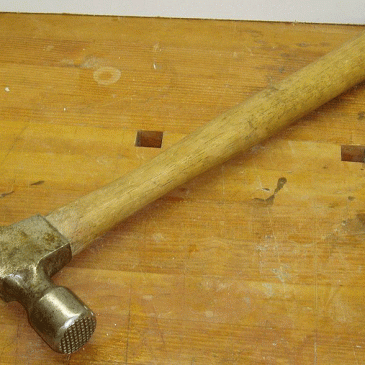
When we were first together my lack of construction skills frustrated BD. I didn’t know the names for tools, or how to tell a Robertson screwdriver from a Phillips. (Mind you, he didn’t know a Dutch hoe from a cultivator, either, or a zucchini from a pepper.) But we persevered through two fixer-uppers, and I learned to lay tile and use a caulking gun; to strip hardwood and patch plaster. He’s learned I see the steps in a project better than he does, and can both create the workflow for the job, and be creative when we run into problems. On top of that, I’m ambidextrous with both a hammer and a paintbrush, and can lay roofing shingles better than he can.

We’ve learned to be mindful of each other, respecting knowledge, listening to each other even when the correct vocabulary isn’t necessarily being used. We know each other’s limits, both physical and mental. I know I have to paint ceilings, because it hurts BD’s back too much to do so. He knows I can’t work over my head with an electric screwdriver.

Doing the work ourselves has also increased our sense of belonging in, and to, this house. We are familiar with every square inch of it, from the basement crawl space to the attic rafters. We’ve seen it naked, stripped to the pine beams that run from foundation to attic. We’ve heard it groan when basement support jacks are moved. We’ve patched its wounds and learned its secrets: the burned beams in the old summer kitchen from a stove fire; the potato store uncovered under the kitchen floor when we stripped the old linoleum. We know where the coal chute was, and the original well, and where the stovepipes ran.

The house belongs to this village; it is built from local trees, sawn and finished at the village sawmill. Its foundation is of local fieldstone. We were the incomers, to a house that had been in one family for seventy-five years. But twenty-one years later, we belong here. We’ve earned that belonging in part by respecting our old house. The woman from whom we bought it had been born in the big bedroom upstairs. She wanted to sell it to someone who would love it, not tear it down and build a new house, and when we invited her back to the housewarming a few months later, she was so happy with what we had – and more to the point – hadn’t done to it. We’d respected its character, and that was important to her, and by extension to the village. Without her approval, we’d never had been offered the hundred-year-old cedar rails by the retired farmer down the road; he’d heard we wanted to build a fence, and said they were ours for the taking if we wanted to pull them out of the fence-rows. Our local chimney-sweep and furnace man told us never to worry about our old wonky furnace going out if we were away in the winter; he’d drop by every day to make sure it was on; he knew the furnace well, and he’d been told we were taking good care of “Doris’s” house.

Now when I walk to the community mailbox, or down to Rose’s for a coffee, or on any of my local walks, it’s the people working on their houses I am most often drawn to stop to talk to, the ones with tools in their hands and sweat dripping. I know it’s not completely fair: I know not everyone has the skills, and that employing others to do work for you is important for the economy. But I’m glad there are still young couples who are doing it themselves. Because I do not love the bathroom we contracted out nearly as much as I love the kitchen we tore down to the bare beams and built up again completely by ourselves; nor do I love the floor someone else laid in the sunroom the way I love the old hardwood I scrubbed and sanded and finished in the long living/dining room. There are memories that go with building that kitchen and sanding that floor, that are part of our journey to understanding and respecting not just this house, and not even our place in this community, but each other.

Looking at Advertising

Hot and humid weather meant I did my walking indoors last week, at the local shopping mall. While it doesn’t have an organized early-morning mall-walking club as some do, its doors open at 6:30 a.m. due to the presence of a fitness club on the lower level, and people are free to walk the enclosed and air-conditioned space any time after that.

I entertained myself during my walks by thinking about the advertising that is, of course, splashed everywhere – it is the job of stores to get you to spend money, after all. And at one level I don’t have a problem with it – I can’t, given that I do it myself with regard to advertising my young-adult novel (which you can currently download for free as a promotion – details here). But it’s still interesting and instructive to look at how it’s done.

The advertising fell into one of three broad categories: the straightforward: e.g., 50% off all summer styles; the not-quite straightforward: BOGOs (buy one get one for x% off) fall into that category, in my opinion, and the ‘lifestyle’ inducers (We Sell Adventure). Straightforward descriptive advertising I have little problem with, and I’ve taken advantage of many of those sales myself in the past. BOGOs need a little more analysis.  Buy one, get one for 50% off seems to be the most common now. And it’s fine too, as long as you went shopping meaning to buy two of something, but if it induces you to spend half again as much as you had planned, or, to buy two of something when you only needed one, then you’ve fallen for their advertising. Even more insidious was this one: “Buy more save more.”  Think about it.  You cannot save money by spending it. Deconstruct that ad carefully. If you really need three new backpacks for the kids for school, and the deal is 50% off the second one if you buy two, and 70% off the third one if you buy three, then it’s worth considering. But only in that type of situation. It’s not worth it when it induces you to buy three skirts when you went to get one, and the other two don’t match anything in your wardrobe.

One store had an interesting twist on this. Inside the display windows was the banner for the BOGO – 50% off the second item. Painted on the display window itself, and overlaying the banner, was the “70% off selected items” ad. With all the other visual clutter in stores, to me this looked as if it was purposely designed to confuse, so that the consumer doesn’t remember which offer was which. Interestingly, this advertising belonged to a store whose clientele are more likely to be middle-aged or older (my age), and potentially less able to sort through the multiple, confusing ads. (I realize that’s a generalization, but it’s based on my own experience – the older I get, the more I can’t handle visual clutter.)

The ‘lifestyle’ ads are telling you that buying something will make your life more exciting or you more interesting. Alcohol ads are very good at this, and I’m old enough to remember that these were the primary means of selling cigarettes, so we know they work. But here in my urban shopping mall, these two caught my eye: “We sell adventure,” and “Amazing is in your hands.” The first one was on the window of a clothing store that sells casual clothing with a bit of a ‘northern’ flavour (whatever that means). They are not an outfitter for outdoor sports.  They are telling you, subtly, two things: one, the ‘right’ clothes make you more adventurous; two: that you need these clothes to fit in at the cottage or resort you’re heading to (or would like to look as if you were.)  Ask yourself how true either of these messages are.

Amazing is in your hands,” was – you guessed it – at an electronics store, pushing the newest phone or tablet. Now, I’m a techie person, and this house has two laptops, two iPADs, two iPhones, and one iPOD. But we also still use a VCR, not a PVR, and a DVD player, because they ‘ain’t broke’. The iPADs are a case in point: they are iPAD-2s, and they serve us well. Why would I buy a new one? – the one I have does everything I need it to, including being my primary writing tool when I’m travelling, and it’s considerably sturdier than the newer models. Some of what the newer technology does is amazing – but is it an amazing you need, want, or will use?  Much of what technology does is driven by the gaming market, and unless you’re a serious gamer, you probably don’t need it.

What I’m really saying is this: be conscious of how advertising is trying to get you to buy things you don’t need or actually even want, and, be very mindful of what it is you do need/want when you go shopping. Then use specials to their maximum.  When my health issues last fall meant BD and I needed a way to be in touch quickly, easily, and unobtrusively (he was still a classroom teacher at the time) I knew our new phones would have to be iPhones. BD had just learned the basics of using an iPAD, and he needed the phone to be effectively the same, or he’d abandon it; he is very easily frustrated by technology. I bought the phones Labour Day weekend in the university town, filled with specials aimed at returning university students, and knowing full well the newest iPhone model was due out shortly. The result was I got the phones – the soon-to-be discontinued model- for free along with the cell-phone plans I was going to buy anyway (having done my research, which had told me that bundling our new phones with our existing wireless and home-phone service was going to give us the best price.) So our iPhones aren’t the latest, but, honestly…do I know the difference? I can call, text, Google stuff, take photos and play Scrabble on it, and it reminds me to take my blood pressure pill. That’s more than enough.

I haven’t even touched on the even more subtle messages – the size and colour of the mannequins clothes are shown on; the overt sexualization of small girls in children’s clothing store ads; the co-opting of social justice messages to sell tween/teen clothing that may well still be made in a sweatshop. But if you’re looking for entertainment on a wet or cold or humid day, go to the mall….not to shop, but to deconstruct the advertising.  It’s quite a bit of fun..and educational.

Loving Leftovers, with a bit of help

Leftovers don’t happen to often in our house, because we plan menus in advance and buy only what we need, but on occasion we do misjudge – usually vegetables – this week it’s too many Brussels sprouts and carrots.  Both keep well, so I’ll likely just work them into next week’s menu.  But an article in yesterday’s newspaper caught my attention, making reference to a web-based tool for planning meals around left-overs.  Intrigued, I went looking for more, and found one other that is specific to using leftovers, not just ‘recipe by ingredients’.  Then I tried them out.

The first one I tried is part of the Tesco (a British grocery store chain) website.  It’s a very simple tool to use – you can enter up to three ingredients and it generates recipes.  It couldn’t, however, generate a recipe that used both carrots and Brussels sprouts; it gave me one for the Brussels sprouts, similar to the recipe I buy them for (penne with Brussels sprouts, broccoli and cheese) and many more than incorporated the carrots, from salads to soups to sandwiches and stews.  When I added chicken to the list, the tool focused on the chicken, giving me lots of good-looking chicken recipes but not really helping with the vegetables.

Then I tried Big Oven’s leftover tool. It uses pretty much the same format – you enter up to three ingredients.  I started with just the two vegetables, as before – and got far better results.  It even sorts them into main dishes, side dishes, etc.  One recipe:  for apple-kielbasa bake – will be tried out almost immediately, using turkey sausage.  When I added chicken to the list of ingredients, the site let me choose to be very specific about the chicken, offering me ‘cubed, wings, broth, whole chicken’  which generated more recipes for me to try…I really liked the look of chicken with winter vegetables. (I’d leave the ‘chicken’ choice as just chicken – narrowing it down to ‘cubed chicken’ really limited the recipes, and I can adapt the recipe as needed.)

Another British grocery store chain, Sainsbury’s, has a leftover tool in development.  It would seem that the UK is taking food waste seriously and attempting to address it right from the suppliers.

I’m not really sure that these ‘leftover’ tools differ from the ‘recipe by ingredient’ tools that are out there – I rather think they’ve just been packaged differently.  But if they help with combatting food waste, I’m all for them.  And they gave me two new recipes to try..so that alone was worth the half-hour I spent testing them!

I’m sure there are more tools out there…which ones have you used and found useful?  Please share!

Bedtime Stories

For about a decade between the years 2000 and 2010, I drove (roughly every third weekend) a round trip of about 650 km (400 miles) to visit my aging parents.  The drive – and I love to drive – is not very interesting, to say the least, and the truck traffic heavy for about the first half of the trip.  After that, it improves, and I can pay less attention to the road and more to the passing countryside, but even then….

So I started to listen to books on CD.  My library had – and has – a good supply, and they relieved the tedium of the drive considerably.  I listened to almost anything:  thrillers, westerns, horror, classics – drawing the line only at romances, which just aren’t my cup of tea.

After 2010 my sister and her husband retired from the big city to the little town one east of my parents’ home, and I didn’t need to make the trip as often.  But by then, I was totally hooked on audiobooks, and not just for driving.  They are my bedtime stories.

In the same decade I was doing those long drives I also entered my mid-forties, and all the related mid-life changes that entails.  Sleep became an issue, both from the joys of waking up too hot, too cold, needing the loo, etc., plus I’d changed jobs to one where there were a lot of problems to solve, and I’d lie awake thinking about work issues, too.

BD is extremely light-sensitive, so reading, even with a little book light, disturbed him.  And it didn’t really work anyhow – I’d get sleepy, but then as soon as I put the book down it was back to thinking.  So I tried audiobooks – in those days, using a Discman portable CD player.  Most of the time, I’d be asleep in ten minutes, the ‘thinking’ part of my mind distracted by the story.

It wasn’t perfect.  I had to guess where I’d fallen asleep on the CD and backtrack every time.  But I slept better.  And time and technology moved on; my library started to offer down-loadable audiobooks through a service called Overdrive.  I bought an iPOD, and began to use the service, but it too had issues – a limited number of copies of books, long wait times, many titles I wasn’t the slightest bit interested in.

Then I discovered Audible and its thousands of titles.  Sure, I had to pay for them, but that wasn’t an issue then and sleeping was!  With a subscription, and buying credits in bulk on special offers, I figured I was spending about $5 a week on audiobooks, and that was a small price to pay for better sleep.  And that is pretty well what I continued to use, up until retirement and the need to spend less.

I looked at the library downloads again – they now have two services, Overdrive and the 3M library.  I am using those to some extent.  But my preferred service now is the completely free Librivox.org. These are all public domain titles (titles whose copyright has expired) and they are read by volunteers. And there is a small ‘commercial’ at the beginning of each chapter for the service. Small annoyances – I’ve learned to tune out the commercial (I seriously don’t hear it anymore) and you can search the site for books read by your preferred readers, or to avoid those read by people whose voice just grates on you.

And what a world it has opened up to me! My father was a reader of Victoriana – the Brontes, Dickens, Trollope. I could never read them – too wordy, too convoluted – but I can listen to them with pleasure. One Anthony Trollope novel generally translates to between fifty and sixty hours of audiobook.  That’s a lot of bedtime storytelling, especially now I sleep better, work worries being a thing of the past.

My greatest epiphany was Moby-Dick.  This was the first book I never finished; we took it in grade 11, I think, and I just couldn’t read it.  But listening to it was an absolute delight, the differing pacing and topics and voices of chapters like the movements of a symphony. I am now convinced that many nineteenth-century books were written to be read out loud, and are best heard rather than read.

Now my biggest issue are the books that are just too interesting – instead of making me sleepy, I want to keep listening!  I save those for that long drive…my parents are gone now, but I have a sister to visit, and the road doesn’t get any more exciting.  So I plug my iPhone into the auxiliary jack, adjust the volume, and I’m off.

PS:  It’s possible some of you saw part of this post appear and disappear from WordPress…that was thanks to Pye-the-cat, who walked over the keyboard, pressing the right buttons to Publish, while I was in the middle of writing it.

One chicken, four meals.

When we were both working, most Friday night dinners were completely predictable:  rotisserie chicken.  According to a recent article in the Toronto Star, “rotisserie chickens are as ubiquitous as burgers or tacos without falling victim to being dubbed trendy” – at least here in the “Greater Toronto Area”. (As an aside, I can’t help but laugh about that sobriquet – technically my tiny crossroads hamlet is part of the GTA, but what we have in common with the ‘mega-city’ to the east of us continues to elude me.)

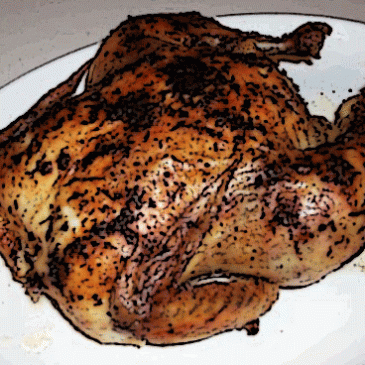
Unless it’s a love of food.  Because I’m not talking about the rotisserie chickens drying out under lights at the back of the grocery store.  For $12, I would buy a free-run, clean-fed chicken, rubbed with herbs and olive oil, moist and tender.  They were simply better than any roast chicken I’ve ever made, and at the end of a long week they were satisfying and fast.

One chicken, a bit over a kg in weight (2.5 lb. more or less) gave us four meals.  The first dinner would be just roast chicken:  the leg and thigh for BD, who prefers dark meat; the breast for me. Served with cranberry chutney from Rose’s, a salad and oven fries (BD makes great oven fries, potato chunks tossed in olive oil, black pepper and rosemary, and roasted at 360 degrees for 45 – 50 minutes) that used, roughly, a bit less than half the chicken.

The equivalent pieces – the other leg and thigh, and the other breast, went into the freezer, to be gently reheated over a pan of water in a slow oven another time.  But at this point there was still a lot of meat on the carcass.  I’d chill it overnight, and then on Saturday strip the rest of the meat from the bones, chopping it into small pieces.

These smaller pieces of meat were destined for either ‘poulterer’s pie’: our version of shepherd’s pie created once BD couldn’t eat red meat, or chicken curry.  I’ve never actually written the recipe for poulterer’s pie down, but basically it’s a mix of chicken and vegetables, herbs and spices, in a thickened chicken broth, topped with a mash- I’ve used potatoes, sweet potatoes, a combination of the two, or a combination that includes parsnips; all work – and baked in the oven until bubbly.  It’s a great cold-weather meal.

Once I’d removed the meat from the bones, the carcass is destined to make chicken broth.  Roasting the bones in a slow oven for a while – 45 minutes or so – before making broth does give a richer flavour but it isn’t necessary if you’re using the carcass of a cooked chicken.  I put the bones, a chunk of chopped onion, and a bit of garlic in my slow cooker, fill it with water, and let it cook all day on low.

Once it’s cooked down to about half of the amount of water originally put in, I strain it and let it cool.  The bones are destined for the compost at this point (we have a municipal kitchen-waste composting pick-up here – the town takes it away once a week, composts it at the waste management site, and gives it away in the spring. When we did back-yard composting of kitchen waste, I stopped composting bones because there is a feed mill in the village…and feed mills attract rats…which like bones and meat scraps.  And I don’t like rats.)

I may do one of two or three things with the broth:  make soup immediately; freeze it in mason jars for later use, or, freeze it in ice-cube trays to give me chunks of broth to use when a recipe needs a small amount.  Mostly I make soup, which served with warm bread and pickles from Rose’s often make up Sunday suppers.  We’ve likely had pancakes and sausage for brunch, so a small evening meal is all we need.  And there is usually enough soup left over for at least one lunch.

So there it is:  one chicken, four meals. BD likes these chickens better than the one’s I’ve roasted (I’m not insulted, because I agree with him) so I think we’ll probably continue buying them, once the cool weather returns.  They fit our food ethics – they are locally raised, and I’m supporting a local small business by buying them, and I’m pretty happy with four meals for two from a twelve-dollar chicken.

The weather forecast calls for highs of 19 degrees C (66 F) later this week.  I think that’s cool enough for roast chicken, don’t you?

Staying Focused

An all-too-common question for retirees is ‘what do you do all day?’  And there is the occasional day I think ‘what did I do today?”  But those are infrequent, because I’ve learned that my days need structure, and the discipline to keep to that structure.

Self-regulation isn’t a strong point for me, or didn’t used to be.  Now, I’m fairly good at it.  That is in part what this blog is about; by writing it every morning just after I get up, it focuses me on the things that matter to me, and reminds me why I do some of the things I do.  I guess, in a way, it makes me more accountable to myself.  And I love getting out of bed, making coffee, doing some stretches (often while emptying the dishwasher – dishes are good light weights), and then settling down with a mug of coffee to write for a while.

There are four things I expect of myself every day:  eat properly, stay hydrated, exercise, spend time with BD.  Food shopping and preparation, and exercise, take up about three hours each day.  Time with BD is variable; occasionally there are days when it’s just mealtimes; other days we’ll spend all day together.  Then there are the high-priority daily activities: the on-going house renovations; writing – not just this blog but also work on Empire’s Hostage; the necessary work of daily living – the budget,  housework, lawn care, laundry.

I have stopped multi-tasking, except for listening to music while I drive or cook.  I’m far more productive this way, giving my whole mind to what I’m doing.  I try to structure my time in roughly one-hour chunks, alternating as best I can between a sedentary activity – writing, doing the accounts, watching a game with BD, playing Scrabble – and active ones, mindful of the studies of the negative effects of sitting too long on our health.  So, each morning, generally after I write the post for Two Simple Lives, I map out my day – not just what I want to accomplish, but when.  Do I always stick to it?  No. Sometimes the piece of the house renovation project turns out to need longer that day.  Sometimes errands take longer than I scheduled; sometimes I walk or bike longer than an hour just because the day is so beautiful. Sometimes BD suggests something to do together over breakfast. The code is more what you’d call “guidelines” than actual rules*.

Once self-discipline is in place in one area of your life, it’s easier to extend it:  it becomes a habit.  It makes the goals of mindfulness, of sustainable practice and of frugal living easier.  The map of my day doesn’t restrict me – I can change it at any time – but it does provide check-in points, times to look at what I’ve accomplished and what I haven’t, and review why. It also helps me not overdo something – I may want to keep writing, or keep walking – but should I?  I know there are limits on both my creativity and my energy at any given time.  Going beyond those limits generally isn’t wise. It’s a bit like coffee – I may want that third cup, but it’s going to make me jittery, and less productive. So two cups, and I’m done.

It’s a rare day I get to bedtime and aren’t satisfied with how I’ve spent the day.  And sometimes, all my day plan says is ‘read, relax, have a glass of wine.”  We all need those days, too.

* my favourite line from the Pirates of the Caribbean series.

Hanging Laundry

This is one of my earliest memories.  It is the summer I am three; I know this because of the house in the memory, and where the trees are.  It is the summer of 1961, and I am helping my mother hang laundry outside.  My job is to hand her clothes pegs.  I want to play with them, make them into little people – these are the pegs that are one split and shaped piece of dowel, with rounded heads, not the sprung ones. My mother lets me play; I am being kept quiet, and not wandering, which is all that matters.

Fast forward fifty-four years.  I am standing outside in our garden, not long after dawn on an August morning, hanging laundry.  A red squirrel chitters and scolds at me from the tall Norway spruce, and a crow announces my presence to the wide wild world.  A breeze ruffles my hair.  I am wearing rubber boots against the dew, and long sleeves against the mosquitoes.

Hanging laundry is pure pleasure for me.  I shake out each piece and pin it to the line, listening to birdsong, and the sounds of cattle and geese from the farm beyond the woods that border our garden.  The day smells new, and there is still a pinkish glow in the sky, reflected on the trees.

To be out here at dawn, or just after, I have put the laundry in the washer the night before, at bedtime, and let it finish its cycle and sit until morning.  This both gives me the maximum drying time, and uses electricity at an off-peak time. Small frugalities; habits of thrift.  Even now, in mid-August in Ontario, I can need all day for things to dry – it was cool today, and cloudy, and the drying line is in the shade for much of the day.

Memories.  Hanging laundry on a rope line in a campground in Arizona, where the cotton shirts and underwear were dry almost before I hung them.  Another campground – Texas, I think – where hummingbirds came to investigate the blue plastic clothes pegs.  A line in Botswana, where all items must be ironed after drying to kill the eggs of a fly, laid in the damp cotton.  Ecuador, where things take three days to dry, in the humidity of the rainforest.

We don’t hang everything.  Tree pollen is my worst hay-fever antagonist, and our garden is full of trees, not even counting the woods behind us, so bedding goes in the dryer in the spring.  BD’s cotton shirts come in damp and are finished in the dryer for ten minutes to prevent wrinkles (and ironing).  The outdoor drying season is only about five months long, six in a year of early spring and late fall; the rest of the year we use the dryer.

Outdoor drying means being mindful, paying attention to the weather forecast, and then to the skies, because the weather forecast isn’t reality.  It takes a bit of planning.  But when I went out, this time in shorts and sandals, to get today’s laundry in at five-thirty, the towels smelled like sun and grass.  The water – our well water – that they had held had evaporated off, to become part of the water cycle and return as rain.  I think about cycles and continuity:  women have been hanging laundry in this garden since this house was built in 1911. The robin that is singing and the red squirrel that is chattering are probably descendants of the ones that were singing and chattering a hundred and four years ago. The water from our well has evaporated off wet clothes, condensed as clouds, rained, become ground water, filled our well….how many times?

My mother lived to ninety-three.  She stopped hanging out laundry somewhere in her late sixties, when arthritis and stairs to the back garden made it impossible for her.  But she missed it; missed being in the garden, being out in the sun, chatting with the neighbour across the fence, hearing birds. She hung laundry for much of her life because she had to; I do it for reasons of sustainability and thrift, but for both of us, the pleasure was, and is, greater than the chore.