Words to Live By

Not all of us can do great things. But we can do small things with great love.

This quote, apparently wrongly attributed to Mother Theresa, remains one of my favourites.  It doesn’t matter who actually said it – it remains a valid and validating statement.

I can’t, for example, paint a masterpiece.  But I can create art for handmade birthday cards, the image usually one I think will have some extra meaning for the person receiving it.

I will never write a best-seller.  But my first novel has been enjoyed by quite a few people, and has been well reviewed.

I will never be a master chef, but I can create meals from scratch that are enjoyed by friends and family.

I am no design guru or master renovator, but I have mudded and caulked and painted and wallpapered and laid tile with care to help create a home we love.

At the end of my career I received a provincial award for contributions in my field of education, completely unexpectedly.  I had never done anything huge, just a lot of small things over many years.

In a recent article in the New York Times, OpEd writer David Brooks asked readers how they found purpose in life.  He writes  “a surprising number of people found their purpose by… pursuing the small, happy life.”

Small things with great love.  Words to live by, at least for me.

Fall Migration

Late yesterday afternoon I walked at Point Pelee National Park in southern Ontario. Known world-wide as a birding mecca in the spring, it’s quieter in the fall, although migrants still pass through. Yesterday it was blue jays, in the thousands, and in two – or perhaps three – layers. The highest birds were flying south, towards the tip of the sandspit that is Point Pelee, jutting out into Lake Erie. From here – or to here, in the spring – birds can fly over the the lake, never too far from land, following the point and then the islands – Pelee, Middle, – to the other shore. It’s why it’s such a hotspot for birding, the first landfall for tired birds making the long trek across the lake.

But jays don’t like to fly over water, so the waves of birds fly south, see the water, and turn back, to follow the shoreline around to the west and cross the Detroit River.So the second layer of jays, lower than the southbound birds, is flying north. There are so many birds the skies look like Toronto highways in rush hour, except the birds are moving faster.

The third layer of birds are those that have dropped down to tree height to feed. Migration needs energy, and the woods are full of jays seeking any source of energy they can find. Like all corvids (the crow family) blue jays are omnivores, and dragonflies, migrating monarchs, other insects, berries, – just about anything edible – will provide fuel for this long flight.

Other than the jays, the park is quiet. A few cyclists on the empty roads, a few other walkers, no other birders late in the afternoon. I don’t think I have ever been here on a weekday afternoon in September, although I have been walking these trails since I could toddle. I grew up close by, and the park was a frequent Sunday afternoon destination for our family.

Here, too, I brought BD when he first started to make the long trek from Toronto to my childhood home to see me the first summers we were going out, and, perhaps most importantly of all, it was here I introduced him to birding.  I’d been a casual birder since earliest childhood, identifying the birds of woodland and fields from a children’s bird-book, part of learning my world, along with trees and wildflowers and insects and rocks. One May afternoon  – probably Mother’s Day weekend – as we walked along the west beach trail, BD said “What are all those people looking at?” “Birds,” I answered, and pointed out in quick succession a yellow warbler and a Baltimore Oriole.  One casual question, an equally casual response – and our lives changed forever.

We learned to bird properly in the early 80s, taught in the field by the companionship, generosity, and good nature of some of the top Ontario birders. It’s been a passion ever since, although what that looks like changes with time. We no longer come to Pelee in the spring: the long drive, crowds, and the too-competitive nature of some birders (and the disregard for the fragility of the ecosystem by some bird photographers) has kept us away. We’ve evolved now into patch-watchers, birding our own local area and watching and recording the seasonal and yearly changes – the return of ravens and sandhill cranes, the increase in red-bellied woodpeckers, the disappearance of house sparrows. It’s a way of birding I prefer: not a competition, but a study, deepening our understanding of where we live, of our world. And as much of it is done on foot, or after a very short drive, it’s more sustainable.

But it’s good to come back to a place that nurtured and nourished us as beginner birders all those years ago. At every turn of the trail memories of what we saw there – a screech owl in that clump of cedars,the red-headed woodpeckers on that snag, the northern waterthrush in this swamp – come back to me.  A passion born on these trails has taken us to seven continents, to places in China and India and Tibet that most Westerners never see, and given us friends and contacts around the world.

Like these north-flying jays, we’re looking now for easier ways to do things.  Long trips over water are no longer as appealing as they once were, and moving to warmer climates for the winter holds great attraction.  But as long as there are trails to walk, birds to watch, and a place to hang a feeder or two, we’ll be fine.

Finding Space

Vacations, for me, are about finding space. I mean this literally. If a trip doesn’t include time spent in at least one of grassland, salt-marsh, range land, moorland or desert then I’m not getting what I need from it. Wide open skies in a huge blue bowl above me; views that go on for miles, the song of birds somewhere in the air.

So when BD’s cousin Liz and I went west for ten days we spent some of the time in the Rockies (almost obligatory when showing a visitor from Scotland the west of Canada) but we spent more of it in the prairies. I have no idea why I need space the way I do. I grew up in flat farming country, mostly untreed, and I carry the genes of generations of fen and salt-marsh dwellers. Is that enough to explain it? All I know is that places that others find bleak, or boring, are the places I love the most.

This love of grassland is the only part of Lena, the protagonist of my novels, that I took directly from myself. Her reaction in the excerpt below was mine, the first time we drove east from Denver and looked down on the High Plains.

Two days later, in mid-morning, we rode up from the bowl of a grassy valley between two ridges of land. We urged the horses up to the crest. As Clio came abreast of the larger horses, I reined her to a stop and looked out. I gasped.

Beyond this final ridge, the land fell away quickly in a series of declining hills. A sea of grass extended far beyond sight toward the horizon. From this height, we could see the roll of the land and the sweep and ripple of the pale, sere grasses. The sky soared above us, and the boundary between land and air looked like a hazy blur on the distant edge of vision. As I gazed at the space and enormity of the grasslands, an unrealized tension eased. I felt an inner expansion, the loosening of constraint. I could live down there, I thought, suddenly, fiercely, wanting it. I could lose myself in that land, below that sky, in all that emptiness.

This time we flew to Calgary, and drove from there, and I felt exactly the same way again at the point the land changes from the mountains to the grass and cereal lands of the prairies. I’ve walked on a few of the world’s great open spaces – the Tibetan Plateau, the Kalahari, the moorlands of northern England and Scotland, the tundra of the Canadian Arctic and the snowfields of the Antarctic – and my reaction is always the same.

BD is good about this. Papua New Guinea? he suggested, to look for birds. (It’s forest.) You go, I said, I’ll go to North Dakota. Peru? he tried, another time. He went; I spent the week in Texas birding the salt-marshes. I’ve spent my time in the forests of the Amazon, and Malaysia, and northern Canada, and I have wonderful memories. I don’t regret those trips, but thinking about them doesn’t soothe my soul the way the memories of sky and wind and space do.

What speaks to you, soothes your soul, loosens your constraints?

On Being a Tortoise

I have become somewhat sloppy in some of my practices of mindful living this past month. Somehow, I got out of my habit of shopping only twice a week, and have been running in to town to pick up a few items almost every day. (We live twelve miles outside of town, in a tiny village with no shop.) This needs to stop, not just because it’s wasteful of gas and time, but because it’s just not how I want to live my life.

I shopped Monday this week, but Tuesday and Wednesday, except for picking up fresh corn and tomatoes, I didn’t (and that doesn’t involve going in to town). Instead, I went walking, good two-hour hikes both mornings through woods and fields. Today I need to go into town again; but I have a plan. I’m going to put my bike on its carrier, park at the store I buy the most at, and then bike to the other places I need to go. I have both a basket and panniers for my bike, and the university town has both bike lanes and an extensive network of off-road multi-use trails, making it easy to get around.

To be fair to myself, I haven’t just been being lazy by not using them. I didn’t have the core strength to ride my bike with the added weight, especially the panniers, which I find also affect the balance of the bike. Following major abdominal surgery thirteen months ago, I was forbidden to do anything except walk or swim for six months, to allow complete healing. (And I can’t swim.) That took me to January, and the middle of the coldest winter on record for many years here. I kept active, but mostly inside, and mall walking, painting woodwork, and using the treadmill or exercise bike wasn’t enough to strengthen the core. (A lot of the regular abdominal exercises are also contraindicated after the type of surgery I had, so I couldn’t just do crunches, either.)

But then spring finally arrived, and I started walking seriously again, and biking, My balance was bad for a while.  I kept at it, and finally this last ten days I have been walking without my Nordic poles; first for half an hour, then for an hour, and for the last two days for two hours each day, on hiking trails with all their ruts, roots, and rocks.  I think I can safely say I don’t need the poles any more, at least on fairly level ground.  This means my core is stronger.  A small but significant victory.

So I’ll put the basket and panniers on my bike, and park in town at the grocery store, and after shopping there plan a circular route that will take me to the specialty poultry store, and the library, and back to the car.  I could walk it, and carry the chicken and the books, but biking works different muscles and I like to do both. If it goes well, then this will be how I run errands in town, at least until snow makes it too dangerous.

There have been times in this past year when I have felt like a tortoise:  slow, ungainly, and dependent on an external support system.  But ‘slow and steady’ did the trick.  I didn’t rush anything; I built on small gains in small increments. Sometimes I did push myself too hard, thinking I was ready for a distance or a difficulty of terrain I wasn’t, but I backed off immediately once I realized I’d misjudged.  I didn’t let either pride or the desire for a quick fix to result in injury, which in turn could have meant more surgery.  (That was quite the incentive to not overdo it, by the way.)

My healthier body means I will drive less, which benefits the environment as well as our gas budget.  I can do my share of the heavier chores, which BD’s bad back will definitely like!  I’m less likely to use (more) health-care resources, more likely to stay creative, happy, and useful in the community, and I’ll be living my life in a manner closer to my ideal.

*****

A later-in-the-day update….the plan worked.  I learned the following:  I have to make sure I have my balance completely right before I take a hand off the handlebars to signal a turn, or I wobble, especially after I had made my purchases and was carrying some weight.  I also learned that choosing to try this out on the hottest and most humid day of the entire summer wasn’t the best choice; normally I bike on rail trails and bike paths, and the additional heat radiating off the paved road surface was more than I had expected…and it was ten-thirty in the morning.  But I did it!

The Two Books I Wish I’d Kept

A year or so ago we culled the library bookshelves. We had to; they were overflowing. Books can take over this house very easily.

I thought I’d done a mindful, considered cull. I really thought about each book. But it’s now clear I culled two books I should have kept.  They were both books that fall into my ‘contemplation’ category: books I read, think about, read again, think some more. Books that have changed, and continue to change, how I see the world. In the case of these two books, they were among the first – one was the first – to do that for me.

The first book, the one that first made me look at the world differently, is Annie Dillard’s Pilgrim at Tinker Creek. I read it for the first time at sixteen or seventeen: it was published in 1974, the year I turned sixteen, so I must have found it (how?) shortly after. A deeply personal and sometimes mystical narrative of the writer’s relationship with the natural world that surrounds her home, it spoke to me at many levels. Dillard’s understanding of the natural world and the appreciation of the rhythms and cycles of life were key to my love affair with the book, but the fact it was also written by a woman was immensely important. I’d read Aldo Leopold and Thoreau and others, but there was always a small disconnect; I couldn’t project myself into them. With Dillard, I could.

I re-read the book several times in my twenties, each time understanding more, recognizing more of the spiritual aspect of it. Then I left it alone for a long time, before reading it again about a decade ago. By then I was on my second copy of it – I’d read my paperback to pieces, and when I found a hardback at a used book store, I bought it. And then last year I gave it away.

The second book is Robert Pirsig’s Zen and the Art of Motorcycle Maintenance. I suspect no other book has influenced my own approach to life as much as this one. I didn’t tackle it until my early to mid twenties, and it was the first book I read (other than my calculus textbook) where I remember recognizing as I read it that I really didn’t understand all of it, not in depth. So I read it again…and again…and again, over the next ten years. Finally, I thought I did understand it, how the search for understanding the elusive definition of quality, of what is good or not good, had become entwined with the author’s mental illness, and how recovery entailed learning to embrace and balance both the romantic and the rational. But again, my paperback was in tatters, and I thought I’d learned all I needed from it.

I wonder now why I thought I was done with them; where that hubris arose from. I have written elsewhere about how I understand the world through walking; in doing so, I create mental maps both real and unreal. The real mental maps mean that once I walk a place mindfully, I cannot get lost there, unless a very long time goes by before I am there again. The unreal are dreamt maps, dreamt walks, that overlay the real world, are different from it but always echo it. These books have been guidebooks for both my conscious and unconscious journeys. And I thought I could give them away?

I can either buy them again – they won’t break the budget, and both are still in print, and easily available used – or I can get them from the library. I think I’ll buy them. And at some level, ask their forgiveness for thinking I could navigate through this life without them.

Staying Focused

An all-too-common question for retirees is ‘what do you do all day?’  And there is the occasional day I think ‘what did I do today?”  But those are infrequent, because I’ve learned that my days need structure, and the discipline to keep to that structure.

Self-regulation isn’t a strong point for me, or didn’t used to be.  Now, I’m fairly good at it.  That is in part what this blog is about; by writing it every morning just after I get up, it focuses me on the things that matter to me, and reminds me why I do some of the things I do.  I guess, in a way, it makes me more accountable to myself.  And I love getting out of bed, making coffee, doing some stretches (often while emptying the dishwasher – dishes are good light weights), and then settling down with a mug of coffee to write for a while.

There are four things I expect of myself every day:  eat properly, stay hydrated, exercise, spend time with BD.  Food shopping and preparation, and exercise, take up about three hours each day.  Time with BD is variable; occasionally there are days when it’s just mealtimes; other days we’ll spend all day together.  Then there are the high-priority daily activities: the on-going house renovations; writing – not just this blog but also work on Empire’s Hostage; the necessary work of daily living – the budget,  housework, lawn care, laundry.

I have stopped multi-tasking, except for listening to music while I drive or cook.  I’m far more productive this way, giving my whole mind to what I’m doing.  I try to structure my time in roughly one-hour chunks, alternating as best I can between a sedentary activity – writing, doing the accounts, watching a game with BD, playing Scrabble – and active ones, mindful of the studies of the negative effects of sitting too long on our health.  So, each morning, generally after I write the post for Two Simple Lives, I map out my day – not just what I want to accomplish, but when.  Do I always stick to it?  No. Sometimes the piece of the house renovation project turns out to need longer that day.  Sometimes errands take longer than I scheduled; sometimes I walk or bike longer than an hour just because the day is so beautiful. Sometimes BD suggests something to do together over breakfast. The code is more what you’d call “guidelines” than actual rules*.

Once self-discipline is in place in one area of your life, it’s easier to extend it:  it becomes a habit.  It makes the goals of mindfulness, of sustainable practice and of frugal living easier.  The map of my day doesn’t restrict me – I can change it at any time – but it does provide check-in points, times to look at what I’ve accomplished and what I haven’t, and review why. It also helps me not overdo something – I may want to keep writing, or keep walking – but should I?  I know there are limits on both my creativity and my energy at any given time.  Going beyond those limits generally isn’t wise. It’s a bit like coffee – I may want that third cup, but it’s going to make me jittery, and less productive. So two cups, and I’m done.

It’s a rare day I get to bedtime and aren’t satisfied with how I’ve spent the day.  And sometimes, all my day plan says is ‘read, relax, have a glass of wine.”  We all need those days, too.

* my favourite line from the Pirates of the Caribbean series.

Hanging Laundry

This is one of my earliest memories.  It is the summer I am three; I know this because of the house in the memory, and where the trees are.  It is the summer of 1961, and I am helping my mother hang laundry outside.  My job is to hand her clothes pegs.  I want to play with them, make them into little people – these are the pegs that are one split and shaped piece of dowel, with rounded heads, not the sprung ones. My mother lets me play; I am being kept quiet, and not wandering, which is all that matters.

Fast forward fifty-four years.  I am standing outside in our garden, not long after dawn on an August morning, hanging laundry.  A red squirrel chitters and scolds at me from the tall Norway spruce, and a crow announces my presence to the wide wild world.  A breeze ruffles my hair.  I am wearing rubber boots against the dew, and long sleeves against the mosquitoes.

Hanging laundry is pure pleasure for me.  I shake out each piece and pin it to the line, listening to birdsong, and the sounds of cattle and geese from the farm beyond the woods that border our garden.  The day smells new, and there is still a pinkish glow in the sky, reflected on the trees.

To be out here at dawn, or just after, I have put the laundry in the washer the night before, at bedtime, and let it finish its cycle and sit until morning.  This both gives me the maximum drying time, and uses electricity at an off-peak time. Small frugalities; habits of thrift.  Even now, in mid-August in Ontario, I can need all day for things to dry – it was cool today, and cloudy, and the drying line is in the shade for much of the day.

Memories.  Hanging laundry on a rope line in a campground in Arizona, where the cotton shirts and underwear were dry almost before I hung them.  Another campground – Texas, I think – where hummingbirds came to investigate the blue plastic clothes pegs.  A line in Botswana, where all items must be ironed after drying to kill the eggs of a fly, laid in the damp cotton.  Ecuador, where things take three days to dry, in the humidity of the rainforest.

We don’t hang everything.  Tree pollen is my worst hay-fever antagonist, and our garden is full of trees, not even counting the woods behind us, so bedding goes in the dryer in the spring.  BD’s cotton shirts come in damp and are finished in the dryer for ten minutes to prevent wrinkles (and ironing).  The outdoor drying season is only about five months long, six in a year of early spring and late fall; the rest of the year we use the dryer.

Outdoor drying means being mindful, paying attention to the weather forecast, and then to the skies, because the weather forecast isn’t reality.  It takes a bit of planning.  But when I went out, this time in shorts and sandals, to get today’s laundry in at five-thirty, the towels smelled like sun and grass.  The water – our well water – that they had held had evaporated off, to become part of the water cycle and return as rain.  I think about cycles and continuity:  women have been hanging laundry in this garden since this house was built in 1911. The robin that is singing and the red squirrel that is chattering are probably descendants of the ones that were singing and chattering a hundred and four years ago. The water from our well has evaporated off wet clothes, condensed as clouds, rained, become ground water, filled our well….how many times?

My mother lived to ninety-three.  She stopped hanging out laundry somewhere in her late sixties, when arthritis and stairs to the back garden made it impossible for her.  But she missed it; missed being in the garden, being out in the sun, chatting with the neighbour across the fence, hearing birds. She hung laundry for much of her life because she had to; I do it for reasons of sustainability and thrift, but for both of us, the pleasure was, and is, greater than the chore.

MOOCing along: The Pleasure of (Free) On-Line Learning

This is an expansion of a post on my writer’s blog, Wind and Silence, so if you read that too, you’ve pretty well read this post, although there are a few differences.

In an earlier post, I wrote about how I sought out community and intellectual stimulation during my house-bound period last winter, following surgery, through becoming involved in Project Feederwatch. In that post, I mentioned there were other ways I found what I needed, and, because this also relates to one of my themes of being frugal, I decided it was worth writing a post about.

I subscribe to a site called Lifehacker on my Facebook newsfeed. Originally I started reading it because it often had technology-related reviews, ratings and ideas,which I needed for work. But then some time last summer, there was a post about free, on-line education.  Intrigued, I looked at it, and found a link to FutureLearn. Associated with the Open University in the UK, this completely free educational site offers dozens of courses on subjects as diverse as Global Food Security, The Works of Gabriel Garcia Marquez, and The European Discovery of China.  Universities from around the world are involved in the design and teaching of the courses. All you need to sign up is a computer and the internet.

I browsed through the course offerings, with, of course, an eye to courses that would increase my understanding of the Roman Empire, the historical template upon which the world of Empire’s Daughter rests. As I wrote in an earlier post on Wind and Silence, my understanding of my created world needs to be thorough, or I can’t write about it convincingly.   Two caught my eye: Hadrian’s Wall:  Life on the Roman Frontier, and, Archaeology of Portus:  Exploring the Lost Harbour of Ancient Rome. These looked promising, and the Hadrian’s Wall course’s timing was perfect – it would start soon after the surgery, but not immediately, so I had time to be able to handle sitting with my laptop again.  So I signed up for the it – we’d been to the Wall a couple of times, the most recent just over year before, and in that case specifically for research for the book and its upcoming sequel. I’d learned a lot from visiting the museum at Vindolanda, as well as just walking the Wall and thinking about what it was like to be a soldier there in the second century A.D., on a cold, damp, windy March day, waiting for your relations to send you more socks.

I’d taken on-line courses before, in relation to my work, so I was prepared for the basic format of readings, videos, questions to be answered and on-line discussions to occur. The course was well-designed and fun; I learned a lot, but the (for me) unexpected benefit was the literally hundreds of viewpoints that were expressed.  These courses are what are known as a MOOC – a Massive Online Open Course – and can have many, many participants.  Not everyone is very vocal, of course, but the wide range of experience, background, imagination and world-views of the participants who did express ideas made me think – not just about Roman Britain, but about my imagined world, and, some of my own preconceptions. It was rich discussion. The result is that some of what happens in the next book(s?) has been directly influenced by this community of learners (in both courses) who were willing to share their knowledge, ideas, and expertise with each other. I hope I remember to thank them all in the author’s notes!

There are, of course, lots of other opportunities for free or low-cost learning (the Lifehacker link is a good place to start) and I’d be interested to hear what others have found.  FutureLearn is just one place you can find free courses, and I’m waiting to hear if another on-line course that looked intriguing is to be offered again, this time through a different provider, Coursera.  My local Senior’s Centre…(yes, it appears I qualify, being over 55, although there is part of me that doesn’t believe this…) offers a number of no-cost face-to-face programs this winter. I am, actually, overwhelmed by choice, and have to be mindful, to stay focused on courses that will inform my writing…and leave me time to actually write.

In Praise of Chickadees

It’s a hot, sunny August morning, and there is probably something else I could be doing, but instead I’m sitting in the sun-room, watching the ruby-throated hummingbirds at the feeder.  There are at least two:  a male, and then one or more juvenile/female-plumaged ones, which could be his offspring or mate.  I think offspring, because he keeps driving them away. There is another feeder, around the corner, situated to be seen from the kitchen window, and occasionally the male flies off to patrol it, letting the juvenile beeline in to feed.

In mid-August, other birds are beginning to appear, landing on the feeder pole and investigating all the arms, looking for the seed feeders they know were there last winter.  Chickadees and goldfinches, mostly, and the occasional blue jay.  We’ll put the seed feeders back up October first; there is plenty of wild food around for these birds, including the sunflowers planted along our fence.

I’ve walked on every continent on Earth to see birds, and I’ve seen literally thousands of species. Some stand out over others:  the Adele penguins on the Antarctic peninsula; Siberian cranes on the Yangtze wetlands in winter; the California Condors over Big Sur; the huge, shy, Great Argus of the Malay peninsula.  I’ve birded in places you wouldn’t think there would be birds:  in the heart of Paris, on the hills above Hong Kong, in downtown Buenos Aires.  I’ve seen the wonder of the sandhill and snow goose migration on the Platte in March; the dance of prairie chicken on the hills at dawn, the mating flight of woodcock in the wet fields at the edge of our village.  But while these have been wondrous, and I am filled with nothing but gratitude and awe that I have been able to see them and so much more, nothing quite makes me smile like a chickadee.

They are such cheerful, curious optimists.  Yes, I know this is anthropomorphism.  Yet there they are in August, landing on the feeder poles, buzzing their questioning chick-a-dee-dee-dee.  If I go out, they won’t fly away; I’ve had them land on me in the garden as if I were a moving tree.  On a minus twenty February morning, as soon as the light begins to filter through the darkness, they’ll be there.  If the feeders are empty, believe me, they tell us, and they’ll fly around my head while I fill them, landing on the hanging feeders before I’ve even put them up again.  The cats – who are strictly indoor cats – sit at the windows and chatter, tails lashing.  When the chickadees come to sit in the bushes under the sun-room windows, Pye and Pyxel are balls of pent-up, frustrated energy.  (But can these two catch the odd white-footed mouse that finds its way into the house?  Of course not.  They are the cat equivalent of armchair quarterbacks.)

Last fall, after major abdominal surgery, and through the weeks of recovery, further treatment and more recovery, the bird feeders – or more precisely the birds at them – were one of my joys.  Prior to my weeks off work, I’d only been able to watch the feeders on weekends once daylight savings time ended, since I left for work in the dark and got home in the dark, and weekends were inevitably filled with chores and errands, so we got brief glimpses here and there of what we were feeding. Sunday brunches were the only times we’d really get to watch.

To focus my watching, I signed up for Project Feederwatch, through Cornell University.  A huge, on-going citizen science project, my part in it was to watch the feeder for at least part of two consecutive days a week, and record the species and numbers I’d seen.  It was great fun, as well as being informative and producing a few surprises, like the flock of nineteen wild turkeys who appeared mid-morning every day to pick up the seeds scattered by the small birds.  More than that, though, for the weeks before my surgeon permitted me to drive, and the weeks before BD felt comfortable letting me go for a walk on my own, it was my daily connection to nature, to the change of the seasons and the living, breathing, wild world.

It was also two other things: community and intellectual stimulation.  One of the things I worked on during my weeks ‘home alone’ was about creating, or rather recreating, both of these, in a different form than they had taken before. My friends were hugely supportive, driving me to doctor’s appointments before I could drive myself, taking me out for lunch, just visiting.  BD, of course, was there evenings and weekends. But I was used to a work environment, where there was always someone who needed to talk to me, or I needed to talk to, in person, by phone, by e-mail, and there was always a problem to be solved, a situation to be mediated, new hardware or software to be reviewed, tested, analyzed.  And so I set out to recreate a smaller version of that – I didn’t want the constant interactions; even at work I had long ago learned to close my door, or drive out to the furthest site I was responsible for, to find some solitude and thinking time. Nor did I want to pursue anything that looked like the work I had been doing – it was a vocation, not an avocation, and I knew I was retiring.  But I did need to use my mind, and to talk to people. All the edits on Empire’s Daughter were done, so the frequent e-mails to and from my editors had ended.  The new book was just an outline, and on my best day I can only write for about three hours.  I was determined to find other ways to use my mind and be connected to people, and I was, temporarily, housebound.

By finding a place in on-line communities – not just through Project Feederwatch but through other means (which perhaps I’ll write about another time) – I satisfied both the need for interaction and the need for intellectual stimulation.  Everything I worked on last winter was time-limited; I knew that once I’d recovered, I’d likely want to spend less time on these projects; I can sign up for Project Feederwatch again this winter, or not, depending on how we decide to spend the winter.  But the project gave me more than either community or intellectual stimulation, and perhaps this last thing is the most important.

I’ve been watching birds for about forty-five years, but this was the first chance -or at least the first opportunity I’d taken – to watch in a different way; to watch the details of how the birds interacted with each other; to sort out the apparent pecking orders within and among species; to note the fine differences between how a chickadee and a goldfinch picks up seed.  I learned to identify specific birds through minor variations in plumage, and I studied the gradations and differences that sorted out the species of redpolls, before the boffins decided, on the basis of DNA, that they’re all one species, regardless. Just when I’d got good at it, of course.

Learning to watch the birds differently, paying attention differently, is a distillation of much of what I have been working towards – to be more mindful of what is important to me, to slow down and see, to live here, now, understanding the landscape and ecosystem and community in which I live and am part of.  T.S. Eliot said it far better than I ever could, in his magnificent poem Little Gidding:

We shall not cease from exploration
And the end of all our exploring
Will be to arrive where we started
And know the place for the first time.

Perhaps I have just begun to know chickadees.
Considering Diderot, IKEA, and Furniture

Two pieces of ‘mail’ this week got me thinking.  One was e-mail – I subscribe to Joshua Becker’s blog Becoming Minimalist, and an e-mail came in telling me of a new post.  The second was traditional mail – a new IKEA catalogue.  I realize those two things seem pretty unrelated, but bear with me.

Becker’s post, Understanding the Diderot Effect (and How to Overcome It) refers to an essay I read in my late teens by the French philosopher Denis Diderot, about how his comfort with his worn surroundings disappeared when a friend gave him a beautiful new dressing gown, which contrasted with the shabbiness of his rooms.  The IKEA catalogue reminded me of Douglas Copeland’s description of the lives of three ‘twenty-somethings’ in his novel Generation X, which included the term ‘semi-disposable Swedish furniture’, and I thought about how we are pressured to constantly replace things – our dishes, our clothes, our furniture.

And then I took a mental step back, and considered our house and our furnishings.  We bought this place – a four-square built in 1911 – in 1984, as a near-wreck, and after a long weekend doing some basic patching and painting of the interior, we moved in with the furniture from our much smaller previous house, much of which had come from IKEA.

Twenty-one years later (and another coat of paint), we still have that IKEA furniture.  And it’s not in the basement.  It’s in our living room, and our sun-room, and the bedrooms, and the library.  The cushion covers on the three chairs and two couches have been replaced,  three times, I think, in the last thirty years – twice by my amateurish upholstering, and once, most recently, professionally. Over that time we’ve added to our furniture:  some came from one aunt’s house, some from another; some was bought second-hand, a very few things bought new, and the rest built by BD.  It’s often a combo:  BD built the dining room table, but the chairs came from IKEA, and the two china cabinets came, one each, from my aunts’ houses.  He built the desk at which I write, but bookshelves from IKEA line the walls of the library; I bought the library rug at a yard sale, and my desk chair came from Staples.

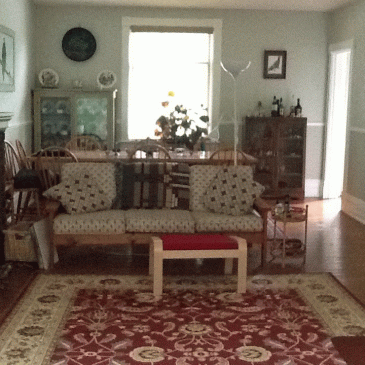
The picture that accompanies this post is a shot into our living/dining room. The rug in this photo is new, bought just last summer, replacing two large hand-braided rugs, made by a friend of my mother’s, that after about seventy years of good service had finally just fallen apart. It’s the piece that could have (should have?) set off the Diderot effect. Everything else – except the footstool and lamp – is at least thirty years old. (You can’t see BD’s armchair, off to the right side, but it’s the same as the couch.)  But somehow, there was no Diderot effect (at least for us – you may think differently!). Perhaps it’s just that I’m comfortable with things not matching, perhaps its the associations I have with each piece of furniture. But whatever the reason(s), I like the way everything looks together.

In the end, furniture is functional, and as long as you like it and it’s comfortable, that should be all that matters.  It doesn’t need to match; it doesn’t matter if some things are more worn than others, and, it’s only ‘semi-disposable’ if you choose to view it that way.  As with just about anything and everything in our lives, if we value our furniture, are mindful of keeping it in a safe and useful state – tightening bolts, working wax into wood, fixing fraying seams – it will serve us well, often for more than one generation.