Cheap Dates

BD and I like to go out once a week or so.  Not so much for meals any longer because of his allergies, but for music, or a movie, or to spend time with friends. But there is a budget to consider, so we’ve worked hard (no, let’s re-word that, I’ve worked hard…) to find things to do that are cheap, or better, free.

Luckily, it’s not difficult.  We have a cinema a reasonable drive away that shows first-run films for $5 on Tuesdays, all day, matinees and evening performances; they’ve just recently opened, but already they are pretty busy on Tuesdays.  Their popcorn is the usual over-priced stuff, so we skip that, but my waistline doesn’t need it anyway!  Our other movie option is our local art-house cinemas – two of them – where a yearly $15.00 membership means the films are $8.00, and at one of them, also gives 15% off at the attached bookstore and restaurant.  (And both of these have cheap, good, popcorn.) When you go to a movie a week, as we tend to, the membership pays for itself pretty quickly, even when I do buy popcorn.

In the summer, free music abounds.  The two towns we live half-way between both have (on different days) free concerts-in-the-park on weekday afternoons.  The musicians are up-and-coming local artists, and are generally all pretty mellow, ranging from country to jazz and folk to pop.  But we’re wide-ranging in our musical tastes, and it’s a pretty good way to spend an hour or two, sitting in the shade on a lawn chair, snacks in the cooler, listening to music.

Come the fall and winter, we turn to the university.  Here they run a free concert series on Thursday at lunch time, sometimes student performances from the Faculty of Music (but not usually).  Again, it’s wide-ranging – this fall’s line-up includes Cuban jazz, Celtic harp, and even rock’n’roll.  Parking on the campus is pricey, so we go early, find a side street with free parking, and walk or bike over to the university.

The churches in both towns also host free or very inexpensive concerts – I happen to particularly love Renaissance church music and choral performance – and it’s not necessary to be a church member (or even a believer) to go.

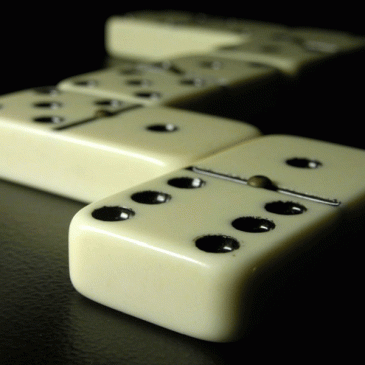
But perhaps our times with friends are the best.  With a simple meal (usually, unless one of us is trying out a fancy new recipe) either before or after our get-together, we sometimes just talk, but our most frequent activity is a board game.  Right now we’re heavily into playing dominoes, but it varies: sometimes cards, sometimes a trivia game, sometimes an obscure geography game called Ubi.  Or we’ll go for darts, or skittles, or a really obscure (for North America) English bar game called shove half-penny (pronounced shove-ha’penny.)  I have the board my grandfather made about a hundred years ago, and every so often we bring it out.

And of course, there’s always the afternoon watching the game on tv, with a large bowl of home-popped popcorn and a beer.

My Love Affair with Thrift Stores

Before I retired this year, my closets were overflowing with business clothes.  Living in a four-season climate meant business wear appropriate for a range of outdoor temperatures from -35 degrees C to +35 degrees C, (or roughly -30 to 90 degrees F), and because my office’s heating/cooling didn’t always work well, and because my work involved a lot of driving and visiting sites, clothes for each season were actually needed.

Shortly after my last day of work, I purged the closets.  I bagged up the vast majority of my business clothes, keeping a few to wear to nice restaurants, weddings, funerals, and whenever else I might need something that wasn’t denim, khaki, fleece, or a t-shirt. As I was loading them into the car, BD (who was helping) said “Are they going back to where they came from?”

Well, yes.  At least for a good number of them.  Because even before retirement, I was a thrift-store shopper, and quite a lot of these clothes had come from my favourite thrift store, Value Village.  Or from consignment shops, which I also love. Partly because there is something about department stores that makes me physically uncomfortable – whether it’s the lighting, the crowded rows, the cavernous spaces – I’m not sure.  But I’ve never liked them, even as a kid.  But mostly because I believe strongly in the idea of not buying new, and re-using good things.

I probably am lucky that my Value Village is in a university town; I suspect the quality of clothes I can find may be better than average. I’ve done best with tailored pieces, skirts and jackets and coats.  But over the years I’ve found as well the lovely multi-coloured Indian jacket in the picture (I kept it, it goes well with jeans), several summer dresses, and all the shorts I own.  Plus my gardening jeans, my favourite sweatshirt, and a collection of heavy shirts I wear in the fall and winter.

From consignment stores have come another lovely, hand-made quilted jacket (which also goes well with jeans, so it stayed too), the absolutely beautiful colour-blocked, lined, wool dress I wore to my father’s funeral this year, my long trench coat, and the dress I can crunch into a ball, shove in a suitcase, and it comes out unwrinkled at the other end even after three weeks of bouncing around in the back of a Land Rover in Uganda.  I’ve had that one ten years, had it shortened to knee-length a couple of years back to look a bit more current, and am constantly being complimented on it.

These stores are the first place I go for kitchenware as well.  Not that we need much, but my arthritic hands do occasionally drop things, and even with a cork floor in the kitchen not everything bounces.  I seem to go through wine glasses the fastest, and half my coffee mugs have had the handles glued back on.  The cats occasionally add to the breakages, too; they’ve been known to send glasses, mugs, and side plates flying while playing chase.

As long as the mugs or plates or bowls are in some shade or mix of green, blue and brown they blend with everything else we own, and wine glasses are clear.  I’d like to think we could get by with just a couple of everything, washing them every time, but we entertain quite a bit, casual dinners, brunches…so I do need more than a set for BD and a set for me.  (I did, however, donate our ‘banquet set’ for twenty to an environmental club at the university that was looking for reusable dinnerware. We’ve given up on formal meals for twenty.  Mind you, I’d only paid $100 for the whole thing – dinner plates, side plates, bowls, two sets of glasses, mugs, and cutlery, in the first place, twenty-odd years ago.  It wasn’t fine china, but it wasn’t plastic, either.)

Everything we purge that is worth re-using goes to a thrift store, Value Village or Goodwill or the like, unless it meets the needs of a post on our local Freecycle or my flea-market vendor friend wants it.  I like the sense of being part of a larger, re-using community; I give what I don’t need away, I buy for a very few dollars the very few things I do need.  There are exceptions:  footwear, our wind-and-waterproof outdoor hiking clothes, needed locally in the winter and for several of our past trips to very cold places.  These are specialized items, though, not everyday needs, and they last a long long time.

September is approaching, and with it colder mornings and evenings….and when I looked at my favourite red sweatshirt last, I realized the neck and cuffs are fraying.  I will fix it  (I don’t sew well, but I can manage some basic repairs), but it might be getting past wearing out to a movie or a casual meal.  My other one was originally given to BD the first Christmas we were going out, by my sister, who didn’t yet know he doesn’t like things that pull over his head.  That was in 1978.  I’m still wearing it, but only around the house and out hiking.  If I really think I need another one, my first stop will be a thrift store.  It might take me a visit or two, but I’ll find one that I like, and fits, and another good piece of clothing will be reused.

Walking, Health and Wholeness

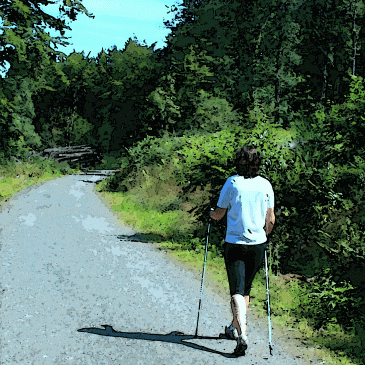
When I began this post, I wondered how I would tag it:  #health  #mindfulness, #sustainability, #writing #frugal #community.  All those reflect what walking means to me, and all are components of something larger, something I am going to call wholeness.  I am not whole if I do not walk.

From my earliest years I have learned by walking, dreamed of walking, found solace and healing in walking, tapped creativity by walking.  My memories of all the places and countries and continents I have been to are memories of walking, of the way one soil feels different underfoot than another, of the contours and smells of the land around me, the flow of rivers, the flight of birds, the shape of trees.  I learn new places by walking them, and once I have done so I am never lost.

I was the youngest by some years in our family, and was frequently solitary.  But I had fields and woods and farm lanes to roam, and those were different days.  I explored further and further afield, usually on foot, sometimes by bicycle, and with the dog for company.  I learned to look, at wildflowers and trees, at birds and mammals, snakes and frogs, at insects.

Then I went to university a long way from home, choosing the university in part because it was not in a town, but set some miles out of town, on a large expanse of land.  But a new reality faced me there:  girls – women – were warned not to walk alone beyond the lighted and paved campus, and none of my new friends wanted to walk.  I stayed a year, became depressed, gained too much weight, and changed universities.  This one too had a large open area, an arboretum with trails that linked to other trails extending out beyond and through the town, and I met friends who wanted to go walking, to look at trees and rivers and birds.  I lost the weight, stopped being depressed, and fell in love with a man who walks more than I do.

Walking informs almost all my writing, either as a theme (sometimes transmuted into other forms of travel through a landscape) or as how I tapped into whatever it is in my brain or the cosmos that creates fiction.  I will go walking with a problem to solve, one of plot or motivation or background, and after a good walk or two, even if I haven’t been directly chewing over the problem as I walk, the solution will appear.  I find letting the problem swirl around in the back of my mind, not looking at it directly, while I focus on watching birds, or fish, or searching through a stand of milkweed for Monarch butterfly caterpillars, often produces the quickest results.

When I start walking I’m stiff, sometimes sore, depending on the day, the weather, and the vagaries of arthritis.  That will pass after the first ten minutes.  Some days, I’m out of sorts, or worried, but being back in touch, physically and spiritually, with sky and land and wind provides perspective, and calms even my most persistent or serious concerns. Most days I walk for an hour or two; at this time of year, when the mosquitoes and deerfly of summer are still active, I walk at the university arboretum.  As summer winds down, I’ll go back to the conservation area trails that surround us.  Only when the weather is at its worst – heavy snow, torrential rain, extreme humidity – do I resort to indoor walking, either at the local shopping mall, or on my treadmill.

Walking together fosters community, whether its the community of our marriage – BD and I talk best when walking together, and face our most difficult challenges that way; the community of friends you’re sharing a walk with; the more casual community of people met on the shared paths and trails, or the neighbours you meet walking down to the mailbox. It’s also a pretty frugal way to exercise: good shoes are recommended, especially for aging feet, but otherwise there aren’t too many places where you can’t find somewhere to walk without paying an entrance fee.

I wonder, sometimes, who I would be, had I not been that youngest child, free to roam a safe rural environment, touching, tasting, watching the wild world, letting my mind and imagination run freely along conscious and unconscious channels, an experience unstructured and unguided. Would I – could I? write?  How healthy – mentally and physically – would I be? Questions that can’t be answered, because every choice of path, every turn we take or don’t take, every hill we do or don’t attempt, changes us, in ways we can’t begin to imagine.

Considering Diderot, IKEA, and Furniture

Two pieces of ‘mail’ this week got me thinking.  One was e-mail – I subscribe to Joshua Becker’s blog Becoming Minimalist, and an e-mail came in telling me of a new post.  The second was traditional mail – a new IKEA catalogue.  I realize those two things seem pretty unrelated, but bear with me.

Becker’s post, Understanding the Diderot Effect (and How to Overcome It) refers to an essay I read in my late teens by the French philosopher Denis Diderot, about how his comfort with his worn surroundings disappeared when a friend gave him a beautiful new dressing gown, which contrasted with the shabbiness of his rooms.  The IKEA catalogue reminded me of Douglas Copeland’s description of the lives of three ‘twenty-somethings’ in his novel Generation X, which included the term ‘semi-disposable Swedish furniture’, and I thought about how we are pressured to constantly replace things – our dishes, our clothes, our furniture.

And then I took a mental step back, and considered our house and our furnishings.  We bought this place – a four-square built in 1911 – in 1984, as a near-wreck, and after a long weekend doing some basic patching and painting of the interior, we moved in with the furniture from our much smaller previous house, much of which had come from IKEA.

Twenty-one years later (and another coat of paint), we still have that IKEA furniture.  And it’s not in the basement.  It’s in our living room, and our sun-room, and the bedrooms, and the library.  The cushion covers on the three chairs and two couches have been replaced,  three times, I think, in the last thirty years – twice by my amateurish upholstering, and once, most recently, professionally. Over that time we’ve added to our furniture:  some came from one aunt’s house, some from another; some was bought second-hand, a very few things bought new, and the rest built by BD.  It’s often a combo:  BD built the dining room table, but the chairs came from IKEA, and the two china cabinets came, one each, from my aunts’ houses.  He built the desk at which I write, but bookshelves from IKEA line the walls of the library; I bought the library rug at a yard sale, and my desk chair came from Staples.

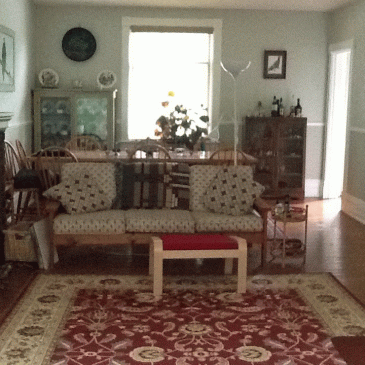
The picture that accompanies this post is a shot into our living/dining room. The rug in this photo is new, bought just last summer, replacing two large hand-braided rugs, made by a friend of my mother’s, that after about seventy years of good service had finally just fallen apart. It’s the piece that could have (should have?) set off the Diderot effect. Everything else – except the footstool and lamp – is at least thirty years old. (You can’t see BD’s armchair, off to the right side, but it’s the same as the couch.)  But somehow, there was no Diderot effect (at least for us – you may think differently!). Perhaps it’s just that I’m comfortable with things not matching, perhaps its the associations I have with each piece of furniture. But whatever the reason(s), I like the way everything looks together.

In the end, furniture is functional, and as long as you like it and it’s comfortable, that should be all that matters.  It doesn’t need to match; it doesn’t matter if some things are more worn than others, and, it’s only ‘semi-disposable’ if you choose to view it that way.  As with just about anything and everything in our lives, if we value our furniture, are mindful of keeping it in a safe and useful state – tightening bolts, working wax into wood, fixing fraying seams – it will serve us well, often for more than one generation.

Garbage Loaf

A week or two ago we had friends over for dinner, a simple post-movie meal of cold chicken and salads, followed by local raspberries, fruit loaf and ice cream.  After everyone had finished, there were a few raspberries left.  “Eat them, BD,” one of our friends said, “otherwise, they’ll just go to waste.”

As I assured her they would most certainly not go to waste, but be eaten the next day, probably as part of my breakfast, I reflected on the amount of food that is thrown away.  According to The Guardian, thirty percent of all food produced in the world is wasted, and in western countries a large portion of that waste is in the home – food we buy, don’t eat, and throw out.

Why?  Well, a very small bit of spoiled food occurs – the tomato sauce that gets shoved to the back of the fridge and forgotten, and has grown a lovely blue mold when you do find it, the cracked egg in the dozen. But those are not that common in the western world of refrigeration and freezers.  I think food is thrown out because of a lack of planning; a lack of cooking skills in some cases, and because we don’t value food enough.  We want it to be cheap and easy.  We forget the purpose of food – to transform the light and warmth of the sun, the nutrients of the earth, the molecules of water – into nourishment for our bodies, through the labour of many hands.  When something is that fundamental, that miraculous – and can I say it, as a secular person? – that sacred – how dare we waste it?

We try to be mindful about food, and that means planning.  Once a week or so, we draw up a menu, and from that menu a shopping list.  And then we stick to it.  This takes time, every week, but it’s time well worth it, and not just because it will mean less money spent; it means BD and I talk about what we’re eating, what recipes to try, how long we’ll need to make supper, where to buy the produce. We are, as a result, perhaps more conscious – more mindful – of what food is in the house, and what it’s for.

I shop twice a week for grocery-store perishables like milk and yogurt, in part because our fridge just isn’t that big.  (Which in itself is a good thing, since it does mean that there is less chance that half-jar of tomato sauce will get shoved to the back and forgotten.)  I shop almost daily for fruit and vegetables during the summer, when the farm stands are open and the produce is freshly picked.  But for meats, I shop, roughly,  monthly, or perhaps every six weeks, buy in moderately large quantities, divide into portion sizes, and freeze.  All this significantly reduces the chances that food will be overlooked or wasted.

But don’t think I’m a paragon of planning.  I keep a freezer inventory, and I mean to cross off what is used, but it doesn’t always happen.  And so, yes, every so often I find some chicken in the freezer that’s looking a bit freezer-burned. Sometimes the only zucchini I can get at the farm stand is too big for just the meal I want it for.  Sometimes one of the apples has too many bruises, or BD forgets to eat his raw carrots and they go soft.  So what then? I can’t bring myself to throw out food unless it’s truly gone off.

Freezer-burned chicken, like the carcass when we have a roast chicken, is saved to make soup, a mainstay of colder-weather meals.  (I’ll wait until the colder weather arrives before writing more about that – I can’t get excited about soup recipes in the summer.)    Soft, over-ripe, or just plain excess fruits and vegetables that don’t freeze well, though, go into ‘garbage loaf’, basically an adaptation of a banana loaf recipe with the same amount of just about any vegetable substituted for the banana.  I even mix them – but be sensible about that:  tomato and zucchini work together, as do apples and carrots, but I wouldn’t do strawberries and tomato.  BD will eat almost any baking, but even he’d draw the line at the last one!

So here’s the recipe for ‘Garbage Loaf’ as I make it. (I probably should have called it Leftovers Loaf, but at least in our house, it’s too late now – Garbage Loaf it is.)

Wet ingredients:

1 cup just about any fruit or vegetable, diced, shredded, or cooked and mashed..  If using carrots or parsnips, grate and steam slightly first.

1/4 cup applesauce (to reduce the fat; if you don’t have it, or don’t want to use it, double the amount of oil.)

1/4 cup light oil – I use safflower, but sunflower, corn or soy works too.

2 eggs, beaten

1 tsp vanilla

4 Tbsp fruit juice (not tomato juice)

Dry Ingredients:

1/2 c brown sugar (this suits us; you may like it sweeter.  It also depends on whether or not you add chocolate chips or dried fruit.)

1 and 3/4 cups flour:  I use whole wheat.

1 tsp baking powder, rounded

1 tsp baking soda

Optional Ingredients 

1/2 cup of any of:

nuts

chocolate chips

raisins or other dried fruits

Preheat your oven to 375 degrees.  If using a glass or metal loaf tin, grease it; a silicon one should not need it.

In a bowl, combine the fruit or vegetable mash, oil, eggs, sugar, vanilla and fruit juice.  Mix with a heavy fork or a hand mixer until well blended.

In a separate bowl, combine the flour, baking powder, and baking soda, and any optional ingredients you are using.

Pour the liquid ingredients into the dry, and mix with a heavy fork or a hand mixer on low; do not over-mix.

Spoon into the loaf pan and bake for 55 minutes or until a skewer inserted into the centre comes out clean.

As I’ve said in an earlier post, BD is a tall and highly-active man, so this loaf doesn’t tend to last long – but it freezes well, and, if by some miracle there is a slice or two left after a couple of days, it also toasts well.

I’ve also added shredded carrots and apple to bread:  it makes a denser, moist bread that won’t keep as long – after the first day we slice it and freeze it, and toast the slices; but it’s good with cheese (for me) or hummus.

And dessert at that dinner that prompted this post?  The fruit loaf was indeed Garbage Loaf, made with over-ripe bananas and a slightly suspect apple, and it complemented the raspberries and ice cream very well.
Pickles, Salsa, Coffee and Community

pickles

The tiny crossroads hamlet in which we live boasts two retail outlets – the feed store, where we buy birdseed in the winter, and a bakery.  More than a bakery, the shop – I’ll call it Rose’s – supplies not just bread, pies, tarts and the best cider donuts for miles, but pickles, salsa and jams.  And coffee. Rose works harder than anyone I know – the bakery opens at 6 a.m. to provide coffee and breakfast fare and closes at 6 p.m., and it’s Rose who is baking, pickling, and providing counter service for all those hours, six days a week.

I used to stop every morning for coffee before I drove to work, and Rose’s donuts and butter tarts were the highlight of many a department meeting.  Over the years, Rose and I became friends, although she has a reputation for being irascible. She’s also the hub for village news – when BD found a grey-and-white kitten in our garage early one summer’s morning five years ago, it was to Rose’s we went to see if anyone had reported her lost.  (They hadn’t, and Pye, all grown up now, is currently sitting on my desk watching me type.)  We tell her when we’re going away, so she’ll keep an eye on the house.  When I was buying coffee at seven a.m. weekday mornings, we’d talk about the fox cubs being reared in the old graveyard; the coyote family Rose saw every morning at five a.m. when she walked her dogs; the sandhill cranes which have returned to the area.  She’s told me who to hire to plough the snow, fix our furnace, pump the septic tank.

But in retirement, I have the leisure to make my own coffee in the morning, and I also needed to consider the money I spent – the coffee was all too frequently combined with a muffin, or a breakfast sandwich – depleting my purse and expanding my waistline.  But I miss going.  I miss our chats, I miss being greeted by her two Labradors, and her coffee is better than mine. Frankly, I miss seeing my friend, and finding out what’s happening in the village.  Dropping in every couple of weeks when we’ve run out of salsa or pickles or cranberry chutney isn’t enough.

So I will return to buying a morning coffee two or three times a week, but now I’ll walk or bike down, or stop in on my way to town for groceries.  It  will cost me a few dollars, but can you put a price on community?

The Love of Libraries

As both a writer and a reader, I love libraries.  I learned to read at a very early age, thanks to my retired-teacher grandmother, who lived with us.  Money was scarce and there was no bookstore in our tiny little town, but there was a library, remarkably well-supplied for rural Ontario.  I read my way through the children’s section, and at about eleven, switched to the adult books. This wasn’t allowed – I was far too young – but my mother fought for my right to read what I wanted, and won.

In high school we swapped books around in a small group of geeky science fiction and fantasy fans, and I read Verne and Lovecraft and Eddison as well as Tolkien and Dunsany and Lewis. Somewhere in my late teens I learned libraries would order books for you, if they didn’t have them, and this opened up another source of new worlds and new thoughts. I read the Beat poets and writers, and Kesey and Tom Wolfe, and Toni Morrison and Alice Walker – new voices for me.  Then I went to university – on student loans and summer wages – and discovered used bookstores, where I spent far too much money.

Meanwhile I continued to use local libraries, reading four or five books a week, fairly indiscriminately.  I’d stopped using the hold or request functions, though, because if I really wanted a book and it wasn’t available, or, I saw one and liked the cover and the blurb, I just bought it.  Bookstores were a destination most weekends, and I rarely came away without at least one book, and as we moved from undergrad to grad school, and then to working, and disposable income increased steadily – I (we, actually) bought more and more books.

During this time, I also came to appreciate the library – in this case the university library – as a place of calm and quiet, a place where I could write.  First my M.Sc. thesis, written on the exceptionally quiet fifth floor, and then, over the years but in the same place, other works – poetry, short stories, and quite a bit of my first novel.   It’s also the same floor and  the same study carrel where I’m writing this blog right now, and where frequently I’m working on Empire’s Hostage, the sequel to Empire’s DaughterIt’s a space both low on distractions – no cats wanting attention, no husband commenting on the game he’s watching, no house or garden chores nagging at me – and high on acquired discipline.  When you’ve been writing in one place for thirty years,  habits of productivity are reinforced by the environment.

While I was working, I only used the university library on weekends.  What little bit of writing I did do during the working week was done at home in my study/library, but in comparison with the university setting I found it hard to work there, even when I was alone in the house.  Gradually I came to realize that the visual distractions in my study – mostly the overflowing shelves of books and the piles of papers on the desk – were in complete counterpoint to the spare and organized university space.  All those books were working against me, love them as I did.  So we culled, donating to book sales, and I moved papers into files on the shelf space freed up.  Suddenly I had a home environment much more conducive to work. (If you are interested in my writer’s blog, please visit it at https://marianlthorpe.wordpress.com/).

But I need new books, for research, for pleasure, for contemplation. Slowly the shelves began to fill up again….and then we retired early, and our income fell by sixty percent.  I looked at what we spent on books each year, and blanched.

These are our book buying parameters now:  first, see if it’s available from the library, including interlibrary loans and purchase requests.  This works about 80% of the time, although there is often a considerable wait.  I once hated waiting for books; now I appreciate the anticipation, the pleasure or learning I know is going to come.  If the library doesn’t have it and can’t get it, look for used, especially on-line when it’s a book I need for research.  Again, waiting a few months often yields the book from these sources.  But if all else fails, and either of us are absolutely certain the book is needed for research OR that it will be read multiple times, as I do with books I buy for contemplation – then it is bought.

And the books I used to buy on impulse, because I liked the cover?  Now I pick those up from the new book shelves at the library.

Habitual Behaviours

Relearning spending patterns, like creating any new behaviour, doesn’t happen overnight.  There are triggers to our spending, especially on things that aren’t necessities. In the downtown of the university town north of us, where I shop, and where we go for films and bookstores, are a few streets of cafes, small interesting shops, a couple of local/organic food stores, two bookshops and an art-house cinema. And the library and an eclectic video rental shop, and the Saturday market. It’s been the cultural and epicurean hub of our lives for the last thirty-five years.  It’s also a spending trigger for me.

On Wednesday this week we were going to see Mr. Holmes at the art-house cinema, along with two friends.  So already there was a ‘treat’, something that didn’t happen every day, waiting for me.  I was making dinner for after the film, and as it’s summer, and warm, I chose to do two salads and cold, sliced chicken breast, along with good bread and olive oil.  I had bought the vegetables for the salads on Tuesday, and I was making the bread, but one of the locally-sourced foodshops downtown does exceptional free-run store-roasted chicken breasts.  So I went to buy them, along with  a few other items needed for later in the week.

I had several other errands to run, and one appointment to keep, and by bad planning it was nearly 1 pm by the time I got to the foodshop, and I hadn’t eaten lunch.  Now, remember, I’ve already said in an earlier post we’d basically blown our entertainment budget for the month by going out for an expensive dinner, plus we were going to a movie the same evening.  But this foodshop also has a little cafe, and makes healthy sandwiches and very good coffee.  So along with my chicken breasts, I bought lunch.  It was a good lunch:  a roasted veggie sandwich with cheese on a store-made wholegrain bun with a cup of coffee.  No guilt about junk food.  But it was $10 I shouldn’t have spent.  Not this month.

It’s not going to send us into debt, of course.  I’m not agonizing over it, but I am analyzing why I did it.  And mostly, it’s the associations of that location.  Yes, I was hungry, but I could (and should) have had a cup of coffee and biscotti – which would have been $3 or so – and eaten when I got home.  It was my last stop.  But this part of downtown is where I went to treat myself when I was working – Saturday morning coffee-and-bagels after the farmers’ market;  pizza and wine after a movie; books browsed and bought.  A good chunk of my novel was written in these coffee shops.  A place of refuge and relaxation from work, and through all my medical treatments last fall and winter.  The sane centre of my world.

So what am I going to do about it?  Three things.  First off, recognize and expect the trigger.  Secondly, plan to not be there at lunchtime on an empty stomach.  And thirdly – keep going!  I don’t need to deny myself the special relationship I have with this neighbourhood, but I do need to go there mindfully.

Choosing Wisely

A few nights ago, we had dinner with two couples at a fairly expensive restaurant.  At first glance, this seemed both unwise – the meal would cost most of our entertainment budget for the month – and contrary to our desire to live simply.  But let’s examine this more closely.

Both of us enjoy and appreciate very good food, and this particular restaurant is very good, consistently featured in Where to Eat in Canada.  It also serves locally sourced foods, which is important to us.  The night was perfect for our patio table, and the company and conversation of our friends delightful.  We had a memorable meal – I ate caesar salad, a quail appetizer, and frites, followed by coffee and a whiskey; my husband had quail and pickerel- and the meal and tip came to about $120.00, as we expected.

As we left the restaurant, our friends asked to join us there again in about three weeks.  And – this is the important part – I declined, explaining honestly that we can’t afford it that often, which they understood.

But as I have reflected on that meal this week, I realized I declined not just because of the cost, but because I really don’t want to eat like that too often.  Not because it was expensive, or we overate (we didn’t), but because it was an experience I want to savour and remember as something exceptional.  Treats are not treats if they happen too often.  Good food is important, something we take seriously in our meal planning, preparation and shopping, but there is a difference between everyday good food and a very special meal.

Adjustments will be made to this month’s spending to accommodate this meal, money cut from both the entertainment and grocery budgets.  We’ve traded a couple of movies at our local art-house cinema and some more-expensive foods and beverages for those few hours on the patio.

But, for us, this meal was a wise choice, because of the quality of time shared with our friends, the immediate appreciation of the food, and the on-going pleasure of the memories engendered.  It was also a considered choice, discussed and planned for, the costs, not just financial but in our quality of life for the rest of the month, analyzed.  Did we choose wisely?  We believe we did.