Seven Things – no, Eight – I Love about Our New House


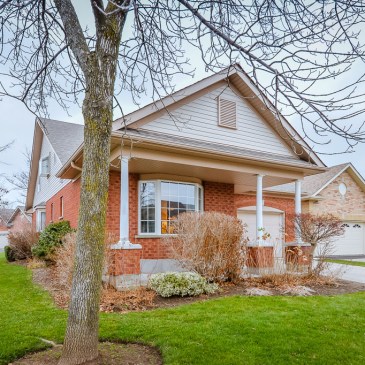
We’ve been here two months next week. Here’s what I love about the new house.

front3

  1. Its location. I’ve written about this before, so I’ll keep this short. I can walk or bike to the university’s arboretum, which alone gives me a 6 km walk if I do the perimeter paths alone, and a lot more if I wander the interior trails…and it’s an easy connect to the city’s multi-use trail system, which takes me downtown, or up to the big north-end park, or further out to the lake. Or along the river system, east, west, or north. I can also walk or bike easily to grocery stores, two butchers, a seasonal local-produce stand, and all the shops and services I could want.
  2. The recreation centre that’s about 250 metres away. Which includes a 25 metre pool, where I’m learning to swim again; a fitness centre, an excellent library, billiard rooms, bocci and tennis courts, concert and theatre venues, and lots of other activities to participate in, should I choose to.
  3. Air conditioning! It’s a hot and humid summer. The previous house didn’t have air conditioning; it kept cool with huge old shade trees and windows open at night, but it would have struggled this summer. We use it judiciously, but we appreciate having it here.
  4. The natural gas barbecue. No propane tanks to buy and change and take back. We’ve barbecued more here in the last month than I think we did in the last house in the past five years. (This is related to reason 6, too.)
  5. New construction. Our previous house was built in 1911. This one was built in 1998. Its windows fit, its doors fit. Floors are flat. It has good insulation. I dusted today for the first time in two months, whereas the old house – well, you dusted, and a few hours later you wondered why you’d bothered.
  6. No mosquitoes! OK, it’s a very dry summer. But it hasn’t stopped the mozzies at the other house, which is rural and in an area with a lot of maple swamps. Here, there’s the occasional one, but I can go outside to pick herbs and tomatoes without insect repellent, which wasn’t the case before.
  7. The city it’s in. I’m hugely biased: I lived here for sixteen years, between 1978 and 1994, before we moved a bit further south to make our commutes do-able. I always wanted to come back – but there was good reason for that. I’ve talked about the trail system, but to that I can add beautiful parks along the rivers, a good arts centre, one of the best bookstores in the world with welcoming writers’ community, some wonderful old architecture, the university’s library, music performances and theatre, the year-round farmer’s market, the best-behaved off-leash dogs I’ve met outside of Paris, and a strong local-food movement. All the things that make a city livable, for me.
  8. The community-within-the-city. Friendly, welcoming neighbours who balance that friendliness with respect for personal space and choices about lifestyle and involvement in community activities.

The biggest thing we’ve had to get used to (again) is paying for water. We’ve been on our own well for the last twenty-two years, and while we were always careful during other drought summers, the water was, essentially, free, although of course there was pump maintenance and replacement, as well as water-tank replacement in those years, and the electricity to run the pump. (Sometime I’ll do the arithmetic on that and see which one was, in the long run, more expensive!) Here, not only do we pay for water use, but we are bound by water restrictions – the city uses groundwater, and in a dry summer like this one we are limited to which days and which hours we can water flowerbeds; lawns are out of the question. I have no problem with that at all – essentially it’s no different than what we did with our own well. I’m not complaining about either paying for water (we should) or the restrictions (necessary and responsible): it’s just the one thing that wasn’t on our radar for the last twenty-two years.

So, when people ask me do I miss the old house, the honest answer is no. It was time to move. I’m glad we did.

Changes

It’s been a while since I posted anything, and that’s because life has moved very quickly in the last three weeks.

One of the things our two months in England confirmed for us was that we want to live somewhere where we’re less dependent on the car to run errands.  The second thing was that we could quite happily live in a bungalow, and the third was that we really liked not being responsible for the lawn and garden.  We’d thought it was time to leave this old two-storey rural house, with its quarter-acre of lawn and garden, 10 miles from anywhere: what England told us is that we were right.

We always said we’d move before it was too late, when we could make the choice. We came home, spent some time wandering around neighbourhoods in the university town north of us that we know well and love.  We narrowed it down to two, and then to one.  And yesterday, we bought a house.

It’s not quite a bungalow, in that it has a bedroom and ensuite on a second floor, but we don’t need to use those except for guests, or, for the foreseeable future, as BD’s study.  It’s a 10 minute walk to the university’s arboretum, for walking and birding; a 15 minute walk (or 5  minutes on the bike) to the university library, where I like to work, a ten-minute walk to a grocery store, on quiet back roads. We can bike downtown, to movies, to lunch, to the arts centre, to the bookstore, to the summer outdoor concerts.

While we own the house, and can do what we like with it, indoors and out, we don’t own the land it sits on: the university does.  So we pay, effectively, condo fees – and for that we get the lawn and garden taken care of, the snow ploughed and shovelled to our front steps, and the use of a large and well-equipped recreation centre. Or, as BD put it yesterday, to be permanently on vacation.

It’s ours in just less than two months, assuming all goes well with the inspection and the bridge financing – we have to get the existing house on the market, but there’s a bit of work to be done yet.  The new house needs its interior walls painted and a few other cosmetic bits and pieces.  One thing for sure, this adventure over the next couple of months – as we try to do this as mindfully as possible, fitting what we already own into the new house, figuring out what we really need (like a new bed), disposing of what we don’t – will give me plenty to write about!


Lifelong Learning

I am sitting in ‘my’ study carrel at the university, the one I’ve been using on and off for thirty-something years.  Today I noticed some new(ish) graffiti on one side: ‘Today is my last day in the library EVER’.

How sad I find this, because it implies to me that the person who wrote it finds learning, books, and study a chore, or worse than that, just something to be endured so that real life can begin.  I’ve come to the library today not to write, as I often do, but to check out books, something I’m allowed to do as an alumna, and these are books I need for my new course.  While learning and books aren’t my whole life by any means, they remain – even thirty years after graduation from university – a hugely important part of it.

I am unbelievably excited about this new course – The Archaeology of Landscape I, offered through the University of Exeter Distance Learning program.  Unlike the two I took last fall and winter, this one wasn’t free, so I had to really think about whether or not I wanted to spend the money (and time) such a course requires.  But it really wasn’t that hard a decision.

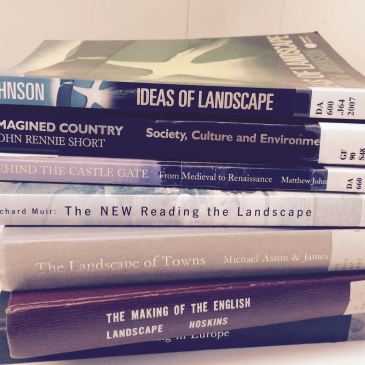
And now I’m looking at a pile of seven books to be read for the first three weeks of the course.  They have titles like “Ideas of Landscape” and “Imagined Country:  Society, Culture and Environment”. I can imagine what most of you are thinking!  But for me, this is feeding a deep need.

And that’s what the best learning is about.  Don’t turn your back on it, just because school and university were perhaps not quite what you hoped.  I can remember being less than impressed with some aspects of my graduate program and quite a few of my undergraduate.  High school was worse.  Then I taught, and was less than impressed with some of what the curriculum required.  I did my best to make it relevant and interesting, but it was a hard go sometimes.

But now I am (again, as I did last fall) learning for the love of it, learning things that will change forever the way I see my world.  Someone (maybe George Bernard Shaw?) said once that education is wasted on the young. I don’t agree with that, but it is certainly not the sole province of the young.  My father was telling me of new things he’d learned through reading and documentaries to within a few weeks of his death at 98.  I hope, very much, to emulate him.

Serendipity

As I’ve written earlier, I don’t buy a lot of books any more, for reasons of both economy and a concerted effort not to buy what I don’t need. Libraries provide me with most of what I read.  But I will buy a book if I need it for research, and I can’t get it any other way, or, it falls into a category I call ‘contemplative books’:  books I will read several times, books that make me think about my relationship to the world.  Mostly these are books like The Wild Places, by Robert MacFarlane, or Four Fields, by Tim Dee, thoughtful, insightful books written about the relationship between nature and humans.  Mostly British, as this is the country I love best of all the world.

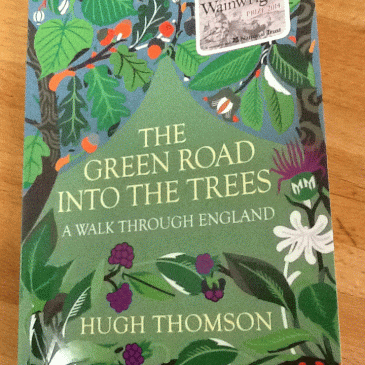
So when Amazon.co.uk sent me their most recently generated list of ‘books recommended for me’, one stood out.  (By the way, I don’t understand the algorithms they use, but they get it right 95% of the time.  I want to buy almost all of them.  I resist.)  The Green Roads into the Trees:  A Walk through England, by Hugh Thomson, ticked enough of the boxes. My libraries didn’t have it  and weren’t interested in getting it – too specialized.  I was pretty certain I would read it more than once.  So it became one of the rare books I bought.

I was busy, so I didn’t look at it for a few day after it arrived.  But when I opened it….call it grace, call it serendipity…but it ticked a box I hadn’t realized it would.  The book is about the author’s walk from Dorset to Norfolk on an ancient trackway called the Icknield Way, a route and an experience I need to research, not for the Empire’s Legacy series, but for another novel which is in the very early planning and research stage.  I was absolutely delighted. And if I know the way of things, there is a good chance that somewhere in this book there will be a line, a comment, that will inform and change that novel in a way I can’t foresee, if I read mindfully, open to what it has to tell me.

This is a shared (and slightly modified) post from my writer’s blog. I don’t plan to overlap the two very often, but this one I felt was appropriate.  

The Love of Libraries

As both a writer and a reader, I love libraries.  I learned to read at a very early age, thanks to my retired-teacher grandmother, who lived with us.  Money was scarce and there was no bookstore in our tiny little town, but there was a library, remarkably well-supplied for rural Ontario.  I read my way through the children’s section, and at about eleven, switched to the adult books. This wasn’t allowed – I was far too young – but my mother fought for my right to read what I wanted, and won.

In high school we swapped books around in a small group of geeky science fiction and fantasy fans, and I read Verne and Lovecraft and Eddison as well as Tolkien and Dunsany and Lewis. Somewhere in my late teens I learned libraries would order books for you, if they didn’t have them, and this opened up another source of new worlds and new thoughts. I read the Beat poets and writers, and Kesey and Tom Wolfe, and Toni Morrison and Alice Walker – new voices for me.  Then I went to university – on student loans and summer wages – and discovered used bookstores, where I spent far too much money.

Meanwhile I continued to use local libraries, reading four or five books a week, fairly indiscriminately.  I’d stopped using the hold or request functions, though, because if I really wanted a book and it wasn’t available, or, I saw one and liked the cover and the blurb, I just bought it.  Bookstores were a destination most weekends, and I rarely came away without at least one book, and as we moved from undergrad to grad school, and then to working, and disposable income increased steadily – I (we, actually) bought more and more books.

During this time, I also came to appreciate the library – in this case the university library – as a place of calm and quiet, a place where I could write.  First my M.Sc. thesis, written on the exceptionally quiet fifth floor, and then, over the years but in the same place, other works – poetry, short stories, and quite a bit of my first novel.   It’s also the same floor and  the same study carrel where I’m writing this blog right now, and where frequently I’m working on Empire’s Hostage, the sequel to Empire’s DaughterIt’s a space both low on distractions – no cats wanting attention, no husband commenting on the game he’s watching, no house or garden chores nagging at me – and high on acquired discipline.  When you’ve been writing in one place for thirty years,  habits of productivity are reinforced by the environment.

While I was working, I only used the university library on weekends.  What little bit of writing I did do during the working week was done at home in my study/library, but in comparison with the university setting I found it hard to work there, even when I was alone in the house.  Gradually I came to realize that the visual distractions in my study – mostly the overflowing shelves of books and the piles of papers on the desk – were in complete counterpoint to the spare and organized university space.  All those books were working against me, love them as I did.  So we culled, donating to book sales, and I moved papers into files on the shelf space freed up.  Suddenly I had a home environment much more conducive to work. (If you are interested in my writer’s blog, please visit it at https://marianlthorpe.wordpress.com/).

But I need new books, for research, for pleasure, for contemplation. Slowly the shelves began to fill up again….and then we retired early, and our income fell by sixty percent.  I looked at what we spent on books each year, and blanched.

These are our book buying parameters now:  first, see if it’s available from the library, including interlibrary loans and purchase requests.  This works about 80% of the time, although there is often a considerable wait.  I once hated waiting for books; now I appreciate the anticipation, the pleasure or learning I know is going to come.  If the library doesn’t have it and can’t get it, look for used, especially on-line when it’s a book I need for research.  Again, waiting a few months often yields the book from these sources.  But if all else fails, and either of us are absolutely certain the book is needed for research OR that it will be read multiple times, as I do with books I buy for contemplation – then it is bought.

And the books I used to buy on impulse, because I liked the cover?  Now I pick those up from the new book shelves at the library.