Raking Leaves

The winds that brought in a cold front a couple of days ago also brought down almost all the leaves hanging on to our two Norway maples. Norway maples – Acer platanoides – have, as their scientific name indicates – huge, plate-like leaves, and they don’t decompose easily. I have a couple of choices – I can rake them onto a tarp, and move them to the edge of the maple swamp behind us, in a (useless) attempt to smother the goutweed that someone planted there, long before our tenure in this house. Or I can mulch them into small fragments, and leave them to enrich the lawn. Burning isn’t an option – that requires a burn permit (if you’re at all law-abiding, anyhow) – and on our small property there is nowhere that meets the criteria.

I choose to mulch them into the lawn with the electric lawnmower. But first I have to rake them away from the porch, and the shrubs, and the garage doors where the wind has pushed them. It’s a cool last day of October, and this is just the right thing to be doing. Last year I was still on post-surgery restrictions, and the years before that I was working, gone from the house from dark to dark, and it seemed to rain every weekend. So for some years a landscape service has taken care of our leaves. But this year, it’s all mine, and I’m reveling in it.

I rake the leaves onto the front and side lawns into more-or-less even drifts, and plug in the mower. I start with the mower set at 3 1/2 inches, and go over the leaves, dropping the mower height down as the leaves are chopped. Across the road, a neighbour with a much larger property is burning hers: the smell takes me back to childhood, when we all burned leaves: the scent of fall.

It takes me about an hour and half to do the front and side lawns, clean the mower, sweep bits off the driveway and the walks. The leaves have been reduced to tiny fragments that will decompose easily, returning their nutrients to the soil, feeding earthworms and micro-flora, strengthening the grass and clover that make up our lawn.

There is something that just feels right about taking care of what we own ourselves, instead of paying a service to do it. I draw the line at the highly specialized or dangerous (BD and I are having a debate about our very tall chimney, which needs repointing. I think it’s too tall for him to do; he thinks otherwise. I point out we only re-shingled the one-storey additions and the garage ourselves, summer jobs, and left the high roof of our three-storey house to the professionals. And the chimney is higher than that roof. He’s ‘thinking about it’.) But raking leaves, cutting the grass, pruning…and inside, cleaning, painting, repairing….I like doing these, and they connect me to my house and my garden. I prefer to be a steward, with all the responsibility that implies, than a occupant, leaving the responsibility to others. Too often, in our working days, we felt more like occupants, renting services to keep the place going.

It rained heavily last night, so I can’t mulch more leaves today. I’ve still got twice as much to do – the other side lawn and the back, the the leaves from one Norway maple and a host of other, smaller-leaved trees – but that’s ok. The weather is promising to be warm all this coming week (unseasonably so, actually) and I have the time now. I’ll wave at neighbours, chat over the fence, watch the chickadees completely ignore me as they go back and forth to the feeders. What better way to spend a sunny, early November day?


Old, Cold Houses

Yesterday it rained all day, heavily, the last gasp of Hurricane Patricia reaching up into the edge of Canada. Today the winds blew hard, gusting to about 90 km/hr, bringing a cold front with them, and stripping most of the remaining leaves from the trees.

Parts of the house are cold tonight.  A four-square built in 1911, it’s grown a bit from the original; a summer kitchen renovated to a rec room in the sixties; the attic made into living space sometime earlier than that; our own addition of a sunroom.  Insulation didn’t exist originally and was minimal when added sometime later.  The windows aren’t quite sealed.  We’ve added pink fibreglas and vapour barriers in all the places we’ve stripped the walls down to the beams, and in the new sunroom.  The rest of the house had insulation blown into the walls a few years ago.  It helps.  It doesn’t make the house completely airtight, and on a day like this, bits of it are cold.

We’ve grown used to this, over the years.  We wear fleece-lined slippers, and layers of warm clothes. There are throws to snuggle into on the couch of an evening.  I have tea after dinner, reading or watching television.  The new high-efficiency oil furnace (no other choice except electricity, where we are) chugs away, doing its best.

All the heating to the bedroom floor is by convection, open grates in the floors and the wide staircase allowing heat to move upward.  Now we’re both home all day, the bedrooms are much warmer than when we were working, and had the thermostat turned down when we were out. We’re still adjusting to that, both of us liking cold bedrooms to sleep in.  I do wonder how the grandmother who slept in the attic survived, though – it’s just plain COLD up there – no heating at all, ice on the windows in the winter, damp in the spring and fall.  I suspect pneumonia carried her off.

We bought the house from a woman who had been born in it, about seventy-five years earlier.  She told us how the pipes use to freeze in the kitchen, unless the cupboard doors under the sink were left open in the winter. How the drains out to the dry well and the septic tank would freeze, too. The house wasn’t built with a bathroom; it came later.  I imagine going out to the privy on a cold winter’s night, or bathing in the kitchen in a tin tub.  We may only have the one bathroom, and when the winter wind is from the northwest prepare to shiver if you forget to turn the electric heater on – but luxury compared to that.

And that is what I am thinking about, this first windy, cold night of the fall.  What exactly do we need, and when does more become, in the words of a Monty Python skit, “bluddy luxury”? We could warm the house more – it would be simple:  turn the heat up, and turn more of the electric space heaters on. But not only would that cost us money, it would produce more greenhouse gases, more climate change, more pollution. Just because we can have something, should we? Doesn’t the attitude that says ‘sure, have more’ lead to obesity, metabolic disease, debt crises, foreclosures, addiction, and all the sins and symptoms of our material world?

Perhaps that’s an advantage of an old, cold, house.  It makes you think.

Kitchen Gadgets I Wouldn’t Want to be Without #2: The Stick Blender

The simple stick blender is a gadget I use almost every day. In the last two days, it’s been used to make smoothies, blend a roux into chicken broth to thicken a stew, and transform left-over roast vegetable salsa into pasta sauce.

I often don’t use electric appliances – I own a hand-held mixer, but usually I mix cake or cookie or muffin doughs by hand, with a solid dinner fork. I might as well use a few more calories up before I eat what I’ve baked! But blending is a different thing.

My sister gave us a traditional blender as a house-warming present the year BD and I moved in together – 1979 – and we still have it. BD uses it to make hummus weekly, and I use it occasionally, but the stick blender has replaced it for most uses. It’s just simpler, and easier to clean.

I’m on my second one. The first one I bought was bottom-of-the-line, inexpensive, since I wasn’t sure how much use it would get. Eventually it burned out – but not immediately – so I bought a better one. Two in fifteen years isn’t too bad!

Here’s how I transformed the salsa to pasta sauce – I’ll start with the salsa recipe, full of local, seasonal vegetables bought at the farmers’ market on its last day for this year.

Roasted Vegetable Salsa

2 red peppers

2 small eggplants (about 3 inches each)

1 medium zucchini

6-12 garlic cloves, depending on how much you like garlic

1 small onion

10-12 grape/cherry tomatoes, preferably roma type

1 cup finely diced butternut squash

1/2 c olive oil

2 Tbsp balsamic vinegar

rosemary

basil

oregano

sea salt

black pepper

1/2 c feta cheese

Preparation

Peppers: seed and dice finely

Eggplant: peel and dice finely

Zucchini: dice finely

Garlic: peel and dice finely

Onion: peel and dice finely

Tomatoes: dice finely

Squash: peel and dice finely

Toss diced vegetables with olive oil and spices and spread on parchment paper on two cookie sheets. Roast at 360 degrees F for 30 minutes. (A higher temperature than this destroys much of the goodness of olive oil.)

Add 1 Tbsp each of dried rosemary, basil, oregano, and 1 Tbsp sea salt, and 1 tsp coarsely ground black pepper, plus the 2 Tbsp balsamic vinegar. Mix well. Adjust seasonings to taste and add more olive oil if desired. Let sit at room temperature to blend flavours.

Just before serving, add 1/2 c feta cheese. Serve with crostini.

This makes about 3 cups. I had just over a cup left over.

To make pasta sauce:

Add 1 c chicken or vegetable broth, preferably low sodium as there is a fair bit of salt in the salsa. Bring to a boil gently. Cool somewhat, and blend in the saucepan with a stick blender.

This gives you a creamy, tangy pasta sauce. Use as a vegetarian sauce with more cheese if desired, or, add ground chicken, turkey or whatever you like.

Now, those of you who follow this blog know that BD is allergic to all dairy. So I actually made two versions of this, one with feta and one without, and did this sauce twice: both worked well, but I would definitely add ground turkey or spicy turkey sausage to the dairy-free version for protein.

Hint-of-Chocolate Pancakes: an Improvisation

Today BD and I had an appointment in the city forty minutes to the west of us at twelve noon. So we decided to have brunch before we went – pancakes and sausages. A good idea, until I went to the freezer and the pantry this morning.

Problem #1? No small containers of soymilk, which I have to use in place of cow’s milk in the pancakes because of BD’s allergies.

Problem #2: No breakfast sausage. Just spicy turkey dinner sausages.

We live 10 miles from town, so it isn’t just a matter of running out to pick things up. But, ok, it’s brunch, spicy dinner sausages will do. But the pancakes? I had two choices: water, or the chocolate soymilk BD drinks. Chocolate pancakes? Why not!

Actually, they were quite good. Just a hint of chocolate, along with the blueberries I always add and the maple syrup on top. Here’s the recipe, in case you want to try it yourself. (I would add walnuts as well, if BD wasn’t allergic to them too!)

Hint-of-chocolate Blueberry Pancakes (recipe makes 6 pancakes)

¾ cup all-purpose whole wheat flour
¾ tsp baking powder
½ cup blueberries (or any other fruit you like – raspberries would be good!)
1 c or a little less chocolate soymilk or milk
1 egg
2 Tbsp light oil – I use safflower.
Mix together the whole wheat flour and baking powder. In a separate cup, mix the egg, soymilk, and oil. Blend the two together, adding more soymilk if necessary to create a fluid batter. Add the blueberries.

Cook on a hot griddle or lightly oiled frying pan until bubbles show throughout the pancake and the top surface looks slightly shiny and set. Flip and cook for another minute or two.

Serve with your preferred toppings – ours is warm maple syrup!

What improv pancakes have you made?

Budget Check!

It’s the first of the month, the day I add up and analyze all the expenses that I entered into the spreadsheet all of the previous month. And because it’s the 1st of October, it’s also time to do a larger analysis, which I do every three months.

Let me preface this by saying I pretty well made up our budget: the numbers I assigned to categories other than fixed expenses were fairly random, my gut feeling on what we had been and should be spending. It turns out I was right on the money (forgive the pun, it was unintended) on some things, and out to lunch on others.

Here’s where I was right (defined as being with 10% of the average monthly expenditure): car maintenance (not gas); the cats; clothing, health – over-the-counter drugs and anything our drug plan doesn’t pay for – and holidays.

What I overestimated: lawn and garden expenses, and, house repair and maintenance. Given we’ve been doing a fair bit of house renovations this year, this latter one surprises me – but it’s mostly been cosmetic, and paint just doesn’t cost that much, I guess.

Now for what I underestimated – the longest list!

Car running expenses. This one surprised me, since we’re not commuting to work any more. We live in the country, so all shopping, library visits, movies, etc., mean a drive. I didn’t realize how much of this I did on my way home from work before, trips that now entail driving to town. I need to get better at consolidating trips!

Charity: well, we should be giving more than I had budgeted, so this one is a good thing.

Entertainment: twice what I had budgeted. But we like going to movies…and the occasional play. Expensive rural internet means Netflix or its competitors isn’t an option. Hmmm.

Groceries: we choose local and sustainable over cheap for meat, fruits and vegetables. It costs. BD’s allergies also mean some specialized foods that are also expensive. I try to make up for it by buying other things at NoFrills, but I don’t think I’ll ever get the monthly expenses down to what I thought I could.

Household: this was a catch-all for anything that wasn’t health and wasn’t groceries, like a new broom or picture hangers. I’m surprised by how high it is, given that we try not to buy much. A surprisingly high portion of it is fees: drivers’ license renewal, memberships, credit-card renewal fees (worth it, though, because we use our air miles frequently).

And then there is Miscellaneous – which differs from Household in that it involves things like haircuts and pedicures and anything else that didn’t fit anywhere else. I probably should just amalgamate these last two.

Our variable expenses are running about 20% higher overall than I thought they would. Now, this isn’t a huge problem – we’re still spending less than what is coming in, but it’s not leaving us with as big a cushion as I would like, and, because we only retired in the spring, the tax withheld from our pension cheques probably is underestimated, which means we’ll be paying a chunk of income tax in the spring. Once I see how much that is, I’ll have the pension deductions adjusted appropriately so it doesn’t happen in another year. BD turns sixty this month, so he starts receiving a small government pension in November as well, which will also need considering when it comes to tax time.

The completely flexible piece in our budget is the holiday spending. If I take that line out of the budget we’re spending about 70% of our net pensions, so overall I think we’re doing fine. We’re not touching our registered retirement savings plans, or our other savings, at all, and we have no debt. There were a lot of raised eyebrows and voiced concerns when I chose to retire two years early, reducing my potential pension by about 20%, but I was fairly confident we could do it. So far, fingers crossed, it looks like I was right.

Words to Live By

Not all of us can do great things. But we can do small things with great love.

This quote, apparently wrongly attributed to Mother Theresa, remains one of my favourites.  It doesn’t matter who actually said it – it remains a valid and validating statement.

I can’t, for example, paint a masterpiece.  But I can create art for handmade birthday cards, the image usually one I think will have some extra meaning for the person receiving it.

I will never write a best-seller.  But my first novel has been enjoyed by quite a few people, and has been well reviewed.

I will never be a master chef, but I can create meals from scratch that are enjoyed by friends and family.

I am no design guru or master renovator, but I have mudded and caulked and painted and wallpapered and laid tile with care to help create a home we love.

At the end of my career I received a provincial award for contributions in my field of education, completely unexpectedly.  I had never done anything huge, just a lot of small things over many years.

In a recent article in the New York Times, OpEd writer David Brooks asked readers how they found purpose in life.  He writes  “a surprising number of people found their purpose by… pursuing the small, happy life.”

Small things with great love.  Words to live by, at least for me.

Dreaming of Soup

It must be fall.

I woke up this morning from a dream about making soup. Italian wedding soup, to be precise. Of course, I’m craving it now, but as I have none of the ingredients in the house, and no trip to town planned for today, it will have to wait a day or two.

I don’t usually dream about food, but I think a number of factors came together to produce this dream. I was planning menus yesterday, and thinking about making soups for lunches, now we’re home all day. I have either a doozy of a cold or the worst fall allergies I’ve ever experienced – can’t tell which, as my nose is running like an open tap but I have no aches, pains, or lack of energy – so there’s an association with soup as a comfort food. Plus, I actually did make soup yesterday.

While I was away, BD bought the biggest cauliflower he could find, on the basis he didn’t need to buy any other vegetables. (This is the man that eats the same thing every day for breakfast, and another ‘same thing everyday’ for lunch, unless I intervene.) Half of it was still left when I got home Tuesday. We ate part of it in a frittata, but there was still a chunk left, so I looked around for what else we had – potatoes, half a box of frozen vegetable broth, garlic, onion. Definitely enough for soup.

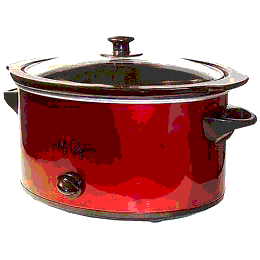
Some years ago I bought myself a second slow cooker, a small one. Except ‘slow’ cooker is the wrong term for this device: it’s a fast cooker. The chopped cauliflower and potato, frozen broth, and garlic was boiling within an hour on high, and then simmered away for another half-hour or so until I could first mash it, and then use my stick blender to puree the mix. I adjusted the seasonings, added cumin, and voilá! -today’s lunch. I’ll turn the ‘fast cooker’ on soon, on low, and bring it back to a simmer, and eat it for lunch with sourdough toast and a sharp cheese for me, and hummus for BD.

And tomorrow when I go to town, I will buy what I need to make Italian Wedding Soup (with chicken or turkey meatballs, for BD’s allergies). I suspect the ‘fast cooker’ is going to be out on the kitchen counter most days now, as the bite of fall sharpens the air, and good long fall hikes sharpen the appetite.

What are your favourite soups? Do you have recipes to share?

Senior’s (and other) Discounts

Am I a senior?  Well, that depends on whose definition you use.  For some organizations – the American Association of Retired Persons (AARP), for example, it’s 50, so I certainly am.  For some other places, it’s 55, so again, I am.  Sixty is quite common, and sixty-five remains the norm in some place, and I haven’t got there yet!

Due to genetics and nothing else, my hair is still 95% brown at fifty-seven. I had it cut yesterday, and was not offered the senior’s discount! (I don’t qualify, there.)  BD’s had grey hair since his 40’s, and now is almost pure white at fifty-nine.  He gets senior discounts everywhere, no questions asked, so he does the shopping at the bulk food store that offers 10% for seniors on Wednesdays, and the pharmacy that does the same on the last Tuesday of every month.

When we retired, we bought supplemental health insurance – it covers dental and opthamalogical costs, travel insurance, and drugs, plus health services such as physiotherapy and orthotics – and along with that came membership in group that provides discounts on items ranging from fitness club memberships to rental cars.  I’m heading west in a week with a cousin from the UK, to spend ten days in the Rockies, so I thought I’d check it out for the hotels and rental car.  It turned out to be definitely worth it for the rental car, saving me thirty percent of the next-cheapest price I could find through Expedia, Kayak, or anywhere else.  For the hotels, not as much – you’re limited to the ones that participate, which aren’t always in the locations you want.  I’ve used it for one or two sites, but am falling back on the discount offered to Automobile Association (CAA in Canada) members in most places.

Even little things add up.  The buy-ten-coffees-get-one-free cards offered by many coffee shops doesn’t sound like much, but if you get a $2 coffee free every second week, that’s $52 you save over the year.  Which can buy you a reasonable dinner out here at a small bistro.  Gas at the south end of our closest town is generally five cents a litre (twenty cents a US gallon) cheaper than it is at the north end; again, it’s only a couple of dollars at most every fill, but that’s another $50 to $100 a year to spend on something else, and if I use my gas station loyalty card to gain points at every fill-up, I can exchange it for an even greater discount on gas.  But even better is gas at Costco, which is generally ten cents a litre (forty cents a gallon) cheaper, and makes the cost of the membership worthwhile. And as it’s directly across the street from a grocery store I visit once a week, it’s not out of my way.

In Canada, automobile insurers are required by law to offer a discounts to “retirees aged 65 or older, and to younger retirees too, if they are receiving a Canada or Quebec Pension or a pension registered under the Income Tax Act.” so we qualified for that.  Banks, too, offer a reduction in service fees (or waive them completely) for older customers – it appears to vary from bank to bank, and they don’t necessarily advertise it, so ask! I did, and it saved us $132 a year.

Many chain restaurants, from McDonalds onward, have senior’s deals or senior’s meals. I’ve been ordering senior’s meals on road trips for years, since they are almost the only thing on the menu with a reasonable portion size at most chains.

I’m learning just to ask if a shop or service offers a senior’s discount, and many are happy to offer it to me just because I asked.  If they stress the age limit, I’m honest and say I do or don’t qualify. It’s a new mind-set, and like all new things is taking a while to learn, but it’s well on it’s way to becoming a habit.

What senior (or other)  discounts have I missed?   Please share!

Lessons from “Doing it Ourselves”

BD and I started off our relationship with very different skill sets. He had helped do the wiring in his newly-finished basement when he was fourteen, and a bit later helped his parents build a cottage, starting with clearing the lot and ending with the finished cottage. I could cook, sew a bit, and grow just about anything. For my father, horticulture was both a vocation and one of his avocations, and I was helping him in the garden when I was no more than three. I could also hang wallpaper. That’s pretty well where my hands-on skills ended.

When we were first together my lack of construction skills frustrated BD. I didn’t know the names for tools, or how to tell a Robertson screwdriver from a Phillips. (Mind you, he didn’t know a Dutch hoe from a cultivator, either, or a zucchini from a pepper.) But we persevered through two fixer-uppers, and I learned to lay tile and use a caulking gun; to strip hardwood and patch plaster. He’s learned I see the steps in a project better than he does, and can both create the workflow for the job, and be creative when we run into problems. On top of that, I’m ambidextrous with both a hammer and a paintbrush, and can lay roofing shingles better than he can.

We’ve learned to be mindful of each other, respecting knowledge, listening to each other even when the correct vocabulary isn’t necessarily being used. We know each other’s limits, both physical and mental. I know I have to paint ceilings, because it hurts BD’s back too much to do so. He knows I can’t work over my head with an electric screwdriver.

Doing the work ourselves has also increased our sense of belonging in, and to, this house. We are familiar with every square inch of it, from the basement crawl space to the attic rafters. We’ve seen it naked, stripped to the pine beams that run from foundation to attic. We’ve heard it groan when basement support jacks are moved. We’ve patched its wounds and learned its secrets: the burned beams in the old summer kitchen from a stove fire; the potato store uncovered under the kitchen floor when we stripped the old linoleum. We know where the coal chute was, and the original well, and where the stovepipes ran.

The house belongs to this village; it is built from local trees, sawn and finished at the village sawmill. Its foundation is of local fieldstone. We were the incomers, to a house that had been in one family for seventy-five years. But twenty-one years later, we belong here. We’ve earned that belonging in part by respecting our old house. The woman from whom we bought it had been born in the big bedroom upstairs. She wanted to sell it to someone who would love it, not tear it down and build a new house, and when we invited her back to the housewarming a few months later, she was so happy with what we had – and more to the point – hadn’t done to it. We’d respected its character, and that was important to her, and by extension to the village. Without her approval, we’d never had been offered the hundred-year-old cedar rails by the retired farmer down the road; he’d heard we wanted to build a fence, and said they were ours for the taking if we wanted to pull them out of the fence-rows. Our local chimney-sweep and furnace man told us never to worry about our old wonky furnace going out if we were away in the winter; he’d drop by every day to make sure it was on; he knew the furnace well, and he’d been told we were taking good care of “Doris’s” house.

Now when I walk to the community mailbox, or down to Rose’s for a coffee, or on any of my local walks, it’s the people working on their houses I am most often drawn to stop to talk to, the ones with tools in their hands and sweat dripping. I know it’s not completely fair: I know not everyone has the skills, and that employing others to do work for you is important for the economy. But I’m glad there are still young couples who are doing it themselves. Because I do not love the bathroom we contracted out nearly as much as I love the kitchen we tore down to the bare beams and built up again completely by ourselves; nor do I love the floor someone else laid in the sunroom the way I love the old hardwood I scrubbed and sanded and finished in the long living/dining room. There are memories that go with building that kitchen and sanding that floor, that are part of our journey to understanding and respecting not just this house, and not even our place in this community, but each other.

Looking at Advertising

Hot and humid weather meant I did my walking indoors last week, at the local shopping mall. While it doesn’t have an organized early-morning mall-walking club as some do, its doors open at 6:30 a.m. due to the presence of a fitness club on the lower level, and people are free to walk the enclosed and air-conditioned space any time after that.

I entertained myself during my walks by thinking about the advertising that is, of course, splashed everywhere – it is the job of stores to get you to spend money, after all. And at one level I don’t have a problem with it – I can’t, given that I do it myself with regard to advertising my young-adult novel (which you can currently download for free as a promotion – details here). But it’s still interesting and instructive to look at how it’s done.

The advertising fell into one of three broad categories: the straightforward: e.g., 50% off all summer styles; the not-quite straightforward: BOGOs (buy one get one for x% off) fall into that category, in my opinion, and the ‘lifestyle’ inducers (We Sell Adventure). Straightforward descriptive advertising I have little problem with, and I’ve taken advantage of many of those sales myself in the past. BOGOs need a little more analysis.  Buy one, get one for 50% off seems to be the most common now. And it’s fine too, as long as you went shopping meaning to buy two of something, but if it induces you to spend half again as much as you had planned, or, to buy two of something when you only needed one, then you’ve fallen for their advertising. Even more insidious was this one: “Buy more save more.”  Think about it.  You cannot save money by spending it. Deconstruct that ad carefully. If you really need three new backpacks for the kids for school, and the deal is 50% off the second one if you buy two, and 70% off the third one if you buy three, then it’s worth considering. But only in that type of situation. It’s not worth it when it induces you to buy three skirts when you went to get one, and the other two don’t match anything in your wardrobe.

One store had an interesting twist on this. Inside the display windows was the banner for the BOGO – 50% off the second item. Painted on the display window itself, and overlaying the banner, was the “70% off selected items” ad. With all the other visual clutter in stores, to me this looked as if it was purposely designed to confuse, so that the consumer doesn’t remember which offer was which. Interestingly, this advertising belonged to a store whose clientele are more likely to be middle-aged or older (my age), and potentially less able to sort through the multiple, confusing ads. (I realize that’s a generalization, but it’s based on my own experience – the older I get, the more I can’t handle visual clutter.)

The ‘lifestyle’ ads are telling you that buying something will make your life more exciting or you more interesting. Alcohol ads are very good at this, and I’m old enough to remember that these were the primary means of selling cigarettes, so we know they work. But here in my urban shopping mall, these two caught my eye: “We sell adventure,” and “Amazing is in your hands.” The first one was on the window of a clothing store that sells casual clothing with a bit of a ‘northern’ flavour (whatever that means). They are not an outfitter for outdoor sports.  They are telling you, subtly, two things: one, the ‘right’ clothes make you more adventurous; two: that you need these clothes to fit in at the cottage or resort you’re heading to (or would like to look as if you were.)  Ask yourself how true either of these messages are.

Amazing is in your hands,” was – you guessed it – at an electronics store, pushing the newest phone or tablet. Now, I’m a techie person, and this house has two laptops, two iPADs, two iPhones, and one iPOD. But we also still use a VCR, not a PVR, and a DVD player, because they ‘ain’t broke’. The iPADs are a case in point: they are iPAD-2s, and they serve us well. Why would I buy a new one? – the one I have does everything I need it to, including being my primary writing tool when I’m travelling, and it’s considerably sturdier than the newer models. Some of what the newer technology does is amazing – but is it an amazing you need, want, or will use?  Much of what technology does is driven by the gaming market, and unless you’re a serious gamer, you probably don’t need it.

What I’m really saying is this: be conscious of how advertising is trying to get you to buy things you don’t need or actually even want, and, be very mindful of what it is you do need/want when you go shopping. Then use specials to their maximum.  When my health issues last fall meant BD and I needed a way to be in touch quickly, easily, and unobtrusively (he was still a classroom teacher at the time) I knew our new phones would have to be iPhones. BD had just learned the basics of using an iPAD, and he needed the phone to be effectively the same, or he’d abandon it; he is very easily frustrated by technology. I bought the phones Labour Day weekend in the university town, filled with specials aimed at returning university students, and knowing full well the newest iPhone model was due out shortly. The result was I got the phones – the soon-to-be discontinued model- for free along with the cell-phone plans I was going to buy anyway (having done my research, which had told me that bundling our new phones with our existing wireless and home-phone service was going to give us the best price.) So our iPhones aren’t the latest, but, honestly…do I know the difference? I can call, text, Google stuff, take photos and play Scrabble on it, and it reminds me to take my blood pressure pill. That’s more than enough.

I haven’t even touched on the even more subtle messages – the size and colour of the mannequins clothes are shown on; the overt sexualization of small girls in children’s clothing store ads; the co-opting of social justice messages to sell tween/teen clothing that may well still be made in a sweatshop. But if you’re looking for entertainment on a wet or cold or humid day, go to the mall….not to shop, but to deconstruct the advertising.  It’s quite a bit of fun..and educational.