Art, Tools, and Ice Cream

On Saturday, I biked the 4.5 km downtown to do three things:  go to the farmers’ market, enjoy ‘Art on the Street’, and drop a few small things off at the new tool library.

Our market is a year-round market, rare in Ontario, but it’s been a fixture of this city for over 180 years, and it has its own building.  In the summer it expands to the outdoors; in the winter, it shrinks.  Fair enough; there’s very little food grown here in the winter, outside of the greenhouse industry, but the baked goods and meats and cheeses remain.  I dropped in only to buy kamut wraps and toss coins into the guitar cases of the buskers, who never fail to make me hum along on a Saturday morning.

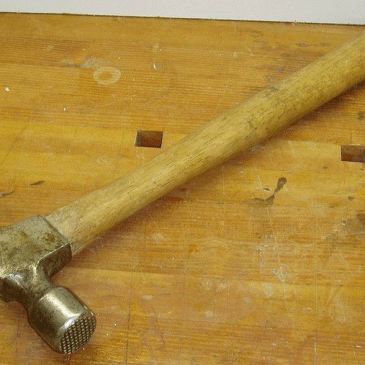
Then it was off to the tool library, a few streets over.  While not a new concept, this is a new initiative for our city. If you’re not familiar with the concept, it’s pretty simple:  if you need a tool, from rice cookers to cement chisels, from stock pots to a screwdriver, you can borrow it from the tool library. I’d first discovered them when I was looking for a place to donate my garden tools from the old house.  A volunteer had come to pick up that load – there were quite a few tools – but now I had a few more things to give them, things that fit in the panniers of my bike.

The space was functional but effective, and all the tools are being catalogued and bar-coded for inventory control.  In a city with a lot of students, its share of low income families, and a strong community ethic towards sustainable and cooperative living, the tool library is a logical addition.  I’m eyeing the tile-cutter in my basement now: I kept it as we consider what to do with the backsplash in the kitchen…but I could always borrow it back.

I left my bike and helmet locked to the rack outside the tool library, and walked over to Art on the Street.  One street had been closed off to house this annual, tented art display and sale, and the place was crowded, cheerful and noisy.  I wandered among the art for the best part of an hour, coveting but not buying a set of glass coasters from one artist,  a mug and vase from another.  Both ‘covets’ had a raven theme, which calls to me strongly.  I’m always torn at art shows:  I am trying not to buy things, to add to the items we own because we really don’t need anything.  I have a dozen coasters and more than a dozen mugs.  But on the other hand, as an independent artist myself…we need people to buy things.  Even when there isn’t financial need, there’s the need for people to appreciate and value the art we make, whether visual or written or aural.  I’m regretting the coasters, just a bit.

I finished off with a small cone of what might be the best chocolate ice cream I’ve ever had, from a small creamery that makes ‘small-batch’ ice cream from mostly-local, in-season product, before biking the longer-but-flatter river path route home.  In retrospect, I should have had the raspberry-rhubarb ice cream….but it’s Wednesday today, the summer Wednesday market will be on downtown; we’re biking down for an afternoon showing at the little rep cinema…and the creamery will be at the market, steps from the cinema.  What better way to fuel up before the ride home?


Good Fences

Good fences make good neighbors, Robert Frost wrote, in Mending Wall.  Between our property and the neighbours on both sides, a split-rail fence delineates the property lines.  We built the fence ourselves, getting on for twenty years ago, pulling the cedar rails out of the brush of an old farm at the edge of the village, gladly given to us by the elderly farmer. When the fence was done, he walked down one day to see them in their new incarnation. “Good to see them used again,” he said, of the old swamp cedar rails, probably even then well over a hundred years old.

But in a massive thunderstorm earlier this year, with drenching rain and high winds from the east, unusual for here, the young butternut that grows just at the edge of our eastern neighbour’s property shifted just a little, leaning into the fence, and took down three rails. Oddly enough, it didn’t break them: the steady pressure on the fence snapped the wire that held them to the posts. But they couldn’t go back up – the trunk of the butternut was in the way now.

We debated taking the tree down, but I really didn’t want to. Another young butternut, at the edge of the maple swamp behind us, also listed in the storm, but it straightened itself up within a couple of weeks.  I decided to wait. Yesterday, mulching leaves, I took a good look at the tree, and realized it had grown straight again, but from about five feet off the ground, meaning its lower trunk still was an impediment to replacing the rails.

BD and I brainstormed, and decided the simplest thing to do was to add a post directly beside the one north of the tree. This would allow us to run the rails from the new post to the existing one south of the tree, creating a slight zig-zag (or, really, only a zig). We throw almost nothing out in term of wood, so hiding down with the compost bins was a huge old post that had once supported the far end of the washing line. Cut down and wired securely to the existing post, it was the perfect size.

It took us about half an hour to fix the fence, on a glorious November day, sunny, very warm, no wind. Overhead ravens swore at and chased migrating red-tail hawks. The chickadees went back and forth to the feeders, ignoring us, joined by two species of nuthatch and two of woodpeckers. The squirrels – black and red – are happy to have their highway contiguous again, and neighbouring dogs and grandchildren have their limits back. Good fences do, indeed, make good neighbours.

Raking Leaves

The winds that brought in a cold front a couple of days ago also brought down almost all the leaves hanging on to our two Norway maples. Norway maples – Acer platanoides – have, as their scientific name indicates – huge, plate-like leaves, and they don’t decompose easily. I have a couple of choices – I can rake them onto a tarp, and move them to the edge of the maple swamp behind us, in a (useless) attempt to smother the goutweed that someone planted there, long before our tenure in this house. Or I can mulch them into small fragments, and leave them to enrich the lawn. Burning isn’t an option – that requires a burn permit (if you’re at all law-abiding, anyhow) – and on our small property there is nowhere that meets the criteria.

I choose to mulch them into the lawn with the electric lawnmower. But first I have to rake them away from the porch, and the shrubs, and the garage doors where the wind has pushed them. It’s a cool last day of October, and this is just the right thing to be doing. Last year I was still on post-surgery restrictions, and the years before that I was working, gone from the house from dark to dark, and it seemed to rain every weekend. So for some years a landscape service has taken care of our leaves. But this year, it’s all mine, and I’m reveling in it.

I rake the leaves onto the front and side lawns into more-or-less even drifts, and plug in the mower. I start with the mower set at 3 1/2 inches, and go over the leaves, dropping the mower height down as the leaves are chopped. Across the road, a neighbour with a much larger property is burning hers: the smell takes me back to childhood, when we all burned leaves: the scent of fall.

It takes me about an hour and half to do the front and side lawns, clean the mower, sweep bits off the driveway and the walks. The leaves have been reduced to tiny fragments that will decompose easily, returning their nutrients to the soil, feeding earthworms and micro-flora, strengthening the grass and clover that make up our lawn.

There is something that just feels right about taking care of what we own ourselves, instead of paying a service to do it. I draw the line at the highly specialized or dangerous (BD and I are having a debate about our very tall chimney, which needs repointing. I think it’s too tall for him to do; he thinks otherwise. I point out we only re-shingled the one-storey additions and the garage ourselves, summer jobs, and left the high roof of our three-storey house to the professionals. And the chimney is higher than that roof. He’s ‘thinking about it’.) But raking leaves, cutting the grass, pruning…and inside, cleaning, painting, repairing….I like doing these, and they connect me to my house and my garden. I prefer to be a steward, with all the responsibility that implies, than a occupant, leaving the responsibility to others. Too often, in our working days, we felt more like occupants, renting services to keep the place going.

It rained heavily last night, so I can’t mulch more leaves today. I’ve still got twice as much to do – the other side lawn and the back, the the leaves from one Norway maple and a host of other, smaller-leaved trees – but that’s ok. The weather is promising to be warm all this coming week (unseasonably so, actually) and I have the time now. I’ll wave at neighbours, chat over the fence, watch the chickadees completely ignore me as they go back and forth to the feeders. What better way to spend a sunny, early November day?

Words to Live By

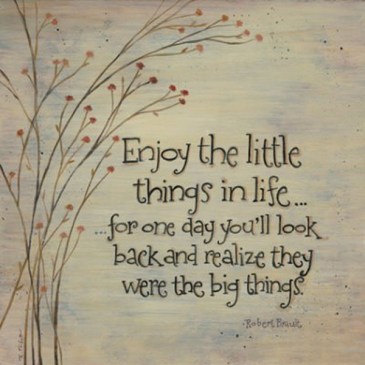
Not all of us can do great things. But we can do small things with great love.

This quote, apparently wrongly attributed to Mother Theresa, remains one of my favourites.  It doesn’t matter who actually said it – it remains a valid and validating statement.

I can’t, for example, paint a masterpiece.  But I can create art for handmade birthday cards, the image usually one I think will have some extra meaning for the person receiving it.

I will never write a best-seller.  But my first novel has been enjoyed by quite a few people, and has been well reviewed.

I will never be a master chef, but I can create meals from scratch that are enjoyed by friends and family.

I am no design guru or master renovator, but I have mudded and caulked and painted and wallpapered and laid tile with care to help create a home we love.

At the end of my career I received a provincial award for contributions in my field of education, completely unexpectedly.  I had never done anything huge, just a lot of small things over many years.

In a recent article in the New York Times, OpEd writer David Brooks asked readers how they found purpose in life.  He writes  “a surprising number of people found their purpose by… pursuing the small, happy life.”

Small things with great love.  Words to live by, at least for me.

Lessons from “Doing it Ourselves”

BD and I started off our relationship with very different skill sets. He had helped do the wiring in his newly-finished basement when he was fourteen, and a bit later helped his parents build a cottage, starting with clearing the lot and ending with the finished cottage. I could cook, sew a bit, and grow just about anything. For my father, horticulture was both a vocation and one of his avocations, and I was helping him in the garden when I was no more than three. I could also hang wallpaper. That’s pretty well where my hands-on skills ended.

When we were first together my lack of construction skills frustrated BD. I didn’t know the names for tools, or how to tell a Robertson screwdriver from a Phillips. (Mind you, he didn’t know a Dutch hoe from a cultivator, either, or a zucchini from a pepper.) But we persevered through two fixer-uppers, and I learned to lay tile and use a caulking gun; to strip hardwood and patch plaster. He’s learned I see the steps in a project better than he does, and can both create the workflow for the job, and be creative when we run into problems. On top of that, I’m ambidextrous with both a hammer and a paintbrush, and can lay roofing shingles better than he can.

We’ve learned to be mindful of each other, respecting knowledge, listening to each other even when the correct vocabulary isn’t necessarily being used. We know each other’s limits, both physical and mental. I know I have to paint ceilings, because it hurts BD’s back too much to do so. He knows I can’t work over my head with an electric screwdriver.

Doing the work ourselves has also increased our sense of belonging in, and to, this house. We are familiar with every square inch of it, from the basement crawl space to the attic rafters. We’ve seen it naked, stripped to the pine beams that run from foundation to attic. We’ve heard it groan when basement support jacks are moved. We’ve patched its wounds and learned its secrets: the burned beams in the old summer kitchen from a stove fire; the potato store uncovered under the kitchen floor when we stripped the old linoleum. We know where the coal chute was, and the original well, and where the stovepipes ran.

The house belongs to this village; it is built from local trees, sawn and finished at the village sawmill. Its foundation is of local fieldstone. We were the incomers, to a house that had been in one family for seventy-five years. But twenty-one years later, we belong here. We’ve earned that belonging in part by respecting our old house. The woman from whom we bought it had been born in the big bedroom upstairs. She wanted to sell it to someone who would love it, not tear it down and build a new house, and when we invited her back to the housewarming a few months later, she was so happy with what we had – and more to the point – hadn’t done to it. We’d respected its character, and that was important to her, and by extension to the village. Without her approval, we’d never had been offered the hundred-year-old cedar rails by the retired farmer down the road; he’d heard we wanted to build a fence, and said they were ours for the taking if we wanted to pull them out of the fence-rows. Our local chimney-sweep and furnace man told us never to worry about our old wonky furnace going out if we were away in the winter; he’d drop by every day to make sure it was on; he knew the furnace well, and he’d been told we were taking good care of “Doris’s” house.

Now when I walk to the community mailbox, or down to Rose’s for a coffee, or on any of my local walks, it’s the people working on their houses I am most often drawn to stop to talk to, the ones with tools in their hands and sweat dripping. I know it’s not completely fair: I know not everyone has the skills, and that employing others to do work for you is important for the economy. But I’m glad there are still young couples who are doing it themselves. Because I do not love the bathroom we contracted out nearly as much as I love the kitchen we tore down to the bare beams and built up again completely by ourselves; nor do I love the floor someone else laid in the sunroom the way I love the old hardwood I scrubbed and sanded and finished in the long living/dining room. There are memories that go with building that kitchen and sanding that floor, that are part of our journey to understanding and respecting not just this house, and not even our place in this community, but each other.