My Love Affair with Thrift Stores

Before I retired this year, my closets were overflowing with business clothes.  Living in a four-season climate meant business wear appropriate for a range of outdoor temperatures from -35 degrees C to +35 degrees C, (or roughly -30 to 90 degrees F), and because my office’s heating/cooling didn’t always work well, and because my work involved a lot of driving and visiting sites, clothes for each season were actually needed.

Shortly after my last day of work, I purged the closets.  I bagged up the vast majority of my business clothes, keeping a few to wear to nice restaurants, weddings, funerals, and whenever else I might need something that wasn’t denim, khaki, fleece, or a t-shirt. As I was loading them into the car, BD (who was helping) said “Are they going back to where they came from?”

Well, yes.  At least for a good number of them.  Because even before retirement, I was a thrift-store shopper, and quite a lot of these clothes had come from my favourite thrift store, Value Village.  Or from consignment shops, which I also love. Partly because there is something about department stores that makes me physically uncomfortable – whether it’s the lighting, the crowded rows, the cavernous spaces – I’m not sure.  But I’ve never liked them, even as a kid.  But mostly because I believe strongly in the idea of not buying new, and re-using good things.

I probably am lucky that my Value Village is in a university town; I suspect the quality of clothes I can find may be better than average. I’ve done best with tailored pieces, skirts and jackets and coats.  But over the years I’ve found as well the lovely multi-coloured Indian jacket in the picture (I kept it, it goes well with jeans), several summer dresses, and all the shorts I own.  Plus my gardening jeans, my favourite sweatshirt, and a collection of heavy shirts I wear in the fall and winter.

From consignment stores have come another lovely, hand-made quilted jacket (which also goes well with jeans, so it stayed too), the absolutely beautiful colour-blocked, lined, wool dress I wore to my father’s funeral this year, my long trench coat, and the dress I can crunch into a ball, shove in a suitcase, and it comes out unwrinkled at the other end even after three weeks of bouncing around in the back of a Land Rover in Uganda.  I’ve had that one ten years, had it shortened to knee-length a couple of years back to look a bit more current, and am constantly being complimented on it.

These stores are the first place I go for kitchenware as well.  Not that we need much, but my arthritic hands do occasionally drop things, and even with a cork floor in the kitchen not everything bounces.  I seem to go through wine glasses the fastest, and half my coffee mugs have had the handles glued back on.  The cats occasionally add to the breakages, too; they’ve been known to send glasses, mugs, and side plates flying while playing chase.

As long as the mugs or plates or bowls are in some shade or mix of green, blue and brown they blend with everything else we own, and wine glasses are clear.  I’d like to think we could get by with just a couple of everything, washing them every time, but we entertain quite a bit, casual dinners, brunches…so I do need more than a set for BD and a set for me.  (I did, however, donate our ‘banquet set’ for twenty to an environmental club at the university that was looking for reusable dinnerware. We’ve given up on formal meals for twenty.  Mind you, I’d only paid $100 for the whole thing – dinner plates, side plates, bowls, two sets of glasses, mugs, and cutlery, in the first place, twenty-odd years ago.  It wasn’t fine china, but it wasn’t plastic, either.)

Everything we purge that is worth re-using goes to a thrift store, Value Village or Goodwill or the like, unless it meets the needs of a post on our local Freecycle or my flea-market vendor friend wants it.  I like the sense of being part of a larger, re-using community; I give what I don’t need away, I buy for a very few dollars the very few things I do need.  There are exceptions:  footwear, our wind-and-waterproof outdoor hiking clothes, needed locally in the winter and for several of our past trips to very cold places.  These are specialized items, though, not everyday needs, and they last a long long time.

September is approaching, and with it colder mornings and evenings….and when I looked at my favourite red sweatshirt last, I realized the neck and cuffs are fraying.  I will fix it  (I don’t sew well, but I can manage some basic repairs), but it might be getting past wearing out to a movie or a casual meal.  My other one was originally given to BD the first Christmas we were going out, by my sister, who didn’t yet know he doesn’t like things that pull over his head.  That was in 1978.  I’m still wearing it, but only around the house and out hiking.  If I really think I need another one, my first stop will be a thrift store.  It might take me a visit or two, but I’ll find one that I like, and fits, and another good piece of clothing will be reused.
Walking, Health and Wholeness

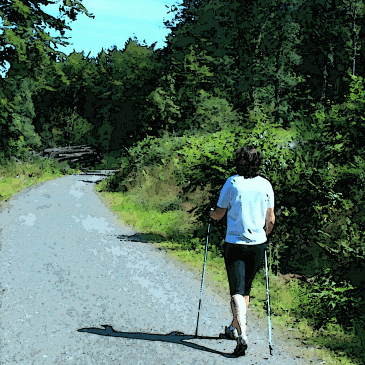
When I began this post, I wondered how I would tag it:  #health  #mindfulness, #sustainability, #writing #frugal #community.  All those reflect what walking means to me, and all are components of something larger, something I am going to call wholeness.  I am not whole if I do not walk.

From my earliest years I have learned by walking, dreamed of walking, found solace and healing in walking, tapped creativity by walking.  My memories of all the places and countries and continents I have been to are memories of walking, of the way one soil feels different underfoot than another, of the contours and smells of the land around me, the flow of rivers, the flight of birds, the shape of trees.  I learn new places by walking them, and once I have done so I am never lost.

I was the youngest by some years in our family, and was frequently solitary.  But I had fields and woods and farm lanes to roam, and those were different days.  I explored further and further afield, usually on foot, sometimes by bicycle, and with the dog for company.  I learned to look, at wildflowers and trees, at birds and mammals, snakes and frogs, at insects.

Then I went to university a long way from home, choosing the university in part because it was not in a town, but set some miles out of town, on a large expanse of land.  But a new reality faced me there:  girls – women – were warned not to walk alone beyond the lighted and paved campus, and none of my new friends wanted to walk.  I stayed a year, became depressed, gained too much weight, and changed universities.  This one too had a large open area, an arboretum with trails that linked to other trails extending out beyond and through the town, and I met friends who wanted to go walking, to look at trees and rivers and birds.  I lost the weight, stopped being depressed, and fell in love with a man who walks more than I do.

Walking informs almost all my writing, either as a theme (sometimes transmuted into other forms of travel through a landscape) or as how I tapped into whatever it is in my brain or the cosmos that creates fiction.  I will go walking with a problem to solve, one of plot or motivation or background, and after a good walk or two, even if I haven’t been directly chewing over the problem as I walk, the solution will appear.  I find letting the problem swirl around in the back of my mind, not looking at it directly, while I focus on watching birds, or fish, or searching through a stand of milkweed for Monarch butterfly caterpillars, often produces the quickest results.

When I start walking I’m stiff, sometimes sore, depending on the day, the weather, and the vagaries of arthritis.  That will pass after the first ten minutes.  Some days, I’m out of sorts, or worried, but being back in touch, physically and spiritually, with sky and land and wind provides perspective, and calms even my most persistent or serious concerns. Most days I walk for an hour or two; at this time of year, when the mosquitoes and deerfly of summer are still active, I walk at the university arboretum.  As summer winds down, I’ll go back to the conservation area trails that surround us.  Only when the weather is at its worst – heavy snow, torrential rain, extreme humidity – do I resort to indoor walking, either at the local shopping mall, or on my treadmill.

Walking together fosters community, whether its the community of our marriage – BD and I talk best when walking together, and face our most difficult challenges that way; the community of friends you’re sharing a walk with; the more casual community of people met on the shared paths and trails, or the neighbours you meet walking down to the mailbox. It’s also a pretty frugal way to exercise: good shoes are recommended, especially for aging feet, but otherwise there aren’t too many places where you can’t find somewhere to walk without paying an entrance fee.

I wonder, sometimes, who I would be, had I not been that youngest child, free to roam a safe rural environment, touching, tasting, watching the wild world, letting my mind and imagination run freely along conscious and unconscious channels, an experience unstructured and unguided. Would I – could I? write?  How healthy – mentally and physically – would I be? Questions that can’t be answered, because every choice of path, every turn we take or don’t take, every hill we do or don’t attempt, changes us, in ways we can’t begin to imagine.

Pickles, Salsa, Coffee and Community

pickles

The tiny crossroads hamlet in which we live boasts two retail outlets – the feed store, where we buy birdseed in the winter, and a bakery.  More than a bakery, the shop – I’ll call it Rose’s – supplies not just bread, pies, tarts and the best cider donuts for miles, but pickles, salsa and jams.  And coffee. Rose works harder than anyone I know – the bakery opens at 6 a.m. to provide coffee and breakfast fare and closes at 6 p.m., and it’s Rose who is baking, pickling, and providing counter service for all those hours, six days a week.

I used to stop every morning for coffee before I drove to work, and Rose’s donuts and butter tarts were the highlight of many a department meeting.  Over the years, Rose and I became friends, although she has a reputation for being irascible. She’s also the hub for village news – when BD found a grey-and-white kitten in our garage early one summer’s morning five years ago, it was to Rose’s we went to see if anyone had reported her lost.  (They hadn’t, and Pye, all grown up now, is currently sitting on my desk watching me type.)  We tell her when we’re going away, so she’ll keep an eye on the house.  When I was buying coffee at seven a.m. weekday mornings, we’d talk about the fox cubs being reared in the old graveyard; the coyote family Rose saw every morning at five a.m. when she walked her dogs; the sandhill cranes which have returned to the area.  She’s told me who to hire to plough the snow, fix our furnace, pump the septic tank.

But in retirement, I have the leisure to make my own coffee in the morning, and I also needed to consider the money I spent – the coffee was all too frequently combined with a muffin, or a breakfast sandwich – depleting my purse and expanding my waistline.  But I miss going.  I miss our chats, I miss being greeted by her two Labradors, and her coffee is better than mine. Frankly, I miss seeing my friend, and finding out what’s happening in the village.  Dropping in every couple of weeks when we’ve run out of salsa or pickles or cranberry chutney isn’t enough.

So I will return to buying a morning coffee two or three times a week, but now I’ll walk or bike down, or stop in on my way to town for groceries.  It  will cost me a few dollars, but can you put a price on community?