Changes

It’s been a while since I posted anything, and that’s because life has moved very quickly in the last three weeks.

One of the things our two months in England confirmed for us was that we want to live somewhere where we’re less dependent on the car to run errands.  The second thing was that we could quite happily live in a bungalow, and the third was that we really liked not being responsible for the lawn and garden.  We’d thought it was time to leave this old two-storey rural house, with its quarter-acre of lawn and garden, 10 miles from anywhere: what England told us is that we were right.

We always said we’d move before it was too late, when we could make the choice. We came home, spent some time wandering around neighbourhoods in the university town north of us that we know well and love.  We narrowed it down to two, and then to one.  And yesterday, we bought a house.

It’s not quite a bungalow, in that it has a bedroom and ensuite on a second floor, but we don’t need to use those except for guests, or, for the foreseeable future, as BD’s study.  It’s a 10 minute walk to the university’s arboretum, for walking and birding; a 15 minute walk (or 5  minutes on the bike) to the university library, where I like to work, a ten-minute walk to a grocery store, on quiet back roads. We can bike downtown, to movies, to lunch, to the arts centre, to the bookstore, to the summer outdoor concerts.

While we own the house, and can do what we like with it, indoors and out, we don’t own the land it sits on: the university does.  So we pay, effectively, condo fees – and for that we get the lawn and garden taken care of, the snow ploughed and shovelled to our front steps, and the use of a large and well-equipped recreation centre. Or, as BD put it yesterday, to be permanently on vacation.

It’s ours in just less than two months, assuming all goes well with the inspection and the bridge financing – we have to get the existing house on the market, but there’s a bit of work to be done yet.  The new house needs its interior walls painted and a few other cosmetic bits and pieces.  One thing for sure, this adventure over the next couple of months – as we try to do this as mindfully as possible, fitting what we already own into the new house, figuring out what we really need (like a new bed), disposing of what we don’t – will give me plenty to write about!


Belonging

Growing up as a child of immigrants, the stories you hear of ‘home’ are usually tinged with nostalgia, seen through the rose-coloured glasses of memory. I can’t say this was true of all my parents’ stories – they had lived through the depression and World War II in Engand- but the ones that stayed with me the most were their stories of long childhood walks through the countryside, roaming footpaths and hedgerows, free and unsupervised.

My own childhood in Canada was as free as most childhoods fifty years ago were, and living at the edge of a village there was freedom to roam the farm lanes close to us, the farmers turning a tolerant eye to our activities, and we certainly bicycled the quiet roads around us. But at the back of my mind, it just wasn’t the same. I had grown up on Enid Blyton and Arthur Ransome, and I wanted footpaths and moorland, quiet hedged lanes, little villages hidden in folds of the hills…and as I grew older, a welcoming pub to stop at.

So here I am, nearly fifty-eight, writing in the sitting room of our holiday cottage that we’ve taken for January and February, back from a walk that ticked just about every box on that list. We set out just after nine this morning, turning right up the lane at our front door. A few hundred meters up the hill a gate opens onto a field and footpath, climbing further up the hill, skirting field margins to bring us out onto a quiet lane. A barn owl is hunting in the field to our west. At the top of the lane, the wide Norfolk views open out; to our west is the broad expanse of the Wash, its flocks of waders and waterfowl visible even from here, the coast of Lincolnshire shimmering in the distance. To our east, fields: field peas and sugar beet, wheat stubble, autumn-ploughed fallow, cut with hedgerows and lanes.

We walk in a northerly direction, following paths and bridleways, along field margins and old drove roads through farms, coming out into villages. The sky is changeable, clouds scudding in the strong westerly winds, patches of blue winking in and out. Hedges, green with ivy, keep the worst of the wind off us except when we the route takes us due west. Grey partridge scatter in front of us, calling their distinctive rasping cry.

After about six kilometers the drove we’re on swings west, past a substantial farm, and then south again for a few kilometers, coming out by a magnificent medieval church perched high on the greensand ridge that runs up the coast here. On a bench outside the church wall we sit for a snack, looking down over the village. It doesn’t do to sit too long, though: we’ve another three or four k to go, and tired muscles ‘set’ all too easily. We walk through the village streets, past the old watermill, and on to the footpath that is the last leg home. In a field to the west about a hundred curlew are feeding, beside jackdaws and wood pigeons, and where the footpath enters a woodland long-tailed tits chatter their high-pitched greeting.

We’re home in time for lunch, just after one o’clock. All this walk was missing was the pub, and that’s just up the road: the well-deserved pint can wait until a bit later this afternoon. I have soup to make for dinner and bread to bake. In all my months of recovery from major surgery and post-surgery treatments in 2014 and 2015, it was the thought of walking under this quiet corner of Norfolk’s skies, along these footpaths and lanes, that kept me going. It was the first place we came when my doctors gave me the green light to travel last spring: in the month here then, I went from being able to walk for less than an hour to managing a couple of hours with sufficient breaks. Now I can walk for four, with a five minute break, and it’s only the arthritis in my hip and foot that keeps me from going further, not a lack of energy.

Spread out on the sitting room floor at my feet is the Ordnance Survey map for this area. In a couple of minutes I’ll sit down with it and start planning another walk. Out to the castle ruins towards the Wash? Due east, to the village with the working windmill? Across the fen to look for short-eared owls and woodlark?

This is not Blyton’s or Ransome’s England, if those ever really existed. It’s not the England of my parents’ childhoods, nearly a hundred years ago. It’s not even the England we started to return to thirty years ago, when my family’s pub still stood where the village’s grocery store does now. But it still offers me footpaths and heathland, quiet hedged lanes, little villages hidden in folds of the hills, skies and birdlife and wind and space, and long walks from my front door. My experiences and memories build on and continue from my childhood stories, the ones my grandparents told, and my father (this was his childhood village), and those of his one surviving cousin, who lives a dozen miles from us here, and whose ninety-fifth birthday we are celebrating later this month. I study and explore these villages and fields as part of my landscape archaeology courses, I write about it in my non-fiction work-in-progress, Reverse Migration, and there is a certain place in the fictional land from Empire’s Daughter that is, simply, here. I belong to this land, this little piece of west Norfolk, and it to me, unlike any other place I know or have lived.

The One-Stop Holiday Shop

We don’t, as an extended family-and-friends group, give anything but small, consumable holiday presents. We’re all adults, all well-enough off and we all own too much stuff. The money we would have spent goes to a cause of the donor’s choice, and we celebrate with food, wine, winter walks and conversation.

But there is still that small consumable present to buy. In keeping with our belief in shopping locally, I consider my options. There is a lavender farm just north of us that has lots of lovely little products. There is a bee-keeper who makes beautiful candles with the beeswax. There is local maple syrup. Or there is Rose’s, our bakery-preserves shop right here in the village. Rose’s jams and chutneys and pickles and salsa are scrumptious, made mostly from locally-grown produce, providing employment and revenue right in our village. Rose’s wins.

I stop on my way to town: I can walk there, but not with nearly two dozen jars of preserves in my bag. I’ve chosen late morning on a mid-week day, when she isn’t so busy. The shelves are lined with jars, their contents gleaming red and purple and green. I buy blueberry jam and hot salsa, crabapple jelly and cranberry-apple chutney, spicy red pepper jelly and bread-and-butter pickles, while inhaling the scent of bread baking. Probably I buy more than I need, but we’ll eat anything that’s left over.

I could, in theory, preserve my own jams and pickles now; retirement should give me the time. But my days are too full already, and with such a supply just down the road, I’m happy to buy them from Rose. A little bit of our local food will make its way around the province in the next few weeks, our local farm and rural economy will benefit, and my holiday shopping stress is nil. Now I can start the holiday baking!

Good Fences

Good fences make good neighbors, Robert Frost wrote, in Mending Wall.  Between our property and the neighbours on both sides, a split-rail fence delineates the property lines.  We built the fence ourselves, getting on for twenty years ago, pulling the cedar rails out of the brush of an old farm at the edge of the village, gladly given to us by the elderly farmer. When the fence was done, he walked down one day to see them in their new incarnation. “Good to see them used again,” he said, of the old swamp cedar rails, probably even then well over a hundred years old.

But in a massive thunderstorm earlier this year, with drenching rain and high winds from the east, unusual for here, the young butternut that grows just at the edge of our eastern neighbour’s property shifted just a little, leaning into the fence, and took down three rails. Oddly enough, it didn’t break them: the steady pressure on the fence snapped the wire that held them to the posts. But they couldn’t go back up – the trunk of the butternut was in the way now.

We debated taking the tree down, but I really didn’t want to. Another young butternut, at the edge of the maple swamp behind us, also listed in the storm, but it straightened itself up within a couple of weeks.  I decided to wait. Yesterday, mulching leaves, I took a good look at the tree, and realized it had grown straight again, but from about five feet off the ground, meaning its lower trunk still was an impediment to replacing the rails.

BD and I brainstormed, and decided the simplest thing to do was to add a post directly beside the one north of the tree. This would allow us to run the rails from the new post to the existing one south of the tree, creating a slight zig-zag (or, really, only a zig). We throw almost nothing out in term of wood, so hiding down with the compost bins was a huge old post that had once supported the far end of the washing line. Cut down and wired securely to the existing post, it was the perfect size.

It took us about half an hour to fix the fence, on a glorious November day, sunny, very warm, no wind. Overhead ravens swore at and chased migrating red-tail hawks. The chickadees went back and forth to the feeders, ignoring us, joined by two species of nuthatch and two of woodpeckers. The squirrels – black and red – are happy to have their highway contiguous again, and neighbouring dogs and grandchildren have their limits back. Good fences do, indeed, make good neighbours.

Canadian Thanksgiving

There are few things more lovely than an early October morning in Ontario.  The sky is a brilliant blue, the roadside and woodlot maples all shades of fire.  I’m going early to the farmer’s market, because this is Thanksgiving weekend in Canada, and the market will be extra-busy.

We’re having Thanksgiving dinner with my brother and his family, my adult niece and nephew home for the weekend from jobs and university, along with the youngest niece, in the last year of high school.  Our contribution to dinner will be the wine, and dessert.  I’m making pear crumble and raspberry cake.  If it’s a nice day – and it’s supposed to be, warm and sunny – we’ll arrive, chat, go out for a walk with Ginger, their labradoodle, come back to the house, open the wine, get in each other’s way in the kitchen, and sooner or later eat turkey and stuffing, mashed potatoes, salad and squash.  Then we’ll all be too full for dessert, so we’ll talk some more, and have coffee and dessert an hour or so later, after the dishes are done.

The market this morning was indeed busy.  I bought pears, and the vegetables for this week’s meals, and two beeswax tapers for our dining room table.  (It’s dark now when we eat dinner, or nearly so, and we like the smell of beeswax rather than artificial waxes.)  Every stall at the market was heaped with local produce – an overabundance of choice, in deep, jewel-like colours:  the purples of plums and cabbage and beets; the reds of peppers and apples and tomatoes; the oranges and yellows of carrots and pears and golden beets, and all the shades of green of brassicas and lettuces and string beans.

Canadian Thanksgiving has its origin in the Harvest Festival of the Anglican and other churches, and there couldn’t be a better time of year for it.  It’s not the huge holiday of Thanksgiving in the USA.  But it’s still a time for many families to get together, celebrate the harvest, enjoy the autumn weather and each other.

I’ve got the pears ripening in paper bags with an apple in each, and tomorrow I’ll make the crumble and the cake.  Here’s the cake recipe: it’s never failed me.

Raspberry Cake With Lemon Drizzle

1-1/2 cups (375 mL) all-purpose flour

1/2 cup (125 mL) whole wheat flour

1 tsp (5 mL) each: baking soda, baking powder

1/2 tsp (2 mL) each: table salt,,ground ginger

2 large eggs

3/4 cup (185 mL) sunflower or safflower oil

1-1/2 cups (375 mL) granulated sugar

2 tsp (10 mL) pure vanilla extract

2-1/2 cups (625 mL) fresh raspberries

1 c semi-sweet chocolate chips, if desired

1/2 tsp (2 mL) finely grated lemon zest

Lemon Drizzle (optional):

1 cup (250 mL) icing sugar, sifted

Finely grated zest of 1 lemon

Juice of 1/2 to 1 lemon, as needed

In large mixing bowl, whisk or stir together all-purpose and whole wheat flours, baking soda, baking powder, salt, and ginger.

In separate large bowl using wooden spoon or whisk, beat eggs, oil, sugar and vanilla until well blended. Stir in raspberries and zest (and chocolate chips if used). Add to flour mixture. Mix well.

Pour batter into greased bundt pan. Bake in centre of preheated 350F (180C) oven until tester inserted in centre comes out clean, about 50 minutes.

Let cool 15 minutes in pan, then turn out on to wire rack.

If making lemon drizzle, in small bowl stir together sugar, lemon peel and enough lemon juice to make an icing of drizzling consistency.

Drizzle icing over warm or room temperature cake.

Makes about 12 servings.

Words to Live By

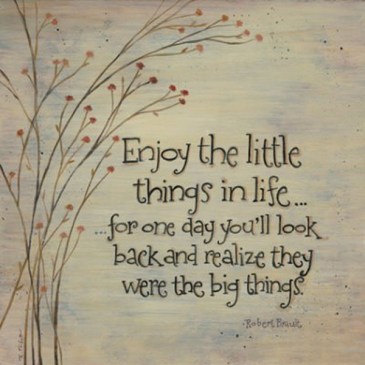
Not all of us can do great things. But we can do small things with great love.

This quote, apparently wrongly attributed to Mother Theresa, remains one of my favourites.  It doesn’t matter who actually said it – it remains a valid and validating statement.

I can’t, for example, paint a masterpiece.  But I can create art for handmade birthday cards, the image usually one I think will have some extra meaning for the person receiving it.

I will never write a best-seller.  But my first novel has been enjoyed by quite a few people, and has been well reviewed.

I will never be a master chef, but I can create meals from scratch that are enjoyed by friends and family.

I am no design guru or master renovator, but I have mudded and caulked and painted and wallpapered and laid tile with care to help create a home we love.

At the end of my career I received a provincial award for contributions in my field of education, completely unexpectedly.  I had never done anything huge, just a lot of small things over many years.

In a recent article in the New York Times, OpEd writer David Brooks asked readers how they found purpose in life.  He writes  “a surprising number of people found their purpose by… pursuing the small, happy life.”

Small things with great love.  Words to live by, at least for me.

Dreaming of Soup

It must be fall.

I woke up this morning from a dream about making soup. Italian wedding soup, to be precise. Of course, I’m craving it now, but as I have none of the ingredients in the house, and no trip to town planned for today, it will have to wait a day or two.

I don’t usually dream about food, but I think a number of factors came together to produce this dream. I was planning menus yesterday, and thinking about making soups for lunches, now we’re home all day. I have either a doozy of a cold or the worst fall allergies I’ve ever experienced – can’t tell which, as my nose is running like an open tap but I have no aches, pains, or lack of energy – so there’s an association with soup as a comfort food. Plus, I actually did make soup yesterday.

While I was away, BD bought the biggest cauliflower he could find, on the basis he didn’t need to buy any other vegetables. (This is the man that eats the same thing every day for breakfast, and another ‘same thing everyday’ for lunch, unless I intervene.) Half of it was still left when I got home Tuesday. We ate part of it in a frittata, but there was still a chunk left, so I looked around for what else we had – potatoes, half a box of frozen vegetable broth, garlic, onion. Definitely enough for soup.

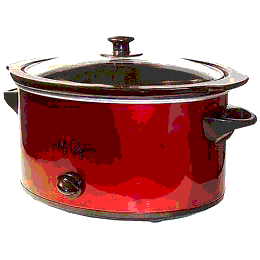
Some years ago I bought myself a second slow cooker, a small one. Except ‘slow’ cooker is the wrong term for this device: it’s a fast cooker. The chopped cauliflower and potato, frozen broth, and garlic was boiling within an hour on high, and then simmered away for another half-hour or so until I could first mash it, and then use my stick blender to puree the mix. I adjusted the seasonings, added cumin, and voilá! -today’s lunch. I’ll turn the ‘fast cooker’ on soon, on low, and bring it back to a simmer, and eat it for lunch with sourdough toast and a sharp cheese for me, and hummus for BD.

And tomorrow when I go to town, I will buy what I need to make Italian Wedding Soup (with chicken or turkey meatballs, for BD’s allergies). I suspect the ‘fast cooker’ is going to be out on the kitchen counter most days now, as the bite of fall sharpens the air, and good long fall hikes sharpen the appetite.

What are your favourite soups? Do you have recipes to share?

Lessons from “Doing it Ourselves”

BD and I started off our relationship with very different skill sets. He had helped do the wiring in his newly-finished basement when he was fourteen, and a bit later helped his parents build a cottage, starting with clearing the lot and ending with the finished cottage. I could cook, sew a bit, and grow just about anything. For my father, horticulture was both a vocation and one of his avocations, and I was helping him in the garden when I was no more than three. I could also hang wallpaper. That’s pretty well where my hands-on skills ended.

When we were first together my lack of construction skills frustrated BD. I didn’t know the names for tools, or how to tell a Robertson screwdriver from a Phillips. (Mind you, he didn’t know a Dutch hoe from a cultivator, either, or a zucchini from a pepper.) But we persevered through two fixer-uppers, and I learned to lay tile and use a caulking gun; to strip hardwood and patch plaster. He’s learned I see the steps in a project better than he does, and can both create the workflow for the job, and be creative when we run into problems. On top of that, I’m ambidextrous with both a hammer and a paintbrush, and can lay roofing shingles better than he can.

We’ve learned to be mindful of each other, respecting knowledge, listening to each other even when the correct vocabulary isn’t necessarily being used. We know each other’s limits, both physical and mental. I know I have to paint ceilings, because it hurts BD’s back too much to do so. He knows I can’t work over my head with an electric screwdriver.

Doing the work ourselves has also increased our sense of belonging in, and to, this house. We are familiar with every square inch of it, from the basement crawl space to the attic rafters. We’ve seen it naked, stripped to the pine beams that run from foundation to attic. We’ve heard it groan when basement support jacks are moved. We’ve patched its wounds and learned its secrets: the burned beams in the old summer kitchen from a stove fire; the potato store uncovered under the kitchen floor when we stripped the old linoleum. We know where the coal chute was, and the original well, and where the stovepipes ran.

The house belongs to this village; it is built from local trees, sawn and finished at the village sawmill. Its foundation is of local fieldstone. We were the incomers, to a house that had been in one family for seventy-five years. But twenty-one years later, we belong here. We’ve earned that belonging in part by respecting our old house. The woman from whom we bought it had been born in the big bedroom upstairs. She wanted to sell it to someone who would love it, not tear it down and build a new house, and when we invited her back to the housewarming a few months later, she was so happy with what we had – and more to the point – hadn’t done to it. We’d respected its character, and that was important to her, and by extension to the village. Without her approval, we’d never had been offered the hundred-year-old cedar rails by the retired farmer down the road; he’d heard we wanted to build a fence, and said they were ours for the taking if we wanted to pull them out of the fence-rows. Our local chimney-sweep and furnace man told us never to worry about our old wonky furnace going out if we were away in the winter; he’d drop by every day to make sure it was on; he knew the furnace well, and he’d been told we were taking good care of “Doris’s” house.

Now when I walk to the community mailbox, or down to Rose’s for a coffee, or on any of my local walks, it’s the people working on their houses I am most often drawn to stop to talk to, the ones with tools in their hands and sweat dripping. I know it’s not completely fair: I know not everyone has the skills, and that employing others to do work for you is important for the economy. But I’m glad there are still young couples who are doing it themselves. Because I do not love the bathroom we contracted out nearly as much as I love the kitchen we tore down to the bare beams and built up again completely by ourselves; nor do I love the floor someone else laid in the sunroom the way I love the old hardwood I scrubbed and sanded and finished in the long living/dining room. There are memories that go with building that kitchen and sanding that floor, that are part of our journey to understanding and respecting not just this house, and not even our place in this community, but each other.

MOOCing along: The Pleasure of (Free) On-Line Learning

This is an expansion of a post on my writer’s blog, Wind and Silence, so if you read that too, you’ve pretty well read this post, although there are a few differences.

In an earlier post, I wrote about how I sought out community and intellectual stimulation during my house-bound period last winter, following surgery, through becoming involved in Project Feederwatch. In that post, I mentioned there were other ways I found what I needed, and, because this also relates to one of my themes of being frugal, I decided it was worth writing a post about.

I subscribe to a site called Lifehacker on my Facebook newsfeed. Originally I started reading it because it often had technology-related reviews, ratings and ideas,which I needed for work. But then some time last summer, there was a post about free, on-line education.  Intrigued, I looked at it, and found a link to FutureLearn. Associated with the Open University in the UK, this completely free educational site offers dozens of courses on subjects as diverse as Global Food Security, The Works of Gabriel Garcia Marquez, and The European Discovery of China.  Universities from around the world are involved in the design and teaching of the courses. All you need to sign up is a computer and the internet.

I browsed through the course offerings, with, of course, an eye to courses that would increase my understanding of the Roman Empire, the historical template upon which the world of Empire’s Daughter rests. As I wrote in an earlier post on Wind and Silence, my understanding of my created world needs to be thorough, or I can’t write about it convincingly.   Two caught my eye: Hadrian’s Wall:  Life on the Roman Frontier, and, Archaeology of Portus:  Exploring the Lost Harbour of Ancient Rome. These looked promising, and the Hadrian’s Wall course’s timing was perfect – it would start soon after the surgery, but not immediately, so I had time to be able to handle sitting with my laptop again.  So I signed up for the it – we’d been to the Wall a couple of times, the most recent just over year before, and in that case specifically for research for the book and its upcoming sequel. I’d learned a lot from visiting the museum at Vindolanda, as well as just walking the Wall and thinking about what it was like to be a soldier there in the second century A.D., on a cold, damp, windy March day, waiting for your relations to send you more socks.

I’d taken on-line courses before, in relation to my work, so I was prepared for the basic format of readings, videos, questions to be answered and on-line discussions to occur. The course was well-designed and fun; I learned a lot, but the (for me) unexpected benefit was the literally hundreds of viewpoints that were expressed.  These courses are what are known as a MOOC – a Massive Online Open Course – and can have many, many participants.  Not everyone is very vocal, of course, but the wide range of experience, background, imagination and world-views of the participants who did express ideas made me think – not just about Roman Britain, but about my imagined world, and, some of my own preconceptions. It was rich discussion. The result is that some of what happens in the next book(s?) has been directly influenced by this community of learners (in both courses) who were willing to share their knowledge, ideas, and expertise with each other. I hope I remember to thank them all in the author’s notes!

There are, of course, lots of other opportunities for free or low-cost learning (the Lifehacker link is a good place to start) and I’d be interested to hear what others have found.  FutureLearn is just one place you can find free courses, and I’m waiting to hear if another on-line course that looked intriguing is to be offered again, this time through a different provider, Coursera.  My local Senior’s Centre…(yes, it appears I qualify, being over 55, although there is part of me that doesn’t believe this…) offers a number of no-cost face-to-face programs this winter. I am, actually, overwhelmed by choice, and have to be mindful, to stay focused on courses that will inform my writing…and leave me time to actually write.

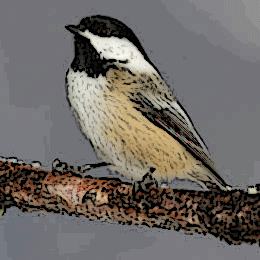
In Praise of Chickadees

It’s a hot, sunny August morning, and there is probably something else I could be doing, but instead I’m sitting in the sun-room, watching the ruby-throated hummingbirds at the feeder.  There are at least two:  a male, and then one or more juvenile/female-plumaged ones, which could be his offspring or mate.  I think offspring, because he keeps driving them away. There is another feeder, around the corner, situated to be seen from the kitchen window, and occasionally the male flies off to patrol it, letting the juvenile beeline in to feed.

In mid-August, other birds are beginning to appear, landing on the feeder pole and investigating all the arms, looking for the seed feeders they know were there last winter.  Chickadees and goldfinches, mostly, and the occasional blue jay.  We’ll put the seed feeders back up October first; there is plenty of wild food around for these birds, including the sunflowers planted along our fence.

I’ve walked on every continent on Earth to see birds, and I’ve seen literally thousands of species. Some stand out over others:  the Adele penguins on the Antarctic peninsula; Siberian cranes on the Yangtze wetlands in winter; the California Condors over Big Sur; the huge, shy, Great Argus of the Malay peninsula.  I’ve birded in places you wouldn’t think there would be birds:  in the heart of Paris, on the hills above Hong Kong, in downtown Buenos Aires.  I’ve seen the wonder of the sandhill and snow goose migration on the Platte in March; the dance of prairie chicken on the hills at dawn, the mating flight of woodcock in the wet fields at the edge of our village.  But while these have been wondrous, and I am filled with nothing but gratitude and awe that I have been able to see them and so much more, nothing quite makes me smile like a chickadee.

They are such cheerful, curious optimists.  Yes, I know this is anthropomorphism.  Yet there they are in August, landing on the feeder poles, buzzing their questioning chick-a-dee-dee-dee.  If I go out, they won’t fly away; I’ve had them land on me in the garden as if I were a moving tree.  On a minus twenty February morning, as soon as the light begins to filter through the darkness, they’ll be there.  If the feeders are empty, believe me, they tell us, and they’ll fly around my head while I fill them, landing on the hanging feeders before I’ve even put them up again.  The cats – who are strictly indoor cats – sit at the windows and chatter, tails lashing.  When the chickadees come to sit in the bushes under the sun-room windows, Pye and Pyxel are balls of pent-up, frustrated energy.  (But can these two catch the odd white-footed mouse that finds its way into the house?  Of course not.  They are the cat equivalent of armchair quarterbacks.)

Last fall, after major abdominal surgery, and through the weeks of recovery, further treatment and more recovery, the bird feeders – or more precisely the birds at them – were one of my joys.  Prior to my weeks off work, I’d only been able to watch the feeders on weekends once daylight savings time ended, since I left for work in the dark and got home in the dark, and weekends were inevitably filled with chores and errands, so we got brief glimpses here and there of what we were feeding. Sunday brunches were the only times we’d really get to watch.

To focus my watching, I signed up for Project Feederwatch, through Cornell University.  A huge, on-going citizen science project, my part in it was to watch the feeder for at least part of two consecutive days a week, and record the species and numbers I’d seen.  It was great fun, as well as being informative and producing a few surprises, like the flock of nineteen wild turkeys who appeared mid-morning every day to pick up the seeds scattered by the small birds.  More than that, though, for the weeks before my surgeon permitted me to drive, and the weeks before BD felt comfortable letting me go for a walk on my own, it was my daily connection to nature, to the change of the seasons and the living, breathing, wild world.

It was also two other things: community and intellectual stimulation.  One of the things I worked on during my weeks ‘home alone’ was about creating, or rather recreating, both of these, in a different form than they had taken before. My friends were hugely supportive, driving me to doctor’s appointments before I could drive myself, taking me out for lunch, just visiting.  BD, of course, was there evenings and weekends. But I was used to a work environment, where there was always someone who needed to talk to me, or I needed to talk to, in person, by phone, by e-mail, and there was always a problem to be solved, a situation to be mediated, new hardware or software to be reviewed, tested, analyzed.  And so I set out to recreate a smaller version of that – I didn’t want the constant interactions; even at work I had long ago learned to close my door, or drive out to the furthest site I was responsible for, to find some solitude and thinking time. Nor did I want to pursue anything that looked like the work I had been doing – it was a vocation, not an avocation, and I knew I was retiring.  But I did need to use my mind, and to talk to people. All the edits on Empire’s Daughter were done, so the frequent e-mails to and from my editors had ended.  The new book was just an outline, and on my best day I can only write for about three hours.  I was determined to find other ways to use my mind and be connected to people, and I was, temporarily, housebound.

By finding a place in on-line communities – not just through Project Feederwatch but through other means (which perhaps I’ll write about another time) – I satisfied both the need for interaction and the need for intellectual stimulation.  Everything I worked on last winter was time-limited; I knew that once I’d recovered, I’d likely want to spend less time on these projects; I can sign up for Project Feederwatch again this winter, or not, depending on how we decide to spend the winter.  But the project gave me more than either community or intellectual stimulation, and perhaps this last thing is the most important.

I’ve been watching birds for about forty-five years, but this was the first chance -or at least the first opportunity I’d taken – to watch in a different way; to watch the details of how the birds interacted with each other; to sort out the apparent pecking orders within and among species; to note the fine differences between how a chickadee and a goldfinch picks up seed.  I learned to identify specific birds through minor variations in plumage, and I studied the gradations and differences that sorted out the species of redpolls, before the boffins decided, on the basis of DNA, that they’re all one species, regardless. Just when I’d got good at it, of course.

Learning to watch the birds differently, paying attention differently, is a distillation of much of what I have been working towards – to be more mindful of what is important to me, to slow down and see, to live here, now, understanding the landscape and ecosystem and community in which I live and am part of.  T.S. Eliot said it far better than I ever could, in his magnificent poem Little Gidding:

We shall not cease from exploration
And the end of all our exploring
Will be to arrive where we started
And know the place for the first time.

Perhaps I have just begun to know chickadees.