Baking bread, part two.

I debated whether or not to continue writing about baking bread – and decided that I would tell the story about my most recent bread disaster, and, about why it happened.

Picture the kitchen – it’s a galley kitchen, a bit wider than some, and big enough for my husband, BD, and me together if we choreograph it correctly.  It’s the end of the day, and I’m a bit tired; we’re doing some house renovations, I’ve been food shopping and I’ve been biking, and spent a chunk  of the day gardening.

We’re having pizza for dinner (cheeseless, due to BD’s allergies), and I’ve made a double bread recipe and will use part of the dough as the pizza crust, and part for bread.  BD is making oatmeal cookies at one end of a counter – well, he’s using two-thirds of the counter, really – and I’m grilling veggies and chicken for the pizza.  I separate off a third of the dough, add herbs and grilled onions to it, and roll it out.  While it’s rising slightly, I divide the rest of the dough between the two bread pans, and put them on top of the stove, to benefit from the warmth as BD’s cookies bake.

We’re doing all this at the same time so that the oven is on for the shortest period of time possible.  Here in Ontario, where we have time-of-use pricing for electricity, the hours between 5 and 7 pm are mid-peak in the summer – the second most expensive per-unit charge.  We’re sensitive to our electricity use, both for budgeting reasons and for environmental concerns.

BD’s cookies are done, and while the oven changes temperature from the 375 degrees the cookies bake at to the 425 the pizza needs, I throw together a salad while BD cleans up the kitchen.  The pizza only takes 15 minutes.  As I take it out of the oven, I look at the bread – it still needs at least half-an-hour to rise.

“Should I turn the oven down to 350 and leave it, ” I ask BD, “or turn it off completely and then reheat it to 425 in half-an-hour?  Which will use more electricity?”  He considers.

“Turn it off,”  he says.  So I do, and put a timer on to remind me to look at the bread in thirty minutes.

We eat dinner, clean up; the bread still needs a bit more time.  It’s 7:30 p.m., time for Jeopardy!, which we watch every night.  Ten minutes into the show, the buzzer goes off to tell me the bread is ready to go in the oven. With at least half my mind on the show, I go to the kitchen, open the oven – yes, it’s warm – and put the bread in, set the timer for fifty minutes, and go back to Jeopardy!.

You can see where this is going, can’t you?  Fifty minutes later, the timer goes off, and I open the oven to find the bread dough has continued to rise, overflowed the pans, and dripped down the sides and through the racks and onto the bottom of the oven.  Because, of course, I didn’t turn the oven back on.

I could make lots of excuses  – I was tired, I was distracted by the quiz show – but the real reason is that I was not being mindful.  The bread did not have my attention.  The human brain really isn’t meant to multitask – for a good discussion of this, see Leo Widrich’s blog here.

I’m not one to beat myself up about this.  I said a few choice words, wiped up the worst of the dough, and baked the bread anyway.  Then I couldn’t get it out of the pans in one piece, so it ended up on the bird feeder, in chunks.  The squirrels were happy.  I made bread again the next day, with my mind on the work.  And when we found ourselves in the same situation a week or so later, we didn’t turn the oven off between cooking dinner and baking the bread.

Baking Bread

Several years ago, my husband developed an unusual food allergy: he is allergic to one specific fatty acid.  When he eats anything containing lauric acid (dodecanoic acid, a saturated fatty acid with a 12-carbon atom chain, if you really want to know), he breaks out in severe hives.  This limits what he can eat, and makes buying many commercial products impossible.  We’ve adapted to this, and as a result probably eat a much healthier diet, as it has eliminated red meat, dairy products, and most fats (with the exception of olive, sunflower and safflower oils) from our meals.

He’s a tall, lean, very physically active man, and needs a lot of calories to maintain a healthy body weight.  (I’m jealous, yes.)  As a result, he eats a lot of bread, but it can’t be just any bread, because many or most commercial breads are made with at least one of the fats he can’t eat.  Luckily, however, there is one artisan-bakery bread widely available here which he can eat, and that’s what we’ve bought for many years.  But…it’s at least $4.00 a loaf, sometimes more, depending on what type we buy, and he goes through the best part of a loaf a day.  When I was preparing for retirement, analyzing our grocery budget, looking for places to reduce spending, this one stood out.

I learned to bake bread as a teenager, and I’ve made it on and off for years, but it’s a time commitment, needing at least three hours and usually more from start to finish.  But we’re home all day now.  I did the math:  I can make two loaves of multi-grain bread, made with nothing else but olive oil, water, and a bit of salt, for about a dollar a loaf.  Plus the electricity. So now, every couple of days, I make bread.  And I love it.

The process begins with the yeast dividing in a half-cup of warm water, scenting the kitchen with promise.  While it’s dividing, which takes about ten minutes, I get out the flour – olive oil and salt sit permanently on our kitchen counter – and the large pizza pan I use to knead the dough on. (It’s easier to clean than the counter-top.) After ten minutes I add a glug of olive oil, a grind or two of sea salt, another 2 cups of water, and three cups of flour.  Then I mix it, with a heavy dinner fork.  At this point, it’s a sticky paste.

Half a cup of flour goes on the pizza pan, and another cup or so into the bowl so that I can start to mix the dough with my hands.  (Before this starts, I put music on – a good reggae song from Max Romeo is ideal.) Then I dump it all out onto the pan, and begin kneading.

The dough feels good under my hands: elastic and alive.  It’s my hands that tell me if I need more flour in the mix, from the feel, silky and resilient, but not stiff.  Usually I end up using between five and six cups of flour to reach the perfect consistency.  I knead for five minutes, hard, pushing the heels of my hands deep into the dough.  When I started doing this, my arms and hands would ache afterwards, but now the muscles have grown stronger.  I dance a little to the music.

After five minutes of kneading I give the dough a last shape into a ball and put the pan either on top of the stove (in the summer) or inside it with the light on (in the winter, when the house is a bit colder) to rise, set the timer for an hour, and leave it to double.  If I’ve got the dough just right, an hour is exactly what it needs; if it’s a touch too stiff, it may need a little longer.

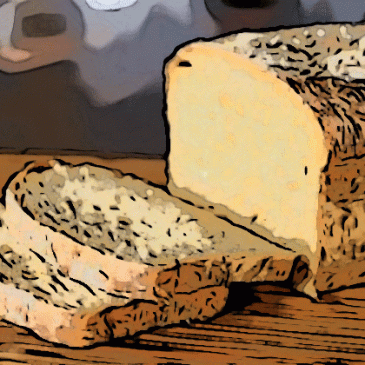
I bake the dough in metal bread tins, well-oiled with safflower oil.  Once the dough has doubled, I give it two or three quick kneads, roll and stretch it out into one long loaf, cut it in half, and put the halves into the tins.  Another hour or so to rise, three shallow cuts on each loaf top, and they go into a 350 degree oven for 50 minutes.  The house smells wonderful.

Of all the cooking I do, there is something elementally satisfying about baking bread, taking a few ingredients to make something so good, whether it’s eaten still warm, dipped in olive oil, or toasted to golden brown and dripping with blueberry jam or honey, knowing that you are participating in an activity that goes back through so many generations.  Sometimes I experiment, adding dried apricots and figs for breakfast bread, or herbs and sauteed onions for a savoury loaf. Occasionally, I have a disaster…and perhaps I’ll tell a story or two about that in another post.