A free book!

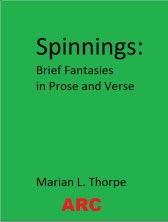
I’ve been neglecting this blog, but sometimes there just aren’t enough hours in the day. Spinnings ARC coverWhat I have been doing is preparing my next book for publication, although to call it a ‘book’ might be misleading: it’s actually two short stories and one related poem.  It’s a quick read, and right now I’m offering an e-book version to anyone who is willing to add a rating or a review to Goodreads.
So, if you’d like an advanced review copy, send me an e-mail at marianlthorpe at gmail.com, or reply to this post here, or on Facebook or Twitter.  I’ll need your email, and whether you want an e-pub (for iBooks) or a Kindle file. Indie authors depend on reviews and ratings on Amazon and Goodreads, and every one helps.

I’ll post the real cover soon…it should be available to me in a few days.

Thanks for considering!


Reviewers Wanted!

This may be an odd request from someone who reviews books regularly, but I’m having a very hard time finding people to review my young adult/new adult e-book, Empire’s Daughter. In part, this may be because it doesn’t fit into any major genre and is difficult to classify. It takes place in a world inspired by Britain after the fall of Rome, but is not historically, geographically, or socially a direct copy. There is no magic. Human relationships cover all pairings, but there is no explicit sex.

You can check it out here:

http://www.amazon.com/Empires-Daughter-Legacy-Book-ebook/dp/B00TXFTZ3G/ref=asap_bc?ie=UTF8

https://www.goodreads.com/book/show/24979052-empire-s-daughter?from_search=true

If you’d like to give it a try in exchange for an honest review on Amazon and/or Goodreads, let me know and I’ll send you the electronic file of your choice for Kindle, iBooks, or Kobo (basically, any of .mobi, e-pub, or PDF).

Thanks,

Marian

Lifelong Learning

I am sitting in ‘my’ study carrel at the university, the one I’ve been using on and off for thirty-something years.  Today I noticed some new(ish) graffiti on one side: ‘Today is my last day in the library EVER’.

How sad I find this, because it implies to me that the person who wrote it finds learning, books, and study a chore, or worse than that, just something to be endured so that real life can begin.  I’ve come to the library today not to write, as I often do, but to check out books, something I’m allowed to do as an alumna, and these are books I need for my new course.  While learning and books aren’t my whole life by any means, they remain – even thirty years after graduation from university – a hugely important part of it.

I am unbelievably excited about this new course – The Archaeology of Landscape I, offered through the University of Exeter Distance Learning program.  Unlike the two I took last fall and winter, this one wasn’t free, so I had to really think about whether or not I wanted to spend the money (and time) such a course requires.  But it really wasn’t that hard a decision.

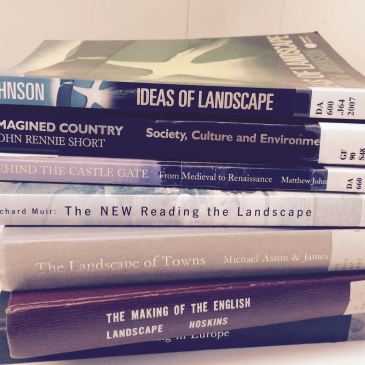
And now I’m looking at a pile of seven books to be read for the first three weeks of the course.  They have titles like “Ideas of Landscape” and “Imagined Country:  Society, Culture and Environment”. I can imagine what most of you are thinking!  But for me, this is feeding a deep need.

And that’s what the best learning is about.  Don’t turn your back on it, just because school and university were perhaps not quite what you hoped.  I can remember being less than impressed with some aspects of my graduate program and quite a few of my undergraduate.  High school was worse.  Then I taught, and was less than impressed with some of what the curriculum required.  I did my best to make it relevant and interesting, but it was a hard go sometimes.

But now I am (again, as I did last fall) learning for the love of it, learning things that will change forever the way I see my world.  Someone (maybe George Bernard Shaw?) said once that education is wasted on the young. I don’t agree with that, but it is certainly not the sole province of the young.  My father was telling me of new things he’d learned through reading and documentaries to within a few weeks of his death at 98.  I hope, very much, to emulate him.

The Two Books I Wish I’d Kept

A year or so ago we culled the library bookshelves. We had to; they were overflowing. Books can take over this house very easily.

I thought I’d done a mindful, considered cull. I really thought about each book. But it’s now clear I culled two books I should have kept.  They were both books that fall into my ‘contemplation’ category: books I read, think about, read again, think some more. Books that have changed, and continue to change, how I see the world. In the case of these two books, they were among the first – one was the first – to do that for me.

The first book, the one that first made me look at the world differently, is Annie Dillard’s Pilgrim at Tinker Creek. I read it for the first time at sixteen or seventeen: it was published in 1974, the year I turned sixteen, so I must have found it (how?) shortly after. A deeply personal and sometimes mystical narrative of the writer’s relationship with the natural world that surrounds her home, it spoke to me at many levels. Dillard’s understanding of the natural world and the appreciation of the rhythms and cycles of life were key to my love affair with the book, but the fact it was also written by a woman was immensely important. I’d read Aldo Leopold and Thoreau and others, but there was always a small disconnect; I couldn’t project myself into them. With Dillard, I could.

I re-read the book several times in my twenties, each time understanding more, recognizing more of the spiritual aspect of it. Then I left it alone for a long time, before reading it again about a decade ago. By then I was on my second copy of it – I’d read my paperback to pieces, and when I found a hardback at a used book store, I bought it. And then last year I gave it away.

The second book is Robert Pirsig’s Zen and the Art of Motorcycle Maintenance. I suspect no other book has influenced my own approach to life as much as this one. I didn’t tackle it until my early to mid twenties, and it was the first book I read (other than my calculus textbook) where I remember recognizing as I read it that I really didn’t understand all of it, not in depth. So I read it again…and again…and again, over the next ten years. Finally, I thought I did understand it, how the search for understanding the elusive definition of quality, of what is good or not good, had become entwined with the author’s mental illness, and how recovery entailed learning to embrace and balance both the romantic and the rational. But again, my paperback was in tatters, and I thought I’d learned all I needed from it.

I wonder now why I thought I was done with them; where that hubris arose from. I have written elsewhere about how I understand the world through walking; in doing so, I create mental maps both real and unreal. The real mental maps mean that once I walk a place mindfully, I cannot get lost there, unless a very long time goes by before I am there again. The unreal are dreamt maps, dreamt walks, that overlay the real world, are different from it but always echo it. These books have been guidebooks for both my conscious and unconscious journeys. And I thought I could give them away?

I can either buy them again – they won’t break the budget, and both are still in print, and easily available used – or I can get them from the library. I think I’ll buy them. And at some level, ask their forgiveness for thinking I could navigate through this life without them.

Bedtime Stories

For about a decade between the years 2000 and 2010, I drove (roughly every third weekend) a round trip of about 650 km (400 miles) to visit my aging parents.  The drive – and I love to drive – is not very interesting, to say the least, and the truck traffic heavy for about the first half of the trip.  After that, it improves, and I can pay less attention to the road and more to the passing countryside, but even then….

So I started to listen to books on CD.  My library had – and has – a good supply, and they relieved the tedium of the drive considerably.  I listened to almost anything:  thrillers, westerns, horror, classics – drawing the line only at romances, which just aren’t my cup of tea.

After 2010 my sister and her husband retired from the big city to the little town one east of my parents’ home, and I didn’t need to make the trip as often.  But by then, I was totally hooked on audiobooks, and not just for driving.  They are my bedtime stories.

In the same decade I was doing those long drives I also entered my mid-forties, and all the related mid-life changes that entails.  Sleep became an issue, both from the joys of waking up too hot, too cold, needing the loo, etc., plus I’d changed jobs to one where there were a lot of problems to solve, and I’d lie awake thinking about work issues, too.

BD is extremely light-sensitive, so reading, even with a little book light, disturbed him.  And it didn’t really work anyhow – I’d get sleepy, but then as soon as I put the book down it was back to thinking.  So I tried audiobooks – in those days, using a Discman portable CD player.  Most of the time, I’d be asleep in ten minutes, the ‘thinking’ part of my mind distracted by the story.

It wasn’t perfect.  I had to guess where I’d fallen asleep on the CD and backtrack every time.  But I slept better.  And time and technology moved on; my library started to offer down-loadable audiobooks through a service called Overdrive.  I bought an iPOD, and began to use the service, but it too had issues – a limited number of copies of books, long wait times, many titles I wasn’t the slightest bit interested in.

Then I discovered Audible and its thousands of titles.  Sure, I had to pay for them, but that wasn’t an issue then and sleeping was!  With a subscription, and buying credits in bulk on special offers, I figured I was spending about $5 a week on audiobooks, and that was a small price to pay for better sleep.  And that is pretty well what I continued to use, up until retirement and the need to spend less.

I looked at the library downloads again – they now have two services, Overdrive and the 3M library.  I am using those to some extent.  But my preferred service now is the completely free Librivox.org. These are all public domain titles (titles whose copyright has expired) and they are read by volunteers. And there is a small ‘commercial’ at the beginning of each chapter for the service. Small annoyances – I’ve learned to tune out the commercial (I seriously don’t hear it anymore) and you can search the site for books read by your preferred readers, or to avoid those read by people whose voice just grates on you.

And what a world it has opened up to me! My father was a reader of Victoriana – the Brontes, Dickens, Trollope. I could never read them – too wordy, too convoluted – but I can listen to them with pleasure. One Anthony Trollope novel generally translates to between fifty and sixty hours of audiobook.  That’s a lot of bedtime storytelling, especially now I sleep better, work worries being a thing of the past.

My greatest epiphany was Moby-Dick.  This was the first book I never finished; we took it in grade 11, I think, and I just couldn’t read it.  But listening to it was an absolute delight, the differing pacing and topics and voices of chapters like the movements of a symphony. I am now convinced that many nineteenth-century books were written to be read out loud, and are best heard rather than read.

Now my biggest issue are the books that are just too interesting – instead of making me sleepy, I want to keep listening!  I save those for that long drive…my parents are gone now, but I have a sister to visit, and the road doesn’t get any more exciting.  So I plug my iPhone into the auxiliary jack, adjust the volume, and I’m off.

PS:  It’s possible some of you saw part of this post appear and disappear from WordPress…that was thanks to Pye-the-cat, who walked over the keyboard, pressing the right buttons to Publish, while I was in the middle of writing it.