My Love Affair with Thrift Stores

Before I retired this year, my closets were overflowing with business clothes.  Living in a four-season climate meant business wear appropriate for a range of outdoor temperatures from -35 degrees C to +35 degrees C, (or roughly -30 to 90 degrees F), and because my office’s heating/cooling didn’t always work well, and because my work involved a lot of driving and visiting sites, clothes for each season were actually needed.

Shortly after my last day of work, I purged the closets.  I bagged up the vast majority of my business clothes, keeping a few to wear to nice restaurants, weddings, funerals, and whenever else I might need something that wasn’t denim, khaki, fleece, or a t-shirt. As I was loading them into the car, BD (who was helping) said “Are they going back to where they came from?”

Well, yes.  At least for a good number of them.  Because even before retirement, I was a thrift-store shopper, and quite a lot of these clothes had come from my favourite thrift store, Value Village.  Or from consignment shops, which I also love. Partly because there is something about department stores that makes me physically uncomfortable – whether it’s the lighting, the crowded rows, the cavernous spaces – I’m not sure.  But I’ve never liked them, even as a kid.  But mostly because I believe strongly in the idea of not buying new, and re-using good things.

I probably am lucky that my Value Village is in a university town; I suspect the quality of clothes I can find may be better than average. I’ve done best with tailored pieces, skirts and jackets and coats.  But over the years I’ve found as well the lovely multi-coloured Indian jacket in the picture (I kept it, it goes well with jeans), several summer dresses, and all the shorts I own.  Plus my gardening jeans, my favourite sweatshirt, and a collection of heavy shirts I wear in the fall and winter.

From consignment stores have come another lovely, hand-made quilted jacket (which also goes well with jeans, so it stayed too), the absolutely beautiful colour-blocked, lined, wool dress I wore to my father’s funeral this year, my long trench coat, and the dress I can crunch into a ball, shove in a suitcase, and it comes out unwrinkled at the other end even after three weeks of bouncing around in the back of a Land Rover in Uganda.  I’ve had that one ten years, had it shortened to knee-length a couple of years back to look a bit more current, and am constantly being complimented on it.

These stores are the first place I go for kitchenware as well.  Not that we need much, but my arthritic hands do occasionally drop things, and even with a cork floor in the kitchen not everything bounces.  I seem to go through wine glasses the fastest, and half my coffee mugs have had the handles glued back on.  The cats occasionally add to the breakages, too; they’ve been known to send glasses, mugs, and side plates flying while playing chase.

As long as the mugs or plates or bowls are in some shade or mix of green, blue and brown they blend with everything else we own, and wine glasses are clear.  I’d like to think we could get by with just a couple of everything, washing them every time, but we entertain quite a bit, casual dinners, brunches…so I do need more than a set for BD and a set for me.  (I did, however, donate our ‘banquet set’ for twenty to an environmental club at the university that was looking for reusable dinnerware. We’ve given up on formal meals for twenty.  Mind you, I’d only paid $100 for the whole thing – dinner plates, side plates, bowls, two sets of glasses, mugs, and cutlery, in the first place, twenty-odd years ago.  It wasn’t fine china, but it wasn’t plastic, either.)

Everything we purge that is worth re-using goes to a thrift store, Value Village or Goodwill or the like, unless it meets the needs of a post on our local Freecycle or my flea-market vendor friend wants it.  I like the sense of being part of a larger, re-using community; I give what I don’t need away, I buy for a very few dollars the very few things I do need.  There are exceptions:  footwear, our wind-and-waterproof outdoor hiking clothes, needed locally in the winter and for several of our past trips to very cold places.  These are specialized items, though, not everyday needs, and they last a long long time.

September is approaching, and with it colder mornings and evenings….and when I looked at my favourite red sweatshirt last, I realized the neck and cuffs are fraying.  I will fix it  (I don’t sew well, but I can manage some basic repairs), but it might be getting past wearing out to a movie or a casual meal.  My other one was originally given to BD the first Christmas we were going out, by my sister, who didn’t yet know he doesn’t like things that pull over his head.  That was in 1978.  I’m still wearing it, but only around the house and out hiking.  If I really think I need another one, my first stop will be a thrift store.  It might take me a visit or two, but I’ll find one that I like, and fits, and another good piece of clothing will be reused.

Free Expression

Unlike some of my other posts, this one is about some of the practicalities of reducing costs, specifically, software costs.  As my retirement day approached, one of the very few things we agreed I needed to buy was a laptop.  Prior to that, I’d had one provided through work – more than one, actually, as a large part of my job was centred around the provision of technology in an educational setting, and I was constantly trying out new devices for compatibility with software, our system, student needs.  So there was always one I could use, and I was violating no employment rules by using them for personal as well as business needs.

Because of my work, I’d had the opportunity to try netbooks, chromebooks, ipads, other tablets…and what I wanted was a regular laptop.  My needs were this:  a screen and keyboard that would be big enough for aging eyes and arthritic shoulders – I’d found with the smaller devices, I leaned forward too much to look at the screen and the smaller keyboards made my shoulders and upper back hurt; I needed it to run an office program, primarily a word-processor for my writing and a spreadsheet program for budgeting; some digital-editing software for my artwork, and to do email, and that was just about it.  Oh, and i-Tunes, which I use occasionally.

I bought the laptop itself in February, for about three hundred dollars, a discontinued (I think) Acer Aspire running Windows 8.  I can bounce between just about any operating system without too many problems, so that was ok, even though it was new to me.  It came with a thirty-day trial of Microsoft Office, but I really didn’t want to spend more money on software.  I considered using only Google Docs, but our rural internet isn’t that good, and in experimentation I found the upload speeds just couldn’t handle it reliably.

Again, based on prior experience, I knew that Open Office, (which is open source freeware) would meet my needs, so that’s what I went with. (I could have used LibreOffice, too, and I’m sure there are others out there just as good. This isn’t a plug for Open Office per se, just a post about freeware.)  It’s met all my needs; all the final work on Empire’s Daughter was done on Open Office, including the last submission and conversion to e-book formats.  I still need to ask the Help menu how to do certain things…but to be honest, I found that I was doing that constantly with the last release of Microsoft Word too.  I think I just can’t hold as many things in my brain any more.

Then there was the artwork.  I’d been using Adobe Photoshop Elements, but I wanted to see if I could get by without it.  The quick answer was no, I couldn’t, not entirely.  Paint is a reasonable basic program, but it wouldn’t do what I wanted when it came to digitizing and modifying my pen-and-ink-and-watercolour originals.  I sometimes create entirely in Paint, though, if I’m looking for a simple, folk-art look, shown in the image that accompanies this post.  I couldn’t find a freeware to do the job, so in this case I gave in and bought Photoshop Elements.  But even then, with a bit of judicious on-line shopping, I ended up paying much less than the Adobe download price, and from a reputable office-supply store, so I could be confident it wasn’t pirated.  I just had to wait a few days for the disc and serial number to arrive in the mail.

Another piece of freeware I use on something resembling a regular basis is my tax software.  BD did the taxes up to two years ago, and by the old-fashioned method of pencil and paper and mailed-in returns.  And usually in November. Revenue Canada always owed us money, because of retirement plan and charitable contributions, so they didn’t really care he was seven months late (they even pay interest)…and he always made mistakes, which they always fixed.  Finally (after thirty-five years) I took them over, and immediately went looking for tax software that would do the calculations and e-file for me. Nicely, Revenue Canada lists several, including freeware, on their website.  I couldn’t see paying thirty or forty dollars (every year) for software…so I read up on the freewares, and picked one, and bingo – the taxes get done on time, no calculation errors, e-filed, and the returns deposited in our bank account in about three weeks.

Finally, there is anti-virus software.  From my sister, who was a systems analyst for thirty-five years (after abandoning law, but that’s a story for another day, about why she did so) I learned about Avast, which is the anti-virus freeware she uses.   I haven’t used it yet; I had a Norton subscription I could switch over to the new laptop, so I’m still using that.

But here is where my sense of community responsibility and justice kicks in.  These softwares are the result of hard work, usually by many people, who are offering them to the public for free.  But I can afford to pay at least something for them; I just don’t feel like putting more money in the hands of big corporations than I need to. (But I’m not technologically talented enough to use Linux, or I probably would.) There’s an option to pay something for all of them, but you get to try them out first, and even then you pay only if you wish.

Now here’s the caveat:  do your research!  There’s a lot of free stuff on the internet which is just a method of getting malware into your computer.  I had years of experience and access to a IT department that would help me solve issues when I – or my staff or the students which I worked with – made mistakes. I know how to restore my computer to its previous safe state if I do screw up (and I’ve had to do it).  Make sure your anti-virus is up to date before downloading anything, and if it’s got a website checker, use it.  Freeware isn’t worth it if you have to pay a tech to fix the problems it caused.  (I’m the unpaid computer tech in this household, and BD’s made some major mistakes over the years which ate up quite a few Saturdays…sigh.  I still can’t make his laptop find his printer in the control panel, although it communicates with the printer without issue otherwise.  Puzzling…)

What freewares have you used?  Do you have experiences to share, good or bad?  I’d be interested in hearing your thoughts.

Walking, Health and Wholeness

When I began this post, I wondered how I would tag it:  #health  #mindfulness, #sustainability, #writing #frugal #community.  All those reflect what walking means to me, and all are components of something larger, something I am going to call wholeness.  I am not whole if I do not walk.

From my earliest years I have learned by walking, dreamed of walking, found solace and healing in walking, tapped creativity by walking.  My memories of all the places and countries and continents I have been to are memories of walking, of the way one soil feels different underfoot than another, of the contours and smells of the land around me, the flow of rivers, the flight of birds, the shape of trees.  I learn new places by walking them, and once I have done so I am never lost.

I was the youngest by some years in our family, and was frequently solitary.  But I had fields and woods and farm lanes to roam, and those were different days.  I explored further and further afield, usually on foot, sometimes by bicycle, and with the dog for company.  I learned to look, at wildflowers and trees, at birds and mammals, snakes and frogs, at insects.

Then I went to university a long way from home, choosing the university in part because it was not in a town, but set some miles out of town, on a large expanse of land.  But a new reality faced me there:  girls – women – were warned not to walk alone beyond the lighted and paved campus, and none of my new friends wanted to walk.  I stayed a year, became depressed, gained too much weight, and changed universities.  This one too had a large open area, an arboretum with trails that linked to other trails extending out beyond and through the town, and I met friends who wanted to go walking, to look at trees and rivers and birds.  I lost the weight, stopped being depressed, and fell in love with a man who walks more than I do.

Walking informs almost all my writing, either as a theme (sometimes transmuted into other forms of travel through a landscape) or as how I tapped into whatever it is in my brain or the cosmos that creates fiction.  I will go walking with a problem to solve, one of plot or motivation or background, and after a good walk or two, even if I haven’t been directly chewing over the problem as I walk, the solution will appear.  I find letting the problem swirl around in the back of my mind, not looking at it directly, while I focus on watching birds, or fish, or searching through a stand of milkweed for Monarch butterfly caterpillars, often produces the quickest results.

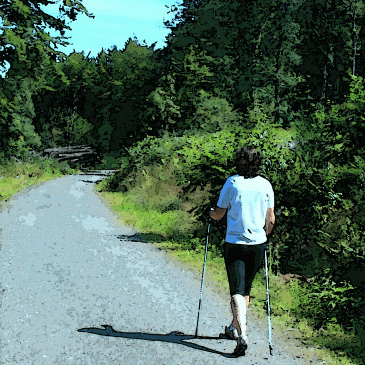
When I start walking I’m stiff, sometimes sore, depending on the day, the weather, and the vagaries of arthritis.  That will pass after the first ten minutes.  Some days, I’m out of sorts, or worried, but being back in touch, physically and spiritually, with sky and land and wind provides perspective, and calms even my most persistent or serious concerns. Most days I walk for an hour or two; at this time of year, when the mosquitoes and deerfly of summer are still active, I walk at the university arboretum.  As summer winds down, I’ll go back to the conservation area trails that surround us.  Only when the weather is at its worst – heavy snow, torrential rain, extreme humidity – do I resort to indoor walking, either at the local shopping mall, or on my treadmill.

Walking together fosters community, whether its the community of our marriage – BD and I talk best when walking together, and face our most difficult challenges that way; the community of friends you’re sharing a walk with; the more casual community of people met on the shared paths and trails, or the neighbours you meet walking down to the mailbox. It’s also a pretty frugal way to exercise: good shoes are recommended, especially for aging feet, but otherwise there aren’t too many places where you can’t find somewhere to walk without paying an entrance fee.

I wonder, sometimes, who I would be, had I not been that youngest child, free to roam a safe rural environment, touching, tasting, watching the wild world, letting my mind and imagination run freely along conscious and unconscious channels, an experience unstructured and unguided. Would I – could I? write?  How healthy – mentally and physically – would I be? Questions that can’t be answered, because every choice of path, every turn we take or don’t take, every hill we do or don’t attempt, changes us, in ways we can’t begin to imagine.

Considering Diderot, IKEA, and Furniture

Two pieces of ‘mail’ this week got me thinking.  One was e-mail – I subscribe to Joshua Becker’s blog Becoming Minimalist, and an e-mail came in telling me of a new post.  The second was traditional mail – a new IKEA catalogue.  I realize those two things seem pretty unrelated, but bear with me.

Becker’s post, Understanding the Diderot Effect (and How to Overcome It) refers to an essay I read in my late teens by the French philosopher Denis Diderot, about how his comfort with his worn surroundings disappeared when a friend gave him a beautiful new dressing gown, which contrasted with the shabbiness of his rooms.  The IKEA catalogue reminded me of Douglas Copeland’s description of the lives of three ‘twenty-somethings’ in his novel Generation X, which included the term ‘semi-disposable Swedish furniture’, and I thought about how we are pressured to constantly replace things – our dishes, our clothes, our furniture.

And then I took a mental step back, and considered our house and our furnishings.  We bought this place – a four-square built in 1911 – in 1984, as a near-wreck, and after a long weekend doing some basic patching and painting of the interior, we moved in with the furniture from our much smaller previous house, much of which had come from IKEA.

Twenty-one years later (and another coat of paint), we still have that IKEA furniture.  And it’s not in the basement.  It’s in our living room, and our sun-room, and the bedrooms, and the library.  The cushion covers on the three chairs and two couches have been replaced,  three times, I think, in the last thirty years – twice by my amateurish upholstering, and once, most recently, professionally. Over that time we’ve added to our furniture:  some came from one aunt’s house, some from another; some was bought second-hand, a very few things bought new, and the rest built by BD.  It’s often a combo:  BD built the dining room table, but the chairs came from IKEA, and the two china cabinets came, one each, from my aunts’ houses.  He built the desk at which I write, but bookshelves from IKEA line the walls of the library; I bought the library rug at a yard sale, and my desk chair came from Staples.

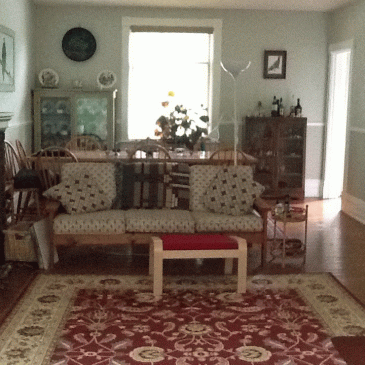
The picture that accompanies this post is a shot into our living/dining room. The rug in this photo is new, bought just last summer, replacing two large hand-braided rugs, made by a friend of my mother’s, that after about seventy years of good service had finally just fallen apart. It’s the piece that could have (should have?) set off the Diderot effect. Everything else – except the footstool and lamp – is at least thirty years old. (You can’t see BD’s armchair, off to the right side, but it’s the same as the couch.)  But somehow, there was no Diderot effect (at least for us – you may think differently!). Perhaps it’s just that I’m comfortable with things not matching, perhaps its the associations I have with each piece of furniture. But whatever the reason(s), I like the way everything looks together.

In the end, furniture is functional, and as long as you like it and it’s comfortable, that should be all that matters.  It doesn’t need to match; it doesn’t matter if some things are more worn than others, and, it’s only ‘semi-disposable’ if you choose to view it that way.  As with just about anything and everything in our lives, if we value our furniture, are mindful of keeping it in a safe and useful state – tightening bolts, working wax into wood, fixing fraying seams – it will serve us well, often for more than one generation.

Garbage Loaf

A week or two ago we had friends over for dinner, a simple post-movie meal of cold chicken and salads, followed by local raspberries, fruit loaf and ice cream.  After everyone had finished, there were a few raspberries left.  “Eat them, BD,” one of our friends said, “otherwise, they’ll just go to waste.”

As I assured her they would most certainly not go to waste, but be eaten the next day, probably as part of my breakfast, I reflected on the amount of food that is thrown away.  According to The Guardian, thirty percent of all food produced in the world is wasted, and in western countries a large portion of that waste is in the home – food we buy, don’t eat, and throw out.

Why?  Well, a very small bit of spoiled food occurs – the tomato sauce that gets shoved to the back of the fridge and forgotten, and has grown a lovely blue mold when you do find it, the cracked egg in the dozen. But those are not that common in the western world of refrigeration and freezers.  I think food is thrown out because of a lack of planning; a lack of cooking skills in some cases, and because we don’t value food enough.  We want it to be cheap and easy.  We forget the purpose of food – to transform the light and warmth of the sun, the nutrients of the earth, the molecules of water – into nourishment for our bodies, through the labour of many hands.  When something is that fundamental, that miraculous – and can I say it, as a secular person? – that sacred – how dare we waste it?

We try to be mindful about food, and that means planning.  Once a week or so, we draw up a menu, and from that menu a shopping list.  And then we stick to it.  This takes time, every week, but it’s time well worth it, and not just because it will mean less money spent; it means BD and I talk about what we’re eating, what recipes to try, how long we’ll need to make supper, where to buy the produce. We are, as a result, perhaps more conscious – more mindful – of what food is in the house, and what it’s for.

I shop twice a week for grocery-store perishables like milk and yogurt, in part because our fridge just isn’t that big.  (Which in itself is a good thing, since it does mean that there is less chance that half-jar of tomato sauce will get shoved to the back and forgotten.)  I shop almost daily for fruit and vegetables during the summer, when the farm stands are open and the produce is freshly picked.  But for meats, I shop, roughly,  monthly, or perhaps every six weeks, buy in moderately large quantities, divide into portion sizes, and freeze.  All this significantly reduces the chances that food will be overlooked or wasted.

But don’t think I’m a paragon of planning.  I keep a freezer inventory, and I mean to cross off what is used, but it doesn’t always happen.  And so, yes, every so often I find some chicken in the freezer that’s looking a bit freezer-burned. Sometimes the only zucchini I can get at the farm stand is too big for just the meal I want it for.  Sometimes one of the apples has too many bruises, or BD forgets to eat his raw carrots and they go soft.  So what then? I can’t bring myself to throw out food unless it’s truly gone off.

Freezer-burned chicken, like the carcass when we have a roast chicken, is saved to make soup, a mainstay of colder-weather meals.  (I’ll wait until the colder weather arrives before writing more about that – I can’t get excited about soup recipes in the summer.)    Soft, over-ripe, or just plain excess fruits and vegetables that don’t freeze well, though, go into ‘garbage loaf’, basically an adaptation of a banana loaf recipe with the same amount of just about any vegetable substituted for the banana.  I even mix them – but be sensible about that:  tomato and zucchini work together, as do apples and carrots, but I wouldn’t do strawberries and tomato.  BD will eat almost any baking, but even he’d draw the line at the last one!

So here’s the recipe for ‘Garbage Loaf’ as I make it. (I probably should have called it Leftovers Loaf, but at least in our house, it’s too late now – Garbage Loaf it is.)

Wet ingredients:

1 cup just about any fruit or vegetable, diced, shredded, or cooked and mashed..  If using carrots or parsnips, grate and steam slightly first.

1/4 cup applesauce (to reduce the fat; if you don’t have it, or don’t want to use it, double the amount of oil.)

1/4 cup light oil – I use safflower, but sunflower, corn or soy works too.

2 eggs, beaten

1 tsp vanilla

4 Tbsp fruit juice (not tomato juice)

Dry Ingredients:

1/2 c brown sugar (this suits us; you may like it sweeter.  It also depends on whether or not you add chocolate chips or dried fruit.)

1 and 3/4 cups flour:  I use whole wheat.

1 tsp baking powder, rounded

1 tsp baking soda

Optional Ingredients 

1/2 cup of any of:

nuts

chocolate chips

raisins or other dried fruits

Preheat your oven to 375 degrees.  If using a glass or metal loaf tin, grease it; a silicon one should not need it.

In a bowl, combine the fruit or vegetable mash, oil, eggs, sugar, vanilla and fruit juice.  Mix with a heavy fork or a hand mixer until well blended.

In a separate bowl, combine the flour, baking powder, and baking soda, and any optional ingredients you are using.

Pour the liquid ingredients into the dry, and mix with a heavy fork or a hand mixer on low; do not over-mix.

Spoon into the loaf pan and bake for 55 minutes or until a skewer inserted into the centre comes out clean.

As I’ve said in an earlier post, BD is a tall and highly-active man, so this loaf doesn’t tend to last long – but it freezes well, and, if by some miracle there is a slice or two left after a couple of days, it also toasts well.

I’ve also added shredded carrots and apple to bread:  it makes a denser, moist bread that won’t keep as long – after the first day we slice it and freeze it, and toast the slices; but it’s good with cheese (for me) or hummus.

And dessert at that dinner that prompted this post?  The fruit loaf was indeed Garbage Loaf, made with over-ripe bananas and a slightly suspect apple, and it complemented the raspberries and ice cream very well.

Serendipity

As I’ve written earlier, I don’t buy a lot of books any more, for reasons of both economy and a concerted effort not to buy what I don’t need. Libraries provide me with most of what I read.  But I will buy a book if I need it for research, and I can’t get it any other way, or, it falls into a category I call ‘contemplative books’:  books I will read several times, books that make me think about my relationship to the world.  Mostly these are books like The Wild Places, by Robert MacFarlane, or Four Fields, by Tim Dee, thoughtful, insightful books written about the relationship between nature and humans.  Mostly British, as this is the country I love best of all the world.

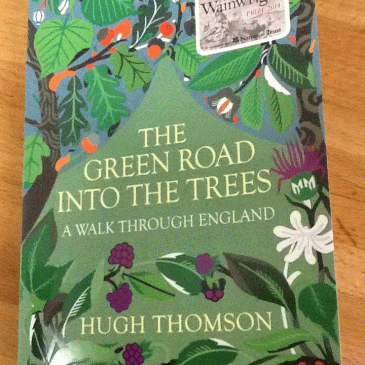
So when Amazon.co.uk sent me their most recently generated list of ‘books recommended for me’, one stood out.  (By the way, I don’t understand the algorithms they use, but they get it right 95% of the time.  I want to buy almost all of them.  I resist.)  The Green Roads into the Trees:  A Walk through England, by Hugh Thomson, ticked enough of the boxes. My libraries didn’t have it  and weren’t interested in getting it – too specialized.  I was pretty certain I would read it more than once.  So it became one of the rare books I bought.

I was busy, so I didn’t look at it for a few day after it arrived.  But when I opened it….call it grace, call it serendipity…but it ticked a box I hadn’t realized it would.  The book is about the author’s walk from Dorset to Norfolk on an ancient trackway called the Icknield Way, a route and an experience I need to research, not for the Empire’s Legacy series, but for another novel which is in the very early planning and research stage.  I was absolutely delighted. And if I know the way of things, there is a good chance that somewhere in this book there will be a line, a comment, that will inform and change that novel in a way I can’t foresee, if I read mindfully, open to what it has to tell me.

This is a shared (and slightly modified) post from my writer’s blog. I don’t plan to overlap the two very often, but this one I felt was appropriate.  

Sustainable or frugal?

Living on roughly half of our previous income, even though we are not by any stretch of the imagination impoverished, still presents some challenges. In the months previous to retiring, I analyzed our spending each month down to the penny, to ensure that we would continue to have a decent quality of life.  For us, quality of life includes being true to our belief in buying local, ethical, and sustainable food whenever possible.

But such food is not inexpensive.  I can buy a dozen factory-farmed eggs for just about half what I pay for eggs from traceable, ethically housed, local free-run chickens.  California greens, even with their drought , are still currently cheaper than the ones from the organic farm up the road.  Food is our biggest single monthly expense, and were I to further change my buying habits, I probably could reduce it by about thirty percent.

I’m not going to, though.  The value of buying the food we do goes well beyond satisfying our own tastes.  A much larger percentage of the money I spend goes directly to the local economy, into the pockets of my neighbours, than if I bought the equivalent products at grocery store.  Animal welfare is improved.  Farming remains viable, which means land remaining productive, and supporting, in the field margins and fence-lines, a healthier bird and wildlife population than would exist if the same land became a housing development.  I can ask the producers of my eggs and meat what they feed their animals, which matters not just in terms of general health for both the animals and us, but because of BD’s allergies.

I am fortunate to be able to afford to buy food like this.  I am fortunate to live in a place that supports, within a ten-mile radius, five seasonal farmers’ markets and one year-round, and innumerable farm stands.  Local food maps are published yearly.  Later today I will go out to buy sweet corn and tomatoes for tonight’s dinner from a farm stand up the road, which sits among the fields where the corn and tomatoes grow.

Frugality has a different meaning for us, when it comes to food.  It means ensuring food is not wasted – broth is made from chicken bones, older fruits and vegetables go into baking (I’ll write about my ‘garbage loaf’ at another time), portion sizes of meats are small.  Vegetarian meals make up half our dinners.  We buy almost nothing prepared; we have the luxury of time, and the skills, to cook from scratch (for which I perpetually thank my parents, who, living through both the depression and the rationing of WWII in Britain, were both frugal and creative with food).

And that sweet corn, tonight, lightly steamed and brushed with olive oil, then sprinkled with salt and pepper, will taste like the essence of earth, water, and summer sunshine in every bite.

Pickles, Salsa, Coffee and Community

pickles

The tiny crossroads hamlet in which we live boasts two retail outlets – the feed store, where we buy birdseed in the winter, and a bakery.  More than a bakery, the shop – I’ll call it Rose’s – supplies not just bread, pies, tarts and the best cider donuts for miles, but pickles, salsa and jams.  And coffee. Rose works harder than anyone I know – the bakery opens at 6 a.m. to provide coffee and breakfast fare and closes at 6 p.m., and it’s Rose who is baking, pickling, and providing counter service for all those hours, six days a week.

I used to stop every morning for coffee before I drove to work, and Rose’s donuts and butter tarts were the highlight of many a department meeting.  Over the years, Rose and I became friends, although she has a reputation for being irascible. She’s also the hub for village news – when BD found a grey-and-white kitten in our garage early one summer’s morning five years ago, it was to Rose’s we went to see if anyone had reported her lost.  (They hadn’t, and Pye, all grown up now, is currently sitting on my desk watching me type.)  We tell her when we’re going away, so she’ll keep an eye on the house.  When I was buying coffee at seven a.m. weekday mornings, we’d talk about the fox cubs being reared in the old graveyard; the coyote family Rose saw every morning at five a.m. when she walked her dogs; the sandhill cranes which have returned to the area.  She’s told me who to hire to plough the snow, fix our furnace, pump the septic tank.

But in retirement, I have the leisure to make my own coffee in the morning, and I also needed to consider the money I spent – the coffee was all too frequently combined with a muffin, or a breakfast sandwich – depleting my purse and expanding my waistline.  But I miss going.  I miss our chats, I miss being greeted by her two Labradors, and her coffee is better than mine. Frankly, I miss seeing my friend, and finding out what’s happening in the village.  Dropping in every couple of weeks when we’ve run out of salsa or pickles or cranberry chutney isn’t enough.

So I will return to buying a morning coffee two or three times a week, but now I’ll walk or bike down, or stop in on my way to town for groceries.  It  will cost me a few dollars, but can you put a price on community?

Baking bread, part two.

I debated whether or not to continue writing about baking bread – and decided that I would tell the story about my most recent bread disaster, and, about why it happened.

Picture the kitchen – it’s a galley kitchen, a bit wider than some, and big enough for my husband, BD, and me together if we choreograph it correctly.  It’s the end of the day, and I’m a bit tired; we’re doing some house renovations, I’ve been food shopping and I’ve been biking, and spent a chunk  of the day gardening.

We’re having pizza for dinner (cheeseless, due to BD’s allergies), and I’ve made a double bread recipe and will use part of the dough as the pizza crust, and part for bread.  BD is making oatmeal cookies at one end of a counter – well, he’s using two-thirds of the counter, really – and I’m grilling veggies and chicken for the pizza.  I separate off a third of the dough, add herbs and grilled onions to it, and roll it out.  While it’s rising slightly, I divide the rest of the dough between the two bread pans, and put them on top of the stove, to benefit from the warmth as BD’s cookies bake.

We’re doing all this at the same time so that the oven is on for the shortest period of time possible.  Here in Ontario, where we have time-of-use pricing for electricity, the hours between 5 and 7 pm are mid-peak in the summer – the second most expensive per-unit charge.  We’re sensitive to our electricity use, both for budgeting reasons and for environmental concerns.

BD’s cookies are done, and while the oven changes temperature from the 375 degrees the cookies bake at to the 425 the pizza needs, I throw together a salad while BD cleans up the kitchen.  The pizza only takes 15 minutes.  As I take it out of the oven, I look at the bread – it still needs at least half-an-hour to rise.

“Should I turn the oven down to 350 and leave it, ” I ask BD, “or turn it off completely and then reheat it to 425 in half-an-hour?  Which will use more electricity?”  He considers.

“Turn it off,”  he says.  So I do, and put a timer on to remind me to look at the bread in thirty minutes.

We eat dinner, clean up; the bread still needs a bit more time.  It’s 7:30 p.m., time for Jeopardy!, which we watch every night.  Ten minutes into the show, the buzzer goes off to tell me the bread is ready to go in the oven. With at least half my mind on the show, I go to the kitchen, open the oven – yes, it’s warm – and put the bread in, set the timer for fifty minutes, and go back to Jeopardy!.

You can see where this is going, can’t you?  Fifty minutes later, the timer goes off, and I open the oven to find the bread dough has continued to rise, overflowed the pans, and dripped down the sides and through the racks and onto the bottom of the oven.  Because, of course, I didn’t turn the oven back on.

I could make lots of excuses  – I was tired, I was distracted by the quiz show – but the real reason is that I was not being mindful.  The bread did not have my attention.  The human brain really isn’t meant to multitask – for a good discussion of this, see Leo Widrich’s blog here.

I’m not one to beat myself up about this.  I said a few choice words, wiped up the worst of the dough, and baked the bread anyway.  Then I couldn’t get it out of the pans in one piece, so it ended up on the bird feeder, in chunks.  The squirrels were happy.  I made bread again the next day, with my mind on the work.  And when we found ourselves in the same situation a week or so later, we didn’t turn the oven off between cooking dinner and baking the bread.

Baking Bread

Several years ago, my husband developed an unusual food allergy: he is allergic to one specific fatty acid.  When he eats anything containing lauric acid (dodecanoic acid, a saturated fatty acid with a 12-carbon atom chain, if you really want to know), he breaks out in severe hives.  This limits what he can eat, and makes buying many commercial products impossible.  We’ve adapted to this, and as a result probably eat a much healthier diet, as it has eliminated red meat, dairy products, and most fats (with the exception of olive, sunflower and safflower oils) from our meals.

He’s a tall, lean, very physically active man, and needs a lot of calories to maintain a healthy body weight.  (I’m jealous, yes.)  As a result, he eats a lot of bread, but it can’t be just any bread, because many or most commercial breads are made with at least one of the fats he can’t eat.  Luckily, however, there is one artisan-bakery bread widely available here which he can eat, and that’s what we’ve bought for many years.  But…it’s at least $4.00 a loaf, sometimes more, depending on what type we buy, and he goes through the best part of a loaf a day.  When I was preparing for retirement, analyzing our grocery budget, looking for places to reduce spending, this one stood out.

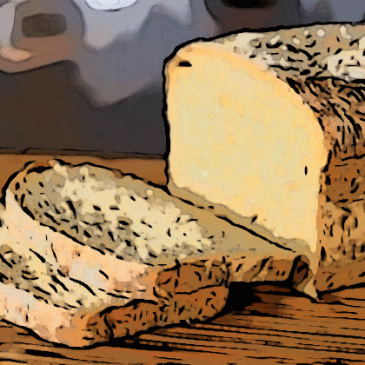
I learned to bake bread as a teenager, and I’ve made it on and off for years, but it’s a time commitment, needing at least three hours and usually more from start to finish.  But we’re home all day now.  I did the math:  I can make two loaves of multi-grain bread, made with nothing else but olive oil, water, and a bit of salt, for about a dollar a loaf.  Plus the electricity. So now, every couple of days, I make bread.  And I love it.

The process begins with the yeast dividing in a half-cup of warm water, scenting the kitchen with promise.  While it’s dividing, which takes about ten minutes, I get out the flour – olive oil and salt sit permanently on our kitchen counter – and the large pizza pan I use to knead the dough on. (It’s easier to clean than the counter-top.) After ten minutes I add a glug of olive oil, a grind or two of sea salt, another 2 cups of water, and three cups of flour.  Then I mix it, with a heavy dinner fork.  At this point, it’s a sticky paste.

Half a cup of flour goes on the pizza pan, and another cup or so into the bowl so that I can start to mix the dough with my hands.  (Before this starts, I put music on – a good reggae song from Max Romeo is ideal.) Then I dump it all out onto the pan, and begin kneading.

The dough feels good under my hands: elastic and alive.  It’s my hands that tell me if I need more flour in the mix, from the feel, silky and resilient, but not stiff.  Usually I end up using between five and six cups of flour to reach the perfect consistency.  I knead for five minutes, hard, pushing the heels of my hands deep into the dough.  When I started doing this, my arms and hands would ache afterwards, but now the muscles have grown stronger.  I dance a little to the music.

After five minutes of kneading I give the dough a last shape into a ball and put the pan either on top of the stove (in the summer) or inside it with the light on (in the winter, when the house is a bit colder) to rise, set the timer for an hour, and leave it to double.  If I’ve got the dough just right, an hour is exactly what it needs; if it’s a touch too stiff, it may need a little longer.

I bake the dough in metal bread tins, well-oiled with safflower oil.  Once the dough has doubled, I give it two or three quick kneads, roll and stretch it out into one long loaf, cut it in half, and put the halves into the tins.  Another hour or so to rise, three shallow cuts on each loaf top, and they go into a 350 degree oven for 50 minutes.  The house smells wonderful.

Of all the cooking I do, there is something elementally satisfying about baking bread, taking a few ingredients to make something so good, whether it’s eaten still warm, dipped in olive oil, or toasted to golden brown and dripping with blueberry jam or honey, knowing that you are participating in an activity that goes back through so many generations.  Sometimes I experiment, adding dried apricots and figs for breakfast bread, or herbs and sauteed onions for a savoury loaf. Occasionally, I have a disaster…and perhaps I’ll tell a story or two about that in another post.