Looking at Advertising

Hot and humid weather meant I did my walking indoors last week, at the local shopping mall. While it doesn’t have an organized early-morning mall-walking club as some do, its doors open at 6:30 a.m. due to the presence of a fitness club on the lower level, and people are free to walk the enclosed and air-conditioned space any time after that.

I entertained myself during my walks by thinking about the advertising that is, of course, splashed everywhere – it is the job of stores to get you to spend money, after all. And at one level I don’t have a problem with it – I can’t, given that I do it myself with regard to advertising my young-adult novel (which you can currently download for free as a promotion – details here). But it’s still interesting and instructive to look at how it’s done.

The advertising fell into one of three broad categories: the straightforward: e.g., 50% off all summer styles; the not-quite straightforward: BOGOs (buy one get one for x% off) fall into that category, in my opinion, and the ‘lifestyle’ inducers (We Sell Adventure). Straightforward descriptive advertising I have little problem with, and I’ve taken advantage of many of those sales myself in the past. BOGOs need a little more analysis.  Buy one, get one for 50% off seems to be the most common now. And it’s fine too, as long as you went shopping meaning to buy two of something, but if it induces you to spend half again as much as you had planned, or, to buy two of something when you only needed one, then you’ve fallen for their advertising. Even more insidious was this one: “Buy more save more.”  Think about it.  You cannot save money by spending it. Deconstruct that ad carefully. If you really need three new backpacks for the kids for school, and the deal is 50% off the second one if you buy two, and 70% off the third one if you buy three, then it’s worth considering. But only in that type of situation. It’s not worth it when it induces you to buy three skirts when you went to get one, and the other two don’t match anything in your wardrobe.

One store had an interesting twist on this. Inside the display windows was the banner for the BOGO – 50% off the second item. Painted on the display window itself, and overlaying the banner, was the “70% off selected items” ad. With all the other visual clutter in stores, to me this looked as if it was purposely designed to confuse, so that the consumer doesn’t remember which offer was which. Interestingly, this advertising belonged to a store whose clientele are more likely to be middle-aged or older (my age), and potentially less able to sort through the multiple, confusing ads. (I realize that’s a generalization, but it’s based on my own experience – the older I get, the more I can’t handle visual clutter.)

The ‘lifestyle’ ads are telling you that buying something will make your life more exciting or you more interesting. Alcohol ads are very good at this, and I’m old enough to remember that these were the primary means of selling cigarettes, so we know they work. But here in my urban shopping mall, these two caught my eye: “We sell adventure,” and “Amazing is in your hands.” The first one was on the window of a clothing store that sells casual clothing with a bit of a ‘northern’ flavour (whatever that means). They are not an outfitter for outdoor sports.  They are telling you, subtly, two things: one, the ‘right’ clothes make you more adventurous; two: that you need these clothes to fit in at the cottage or resort you’re heading to (or would like to look as if you were.)  Ask yourself how true either of these messages are.

Amazing is in your hands,” was – you guessed it – at an electronics store, pushing the newest phone or tablet. Now, I’m a techie person, and this house has two laptops, two iPADs, two iPhones, and one iPOD. But we also still use a VCR, not a PVR, and a DVD player, because they ‘ain’t broke’. The iPADs are a case in point: they are iPAD-2s, and they serve us well. Why would I buy a new one? – the one I have does everything I need it to, including being my primary writing tool when I’m travelling, and it’s considerably sturdier than the newer models. Some of what the newer technology does is amazing – but is it an amazing you need, want, or will use?  Much of what technology does is driven by the gaming market, and unless you’re a serious gamer, you probably don’t need it.

What I’m really saying is this: be conscious of how advertising is trying to get you to buy things you don’t need or actually even want, and, be very mindful of what it is you do need/want when you go shopping. Then use specials to their maximum.  When my health issues last fall meant BD and I needed a way to be in touch quickly, easily, and unobtrusively (he was still a classroom teacher at the time) I knew our new phones would have to be iPhones. BD had just learned the basics of using an iPAD, and he needed the phone to be effectively the same, or he’d abandon it; he is very easily frustrated by technology. I bought the phones Labour Day weekend in the university town, filled with specials aimed at returning university students, and knowing full well the newest iPhone model was due out shortly. The result was I got the phones – the soon-to-be discontinued model- for free along with the cell-phone plans I was going to buy anyway (having done my research, which had told me that bundling our new phones with our existing wireless and home-phone service was going to give us the best price.) So our iPhones aren’t the latest, but, honestly…do I know the difference? I can call, text, Google stuff, take photos and play Scrabble on it, and it reminds me to take my blood pressure pill. That’s more than enough.

I haven’t even touched on the even more subtle messages – the size and colour of the mannequins clothes are shown on; the overt sexualization of small girls in children’s clothing store ads; the co-opting of social justice messages to sell tween/teen clothing that may well still be made in a sweatshop. But if you’re looking for entertainment on a wet or cold or humid day, go to the mall….not to shop, but to deconstruct the advertising.  It’s quite a bit of fun..and educational.

Loving Leftovers, with a bit of help

Leftovers don’t happen to often in our house, because we plan menus in advance and buy only what we need, but on occasion we do misjudge – usually vegetables – this week it’s too many Brussels sprouts and carrots.  Both keep well, so I’ll likely just work them into next week’s menu.  But an article in yesterday’s newspaper caught my attention, making reference to a web-based tool for planning meals around left-overs.  Intrigued, I went looking for more, and found one other that is specific to using leftovers, not just ‘recipe by ingredients’.  Then I tried them out.

The first one I tried is part of the Tesco (a British grocery store chain) website.  It’s a very simple tool to use – you can enter up to three ingredients and it generates recipes.  It couldn’t, however, generate a recipe that used both carrots and Brussels sprouts; it gave me one for the Brussels sprouts, similar to the recipe I buy them for (penne with Brussels sprouts, broccoli and cheese) and many more than incorporated the carrots, from salads to soups to sandwiches and stews.  When I added chicken to the list, the tool focused on the chicken, giving me lots of good-looking chicken recipes but not really helping with the vegetables.

Then I tried Big Oven’s leftover tool. It uses pretty much the same format – you enter up to three ingredients.  I started with just the two vegetables, as before – and got far better results.  It even sorts them into main dishes, side dishes, etc.  One recipe:  for apple-kielbasa bake – will be tried out almost immediately, using turkey sausage.  When I added chicken to the list of ingredients, the site let me choose to be very specific about the chicken, offering me ‘cubed, wings, broth, whole chicken’  which generated more recipes for me to try…I really liked the look of chicken with winter vegetables. (I’d leave the ‘chicken’ choice as just chicken – narrowing it down to ‘cubed chicken’ really limited the recipes, and I can adapt the recipe as needed.)

Another British grocery store chain, Sainsbury’s, has a leftover tool in development.  It would seem that the UK is taking food waste seriously and attempting to address it right from the suppliers.

I’m not really sure that these ‘leftover’ tools differ from the ‘recipe by ingredient’ tools that are out there – I rather think they’ve just been packaged differently.  But if they help with combatting food waste, I’m all for them.  And they gave me two new recipes to try..so that alone was worth the half-hour I spent testing them!

I’m sure there are more tools out there…which ones have you used and found useful?  Please share!

Bedtime Stories

For about a decade between the years 2000 and 2010, I drove (roughly every third weekend) a round trip of about 650 km (400 miles) to visit my aging parents.  The drive – and I love to drive – is not very interesting, to say the least, and the truck traffic heavy for about the first half of the trip.  After that, it improves, and I can pay less attention to the road and more to the passing countryside, but even then….

So I started to listen to books on CD.  My library had – and has – a good supply, and they relieved the tedium of the drive considerably.  I listened to almost anything:  thrillers, westerns, horror, classics – drawing the line only at romances, which just aren’t my cup of tea.

After 2010 my sister and her husband retired from the big city to the little town one east of my parents’ home, and I didn’t need to make the trip as often.  But by then, I was totally hooked on audiobooks, and not just for driving.  They are my bedtime stories.

In the same decade I was doing those long drives I also entered my mid-forties, and all the related mid-life changes that entails.  Sleep became an issue, both from the joys of waking up too hot, too cold, needing the loo, etc., plus I’d changed jobs to one where there were a lot of problems to solve, and I’d lie awake thinking about work issues, too.

BD is extremely light-sensitive, so reading, even with a little book light, disturbed him.  And it didn’t really work anyhow – I’d get sleepy, but then as soon as I put the book down it was back to thinking.  So I tried audiobooks – in those days, using a Discman portable CD player.  Most of the time, I’d be asleep in ten minutes, the ‘thinking’ part of my mind distracted by the story.

It wasn’t perfect.  I had to guess where I’d fallen asleep on the CD and backtrack every time.  But I slept better.  And time and technology moved on; my library started to offer down-loadable audiobooks through a service called Overdrive.  I bought an iPOD, and began to use the service, but it too had issues – a limited number of copies of books, long wait times, many titles I wasn’t the slightest bit interested in.

Then I discovered Audible and its thousands of titles.  Sure, I had to pay for them, but that wasn’t an issue then and sleeping was!  With a subscription, and buying credits in bulk on special offers, I figured I was spending about $5 a week on audiobooks, and that was a small price to pay for better sleep.  And that is pretty well what I continued to use, up until retirement and the need to spend less.

I looked at the library downloads again – they now have two services, Overdrive and the 3M library.  I am using those to some extent.  But my preferred service now is the completely free Librivox.org. These are all public domain titles (titles whose copyright has expired) and they are read by volunteers. And there is a small ‘commercial’ at the beginning of each chapter for the service. Small annoyances – I’ve learned to tune out the commercial (I seriously don’t hear it anymore) and you can search the site for books read by your preferred readers, or to avoid those read by people whose voice just grates on you.

And what a world it has opened up to me! My father was a reader of Victoriana – the Brontes, Dickens, Trollope. I could never read them – too wordy, too convoluted – but I can listen to them with pleasure. One Anthony Trollope novel generally translates to between fifty and sixty hours of audiobook.  That’s a lot of bedtime storytelling, especially now I sleep better, work worries being a thing of the past.

My greatest epiphany was Moby-Dick.  This was the first book I never finished; we took it in grade 11, I think, and I just couldn’t read it.  But listening to it was an absolute delight, the differing pacing and topics and voices of chapters like the movements of a symphony. I am now convinced that many nineteenth-century books were written to be read out loud, and are best heard rather than read.

Now my biggest issue are the books that are just too interesting – instead of making me sleepy, I want to keep listening!  I save those for that long drive…my parents are gone now, but I have a sister to visit, and the road doesn’t get any more exciting.  So I plug my iPhone into the auxiliary jack, adjust the volume, and I’m off.

PS:  It’s possible some of you saw part of this post appear and disappear from WordPress…that was thanks to Pye-the-cat, who walked over the keyboard, pressing the right buttons to Publish, while I was in the middle of writing it.

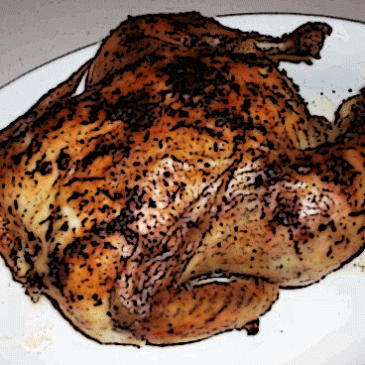
One chicken, four meals.

When we were both working, most Friday night dinners were completely predictable:  rotisserie chicken.  According to a recent article in the Toronto Star, “rotisserie chickens are as ubiquitous as burgers or tacos without falling victim to being dubbed trendy” – at least here in the “Greater Toronto Area”. (As an aside, I can’t help but laugh about that sobriquet – technically my tiny crossroads hamlet is part of the GTA, but what we have in common with the ‘mega-city’ to the east of us continues to elude me.)

Unless it’s a love of food.  Because I’m not talking about the rotisserie chickens drying out under lights at the back of the grocery store.  For $12, I would buy a free-run, clean-fed chicken, rubbed with herbs and olive oil, moist and tender.  They were simply better than any roast chicken I’ve ever made, and at the end of a long week they were satisfying and fast.

One chicken, a bit over a kg in weight (2.5 lb. more or less) gave us four meals.  The first dinner would be just roast chicken:  the leg and thigh for BD, who prefers dark meat; the breast for me. Served with cranberry chutney from Rose’s, a salad and oven fries (BD makes great oven fries, potato chunks tossed in olive oil, black pepper and rosemary, and roasted at 360 degrees for 45 – 50 minutes) that used, roughly, a bit less than half the chicken.

The equivalent pieces – the other leg and thigh, and the other breast, went into the freezer, to be gently reheated over a pan of water in a slow oven another time.  But at this point there was still a lot of meat on the carcass.  I’d chill it overnight, and then on Saturday strip the rest of the meat from the bones, chopping it into small pieces.

These smaller pieces of meat were destined for either ‘poulterer’s pie’: our version of shepherd’s pie created once BD couldn’t eat red meat, or chicken curry.  I’ve never actually written the recipe for poulterer’s pie down, but basically it’s a mix of chicken and vegetables, herbs and spices, in a thickened chicken broth, topped with a mash- I’ve used potatoes, sweet potatoes, a combination of the two, or a combination that includes parsnips; all work – and baked in the oven until bubbly.  It’s a great cold-weather meal.

Once I’d removed the meat from the bones, the carcass is destined to make chicken broth.  Roasting the bones in a slow oven for a while – 45 minutes or so – before making broth does give a richer flavour but it isn’t necessary if you’re using the carcass of a cooked chicken.  I put the bones, a chunk of chopped onion, and a bit of garlic in my slow cooker, fill it with water, and let it cook all day on low.

Once it’s cooked down to about half of the amount of water originally put in, I strain it and let it cool.  The bones are destined for the compost at this point (we have a municipal kitchen-waste composting pick-up here – the town takes it away once a week, composts it at the waste management site, and gives it away in the spring. When we did back-yard composting of kitchen waste, I stopped composting bones because there is a feed mill in the village…and feed mills attract rats…which like bones and meat scraps.  And I don’t like rats.)

I may do one of two or three things with the broth:  make soup immediately; freeze it in mason jars for later use, or, freeze it in ice-cube trays to give me chunks of broth to use when a recipe needs a small amount.  Mostly I make soup, which served with warm bread and pickles from Rose’s often make up Sunday suppers.  We’ve likely had pancakes and sausage for brunch, so a small evening meal is all we need.  And there is usually enough soup left over for at least one lunch.

So there it is:  one chicken, four meals. BD likes these chickens better than the one’s I’ve roasted (I’m not insulted, because I agree with him) so I think we’ll probably continue buying them, once the cool weather returns.  They fit our food ethics – they are locally raised, and I’m supporting a local small business by buying them, and I’m pretty happy with four meals for two from a twelve-dollar chicken.

The weather forecast calls for highs of 19 degrees C (66 F) later this week.  I think that’s cool enough for roast chicken, don’t you?

Staying Focused

An all-too-common question for retirees is ‘what do you do all day?’  And there is the occasional day I think ‘what did I do today?”  But those are infrequent, because I’ve learned that my days need structure, and the discipline to keep to that structure.

Self-regulation isn’t a strong point for me, or didn’t used to be.  Now, I’m fairly good at it.  That is in part what this blog is about; by writing it every morning just after I get up, it focuses me on the things that matter to me, and reminds me why I do some of the things I do.  I guess, in a way, it makes me more accountable to myself.  And I love getting out of bed, making coffee, doing some stretches (often while emptying the dishwasher – dishes are good light weights), and then settling down with a mug of coffee to write for a while.

There are four things I expect of myself every day:  eat properly, stay hydrated, exercise, spend time with BD.  Food shopping and preparation, and exercise, take up about three hours each day.  Time with BD is variable; occasionally there are days when it’s just mealtimes; other days we’ll spend all day together.  Then there are the high-priority daily activities: the on-going house renovations; writing – not just this blog but also work on Empire’s Hostage; the necessary work of daily living – the budget,  housework, lawn care, laundry.

I have stopped multi-tasking, except for listening to music while I drive or cook.  I’m far more productive this way, giving my whole mind to what I’m doing.  I try to structure my time in roughly one-hour chunks, alternating as best I can between a sedentary activity – writing, doing the accounts, watching a game with BD, playing Scrabble – and active ones, mindful of the studies of the negative effects of sitting too long on our health.  So, each morning, generally after I write the post for Two Simple Lives, I map out my day – not just what I want to accomplish, but when.  Do I always stick to it?  No. Sometimes the piece of the house renovation project turns out to need longer that day.  Sometimes errands take longer than I scheduled; sometimes I walk or bike longer than an hour just because the day is so beautiful. Sometimes BD suggests something to do together over breakfast. The code is more what you’d call “guidelines” than actual rules*.

Once self-discipline is in place in one area of your life, it’s easier to extend it:  it becomes a habit.  It makes the goals of mindfulness, of sustainable practice and of frugal living easier.  The map of my day doesn’t restrict me – I can change it at any time – but it does provide check-in points, times to look at what I’ve accomplished and what I haven’t, and review why. It also helps me not overdo something – I may want to keep writing, or keep walking – but should I?  I know there are limits on both my creativity and my energy at any given time.  Going beyond those limits generally isn’t wise. It’s a bit like coffee – I may want that third cup, but it’s going to make me jittery, and less productive. So two cups, and I’m done.

It’s a rare day I get to bedtime and aren’t satisfied with how I’ve spent the day.  And sometimes, all my day plan says is ‘read, relax, have a glass of wine.”  We all need those days, too.

* my favourite line from the Pirates of the Caribbean series.

Hanging Laundry

This is one of my earliest memories.  It is the summer I am three; I know this because of the house in the memory, and where the trees are.  It is the summer of 1961, and I am helping my mother hang laundry outside.  My job is to hand her clothes pegs.  I want to play with them, make them into little people – these are the pegs that are one split and shaped piece of dowel, with rounded heads, not the sprung ones. My mother lets me play; I am being kept quiet, and not wandering, which is all that matters.

Fast forward fifty-four years.  I am standing outside in our garden, not long after dawn on an August morning, hanging laundry.  A red squirrel chitters and scolds at me from the tall Norway spruce, and a crow announces my presence to the wide wild world.  A breeze ruffles my hair.  I am wearing rubber boots against the dew, and long sleeves against the mosquitoes.

Hanging laundry is pure pleasure for me.  I shake out each piece and pin it to the line, listening to birdsong, and the sounds of cattle and geese from the farm beyond the woods that border our garden.  The day smells new, and there is still a pinkish glow in the sky, reflected on the trees.

To be out here at dawn, or just after, I have put the laundry in the washer the night before, at bedtime, and let it finish its cycle and sit until morning.  This both gives me the maximum drying time, and uses electricity at an off-peak time. Small frugalities; habits of thrift.  Even now, in mid-August in Ontario, I can need all day for things to dry – it was cool today, and cloudy, and the drying line is in the shade for much of the day.

Memories.  Hanging laundry on a rope line in a campground in Arizona, where the cotton shirts and underwear were dry almost before I hung them.  Another campground – Texas, I think – where hummingbirds came to investigate the blue plastic clothes pegs.  A line in Botswana, where all items must be ironed after drying to kill the eggs of a fly, laid in the damp cotton.  Ecuador, where things take three days to dry, in the humidity of the rainforest.

We don’t hang everything.  Tree pollen is my worst hay-fever antagonist, and our garden is full of trees, not even counting the woods behind us, so bedding goes in the dryer in the spring.  BD’s cotton shirts come in damp and are finished in the dryer for ten minutes to prevent wrinkles (and ironing).  The outdoor drying season is only about five months long, six in a year of early spring and late fall; the rest of the year we use the dryer.

Outdoor drying means being mindful, paying attention to the weather forecast, and then to the skies, because the weather forecast isn’t reality.  It takes a bit of planning.  But when I went out, this time in shorts and sandals, to get today’s laundry in at five-thirty, the towels smelled like sun and grass.  The water – our well water – that they had held had evaporated off, to become part of the water cycle and return as rain.  I think about cycles and continuity:  women have been hanging laundry in this garden since this house was built in 1911. The robin that is singing and the red squirrel that is chattering are probably descendants of the ones that were singing and chattering a hundred and four years ago. The water from our well has evaporated off wet clothes, condensed as clouds, rained, become ground water, filled our well….how many times?

My mother lived to ninety-three.  She stopped hanging out laundry somewhere in her late sixties, when arthritis and stairs to the back garden made it impossible for her.  But she missed it; missed being in the garden, being out in the sun, chatting with the neighbour across the fence, hearing birds. She hung laundry for much of her life because she had to; I do it for reasons of sustainability and thrift, but for both of us, the pleasure was, and is, greater than the chore.

Reasonably Well-Off in Early Retirement: How Did We Get Here?

Instead of responding to individual questions, I’m going to write one post about our journey to being sufficiently well-off in early retirement. First off, let me define early retirement: I retired six weeks after my 57th birthday; BD, who retired on the same day, was six months short of his 60th birthday. So this isn’t retiring at forty, but nor is it retiring at sixty-five or seventy.

Secondly, let me say that I know we were fortunate in many ways, and this is simply our story. Some of it was luck, and some of it was planning.  I don’t want to sound smug, or patronizing, or that I’m telling anyone how to do this. This is simply how it played out for us.

Thirdly, if you don’t want to read the story-telling version, and just cut to the chase, I recapped in the third-last paragraph!

BD and I met in university in 1978, in my second year and his last year of our respective undergraduate degrees (Now, for both the sake of my non-Canadian readers, and those younger than us, let me explain two things. One is that Canadian universities all cost more or less the same for undergraduate programs; there are not the private universities costing multiples of ten thousand a year vs. less-costly state universities that there are in the U.S.  Secondly, when we were in university, tuition was a smaller percentage of a year’s costs than it is now, so overall university wasn’t as expensive.  We were, I seem to remember, spending about $1000/yr on tuition each and a few more thousand each to buy books and to live, versus about $6000 a year on undergraduate tuition in Canada now.)

Both BD and I had been brought up by frugal immigrant parents. Neither of our sets of parents paid for our university educations. Both of us took a year off to make money before going ahead with university. He’d had very good factory jobs in his year off and in the summers and had no student loans at all; I had one smallish loan from my first year and after that had been able to make good enough money in the summer to not take out any further loans, although I did qualify for some grants, and both of us for some scholarships. BD had enough money saved, in fact, to buy a car (used and very small) at the end of his last undergraduate year; I had gone home for the summer (since I had a very good job waiting) and he wanted to be able to come to see me – and he lived 200 miles away.

We lived for the next six years on part-time work and graduate student stipends, and with hand-me-down furniture and little else. But all our friends were in the same boat, so it was just normal, and we had a lot of cheap fun playing cards, occasionally visiting somebody’s parents’ summer cottage, and going for $0.99 all-you-can-eat spaghetti at a local chain on Tuesday nights. But we actually also tucked away a little bit of money over those years into a special savings program that existed at the time to allow young people to save for a house and gave them a tax break. So the day we learned the little house we were renting had been put up for sale, we could actually, just, buy it, with a 95% mortgage. But, the mortgage payments were cheaper than the rent had been, and we were gaining equity in a rising market.

Grad school ended with a Ph.D for BD and an M.Sc. for me — we defended our theses two weeks apart – and then we did research at the same university for a few years, our tiny salaries being paid from successful grant applications we had written. (Talk about incentive to write a good one!) Somewhere around turning thirty (me, not BD) we realized while this was lots and lots of fun, it wasn’t exactly stable and the long-term prospects didn’t look rosy. So we did some hard thinking and talking about what to do next.

We already knew we didn’t plan to have children. We wanted to do something useful for society, but that would provide us with reasonable salaries and a decent pension. We weren’t interested in getting rich or being entrepreneurs. One of the things we’d both really liked about grad school was being teaching assistants – teaching the seminar or lab portions of classes to undergraduates. High school teaching (we both couldn’t see ourselves with smaller children) ticked all the right boxes.

(Another explanation here…the vast majority of kids in Canada are in public schools, not private or charter schools; in Ontario (all I can comment on) school districts pay their teachers respectably well once you get to the top of the salary grid, there are only minor differences in salary from one school district to another, and the pension plan is defined-benefit:  a guaranteed pension based on years of service and salary, with built-in cost-of-living increases. The result of a respectable, respected (mostly), and well-compensated education system is that is extremely difficult to get into a Faculty of Education to get your teaching degree. You need very high marks, lots of teaching-type experience, and, probably, luck.)

But lucky we were (plus all that grant-application writing stood us in good stead) and in consecutive years (we couldn’t afford to both go in one year) spent the requisite year becoming qualified. And got jobs, with the same school district.  So finally, at thirty-three and thirty-one, we entered the world of real salaries.

So, from 1991 to 2015, we taught – or to be precise, BD taught all those years; I taught for ten and then moved into a regional central-office position, but still directly involved with students and teachers. The pension plan took 13% of our gross salaries, and we put away on top of that every penny we were legally allowed to (it wasn’t much) into Canada’s Registered Retirement Plans, plus we paid off our mortgage by using weekly payments as well as yearly lump-sum payments. By 1993 we were free of mortgage debt, and that was the only debt we had – and we did it by not changing our grad-school life style (except for buying some teaching clothes) for those first two years.  We even only had one car – BD dropped me off at my school and then drove on to his, fifteen miles further south.

Then we took another look at finances and our lives. We sold the little house for twice what we’d paid for it, bought a fixer-upper closer to our schools for double the money we’d got for the little house – but we put 50% down on it, so the mortgage was easy to carry, and a second (used) car. Until this mortgage was paid (it took six years) all our holidays were in tents – some of them for six weeks at a time. BD had learned woodworking and construction from his father, so he (with me as barely-competent help) did the vast majority of renovations to the house.

That first car BD bought back in grad school was a tiny sub-compact, and we’ve never driven anything else except for one – my first used car, a $1000 Chevy Impala I drove for four years. Those sub-compacts – Civics, Escorts and Accents – were all driven to 300,000 km before being traded in; they’ve taken us up the gravel Dempster Highway through the Yukon and Northwest Territories to the furthest northern point you can drive in Canada, and across the US three times (and not on interstates), loaded with camping and hiking equipment.  A standard transmission, decent tires, and front-wheel drive will take you most places in North America.  And we’ve never paid more than $15,000 for any one of them, even new.

We never ever carried credit-card debt, but we put everything possible onto our credit cards in exchange for rewards:  first the Driver’s Edge rebates, which paid for big chunks of several of our cars, and more recently, once we began travelling more, a frequent flyer program which has taken us to many many places.  It’s worth paying $150 a year for a card that means you can both fly to Australia for just the taxes, while it pays for the insurance on the rental car while you’re there, and recompenses you for all your expenses when a delayed flight means a missed connection.

So, when my health took a turn for the worse in 2014, and I realized the stress of my job wasn’t helping anything, we discussed options again, and decided that early retirement was the best thing for me. It didn’t seem fair for me to retire if BD didn’t, so, we crunched numbers and decided we could do it.  The mortgage had been paid for fifteen years; our rural taxes are low; and we’d never forgotten how to be frugal.  What we were giving up was travel, but we had chosen not to wait for retirement for that – we’d seen too many people get to retirement and get hit by heart disease or cancer or diabetes, so we’d spent the last fifteen years travelling, every chance we could – spring breaks, Christmas holidays, summers.  We’d been to all seven continents, most of them more than once.   We had chosen to live on BD’s lower salary, and use mine for savings and travel.  And our combined pension incomes would be almost exactly equal to BD’s salary.

(Now, again, remember, this is Canada.  Health care is free (well, no, but paid for from our taxes), and I am alive and healthy today because it’s also, in my experience,  excellent, as are all our other friends and family who’ve been hit by the nasty and sometimes obscure diseases of middle age.  So health care costs, such a huge concern and expense in some countries – don’t significantly enter into our calculations. That is not to be underestimated.)

Here’s the recap. We got here, after only twenty-five years of actually working at real jobs with real salaries, by the following means:  we never lived above our means, and when we had to defer something – university, a car – we did.  We targeted employment in a field that would be personally rewarding but also pay us sufficiently and had a defined-benefit pension, choosing the long-term view over the possibilities of higher pay, bonuses, or entrepreneurial success (and were lucky enough to find employment in it.) We use credit cards to gain rewards that have real value to us.  As our salaries grew, we didn’t give in to ‘life-style creep’, but instead put the money into the mortgage and retirement savings, again deferring expensive travel until we could afford it.  We didn’t buy “starter” houses with granite and ceramic tile (nor do we have those things now) but instead bought older houses that needed work and put a lot of ‘sweat equity’ into them.  We still drive sub-compact, fuel-efficient cars.

We took a pension hit by retiring early, especially me, as I retired two years before my eligibility for a 50% unreduced pension, based on a formula of age plus years of service.  BD took a much smaller hit, as he was actually eligible to retire at the end of this year. As well, our pensions, by our choice, carry 75% survivor benefits and are set so in the first ten years of pension benefits, the survivor gets 100% of the deceased’s pension to the end of that ten years. We chose those benefits, and they cost us a bit each month, but we wanted to ensure whoever outlived the other had a good quality of life.

This isn’t going to work for everyone.  There is an element of luck in it, and what was possible to do in the 1980s when we were in university isn’t necessarily what is possible today. Not having children is a very personal choice, but one that also significantly affects finances.

Our next (probable) step is to realize the equity in this house by taking advantage of a healthy market in this part of Ontario and moving to the area where I grew up, where my sister and her husband live, and where housing costs are one-half to one-third of what they are here.  We’ll probably then use that available cash to continue to travel, but we’re still analyzing this in more detail.  And keeping an eye on what happens if China devalues its currency again.  Meanwhile, we’re enjoying our (frugal) life -and that’s what really matters.  And that’s what I’ll go back to writing about, after this.

Cheap Dates

BD and I like to go out once a week or so.  Not so much for meals any longer because of his allergies, but for music, or a movie, or to spend time with friends. But there is a budget to consider, so we’ve worked hard (no, let’s re-word that, I’ve worked hard…) to find things to do that are cheap, or better, free.

Luckily, it’s not difficult.  We have a cinema a reasonable drive away that shows first-run films for $5 on Tuesdays, all day, matinees and evening performances; they’ve just recently opened, but already they are pretty busy on Tuesdays.  Their popcorn is the usual over-priced stuff, so we skip that, but my waistline doesn’t need it anyway!  Our other movie option is our local art-house cinemas – two of them – where a yearly $15.00 membership means the films are $8.00, and at one of them, also gives 15% off at the attached bookstore and restaurant.  (And both of these have cheap, good, popcorn.) When you go to a movie a week, as we tend to, the membership pays for itself pretty quickly, even when I do buy popcorn.

In the summer, free music abounds.  The two towns we live half-way between both have (on different days) free concerts-in-the-park on weekday afternoons.  The musicians are up-and-coming local artists, and are generally all pretty mellow, ranging from country to jazz and folk to pop.  But we’re wide-ranging in our musical tastes, and it’s a pretty good way to spend an hour or two, sitting in the shade on a lawn chair, snacks in the cooler, listening to music.

Come the fall and winter, we turn to the university.  Here they run a free concert series on Thursday at lunch time, sometimes student performances from the Faculty of Music (but not usually).  Again, it’s wide-ranging – this fall’s line-up includes Cuban jazz, Celtic harp, and even rock’n’roll.  Parking on the campus is pricey, so we go early, find a side street with free parking, and walk or bike over to the university.

The churches in both towns also host free or very inexpensive concerts – I happen to particularly love Renaissance church music and choral performance – and it’s not necessary to be a church member (or even a believer) to go.

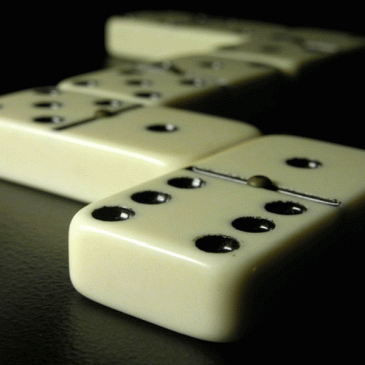
But perhaps our times with friends are the best.  With a simple meal (usually, unless one of us is trying out a fancy new recipe) either before or after our get-together, we sometimes just talk, but our most frequent activity is a board game.  Right now we’re heavily into playing dominoes, but it varies: sometimes cards, sometimes a trivia game, sometimes an obscure geography game called Ubi.  Or we’ll go for darts, or skittles, or a really obscure (for North America) English bar game called shove half-penny (pronounced shove-ha’penny.)  I have the board my grandfather made about a hundred years ago, and every so often we bring it out.

And of course, there’s always the afternoon watching the game on tv, with a large bowl of home-popped popcorn and a beer.

MOOCing along: The Pleasure of (Free) On-Line Learning

This is an expansion of a post on my writer’s blog, Wind and Silence, so if you read that too, you’ve pretty well read this post, although there are a few differences.

In an earlier post, I wrote about how I sought out community and intellectual stimulation during my house-bound period last winter, following surgery, through becoming involved in Project Feederwatch. In that post, I mentioned there were other ways I found what I needed, and, because this also relates to one of my themes of being frugal, I decided it was worth writing a post about.

I subscribe to a site called Lifehacker on my Facebook newsfeed. Originally I started reading it because it often had technology-related reviews, ratings and ideas,which I needed for work. But then some time last summer, there was a post about free, on-line education.  Intrigued, I looked at it, and found a link to FutureLearn. Associated with the Open University in the UK, this completely free educational site offers dozens of courses on subjects as diverse as Global Food Security, The Works of Gabriel Garcia Marquez, and The European Discovery of China.  Universities from around the world are involved in the design and teaching of the courses. All you need to sign up is a computer and the internet.

I browsed through the course offerings, with, of course, an eye to courses that would increase my understanding of the Roman Empire, the historical template upon which the world of Empire’s Daughter rests. As I wrote in an earlier post on Wind and Silence, my understanding of my created world needs to be thorough, or I can’t write about it convincingly.   Two caught my eye: Hadrian’s Wall:  Life on the Roman Frontier, and, Archaeology of Portus:  Exploring the Lost Harbour of Ancient Rome. These looked promising, and the Hadrian’s Wall course’s timing was perfect – it would start soon after the surgery, but not immediately, so I had time to be able to handle sitting with my laptop again.  So I signed up for the it – we’d been to the Wall a couple of times, the most recent just over year before, and in that case specifically for research for the book and its upcoming sequel. I’d learned a lot from visiting the museum at Vindolanda, as well as just walking the Wall and thinking about what it was like to be a soldier there in the second century A.D., on a cold, damp, windy March day, waiting for your relations to send you more socks.

I’d taken on-line courses before, in relation to my work, so I was prepared for the basic format of readings, videos, questions to be answered and on-line discussions to occur. The course was well-designed and fun; I learned a lot, but the (for me) unexpected benefit was the literally hundreds of viewpoints that were expressed.  These courses are what are known as a MOOC – a Massive Online Open Course – and can have many, many participants.  Not everyone is very vocal, of course, but the wide range of experience, background, imagination and world-views of the participants who did express ideas made me think – not just about Roman Britain, but about my imagined world, and, some of my own preconceptions. It was rich discussion. The result is that some of what happens in the next book(s?) has been directly influenced by this community of learners (in both courses) who were willing to share their knowledge, ideas, and expertise with each other. I hope I remember to thank them all in the author’s notes!

There are, of course, lots of other opportunities for free or low-cost learning (the Lifehacker link is a good place to start) and I’d be interested to hear what others have found.  FutureLearn is just one place you can find free courses, and I’m waiting to hear if another on-line course that looked intriguing is to be offered again, this time through a different provider, Coursera.  My local Senior’s Centre…(yes, it appears I qualify, being over 55, although there is part of me that doesn’t believe this…) offers a number of no-cost face-to-face programs this winter. I am, actually, overwhelmed by choice, and have to be mindful, to stay focused on courses that will inform my writing…and leave me time to actually write.

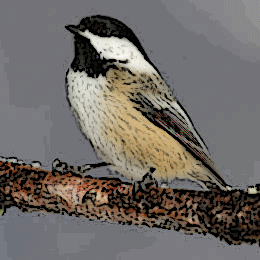
In Praise of Chickadees

It’s a hot, sunny August morning, and there is probably something else I could be doing, but instead I’m sitting in the sun-room, watching the ruby-throated hummingbirds at the feeder.  There are at least two:  a male, and then one or more juvenile/female-plumaged ones, which could be his offspring or mate.  I think offspring, because he keeps driving them away. There is another feeder, around the corner, situated to be seen from the kitchen window, and occasionally the male flies off to patrol it, letting the juvenile beeline in to feed.

In mid-August, other birds are beginning to appear, landing on the feeder pole and investigating all the arms, looking for the seed feeders they know were there last winter.  Chickadees and goldfinches, mostly, and the occasional blue jay.  We’ll put the seed feeders back up October first; there is plenty of wild food around for these birds, including the sunflowers planted along our fence.

I’ve walked on every continent on Earth to see birds, and I’ve seen literally thousands of species. Some stand out over others:  the Adele penguins on the Antarctic peninsula; Siberian cranes on the Yangtze wetlands in winter; the California Condors over Big Sur; the huge, shy, Great Argus of the Malay peninsula.  I’ve birded in places you wouldn’t think there would be birds:  in the heart of Paris, on the hills above Hong Kong, in downtown Buenos Aires.  I’ve seen the wonder of the sandhill and snow goose migration on the Platte in March; the dance of prairie chicken on the hills at dawn, the mating flight of woodcock in the wet fields at the edge of our village.  But while these have been wondrous, and I am filled with nothing but gratitude and awe that I have been able to see them and so much more, nothing quite makes me smile like a chickadee.

They are such cheerful, curious optimists.  Yes, I know this is anthropomorphism.  Yet there they are in August, landing on the feeder poles, buzzing their questioning chick-a-dee-dee-dee.  If I go out, they won’t fly away; I’ve had them land on me in the garden as if I were a moving tree.  On a minus twenty February morning, as soon as the light begins to filter through the darkness, they’ll be there.  If the feeders are empty, believe me, they tell us, and they’ll fly around my head while I fill them, landing on the hanging feeders before I’ve even put them up again.  The cats – who are strictly indoor cats – sit at the windows and chatter, tails lashing.  When the chickadees come to sit in the bushes under the sun-room windows, Pye and Pyxel are balls of pent-up, frustrated energy.  (But can these two catch the odd white-footed mouse that finds its way into the house?  Of course not.  They are the cat equivalent of armchair quarterbacks.)

Last fall, after major abdominal surgery, and through the weeks of recovery, further treatment and more recovery, the bird feeders – or more precisely the birds at them – were one of my joys.  Prior to my weeks off work, I’d only been able to watch the feeders on weekends once daylight savings time ended, since I left for work in the dark and got home in the dark, and weekends were inevitably filled with chores and errands, so we got brief glimpses here and there of what we were feeding. Sunday brunches were the only times we’d really get to watch.

To focus my watching, I signed up for Project Feederwatch, through Cornell University.  A huge, on-going citizen science project, my part in it was to watch the feeder for at least part of two consecutive days a week, and record the species and numbers I’d seen.  It was great fun, as well as being informative and producing a few surprises, like the flock of nineteen wild turkeys who appeared mid-morning every day to pick up the seeds scattered by the small birds.  More than that, though, for the weeks before my surgeon permitted me to drive, and the weeks before BD felt comfortable letting me go for a walk on my own, it was my daily connection to nature, to the change of the seasons and the living, breathing, wild world.

It was also two other things: community and intellectual stimulation.  One of the things I worked on during my weeks ‘home alone’ was about creating, or rather recreating, both of these, in a different form than they had taken before. My friends were hugely supportive, driving me to doctor’s appointments before I could drive myself, taking me out for lunch, just visiting.  BD, of course, was there evenings and weekends. But I was used to a work environment, where there was always someone who needed to talk to me, or I needed to talk to, in person, by phone, by e-mail, and there was always a problem to be solved, a situation to be mediated, new hardware or software to be reviewed, tested, analyzed.  And so I set out to recreate a smaller version of that – I didn’t want the constant interactions; even at work I had long ago learned to close my door, or drive out to the furthest site I was responsible for, to find some solitude and thinking time. Nor did I want to pursue anything that looked like the work I had been doing – it was a vocation, not an avocation, and I knew I was retiring.  But I did need to use my mind, and to talk to people. All the edits on Empire’s Daughter were done, so the frequent e-mails to and from my editors had ended.  The new book was just an outline, and on my best day I can only write for about three hours.  I was determined to find other ways to use my mind and be connected to people, and I was, temporarily, housebound.

By finding a place in on-line communities – not just through Project Feederwatch but through other means (which perhaps I’ll write about another time) – I satisfied both the need for interaction and the need for intellectual stimulation.  Everything I worked on last winter was time-limited; I knew that once I’d recovered, I’d likely want to spend less time on these projects; I can sign up for Project Feederwatch again this winter, or not, depending on how we decide to spend the winter.  But the project gave me more than either community or intellectual stimulation, and perhaps this last thing is the most important.

I’ve been watching birds for about forty-five years, but this was the first chance -or at least the first opportunity I’d taken – to watch in a different way; to watch the details of how the birds interacted with each other; to sort out the apparent pecking orders within and among species; to note the fine differences between how a chickadee and a goldfinch picks up seed.  I learned to identify specific birds through minor variations in plumage, and I studied the gradations and differences that sorted out the species of redpolls, before the boffins decided, on the basis of DNA, that they’re all one species, regardless. Just when I’d got good at it, of course.

Learning to watch the birds differently, paying attention differently, is a distillation of much of what I have been working towards – to be more mindful of what is important to me, to slow down and see, to live here, now, understanding the landscape and ecosystem and community in which I live and am part of.  T.S. Eliot said it far better than I ever could, in his magnificent poem Little Gidding:

We shall not cease from exploration
And the end of all our exploring
Will be to arrive where we started
And know the place for the first time.

Perhaps I have just begun to know chickadees.