Acrobatic Accipiters

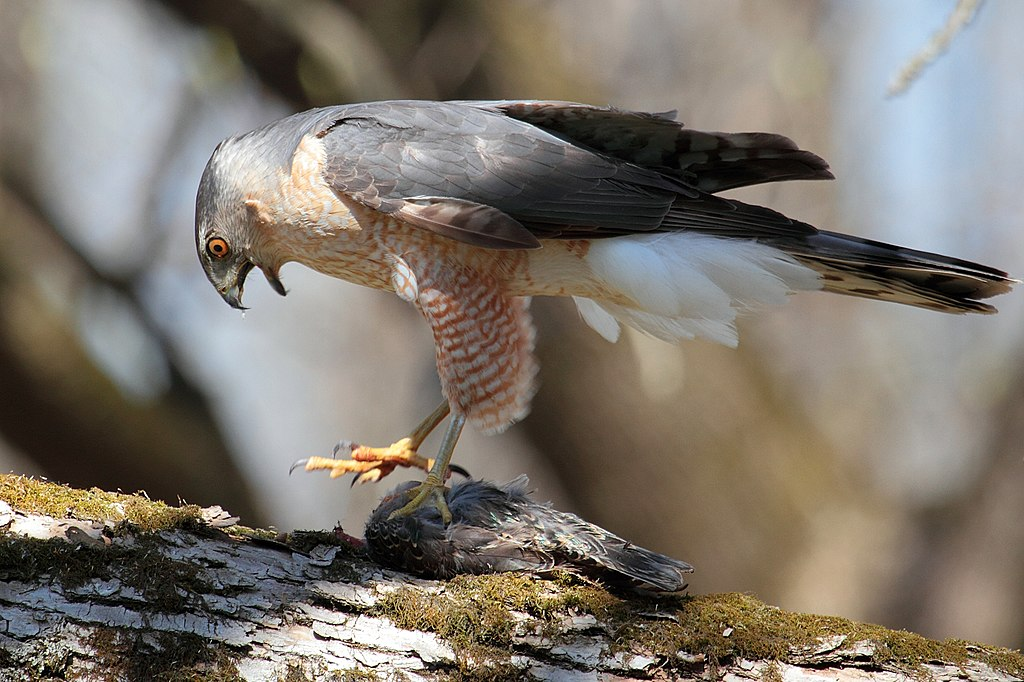
Cephas, CC BY-SA 3.0 https://creativecommons.org/licenses/by-sa/3.0, via Wikimedia Commons

Our bird feeders, caged to deter squirrels and greedy grackles, attract mostly finches and chickadees, both nuthatches of northeastern North America, and the occasional downy woodpecker, all small enough to slip between the crossbars of the cage.  The eat an expensive diet of hulled sunflower seeds, and so there are frequently no empty perches. The feeders are also on the hunting route of an accipiter. From it size and tail and the flatness of its head, I’d say it’s a Cooper’s Hawk, the medium-sized accipiter of North America.

Accipiters are wily hunters. They learned early in their interaction with settlers and their chickens to use buildings to spring surprise attacks on the free-ranging flocks, whipping around corners to pick off young birds and earning them the sobriquet ‘chicken hawk’. We saw this behaviour at our previous house, where the hawk would use the space between our house and the neighbours as a hidden route to the feeders, taking—at speed—a too-late-startled cardinal off the tray feeder before the bird had a chance to do more than launch itself into the air.

At this house, the first accipiter to find our feeders used a simple but crafty technique: swoop in and scatter the finches. One, panicked, would almost always hit the window or the patio doors. The hawk just picked the stunned bird out of the air as it fell, returning to the nearest tree to pluck it.

I’m not sure how often the hawk hunts at our feeders: I’m not in the living room that often during daylight hours. I wander into the kitchen to make coffee or tea, or empty the dishwasher, little movement breaks from my desk, and I’ll see the hawk once or twice most days. Most of the time it is unsuccessful in its attack, but every so often it takes a finch. I think we’re just one fly-through lane on its daily patrol of the neighbourhood feeders, a place for a quick snack to energize it before it goes after a larger meal of mourning dove somewhere else.

But how it gets that quick snack is something new to me. The caged feeder hangs from a tall pole. The hawk flies in low, turns upside down, and hooks its talons onto the bottom of the cage. Then it reaches in with one foot and pulls a goldfinch off its perch. It reminds me of the hunting technique of the gymnogene, or African harrier-hawk, which pulls nestlings and eggs from cavity nests with its talons.  Somehow, this particular southern Ontario Cooper’s Hawk has learned this is a successful technique.

I haven’t read or heard of other accipters doing this, but surely ‘our’ hawk isn’t unique?

Thirty-five Years Ago

The world was shades of copper and bronze, the sand of the desert glowing pink in the dawn light. Wisps of clouds over the mesas reflected the glow of the rising sun. It was already hot, the sky as it lightened a clear blue, the only sounds the rasp of ravens. Overhead, a long V of birds crossed the sky: not geese, long necks, long legs, birds the colour of the desert sands. We stood by our car in the Texas dawn and watched them fly south, heading for the Gulf of Mexico and their wintering grounds. Sandhill cranes, birds we’d never seen before, birds that the great American writer Aldo Leopold predicted would disappear: “the last crane will trumpet his farewell and spiral skyward….” (Marshland Elegy, 1937). In 1987, fifty years later, the populations had just begun to increase. We knew we were watching something special, something that could have been lost to the world forever.

Image by Jason Gillman from Pixabay 

We were there in Texas in November because in ten days, we were both due to be giving graduate student papers at the American Society of Agronomy conference in Atlanta. With our theses supervisors’ blessings, we had taken two weeks holiday prior to the conference, and had driven our Honda Civic, laden with camping gear, south. Two days of steady driving; on the third morning, we left the last green fields behind and drove into the vast deserts of southern Texas, a world completely alien then to us both, and filled with birds we’d never seen.

It seemed that November that we could barely drive a mile without stopping. The fences were full of sparrows; the cactus and sage full of wrens and thrashers. In a little wash along a highway somewhere we stopped to scramble down the side to see what might be found in the green scrub along the side of the tiny creek, and found our first wild turkeys. Bay-winged hawks (Harris’s hawk) or Swainson’s were on every utility pole, it seemed. At dusk of the same day that had started with sandhill cranes in the dawn, we stood at the Rio Grande, where it runs between huge, bare cliffs, and heard for the first time the haunting, sorrowful descent of the canyon wren’s song.

There were so many ‘firsts’. Some stand out without recourse to notes: the Say’s phoebe at the headquarters of Big Bend National Park; the vermilion flycatcher in a stand of cottonwoods in the same park. The “King-Kong-fisher” (the ringed kingfisher) at Bentsen-Rio Grande State Park, and the tiny green kingfisher on a creek at the Santa Margarita Ranch – a Spanish land-grant ranch, held in the same family from the years when Texas was part of Mexico, not the USA; to enter, you drove in, honked the horn, held up your binoculars, and paid the non-English-speaking old woman who came out from the ranch house two dollars. Green jays and plain chachalaca. Crested cara-cara. And from a boat, where as Canadian visitors we were given the best seats, the last flock of migratory whooping cranes in the world, wintering at Aransis.

Seeds were sown that trip; not just the seeds of birding further afield, but those of a love for cranes. From that first V of sandhills in the dawn, and the fragile tenacity of that flock of whooping cranes began my connection to these birds; birds of grassland and wetland, wanderers of the great plains of the world. The ‘Birds of Heaven’* would take me to the Platte River in March and the muskeg of Manitoba in July; to South Africa, to China, to the Norfolk Broads. Ten springs ago, just north of the tiny southern Ontario hamlet we lived in at the time, I stopped the car in wonder and joy: in a field of corn stubble, four sandhill cranes were feeding. I was looking, with tears in my eyes and my hands shaking, at birds not seen in my locale in the best part of a hundred years. Aldo Leopold was wrong, on this. I am thankful beyond words he was, and I believe he would have been, too.

The Birds of Heaven is the title of Peter Matthiessen’s beautiful book about his travels to see the cranes of the world.

A Long(ish) Walk

November 10th, and the forecast says warm and sunny. It is, I suspect, the last warm day of the year, and I’m not going to waste it. The wind gusts are forecast to be 35 – 40 kph, however, so it’s not a biking day. I decide, on the spur of the moment, to walk to Riverside Park along the river trails.

Brian joins me for the first part of the walk through the Arboretum to the Eramosa River trail. We follow the paths through Wild Goose Woods, then the old gravel pit and on to Victoria Woods. It’s quiet, aside from the drumming of a hairy woodpecker, the occasional chirp of a junco, and the familiar, cheery call of chickadees. We cross College Avenue, walk up the gravel road, and turn off onto the new Arboretum Side Trail that links the Arboretum trails with the river trail. Where it comes out on Victoria Road, just north of the bridge, we part company: Brian to walk the eastern trail section out to Stone Road, I to head west towards the confluence and the Boathouse.

Lots of dog walkers out, as usual, on this part of the trail. But good dogs, ignoring me. At Lyon Park I leave the river, cross York Road, and walk up through the Ward along Ontario Street to downtown. I’m cheating a little, not staying on the river, but it saves me a couple of kilometers—and anyhow, I like the Ward. We used to live here, and its eclectic mix of houses, old stores that are now houses (some with the signs, painted on the brick, still visible), big vegetable gardens, and old factories being converted to apartments still feels a bit like home.

St George’s bells are ringing ten o’clock when I reach downtown. I’ve been walking nearly two hours; it’s time for a coffee break. My favourite café is closed for renovations, so I choose another on the other side of St George’s Square and settle down with a café latte and an almond croissant. Not too long a break, though, or I’ll stiffen up.

So it’s not too long before I’m up and moving again. Down to Goldie’s Mill Park, and now I have a choice. The paved trail that parallels the railroad tracks out to Speedvale, or the Rapids Side Trail, a hiking trail that drops down to the banks of the Speed? It’ll be rougher, and a bit rugged in places…but it’s right at the river. If there are going to be birds anywhere, they’ll be at the river. I turn onto the blue-blazed side trail.

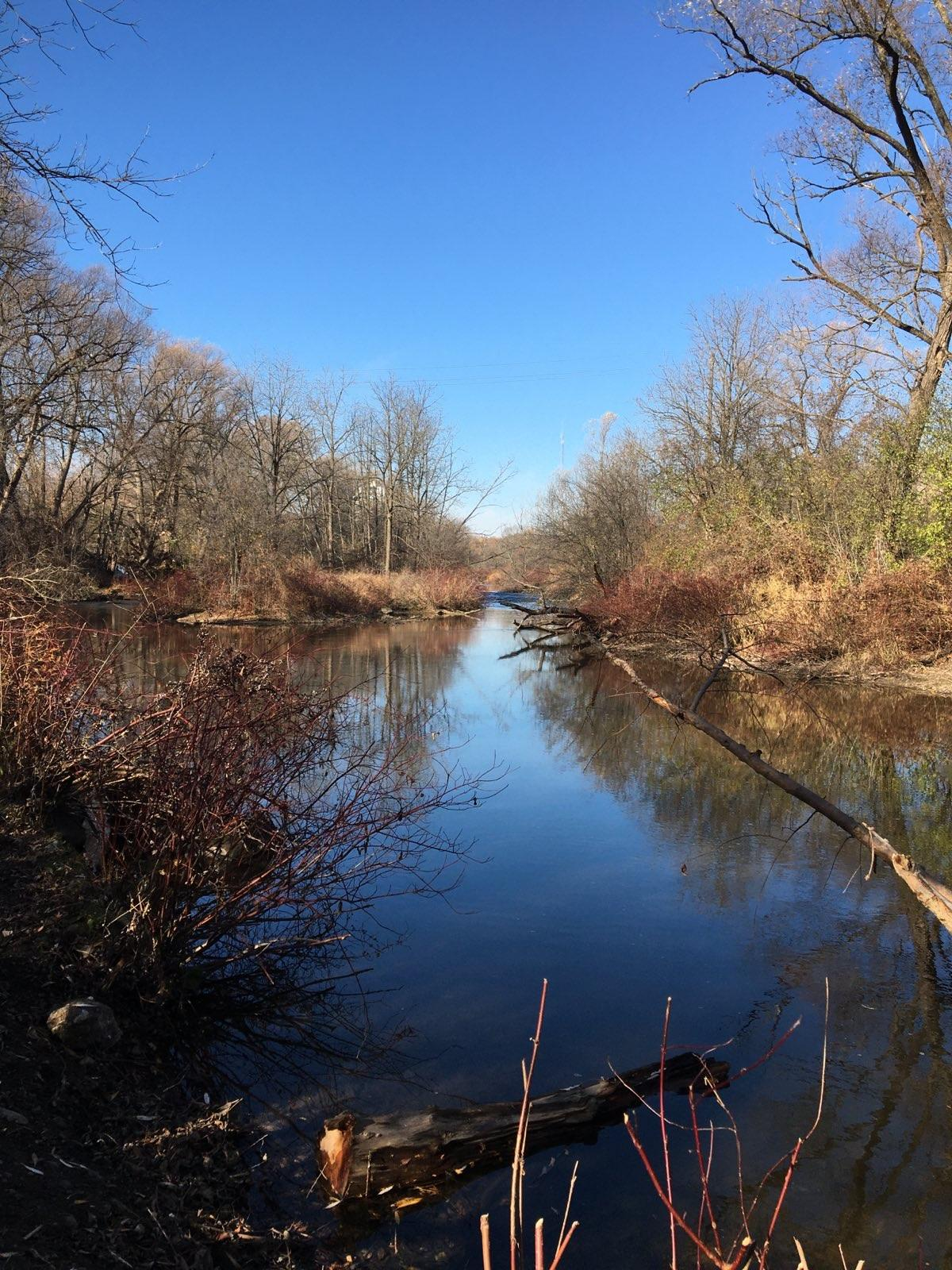
Speed River from the Rapids Side Trail

There are juncos and chickadees, and two squabbling downy woodpeckers, and a host of Canada geese and mallards on the river. It’s hard to believe I’m in the middle of Guelph. It’s a lot more interesting than the paved trail it parallels (as much as I like biking that one!) At a marshy area a few hundred meters before Speedvale, the path turns back to meet the paved trail.

I cross Speedvale in a break in the traffic, and now I’m in Riverside Park. Slowly, because my feet hurt by now, I walk along the bank of the river, looking at the gulls and waterfowl. There can be unusual ducks here, but not this year. I make my way up to the footbridge, cross the river, and find a bench to sit on for a while. I’ve walked about 10 km, on a whim.

But I take the bus home!

(P.S. -regardless of what Google Maps shows, it took me a bit over three hours, not including breaks.)

Drawing a Squirrel

It’s been five years and more since I wrote anything here. Two Simple Lives started out as a blog about early retirement, about learning to live with a (little) less, about appreciating the small things in life after a life of extensive birding travel. When I started it, my first book had just been published. When I stopped writing it, my second had just come out. For the last five years, most of my life’s been taken up, one way or the other, with being an author.

The seventh book comes out in six weeks. I loved writing it, the challenge of a difficult voice, the interweaving of two very different stories. And during the height of the pandemic, writing kept me centred and purposeful. I’m not about to stop: there’s one more book in the current series to write, and the glimmers of an idea for at least one after that.

But this week I made a list of all the things I’d like to do. It’s an eclectic list:  draw squirrels and birds and leaves (why squirrels?); write poetry again; look at maps; read a lot more; cook creatively. All things I used to do. On top of that, there’s no denying we’re living in challenging, difficult, times: the climate crisis; the erosion of human rights in every country; increasing intolerance and division; soaring inflation.  I feel a need to respond to these, even if it will be in small and local ways. (And without preaching about it, don’t worry.)

I tend to get restless every five to six years, wanting a change. Most of this year’s been spent working out what that change needs to be. What it came down to (I think – only trying it out will tell) is that I don’t want to be a writer with a few snatched moments for other interests on the side: I want to be the birder/walker/biker/artist/landscape historian who also writes books. Which is who I was, before.

I make sense of my world through words (except when it’s maps, but that’s a different subject), so I must write – just less fiction for a while, and more observations and thought. For those of you who want that last book of Lena’s story – it’ll come. Just a bit more slowly, probably.

I hope some of you enjoy what ends up on this blog, although that’s not why I’m writing it. Book reviews and articles related to writing will remain over at marianlthorpe.com.  

And now, I’m going to go draw a squirrel.

Image by Peace,love,happiness from Pixabay 

The Moving Diaries: What the Cats Think

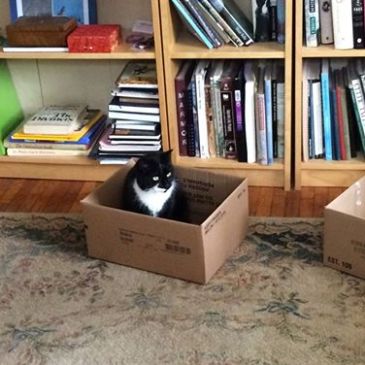
Today we culled and boxed the books from the library, a herculean task that took hours and has left us with boxes to be moved, boxes to be donated, boxes to be recycled, and empty shelves. And one very unsure cat. (Mind you, we have two cats, but more about that in a bit.)

She is sitting in boxes, sitting in empty shelves, watching every move, stalking around investigating everything. The last time we boxed up all these books, we were renovating…and then half-way through that summer I had major surgery, and returned to be in bed much of each day for a few weeks – something she thought was the ideal way to spend time. Is she remembering that? Or is she remembering being cloistered in the attic for most of each day while we wall-papered and panelled and painted? Whatever is going on in her little black and white head, she knows something is different, and she’s not sure she likes it.

Pye, a.k.a. Fur-for-Brains, on the other hand, is oblivious. Completely and utterly oblivious. As long as her favourite chair is there, and she can sit on BD’s lap while he watches football (soccer), or on my ankles when I sit on the couch in the evening, she’s happy.

As I write Pyxel is sitting in the lid of one box with her head inside another, wondering whatever cat brains wonder. I know she’s upset, because she’s given up on almost all her routines, and this is a cat who lived by routines. She’ll be the one at the new house who will hide, and come out tentatively, creeping out to peek around corners and plaintively meow at us. Pye will be unhappy, but her need for human companionship and contact will outweigh the scariness of a new place. At least, that’s my guess. I’ll let you know in mid June.

Meanwhile, we’ll keep filling boxes, and living in almost-controlled chaos. The new house has had the electrician in to move services (are all electricians garrulous? I was there with him over six hours and I swear I heard his entire life story and much more…a nice man, but could he talk!), and the broken baseboards and the horribly-installed quarter-round replaced by the renovation crew. The painter starts Monday. We move on June 8th. I haven’t started screaming, yet. Bets on when I start?

The Moving Diaries: Phase 2: Juggling Two Houses

We took possession of the new house on April 29th. It was mid-afternoon before the lawyer’s office called to say everything was done; we immediately drove over to take another look at the house, inside and out.

It’s an opportunity that doesn’t come very often in a life, wandering around the new living space, thinking about wall colours, furniture placement, what will go in the kitchen cupboards. In our thirty-eight years together, we’ve moved five times before: three apartments, two houses. This is the first time the move is to a house that needs only cosmetic upgrades, and the first time we have enough money to make the changes before we move in.

Yesterday and today I cleaned, the kitchen, pantry and bathroom cupboards: everything else was spotless, but these needed a better cleaning than they, for the most part, had had. BD put up shelves in the basement, and took down the curtain rods and runners: we prefer blinds. We bought a couple of new light fixtures, and new knobs for the kitchen cupboards, and collected paint samples.

And now we’re kind of in holding mode. Tomorrow we meet with the person who will measure the three bay windows for blinds, and the day after with the contractor who is doing the painting and minor repairs that are needed. Thursday we meet with another contractor, this one to choose the gas fireplace we’re having installed. We’re hoping the timelines will be such that we’ll be able to move in at the beginning of June.

But until this work is done, we can only move so much stuff over. The basement is getting things that are of low priority (like boxes of Christmas things, and winter boots, and the picnic basket) and the garage is the repository for the boxes that need unpacking fairly quickly. Now the cleaning is done, we actually need to spend more time here, sorting and packing, and then making runs to town to drop off things at the charity shop or the new house. But the temptation to go to the new house is so strong!

I’m also making endless lists. Things to ask the contractors. Things to bring over – tape, magnets for the fridge, teabags. Things to consider – can we replace the track lighting near the kitchen island with a different type of fixture? We won’t know until later in the year, when it’s dark at meal preparation time. Will the north-facing deck get enough sun to need a sunshade? Again, it’s too early to know: the two trees shading it haven’t leafed out yet.

And at the other end, we’re waiting to hear if the person who wants to buy this house can get the financing. I make other lists for this house: what needs fixing, where I need to send change-of-address notices. Reminders to get the well tested, the septic tank pumped, the insurance changed.

It’s a lot of work. But yesterday, taking a break from the cleaning, I walked out the door, got on my bicycle, and biked the short distance over to the Arboretum. I locked my bike to the rack provided, and walked for an hour, listening to the birds, taking pictures of spring wildflowers, watching a raccoon (this one where it should be, and not in our chimney!) hunting through the mud at the edge of pond for food. The Canada geese nesting on a hummock in the swamp have goslings now: I stood on the boardwalk and watched them exploring their brand new world. And then I unlocked my bike, and five minutes later I was back home. It’s definitely worth the work.

Eating (semi)well on the road.

We’ve just returned from a two-week road trip through California and southern Arizona, a trip booked long before the idea of buying a new house entered our minds. Nothing was going to happen with the house purchase in those weeks anyway, so there was no reason not to go.

Since the days of our six-and-seven week road trips, where we mostly camped, took a cooler with us, and bought groceries, several things have changed. One, of course, is that we were flying and renting a car. Secondly – and most importantly – are the food allergies/sensitivities BD has developed. It’s really difficult to find food he can eat, and even more difficult to find restaurants he can eat at. His allergy is to a specific fatty acid – lauric acid – which is found in red meats, most fats, coconut and palm products, all dairy, and some spices. It makes him break out in hives, big nasty hives which even extra-strength Benadryl only somewhat controls. So we need to be very careful about what he eats.

We could have bought a cooler in California, shopped for groceries, and eaten at parks and picnic stops. But there were a couple of strikes against this: one is that, for the most part, it was too cold to do this comfortably – we had snow in the foothills in Arizona! – and the second strike was just that we wanted more ease. We’ve done our share – more than our share – of eating in wind, rain, cold, searing heat and annoying insects, or perched on the side of the bed in a hotel room. Frankly, I’ve had enough of that.

Subway is one chain we know is safe for BD, if he sticks to chicken or turkey, but a constant diet of Subway grows old quickly, plus the sodium content is pretty high. We decided to try Denny’s, the classic diner chain: their available nutrition information is good, and they have something extremely difficult to find in US restaurant chains: reasonably sized meals, if you order carefully.

For dinners, we mostly stuck to the 55+ meals, eating a salad (with no cheese or dressing for BD), fish or chicken with broccoli and another vegetable – corn for me, squash for BD – every night. With unsweetened iced tea, the calorie count was around 650, the sodium, fat, and sugar content low for restaurant food, and there was nothing in the spices or preparation that triggered BD’s allergies. Breakfasts were fairly easy too: ordering a la carte, BD ate poached eggs on dry toast, oatmeal, and fresh fruit every morning; I had the same, or sometimes yogurt instead of the oatmeal. Again, the meals ran in the 650 calorie range, and it was easy to avoid the dairy and oil that would have been a problem. And we both appreciated comfortable booths and table service, especially after a long day, and in the morning when I’m not human before that first coffee.

It was also quite a bit of food. Neither of us were terribly hungry at lunch time, even after hikes of several hours most days. We’d found an energy bar by KIND that BD could eat without problems, so lunches tended to be an energy bar and an apple. BD would add a handful or almonds or peanuts; I’d add a latte if there was one to be had. If we walked a lot, sometimes we had a second energy bar, or more nuts.

Not every meal was eaten at Denny’s or Subway. We ate a couple of breakfasts at little cafes at Morro Bay and Cayucas. We drove to Oxnard (twice) specifically for fish and chips at Sea Fresh, which fries in peanut oil (BD had a double order of chips, it was such a treat.) Only something at Olive Garden triggered any reaction in BD, and it was mild, so a trace of oil or spice, most likely.

I celebrated my 58th birthday while on this trip. We debated a special dinner, but I didn’t particularly want that: what I did want was ice cream, as it was an unseasonably hot day (the only one of the trip) at Point Reyes National Seashore north of San Francisco. I usually avoid eating ice cream in front of BD – it seems cruel, when he can’t eat it any more – but I made an exception for my birthday. And in the little general store in Inverness, California, not only did I find my favourite Haagen-Daas chocolate-coffee-almond bar, but a lime gelato bar with no dairy that BD could eat (and he loves lime). We sat at a picnic table overlooking the bay and ate our treats, enjoying every frozen bite.

We were pleased with the trip – not only did we find the two birds we went to see around San Francisco, ones that have been eluding us for thirty years (because they are found by call, and they only call during breeding season, and that was always while we were working) – but we ate fairly nutritious food and didn’t trigger BD’s allergies. We went for long walks, watched dolphins and sea otters and seals along Highway 1, heard coyotes singing in the dusk at Yuma and watched the sun rise over the mountains. A good holiday. Now back to the realities of packing up this house for the move. Stay tuned!

Belonging

Growing up as a child of immigrants, the stories you hear of ‘home’ are usually tinged with nostalgia, seen through the rose-coloured glasses of memory. I can’t say this was true of all my parents’ stories – they had lived through the depression and World War II in Engand- but the ones that stayed with me the most were their stories of long childhood walks through the countryside, roaming footpaths and hedgerows, free and unsupervised.

My own childhood in Canada was as free as most childhoods fifty years ago were, and living at the edge of a village there was freedom to roam the farm lanes close to us, the farmers turning a tolerant eye to our activities, and we certainly bicycled the quiet roads around us. But at the back of my mind, it just wasn’t the same. I had grown up on Enid Blyton and Arthur Ransome, and I wanted footpaths and moorland, quiet hedged lanes, little villages hidden in folds of the hills…and as I grew older, a welcoming pub to stop at.

So here I am, nearly fifty-eight, writing in the sitting room of our holiday cottage that we’ve taken for January and February, back from a walk that ticked just about every box on that list. We set out just after nine this morning, turning right up the lane at our front door. A few hundred meters up the hill a gate opens onto a field and footpath, climbing further up the hill, skirting field margins to bring us out onto a quiet lane. A barn owl is hunting in the field to our west. At the top of the lane, the wide Norfolk views open out; to our west is the broad expanse of the Wash, its flocks of waders and waterfowl visible even from here, the coast of Lincolnshire shimmering in the distance. To our east, fields: field peas and sugar beet, wheat stubble, autumn-ploughed fallow, cut with hedgerows and lanes.

We walk in a northerly direction, following paths and bridleways, along field margins and old drove roads through farms, coming out into villages. The sky is changeable, clouds scudding in the strong westerly winds, patches of blue winking in and out. Hedges, green with ivy, keep the worst of the wind off us except when we the route takes us due west. Grey partridge scatter in front of us, calling their distinctive rasping cry.

After about six kilometers the drove we’re on swings west, past a substantial farm, and then south again for a few kilometers, coming out by a magnificent medieval church perched high on the greensand ridge that runs up the coast here. On a bench outside the church wall we sit for a snack, looking down over the village. It doesn’t do to sit too long, though: we’ve another three or four k to go, and tired muscles ‘set’ all too easily. We walk through the village streets, past the old watermill, and on to the footpath that is the last leg home. In a field to the west about a hundred curlew are feeding, beside jackdaws and wood pigeons, and where the footpath enters a woodland long-tailed tits chatter their high-pitched greeting.

We’re home in time for lunch, just after one o’clock. All this walk was missing was the pub, and that’s just up the road: the well-deserved pint can wait until a bit later this afternoon. I have soup to make for dinner and bread to bake. In all my months of recovery from major surgery and post-surgery treatments in 2014 and 2015, it was the thought of walking under this quiet corner of Norfolk’s skies, along these footpaths and lanes, that kept me going. It was the first place we came when my doctors gave me the green light to travel last spring: in the month here then, I went from being able to walk for less than an hour to managing a couple of hours with sufficient breaks. Now I can walk for four, with a five minute break, and it’s only the arthritis in my hip and foot that keeps me from going further, not a lack of energy.

Spread out on the sitting room floor at my feet is the Ordnance Survey map for this area. In a couple of minutes I’ll sit down with it and start planning another walk. Out to the castle ruins towards the Wash? Due east, to the village with the working windmill? Across the fen to look for short-eared owls and woodlark?

This is not Blyton’s or Ransome’s England, if those ever really existed. It’s not the England of my parents’ childhoods, nearly a hundred years ago. It’s not even the England we started to return to thirty years ago, when my family’s pub still stood where the village’s grocery store does now. But it still offers me footpaths and heathland, quiet hedged lanes, little villages hidden in folds of the hills, skies and birdlife and wind and space, and long walks from my front door. My experiences and memories build on and continue from my childhood stories, the ones my grandparents told, and my father (this was his childhood village), and those of his one surviving cousin, who lives a dozen miles from us here, and whose ninety-fifth birthday we are celebrating later this month. I study and explore these villages and fields as part of my landscape archaeology courses, I write about it in my non-fiction work-in-progress, Reverse Migration, and there is a certain place in the fictional land from Empire’s Daughter that is, simply, here. I belong to this land, this little piece of west Norfolk, and it to me, unlike any other place I know or have lived.

Quiet

For the worst two months of Ontario’s winter we’ve escaped to a small English village in the still mostly rural county of Norfolk; it’s winter here too, but here that means the occasional overnight frost and daytime temperatures anywhere between 4 and 12 degrees C. There are flowers out, snowdrops and winter aconite and primula. It rains a bit, but we also have beautiful sunny days, and it rarely rains hard enough, or long enough, to mean we can’t get a good walk in every day.

This morning, in glorious 7 degree C sunshine, we were standing on a high point on Roydon Common, a large expanse of heathland a few miles from our village. It’s about 2 km square (a bit more than a square mile), inhabited by birds and roe deer, netted with walking paths, grazed by some Dartmoor ponies, and mostly empty of humans except a few dog walkers. We were looking north-east: to the west is the market town of King’s Lynn and the bay of the North Sea called The Wash; in all other directions, it’s farmland.

We have something here we didn’t realize we were missing even in our rural home in Ontario: quiet. The Ontario house is 4 km or so north of the major highway into Toronto (the equivalent of an interstate or a motorway) and it is never quiet: truck and car traffic is heaviest morning and evening but it is constant, all day, every day. Even 4 km away, with the prevailing winds bringing the sound to us, the highway is a background noise to all we do, in or out of the house. A railway runs through our home village: it’s a spur line, with trains two or three times a day, but it’s still noise. We’re on the flight path for take offs and landings at Pearson International Airport. All of this adds up.

But here…our rental cottage is as quiet as can be, even in its village location. During the day, walking the footpaths and lanes, there is farm equipment, the sounds of livestock, a few cars. The major road is a couple of kilometers a away, and has less traffic than my commuter route from when I was working. We sleep deeply here, undisturbed by background noise that we didn’t even realize was affecting our sleep. The first sound I hear most mornings is the call of the pink-footed geese as they fly over the cottage, moving from The Wash to the fields where they feed.

Quiet is a luxury in our world, and one I suspect many people don’t know they don’t have. I didn’t…compared to many places, our Ontario home is quiet…it’s just not this quiet. I’ve experienced quiet before, camping in remote places, travelling through the highlands of Scotland, but I’ve never lived in it for an extended time since childhood. It’s been an added blessing in our winter escape. Along with flowers in January, wide skies, and skylarks singing.

Good Fences

Good fences make good neighbors, Robert Frost wrote, in Mending Wall.  Between our property and the neighbours on both sides, a split-rail fence delineates the property lines.  We built the fence ourselves, getting on for twenty years ago, pulling the cedar rails out of the brush of an old farm at the edge of the village, gladly given to us by the elderly farmer. When the fence was done, he walked down one day to see them in their new incarnation. “Good to see them used again,” he said, of the old swamp cedar rails, probably even then well over a hundred years old.

But in a massive thunderstorm earlier this year, with drenching rain and high winds from the east, unusual for here, the young butternut that grows just at the edge of our eastern neighbour’s property shifted just a little, leaning into the fence, and took down three rails. Oddly enough, it didn’t break them: the steady pressure on the fence snapped the wire that held them to the posts. But they couldn’t go back up – the trunk of the butternut was in the way now.

We debated taking the tree down, but I really didn’t want to. Another young butternut, at the edge of the maple swamp behind us, also listed in the storm, but it straightened itself up within a couple of weeks.  I decided to wait. Yesterday, mulching leaves, I took a good look at the tree, and realized it had grown straight again, but from about five feet off the ground, meaning its lower trunk still was an impediment to replacing the rails.

BD and I brainstormed, and decided the simplest thing to do was to add a post directly beside the one north of the tree. This would allow us to run the rails from the new post to the existing one south of the tree, creating a slight zig-zag (or, really, only a zig). We throw almost nothing out in term of wood, so hiding down with the compost bins was a huge old post that had once supported the far end of the washing line. Cut down and wired securely to the existing post, it was the perfect size.

It took us about half an hour to fix the fence, on a glorious November day, sunny, very warm, no wind. Overhead ravens swore at and chased migrating red-tail hawks. The chickadees went back and forth to the feeders, ignoring us, joined by two species of nuthatch and two of woodpeckers. The squirrels – black and red – are happy to have their highway contiguous again, and neighbouring dogs and grandchildren have their limits back. Good fences do, indeed, make good neighbours.