Considering Diderot, IKEA, and Furniture

Two pieces of ‘mail’ this week got me thinking.  One was e-mail – I subscribe to Joshua Becker’s blog Becoming Minimalist, and an e-mail came in telling me of a new post.  The second was traditional mail – a new IKEA catalogue.  I realize those two things seem pretty unrelated, but bear with me.

Becker’s post, Understanding the Diderot Effect (and How to Overcome It) refers to an essay I read in my late teens by the French philosopher Denis Diderot, about how his comfort with his worn surroundings disappeared when a friend gave him a beautiful new dressing gown, which contrasted with the shabbiness of his rooms.  The IKEA catalogue reminded me of Douglas Copeland’s description of the lives of three ‘twenty-somethings’ in his novel Generation X, which included the term ‘semi-disposable Swedish furniture’, and I thought about how we are pressured to constantly replace things – our dishes, our clothes, our furniture.

And then I took a mental step back, and considered our house and our furnishings.  We bought this place – a four-square built in 1911 – in 1984, as a near-wreck, and after a long weekend doing some basic patching and painting of the interior, we moved in with the furniture from our much smaller previous house, much of which had come from IKEA.

Twenty-one years later (and another coat of paint), we still have that IKEA furniture.  And it’s not in the basement.  It’s in our living room, and our sun-room, and the bedrooms, and the library.  The cushion covers on the three chairs and two couches have been replaced,  three times, I think, in the last thirty years – twice by my amateurish upholstering, and once, most recently, professionally. Over that time we’ve added to our furniture:  some came from one aunt’s house, some from another; some was bought second-hand, a very few things bought new, and the rest built by BD.  It’s often a combo:  BD built the dining room table, but the chairs came from IKEA, and the two china cabinets came, one each, from my aunts’ houses.  He built the desk at which I write, but bookshelves from IKEA line the walls of the library; I bought the library rug at a yard sale, and my desk chair came from Staples.

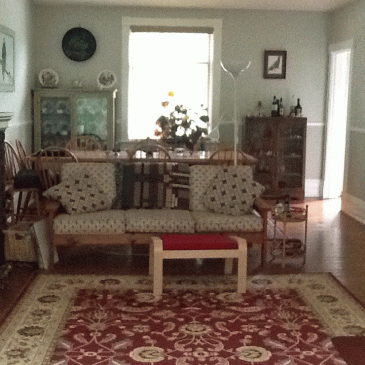
The picture that accompanies this post is a shot into our living/dining room. The rug in this photo is new, bought just last summer, replacing two large hand-braided rugs, made by a friend of my mother’s, that after about seventy years of good service had finally just fallen apart. It’s the piece that could have (should have?) set off the Diderot effect. Everything else – except the footstool and lamp – is at least thirty years old. (You can’t see BD’s armchair, off to the right side, but it’s the same as the couch.)  But somehow, there was no Diderot effect (at least for us – you may think differently!). Perhaps it’s just that I’m comfortable with things not matching, perhaps its the associations I have with each piece of furniture. But whatever the reason(s), I like the way everything looks together.

In the end, furniture is functional, and as long as you like it and it’s comfortable, that should be all that matters.  It doesn’t need to match; it doesn’t matter if some things are more worn than others, and, it’s only ‘semi-disposable’ if you choose to view it that way.  As with just about anything and everything in our lives, if we value our furniture, are mindful of keeping it in a safe and useful state – tightening bolts, working wax into wood, fixing fraying seams – it will serve us well, often for more than one generation.

Garbage Loaf

A week or two ago we had friends over for dinner, a simple post-movie meal of cold chicken and salads, followed by local raspberries, fruit loaf and ice cream.  After everyone had finished, there were a few raspberries left.  “Eat them, BD,” one of our friends said, “otherwise, they’ll just go to waste.”

As I assured her they would most certainly not go to waste, but be eaten the next day, probably as part of my breakfast, I reflected on the amount of food that is thrown away.  According to The Guardian, thirty percent of all food produced in the world is wasted, and in western countries a large portion of that waste is in the home – food we buy, don’t eat, and throw out.

Why?  Well, a very small bit of spoiled food occurs – the tomato sauce that gets shoved to the back of the fridge and forgotten, and has grown a lovely blue mold when you do find it, the cracked egg in the dozen. But those are not that common in the western world of refrigeration and freezers.  I think food is thrown out because of a lack of planning; a lack of cooking skills in some cases, and because we don’t value food enough.  We want it to be cheap and easy.  We forget the purpose of food – to transform the light and warmth of the sun, the nutrients of the earth, the molecules of water – into nourishment for our bodies, through the labour of many hands.  When something is that fundamental, that miraculous – and can I say it, as a secular person? – that sacred – how dare we waste it?

We try to be mindful about food, and that means planning.  Once a week or so, we draw up a menu, and from that menu a shopping list.  And then we stick to it.  This takes time, every week, but it’s time well worth it, and not just because it will mean less money spent; it means BD and I talk about what we’re eating, what recipes to try, how long we’ll need to make supper, where to buy the produce. We are, as a result, perhaps more conscious – more mindful – of what food is in the house, and what it’s for.

I shop twice a week for grocery-store perishables like milk and yogurt, in part because our fridge just isn’t that big.  (Which in itself is a good thing, since it does mean that there is less chance that half-jar of tomato sauce will get shoved to the back and forgotten.)  I shop almost daily for fruit and vegetables during the summer, when the farm stands are open and the produce is freshly picked.  But for meats, I shop, roughly,  monthly, or perhaps every six weeks, buy in moderately large quantities, divide into portion sizes, and freeze.  All this significantly reduces the chances that food will be overlooked or wasted.

But don’t think I’m a paragon of planning.  I keep a freezer inventory, and I mean to cross off what is used, but it doesn’t always happen.  And so, yes, every so often I find some chicken in the freezer that’s looking a bit freezer-burned. Sometimes the only zucchini I can get at the farm stand is too big for just the meal I want it for.  Sometimes one of the apples has too many bruises, or BD forgets to eat his raw carrots and they go soft.  So what then? I can’t bring myself to throw out food unless it’s truly gone off.

Freezer-burned chicken, like the carcass when we have a roast chicken, is saved to make soup, a mainstay of colder-weather meals.  (I’ll wait until the colder weather arrives before writing more about that – I can’t get excited about soup recipes in the summer.)    Soft, over-ripe, or just plain excess fruits and vegetables that don’t freeze well, though, go into ‘garbage loaf’, basically an adaptation of a banana loaf recipe with the same amount of just about any vegetable substituted for the banana.  I even mix them – but be sensible about that:  tomato and zucchini work together, as do apples and carrots, but I wouldn’t do strawberries and tomato.  BD will eat almost any baking, but even he’d draw the line at the last one!

So here’s the recipe for ‘Garbage Loaf’ as I make it. (I probably should have called it Leftovers Loaf, but at least in our house, it’s too late now – Garbage Loaf it is.)

Wet ingredients:

1 cup just about any fruit or vegetable, diced, shredded, or cooked and mashed..  If using carrots or parsnips, grate and steam slightly first.

1/4 cup applesauce (to reduce the fat; if you don’t have it, or don’t want to use it, double the amount of oil.)

1/4 cup light oil – I use safflower, but sunflower, corn or soy works too.

2 eggs, beaten

1 tsp vanilla

4 Tbsp fruit juice (not tomato juice)

Dry Ingredients:

1/2 c brown sugar (this suits us; you may like it sweeter.  It also depends on whether or not you add chocolate chips or dried fruit.)

1 and 3/4 cups flour:  I use whole wheat.

1 tsp baking powder, rounded

1 tsp baking soda

Optional Ingredients 

1/2 cup of any of:

nuts

chocolate chips

raisins or other dried fruits

Preheat your oven to 375 degrees.  If using a glass or metal loaf tin, grease it; a silicon one should not need it.

In a bowl, combine the fruit or vegetable mash, oil, eggs, sugar, vanilla and fruit juice.  Mix with a heavy fork or a hand mixer until well blended.

In a separate bowl, combine the flour, baking powder, and baking soda, and any optional ingredients you are using.

Pour the liquid ingredients into the dry, and mix with a heavy fork or a hand mixer on low; do not over-mix.

Spoon into the loaf pan and bake for 55 minutes or until a skewer inserted into the centre comes out clean.

As I’ve said in an earlier post, BD is a tall and highly-active man, so this loaf doesn’t tend to last long – but it freezes well, and, if by some miracle there is a slice or two left after a couple of days, it also toasts well.

I’ve also added shredded carrots and apple to bread:  it makes a denser, moist bread that won’t keep as long – after the first day we slice it and freeze it, and toast the slices; but it’s good with cheese (for me) or hummus.

And dessert at that dinner that prompted this post?  The fruit loaf was indeed Garbage Loaf, made with over-ripe bananas and a slightly suspect apple, and it complemented the raspberries and ice cream very well.