A New Kitchen Tool

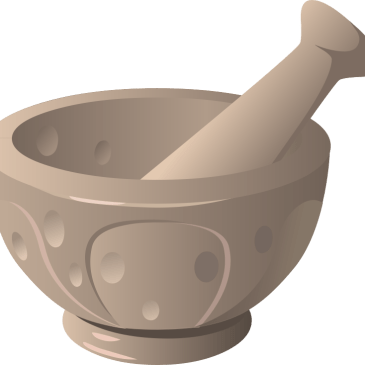
I bought a mortar and pestle today, a kitchen tool I’ve done without for thirty-five years.tools-mortar-and-pestle-800px  As I have a general policy of not buying things, why did I make an exception for this?

The answer lies, and hangs, in my basement: a rack and two elevated screens of drying herbs, the last harvest before winter.  Rosemary and sage, oregano, parsley and chives: some hang in bunches from the rack that used to, in my working days, dry my panty-hose; more are spread on window screens elevated on paint cans.  (None of them are catnip, to Pye’s total disgust – she loves it. Pyxel, on the other hand, watches Pye go ecstatic over a catnip toy the way a teetotaler watches someone enjoying a glass of wine.)

I could have chopped the herbs and stored them frozen in oil; or just frozen, in small bags, but I prefer dried herbs for the simple reason I don’t have to remember to thaw them prior to cooking. (I do freeze pesto.) I could have microwaved or oven-dried them, but why use energy when the basement is dry and warm?  In another few days, I’ll bring them up to the kitchen, and strip the leaves off the stems prior to storing in glass jars.  Some of them – the rosemary in particular – I will later grind.

Ground rosemary used to be easy to find in grocery stores, but for a long time now all I can find are whole leaves – which are fine, and I use them, but sometimes I want ground rosemary, when the texture of what I’m making will not benefit from the whole leaf.  There are a few other herbs that can benefit from grinding, sometimes: dill for use in sauces or on fish comes to mind.  And spices – well, Indian spices like mustard seeds need grinding just before they are added to a curry; powdered mustard seed lacks the fragrance and bite of freshly-ground.  These were all good reasons to buy a mortar and pestle years ago, but for some reason I never got around to it.  (You can bash mustard seed with a rolling pin, in a pinch.)

But I am also thinking ahead.  The community in which I live has a communal herb garden, and I’ve volunteered to be one of the people who takes care of it. It satisfies my wish to garden without committing me to something too big or too demanding of my time. Next year we’ll have quite a wide variety of herbs, edible flowers, and perhaps a few other plants like jalapeno peppers.  With a larger variety of herbs to cook with and to dry, I will (I hope) need the mortar and pestle more than ever before.

But I’m curious…those of you who use a mortar and pestle regularly, what other kitchen uses does it have?

Slow-but-quick Soup

I have written before about how two of my favourite kitchen tools are my slow cooker and my stick blender, but the two together are proving to be indispensable.

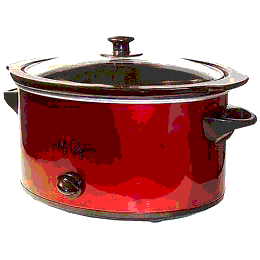
Last winter in England, we bought a small slower cooker – about 2 litres (2 quarts, more or less) in size. It was perfect for the two of us, and could stretch to a meal for three on occasion. When we left to come back to Canada, we gave it to a charity shop. (Not only was it too awkward to bring home, the UK uses 220V power, so I couldn’t use it here if I’d wanted to.) I often wished during those weeks that I had one of the same size here, but I’d never been able to find one.

But this September, in the university town where I live, suddenly 2 litre slow cookers appeared, marketed to the student population. Hooray, I said, and bought two – one for me, one for my sister. And it’s a rare day I don’t use it. Now the heat of the summer is gone, I like to have soup for lunch. Ingredients thrown in the pot when I get up are ready by noon, but not over-cooked as such a small amount might be in a larger slow cooker. A quick pureeing with the stick blender, and with some good bread and a bit of olive oil for dipping, lunch is ready.

Today it was a couple of cups of frozen diced butternut squash (raw), and a few pieces of left-over roast parsnip. As I was out of chicken broth, usually a pantry staple, I just used water, about a cup. These simmered away on the high setting till noon; I added salt and pepper and a bit of cumin, gave it a whirl with the stick blender – and the soup was ready. Those proportions make enough for one generous serving.

Another day it will be minestrone: 2 cups of low-sodium diced tomatoes, 1/3 tin tomato paste (I freeze it in small plastic containers) 1/4 cup red lentils (or any other cooked legume), some frozen spinach, and whatever other frozen or left-over vegetables I choose to throw in, along with a cup of liquid. This gets some red pepper flakes and garlic added, sometimes a tablespoon of pesto.

Almost any left-overs can be turned into soup. I frequently make just a bit too much when I’m making meals like chili or dhal or even chicken stew, but that less-than-one-serving that’s left doesn’t get thrown out, it goes into the little slow cooker the next day with chicken broth and veggies, and tomato paste and spices if needed, to become my lunch-time soup. Sometimes I blend it to an even consistency, sometimes I don’t. I eat it with bread and olive oil, or bread and cheese, or cheese and crackers….whatever is available. I finish the meal with a cup of coffee and one square of dark Swiss chocolate and am thoroughly satisfied.

And if it’s a soup-for-supper day, then I just double everything so there’s enough for us both. Soup-for-supper is served with an amazingly easy focaccia bread. I’ll post that recipe another day!

Art, Tools, and Ice Cream

On Saturday, I biked the 4.5 km downtown to do three things:  go to the farmers’ market, enjoy ‘Art on the Street’, and drop a few small things off at the new tool library.

Our market is a year-round market, rare in Ontario, but it’s been a fixture of this city for over 180 years, and it has its own building.  In the summer it expands to the outdoors; in the winter, it shrinks.  Fair enough; there’s very little food grown here in the winter, outside of the greenhouse industry, but the baked goods and meats and cheeses remain.  I dropped in only to buy kamut wraps and toss coins into the guitar cases of the buskers, who never fail to make me hum along on a Saturday morning.

Then it was off to the tool library, a few streets over.  While not a new concept, this is a new initiative for our city. If you’re not familiar with the concept, it’s pretty simple:  if you need a tool, from rice cookers to cement chisels, from stock pots to a screwdriver, you can borrow it from the tool library. I’d first discovered them when I was looking for a place to donate my garden tools from the old house.  A volunteer had come to pick up that load – there were quite a few tools – but now I had a few more things to give them, things that fit in the panniers of my bike.

The space was functional but effective, and all the tools are being catalogued and bar-coded for inventory control.  In a city with a lot of students, its share of low income families, and a strong community ethic towards sustainable and cooperative living, the tool library is a logical addition.  I’m eyeing the tile-cutter in my basement now: I kept it as we consider what to do with the backsplash in the kitchen…but I could always borrow it back.

I left my bike and helmet locked to the rack outside the tool library, and walked over to Art on the Street.  One street had been closed off to house this annual, tented art display and sale, and the place was crowded, cheerful and noisy.  I wandered among the art for the best part of an hour, coveting but not buying a set of glass coasters from one artist,  a mug and vase from another.  Both ‘covets’ had a raven theme, which calls to me strongly.  I’m always torn at art shows:  I am trying not to buy things, to add to the items we own because we really don’t need anything.  I have a dozen coasters and more than a dozen mugs.  But on the other hand, as an independent artist myself…we need people to buy things.  Even when there isn’t financial need, there’s the need for people to appreciate and value the art we make, whether visual or written or aural.  I’m regretting the coasters, just a bit.

I finished off with a small cone of what might be the best chocolate ice cream I’ve ever had, from a small creamery that makes ‘small-batch’ ice cream from mostly-local, in-season product, before biking the longer-but-flatter river path route home.  In retrospect, I should have had the raspberry-rhubarb ice cream….but it’s Wednesday today, the summer Wednesday market will be on downtown; we’re biking down for an afternoon showing at the little rep cinema…and the creamery will be at the market, steps from the cinema.  What better way to fuel up before the ride home?


New Year’s Day Lunch

We’re in the lull between holiday celebrations. Our two-part Christmas – Christmas Day dinner with BD’s brother and family, and my family get-together a couple of days later – are done. I’ve baked a lot, eaten far too much, and played a marathon men-against-women game of Trivial Pursuit (we women won, finally.)

On New Year’s Day we’ll host a lunch. This used to be an annual occurrence, until we started travelling over the two-week Christmas holiday to places like India and China (and Antarctica, once) and so were no longer at home on New Year’s Day. Now we’re retired, the winter travel will take place in January and February, so we’re having the lunch again.

It’s a pretty simple affair. Jeans and sweaters meet the suggested dress code. After the excesses of the last couple of weeks, we try to keep both food and drink to some basics: hot spiced cider, soft drinks, a glass of wine for a toast. I’m making little tart-sized quiches and sausage rolls; there will be smoked salmon, hummus, cheeses and paté, along with crostini and crackers and fresh baguettes. Crudités, olives, pickles, and roasted red pepper and eggplant will round it out. Served buffet style, the twenty or so people attending will eat in small groups scattered around the house: we’ve chairs a-plenty. Dessert will be raspberry-ginger cake served with coffee or tea. Nor am I cooking all this: friends and family are bringing parts of it.

Yesterday BD and I got the wine glasses down and ran them through the gentle cycle of the dishwasher: this set hasn’t been used in a few years, and were very dusty. Some of the plates got the same treatment. It shocks me slightly that I gave away our ‘banquet set’ for twenty-four last year, and yet we still have enough plates – dinner, lunch, and dessert – , as well as glassware, mugs and cutlery to accommodate twenty people. Not that they match, but who cares? But if we want to keep doing these annual lunches, I guess I’ll have to keep them. I abhor the idea of disposables. The other alternative, which we used to do for pot-lucks at work, is to ask everyone to bring their own. I’ll have to give that serious consideration another year.

Guests will start to arrive about 12:30 p.m. With luck, the first man through the door will be dark-haired – an old Scottish tradition called ‘first-footing’ gives good luck to the house and its inhabitants if the first man who enters on New Year’s Day is dark. We’ll serve drinks, talk, exchange Christmas stories, laugh, until about 2, when we’ll eat; by five at the latest, folks will have left, leaving us plenty of time to run the dishwasher, nibble on left-overs, and tidy up.

We used to do evening parties: for years I hosted our work Christmas dinner: roast turkey and all the trimmings for nearly thirty people. Then we did the New Year’s lunch as a sit-down meal, which involved renting tables and chairs and big white tablecloths and rearranging the furniture a bit. As I get older, the parties get simpler, and I’m happy for people to bring food or drink. Everyone enjoys it just as much…or perhaps more.

Just How Connected do I Need to Be?

We live 70 km (40 miles) from downtown Toronto, but there are times it feels like 700 km. Not only do we have a well, and a septic tank, and until not-very-long ago no garbage or recycling pickup, we are – shall we say – underserviced in the wireless communications department.

Until very recently the only place I could get a cell phone signal was outside. That’s improved, which is good, because the cell phone system is how we access the internet. It’s the only signal that reaches our house effectively, surrounded as we are by very tall trees. We have what is called a ‘turbo-hub’, basically a wireless router that uses the cell phone signal instead of other options. The problem is, it’s expensive.

We pay in usage increments, up to 15 GB of data, which maxes out at $105, and then per MB after that. Yep, per MB. This hadn’t actually been a problem until very recently, when a combination of three things brought us up short. The first was automatic updates to Windows and to our virus protection, which for our two laptops was suddenly eating up about 2GB every month….and that’s without the potential Windows 10 download. And then there are automatic app updates on our two iPADs and our two iPhones. The second was a period of rapid growth in my freelance writing & editing business, which suddenly took off – but as it’s all done electronically, it was using a lot of data, especially when there are pictures involved. And the third was my on-line university course, which suddenly had a lot of on-line interactive map manipulations in the assignments. When last month’s overage charges were one and half times our 15GB rate, we knew something had to change.

Now my business actually does something, the obvious solution is for me to get a separate turbo-hub for my laptop, so I can charge the costs back to the business. Which I will do, in the new year. But until then, we took a hard look at our internet use, and more importantly, our habits.

How often a day do I actually need to check Facebook, Twitter, Google+, my blog pages, and e-mail? Once? Twice? The business e-mail more often, yes, and I use social media to advertise and promote, but I still don’t need to be on them constantly. And why were all our devices constantly connected to the internet? How long does it actually take to make that connection? So things have been turned to airplane mode when not actively in use, the phones are off wi-fi completely (we have a decent amount of data in our plan) and I’m disciplining myself about social media. The personal e-mail gets checked once a day – if something’s really important, my siblings or friends will text me…or, heaven forfend, actually call me. But in our instantly connected world, this is taking conscious work to break these habits.

Almost equally hard to break was the immediate up-or-downloading of files. The next chapters have arrived from one of my editorial customers? Download them right now. Finished the edits? Send them back right now, regardless of the fact the customer is several time zones away. Until the business turbo-hub is in place, ‘right now’ has been replaced by ‘when I’m in town, and can access the secure network at the university’. Has anyone complained? Nope…..

The result of all this is not only will we not get hit with another bill of $250 for a month of internet, I actually get more work done, more efficiently. Does that surprise anyone? No? Not even me…so now I’m wondering how I let myself spend my time (and my money) so inefficiently, for the sake of the reassurance (or disappointment ) we get from those instant connections. But I have to say, playing with the maps in my landscape archaeology course may have used a lot of data, but it was a lot of fun.

As Christmas Approaches

December, and time here in Canada to start thinking about the holidays. While we acknowledge the need for ritual and gathering in the shortest, darkest days of the year, Christmas is not a holiday BD and I usually celebrate, for a number of reasons. Neither of us are conventionally religious, and therefore the Christian reasons for the holiday are not relevant to us. The rampant consumerism that has taken it over in most of the western world also repels us, and, finally, BD – who has the two-sided gift called Asperger’s Syndrome – is overwhelmed by the lights, music, colours and crowds of the season. So, over the years, we’ve distanced ourselves from the mad rush of Christmas.

For many years we’ve travelled over the period, removing ourselves from it altogether. We’ve been, on December 25th, places as far-flung as Antarctica (it’s summer there, in mid December), India, China and England. But this year, since we are no longer bound by the two-week school holiday, we’re not travelling until January, and will be home.

We’re spending Christmas Day with BD’s brother’s family, his nephew home from Australia, where he’s in grad school; his niece home from a closer university. We haven’t yet decided who is contributing what to the meal, but it will be a shared effort. We’ll tell stories and learn what the kids have been up to, and be respectful of this family’s Christian beliefs, as they will be respectful of our agnosticism. Then we’ll head down to my sister’s house for the 27th, to spend some time with her and her husband, and my brother and his family. This is the first year without anyone from our parent’s generation: both my father, and my sister-in-law’s father, died this past year, and so we are gathering differently, to share food and wine and laughter in a different house than other years, a new chapter in the story.

When I look back on my childhood, what I remember of Christmas – what stands out – is never the presents. I remember the food, the turkey and stuffing, the cranberry sauce and the mince tarts. There were almost always extra people at that dinner: widowed friends, an elderly childless couple, my mother doing her best to alleviate loneliness for one day. I remember decorating the tree each year, bringing out the old, battered decorations, having their stories retold each year, maybe adding one or two new ones, often hand-made. I remember sitting one year with my older brother singing Silent Night in front of the tree. I remember the long games of Monopoly on Christmas afternoon. And the few presents I do remember were ones made with love and by hand: a new outfit for my favourite doll, when I was about 4 or 5; a purple corduroy housecoat when I was thirteen, a hand-carved plaque saying Sid (because my hair, in the mornings, looked like Sid Vicious’s,) that BD made me early on in our relationship.

Our families on both sides have long ago given up on exchanging anything more than token, consumable presents: none of us need anything, and so the money we would have spent goes to support a cause we believe in – anything from the local food bank to mosquito nets, wildlife habitat to refugee sponsorship. Some of those battered decorations will be on my sister’s Christmas tree this year, and the stuffing and mince tarts are still my mother’s recipes. Our extended celebrations will be spread over the days between the solstice – December 22nd this year – when we light a candle that will burn through the night, an acknowledgement of the shortest day, to New Year’s Day, when we’ll host friends and family for a late lunch.

Whatever you celebrate or acknowledge in late December, whether or not your family is close or not, there is a deep atavistic need for light and warmth and companionship in the darkest days in the northern hemisphere. I wish that for everyone, although I know it isn’t possible for many. As you plan your Christmas, think about what you remember. I am old enough that a tangerine in my stocking was a special treat of the season. Such a small thing…but given with great love. That is what I remember.

The Quiet Joy of Enough

Walking today on the snowy trails at our local conservation area, BD expressed once again his sense of disbelief that we are actually retired. Like many – if not most – of our generation, he’d expected to work to 65. ‘But,’ I gently pointed out, ‘many people just wouldn’t be prepared to take the pay cut we did, to retire early.’

‘Enough’ played its role in determining it was time to retire.  Both in it’s negative sense: ‘I’ve had enough of this job.’ and in its positive: ‘We have enough money to retire.’  The latter statement was true only if we kept the positive concept of ‘enough’ in our minds.  ‘What isn’t need is greed’: I don’t know who said that, and I’m not sure I entirely agree with it – but that depends on how you define need. If you acknowledge that the soul has needs as well as the body, then it’s not a bad quote.

‘Enough’ sometimes is difficult.  My health issues have meant I have had to learn what ‘enough’ is with regard to certain foods; that one glass of wine is plenty; that I have physical limitations that must be considered. BD has had similar lessons to learn.  But ‘enough’ is also marvelous: there is enough time now for me to write, to read and review books, to edit for others, to walk every day: all the things that the demands of the salaried job took away from me.  And even better, there is enough money that I can do these things as a true amateur, for the love of them, and not for profit, and so I have only myself to answer to. But this is true because I can say this of so many things: clothes, furnishings, possessions of all sorts –  ‘I have enough’.

I will honestly admit to greed in the past. I had too many clothes; I liked food and wine all too well, and no-one needs the travel experiences we have had, although how can you regret the sight of a tiger hunting along an Indian river, or an Adele penguin standing at your feet, peering up at you? I can’t.  But I can also say, even about that, ‘enough’.  We have the memories.

Our world is smaller now, but our time is…ours.  I wake every morning with quiet joy, knowing I have enough.


On Being a Tortoise

I have become somewhat sloppy in some of my practices of mindful living this past month. Somehow, I got out of my habit of shopping only twice a week, and have been running in to town to pick up a few items almost every day. (We live twelve miles outside of town, in a tiny village with no shop.) This needs to stop, not just because it’s wasteful of gas and time, but because it’s just not how I want to live my life.

I shopped Monday this week, but Tuesday and Wednesday, except for picking up fresh corn and tomatoes, I didn’t (and that doesn’t involve going in to town). Instead, I went walking, good two-hour hikes both mornings through woods and fields. Today I need to go into town again; but I have a plan. I’m going to put my bike on its carrier, park at the store I buy the most at, and then bike to the other places I need to go. I have both a basket and panniers for my bike, and the university town has both bike lanes and an extensive network of off-road multi-use trails, making it easy to get around.

To be fair to myself, I haven’t just been being lazy by not using them. I didn’t have the core strength to ride my bike with the added weight, especially the panniers, which I find also affect the balance of the bike. Following major abdominal surgery thirteen months ago, I was forbidden to do anything except walk or swim for six months, to allow complete healing. (And I can’t swim.) That took me to January, and the middle of the coldest winter on record for many years here. I kept active, but mostly inside, and mall walking, painting woodwork, and using the treadmill or exercise bike wasn’t enough to strengthen the core. (A lot of the regular abdominal exercises are also contraindicated after the type of surgery I had, so I couldn’t just do crunches, either.)

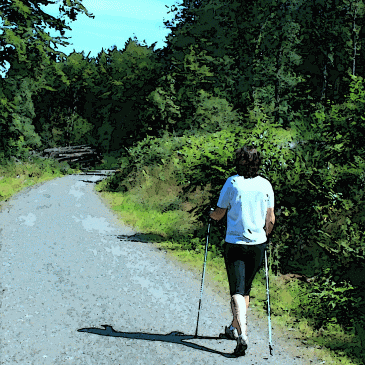
But then spring finally arrived, and I started walking seriously again, and biking, My balance was bad for a while.  I kept at it, and finally this last ten days I have been walking without my Nordic poles; first for half an hour, then for an hour, and for the last two days for two hours each day, on hiking trails with all their ruts, roots, and rocks.  I think I can safely say I don’t need the poles any more, at least on fairly level ground.  This means my core is stronger.  A small but significant victory.

So I’ll put the basket and panniers on my bike, and park in town at the grocery store, and after shopping there plan a circular route that will take me to the specialty poultry store, and the library, and back to the car.  I could walk it, and carry the chicken and the books, but biking works different muscles and I like to do both. If it goes well, then this will be how I run errands in town, at least until snow makes it too dangerous.

There have been times in this past year when I have felt like a tortoise:  slow, ungainly, and dependent on an external support system.  But ‘slow and steady’ did the trick.  I didn’t rush anything; I built on small gains in small increments. Sometimes I did push myself too hard, thinking I was ready for a distance or a difficulty of terrain I wasn’t, but I backed off immediately once I realized I’d misjudged.  I didn’t let either pride or the desire for a quick fix to result in injury, which in turn could have meant more surgery.  (That was quite the incentive to not overdo it, by the way.)

My healthier body means I will drive less, which benefits the environment as well as our gas budget.  I can do my share of the heavier chores, which BD’s bad back will definitely like!  I’m less likely to use (more) health-care resources, more likely to stay creative, happy, and useful in the community, and I’ll be living my life in a manner closer to my ideal.

*****

A later-in-the-day update….the plan worked.  I learned the following:  I have to make sure I have my balance completely right before I take a hand off the handlebars to signal a turn, or I wobble, especially after I had made my purchases and was carrying some weight.  I also learned that choosing to try this out on the hottest and most humid day of the entire summer wasn’t the best choice; normally I bike on rail trails and bike paths, and the additional heat radiating off the paved road surface was more than I had expected…and it was ten-thirty in the morning.  But I did it!

Cheap Dates

BD and I like to go out once a week or so.  Not so much for meals any longer because of his allergies, but for music, or a movie, or to spend time with friends. But there is a budget to consider, so we’ve worked hard (no, let’s re-word that, I’ve worked hard…) to find things to do that are cheap, or better, free.

Luckily, it’s not difficult.  We have a cinema a reasonable drive away that shows first-run films for $5 on Tuesdays, all day, matinees and evening performances; they’ve just recently opened, but already they are pretty busy on Tuesdays.  Their popcorn is the usual over-priced stuff, so we skip that, but my waistline doesn’t need it anyway!  Our other movie option is our local art-house cinemas – two of them – where a yearly $15.00 membership means the films are $8.00, and at one of them, also gives 15% off at the attached bookstore and restaurant.  (And both of these have cheap, good, popcorn.) When you go to a movie a week, as we tend to, the membership pays for itself pretty quickly, even when I do buy popcorn.

In the summer, free music abounds.  The two towns we live half-way between both have (on different days) free concerts-in-the-park on weekday afternoons.  The musicians are up-and-coming local artists, and are generally all pretty mellow, ranging from country to jazz and folk to pop.  But we’re wide-ranging in our musical tastes, and it’s a pretty good way to spend an hour or two, sitting in the shade on a lawn chair, snacks in the cooler, listening to music.

Come the fall and winter, we turn to the university.  Here they run a free concert series on Thursday at lunch time, sometimes student performances from the Faculty of Music (but not usually).  Again, it’s wide-ranging – this fall’s line-up includes Cuban jazz, Celtic harp, and even rock’n’roll.  Parking on the campus is pricey, so we go early, find a side street with free parking, and walk or bike over to the university.

The churches in both towns also host free or very inexpensive concerts – I happen to particularly love Renaissance church music and choral performance – and it’s not necessary to be a church member (or even a believer) to go.

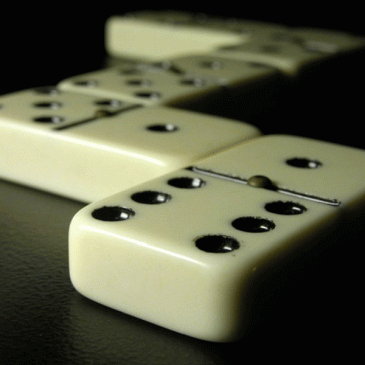
But perhaps our times with friends are the best.  With a simple meal (usually, unless one of us is trying out a fancy new recipe) either before or after our get-together, we sometimes just talk, but our most frequent activity is a board game.  Right now we’re heavily into playing dominoes, but it varies: sometimes cards, sometimes a trivia game, sometimes an obscure geography game called Ubi.  Or we’ll go for darts, or skittles, or a really obscure (for North America) English bar game called shove half-penny (pronounced shove-ha’penny.)  I have the board my grandfather made about a hundred years ago, and every so often we bring it out.

And of course, there’s always the afternoon watching the game on tv, with a large bowl of home-popped popcorn and a beer.

Walking, Health and Wholeness

When I began this post, I wondered how I would tag it:  #health  #mindfulness, #sustainability, #writing #frugal #community.  All those reflect what walking means to me, and all are components of something larger, something I am going to call wholeness.  I am not whole if I do not walk.

From my earliest years I have learned by walking, dreamed of walking, found solace and healing in walking, tapped creativity by walking.  My memories of all the places and countries and continents I have been to are memories of walking, of the way one soil feels different underfoot than another, of the contours and smells of the land around me, the flow of rivers, the flight of birds, the shape of trees.  I learn new places by walking them, and once I have done so I am never lost.

I was the youngest by some years in our family, and was frequently solitary.  But I had fields and woods and farm lanes to roam, and those were different days.  I explored further and further afield, usually on foot, sometimes by bicycle, and with the dog for company.  I learned to look, at wildflowers and trees, at birds and mammals, snakes and frogs, at insects.

Then I went to university a long way from home, choosing the university in part because it was not in a town, but set some miles out of town, on a large expanse of land.  But a new reality faced me there:  girls – women – were warned not to walk alone beyond the lighted and paved campus, and none of my new friends wanted to walk.  I stayed a year, became depressed, gained too much weight, and changed universities.  This one too had a large open area, an arboretum with trails that linked to other trails extending out beyond and through the town, and I met friends who wanted to go walking, to look at trees and rivers and birds.  I lost the weight, stopped being depressed, and fell in love with a man who walks more than I do.

Walking informs almost all my writing, either as a theme (sometimes transmuted into other forms of travel through a landscape) or as how I tapped into whatever it is in my brain or the cosmos that creates fiction.  I will go walking with a problem to solve, one of plot or motivation or background, and after a good walk or two, even if I haven’t been directly chewing over the problem as I walk, the solution will appear.  I find letting the problem swirl around in the back of my mind, not looking at it directly, while I focus on watching birds, or fish, or searching through a stand of milkweed for Monarch butterfly caterpillars, often produces the quickest results.

When I start walking I’m stiff, sometimes sore, depending on the day, the weather, and the vagaries of arthritis.  That will pass after the first ten minutes.  Some days, I’m out of sorts, or worried, but being back in touch, physically and spiritually, with sky and land and wind provides perspective, and calms even my most persistent or serious concerns. Most days I walk for an hour or two; at this time of year, when the mosquitoes and deerfly of summer are still active, I walk at the university arboretum.  As summer winds down, I’ll go back to the conservation area trails that surround us.  Only when the weather is at its worst – heavy snow, torrential rain, extreme humidity – do I resort to indoor walking, either at the local shopping mall, or on my treadmill.

Walking together fosters community, whether its the community of our marriage – BD and I talk best when walking together, and face our most difficult challenges that way; the community of friends you’re sharing a walk with; the more casual community of people met on the shared paths and trails, or the neighbours you meet walking down to the mailbox. It’s also a pretty frugal way to exercise: good shoes are recommended, especially for aging feet, but otherwise there aren’t too many places where you can’t find somewhere to walk without paying an entrance fee.

I wonder, sometimes, who I would be, had I not been that youngest child, free to roam a safe rural environment, touching, tasting, watching the wild world, letting my mind and imagination run freely along conscious and unconscious channels, an experience unstructured and unguided. Would I – could I? write?  How healthy – mentally and physically – would I be? Questions that can’t be answered, because every choice of path, every turn we take or don’t take, every hill we do or don’t attempt, changes us, in ways we can’t begin to imagine.