Today There Was Birdsong and Wind

My head was full of voices. The voices of the complex characters of the book I’ve been editing for the last month. The voices of the characters of my own work-in-progress, the four protagonists jostling to be heard. Real life voices from my volunteer work; voices from the books I’m reading or listening to, voices from the tv shows I’m watching. Family voices. Friends. I needed silence.

Today dawned windy and cool, a day stolen from fall. The foot pain that’s been plaguing me for the past two weeks has gone, rest, exercises and new orthotics doing their job. A day for walking, then. (Not too far, so I don’t aggravate the foot again.) It wasn’t until early afternoon I actually escaped my desk for the Arboretum, hoping the cool, occasionally showery day meant it would be fairly empty.

It was. I walked the internal trails, rather than the perimeter, which is always busier. A house wren chattered at me; indigo buntings and redstarts sang from cover. From the canopy, a red-eyed vireo repeated ‘see me see me see me please’ over and over. There were no voices, human or imagined or electronic.

I saw a couple of people, exchanged quick ‘hellos’. The only other mammals were squirrels. I took pictures of wildflowers: in this regenerating old-field ecosystem, they’re the immigrant flowers of southern Ontario: Queen Anne’s lace, birds’ foot trefoil, vetch, clover, ox-eye daisies.

When I reached my favourite bench, with its view over grassland and bushes, I sat. An eastern kingbird hunted insects in graceful swoops. Butterflies flitted from flower to flower. A crow called. Bees buzzed; a chipping sparrow echoed them with its tree-top trill. No one disturbed me.

I didn’t sit long, maybe fifteen minutes. My mind stayed quiet. Has stayed quiet, so far. Tomorrow there are characters to listen to again, and friends, and the ambient hum of the cafe where on Mondays we meet to write and then have lunch and talk. It’ll be fine. Because today, there was birdsong and wind.

What are the odds? ONE resolution for 2024.

As 2024 approaches, my ‘finish by the end of the year’ list is just about manageable. My ‘to do in January’ list is—umm—a little packed. More so than it should be, but it’s so I can take February off completely and go birding in Spain and Portugal.

Except…I have a book coming out in February: Empire’s Passing, the eighth and last of my Empire’s Legacy series. But it isn’t a standalone, and if people who’ve read the others don’t find out it’s out for a few weeks, frankly, so what?  Books don’t go bad. My nine-year-old first book, Empire’s Daughter, still sells steadily. There would have been I time I would have worried about not being present online for Passing’s release. That time is past.

I’m making one New Year’s resolution this year: to stop overachieving. This past year is a blur. I spent three months nearly 6000K away from home, dealing with the funeral and settling the estate of a cousin, learning to navigate a new legal and tax system, clearing the house, selling the house. And writing a book, because I had promised it would be out, and I was going to honour that promise.

 I also wrote five short stories, four for an on-line magazine (of which I am also the webmaster) and one for an anthology. And edited three other books. And chaired and edited our community newsletter, co-coordinated a writing group, read and reviewed a number of books for a book tour company, drove a van with my niece’s furniture to Nova Scotia, took a cousin on a ten-day driving holiday, developed and ran two full day planning sessions for a community group, gave a guest lecture in Philadelphia, kept up (well, sort of) with my two blogs and my newsletter, and tried to maintain some sort of social media presence. While attempting to learn Spanish, volunteering for another community writer’s group, and doing in-person book sales and open mic nights. Are you tired yet?  I am.  And not just from this year.

2014 – a decade ago, nearly– was a watershed year for me: a year in which I was diagnosed with Stage 3, high-grade cancer. It was also the year in which my publisher went out of business, the rights to Empire’s Daughter reverting back to me. In that year of surgery, radiation, and chemotherapy, I got Daughter ready for self-publication (I wasn’t going to spend another two years querying again – I didn’t know if I HAD another two years). While renovating the house, driving myself back and forth to radiation (an 80 k round trip, five days a week, for five weeks), and doing almost all the grocery shopping and cooking.  Are you rolling your eyes yet? But I was determined. Life went on as close to normal as it could, I learned to create an epub, and then format a paperback, and navigate KDP.

Two weeks after my chemo ended, we flew to Texas to go birding. Then I went back to work for a short time, and took official retirement, as did my husband, on the 15th of May. The next day, we flew to England for a month. Then we came home, bought a new house in town, and put the country one up for sale. My father had died (at almost 99) that winter of my treatments, and I helped (a bit) with clearing that house, as well as packing up our own,

We moved. I started volunteering with the community newsletter, and with a local writing group. I started the next book, and a blog, and then another one. I walked a lot, biked, and birded. I started editing and formatting books for others, and began a small imprint that has now published my own eight books and five for other people. We went to England in the winter to walk and bird. I took a lot of on-line university courses, on Roman and medieval history, and on landscape archaeology.  I read a lot of books, and wrote a few more. They were short-listed for and/or won a bunch of awards, which was nice.

We travelled, a lot: Australia, Fiji, New Caledonia. The Caribbean – ten islands in ten days, or close to it, for birds. Japan, Taiwan, Mongolia, for the snow leopard I thought I’d never see. Rome, for me, for research. And always England, for ten weeks or so each January to March.

One year I flew back from England for four days for my brother’s funeral, a too-quick, too-young death from cancer. Then I went back, and kept writing, and walking, and birding, because that’s what I do, and came home and kept on doing what it is I do here, too. You don’t waste second chances, and I got one. My brother didn’t.

And then came COVID, and the world changed. I wrote more books, of course. Social media became more important, just to talk to people and make connections. Zoom became part of my life: the community newsletter meetings, the writing group meetings, even family. Until this year.

Maybe a younger person, or a better organized one, could have juggled things better. Maybe I should have just admitted I’m 65 years old and I don’t have the physical or mental energy I once had. And it did all get done – the newsletter and writing group meetings done across time zones 5 hours apart; the newsletter layouts done and PDFs made and emailed for printing; the social media posts scheduled, the Amazon ads planned and monitored. Books were read and reviewed. Short stories were written. The English estate was settled, the house sold, the legacies distributed. Empire’s Passing was finished, and beta read, and edited (and edited and edited) and formatted. Maps got drawn. I even went birding, and wrote some blog posts, and did all the other things I listed in the fourth paragraph.

But I’m tired, as I said. It’s enough. It’s more than enough. I’ve proven, mostly to myself, that I could do what I always wanted to, and write good books, and the series is done. I’m not planning to stop, but I am going to slow down. (My husband is laughing, by the way. He doesn’t believe me.) More reading. More photography, maybe a return to some artwork and some poetry. Things I’ve neglected. Less productivity. Fewer social media posts, probably fewer blog posts. Some new learning, and some ‘getting to know you’ stories about new characters. Longer walks. A slower life.

Think I can do it?

Image by Gordon Johnson from Pixabay
November Diary 3

November 20: University of Guelph Arboretum

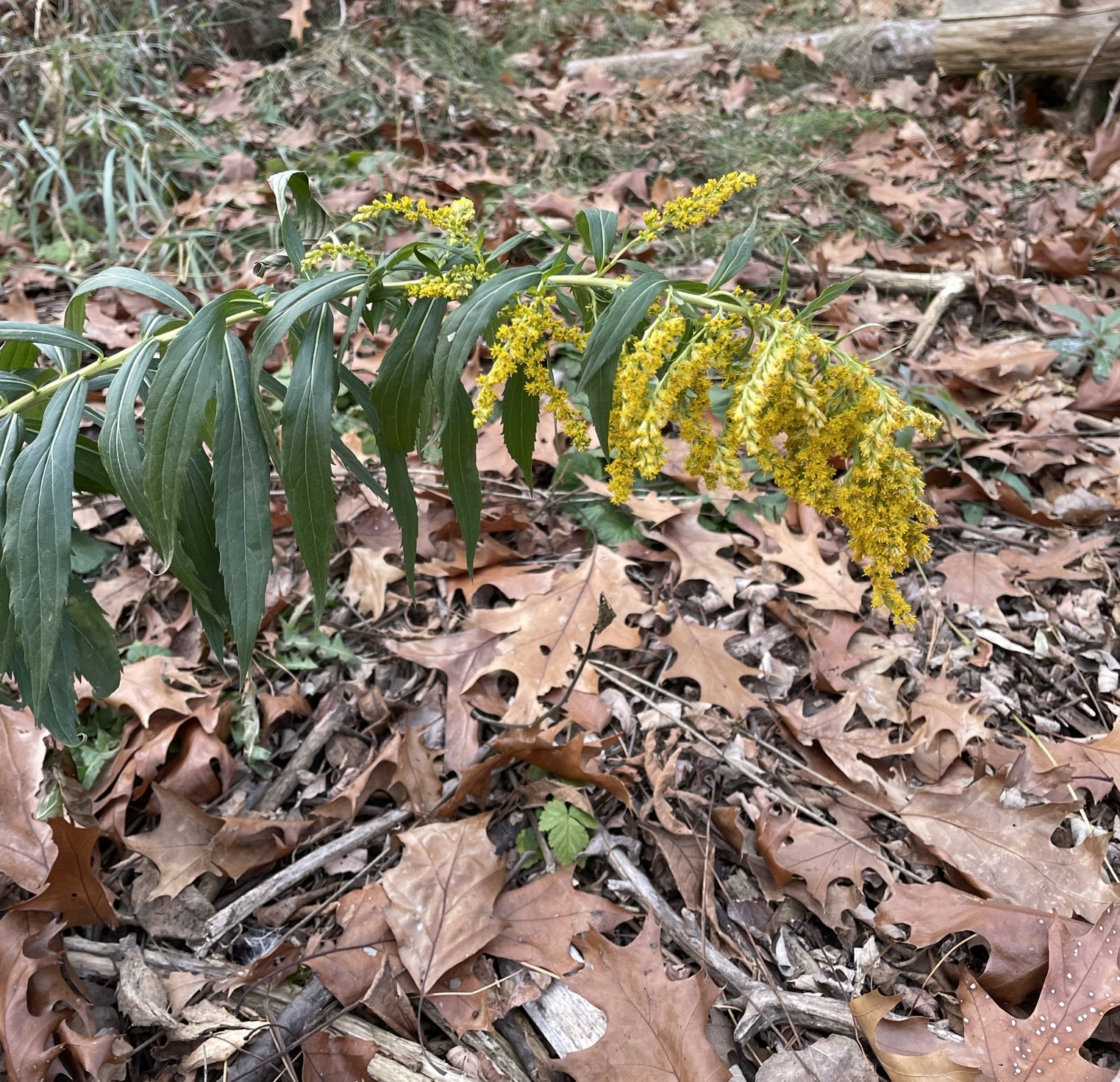
Regardless of the hard frost, a few goldenrod plants are still flowering, bright against the brown leaves. As are the bright red berries of a shrub I can’t identify. The goldenrod is wild, wind or bird seeded; the shrubs are planted. One is likely more appreciated than the others by humans, but I know which the chickadees prefer.

November 22: University of Guelph Arboretum

Neither flowers nor berries were needed to enhance this landscape: the diffuse light, the time of day, the copper and gold of goldenrod and grasses combined were enough. The field glowed.

Further along the path, the white-berried bushes – grey dogwood? – were full of birds. First a flock of starlings, sounding like rusty hinges and oblivious to my presence (or simply not caring); then a dozen robins arrived. Starlings and robins mixed without issue, but in a close bare tree, ten bluebirds (or greybirds, on this cloudy day) waited for the larger birds to leave.

The deciduous trees are bare now, except for the few beeches and oaks still hanging onto their brown leaves. November begins to show us the hidden things, nests in the forks of trees and shrubs, wasps’ nests hanging from branch tips, and high in a maple tree near the old quarry, a porcupine, too far away for my iphone camera to capture anything but a lump.

The last surprise of the day was the fruit of an Osage Orange (Maclura pomifera) at the edge of a hedgerow, their almost lemon-yellow colour standing out against the leaves. Three fruits, scattered across a small area. The closest (and only, I think) Osage Orange tree in the Arboretum is some distance away. I expect these were human-gathered and human-discarded. Will they be there the next time I walk this path?

November 24: University of Guelph Arboretum

First snow, a bare sprinkling arriving mid morning. The air is crisp still at 10 am. I round a curve on one of my favourite paths and freeze. On a waist-high stump not more than 6 or 8 meters from me, a young red-tailed hawk is devouring a squirrel. (The picture below is a terrible record shot, but it’s the best my phone could do.)

I watch the bird through my binoculars for several minutes, its head dipping, the strong yellow beak tearing at flesh, the head rising again, the beak red with blood and meat, the ripple of the throat as it swallows. The hawk is hungry after the cold night, and pays me no attention at all. Even when I move again, it just keeps feeding.

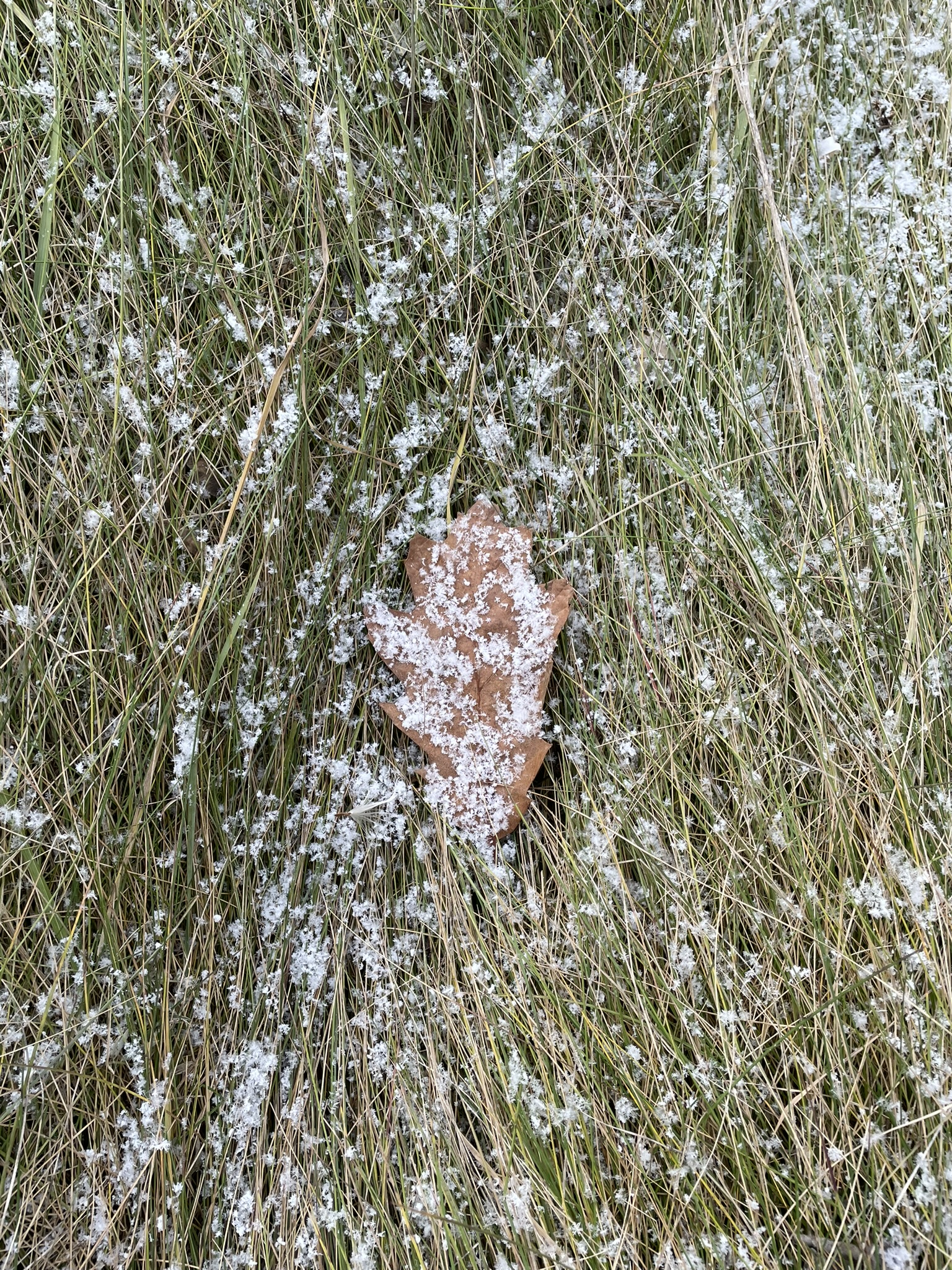
I walk my usual route, looking at the patterns of snowflakes on grass and leaves, hearing juncos and chickadees and crows. When I return to where the hawk was, forty minutes later, there is nothing but a few wisps of fur on the stump.

November 26: University of Guelph Arboretum

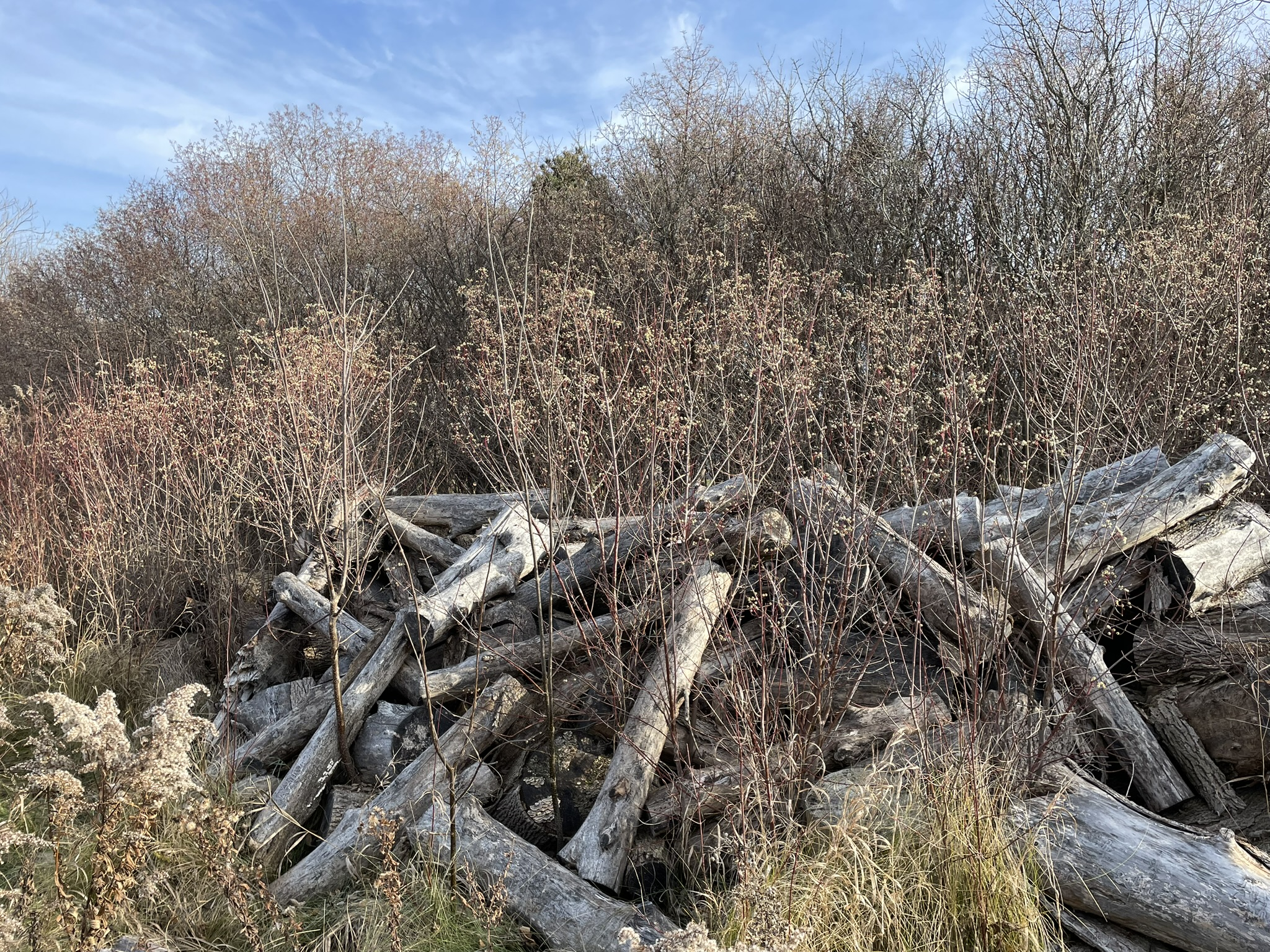
Still sluggish after my COVID shot, I walk slowly around my favourite paths. This location intrigues me: the pile of logs, the perennial plants, the white-berried shrubs (gray dogwood again?) behind them makes for excellent habitat. (The shrubs are full of cardinals this morning, feeding.) If there’s snow on the ground before we leave for England in early January, I’ll come back here to look at the tracks leading in and out of the logpile, to see what stories they tell.

When I’m almost back to the car, the many shades of brown of these red oak leaves catches my attention. On a cloudy day, they probably wouldn’t have, but in the morning sunshine they gleam, a patch of subtle beauty easily overlooked.

Honouring Labour, Honouring Food

I’m emerging from the intense process of bringing a book to life: the detailed proofing, the minor cover changes, the precise production values.  It’s done, and published, and starting to make its (so far) well-received way in the world.  Which means I can raise my head, and look around, and think about some other things.

One thing I’ve been thinking about recently (again) is food.  Not the cooking of it, or not only, but the ways we value it, or don’t value it, and more precisely how we don’t, in general, value the labour and resources that go into producing it.  Food waste has got a lot of press recently, and it should.  But there is more than one devaluing going on when food is thrown out: we are, when we waste edible food, dismissing it – whether it’s an extra zucchini or soft carrots – but we are also ignoring the human and resource cost of producing that food.

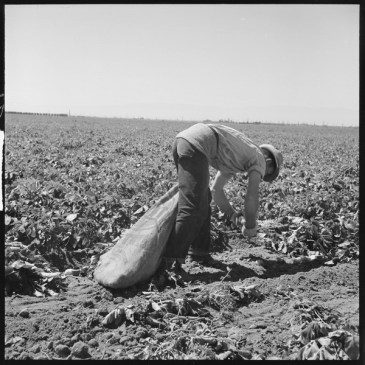
I have a couple of degrees in agricultural science.  I have also worked, in my teen years,stoop labour in what is called ‘stoop labour’: picking tomatoes and green beans, riding a potato digger, harvesting sweet corn, cutting grapes. Long, hot, sweaty days, often with no access to a washroom or running water; lunch eaten with dirty hands, sometimes between the rows. Sometimes the pay was hourly, sometimes it was piece work. It was never good. I’ve worked alongside immigrant women with advanced degrees, whose English wasn’t good enough to let them work in their area of expertise, women from Portugal and Hungary. I’ve worked alongside men from St. Kitts and Jamaica, who come to Canada yearly to support their families back in the islands. I did this work for a few weeks every summer, and only for a few years.  These people did it, do it, year after year after year.

I find myself remembering this more these days, maybe because I am in my 60th year, and my knees creak and my back hurts, and arthritis plagues me occasionally.  I buy a head of broccoli at the farm stand, or a bunch or radishes, and I look at it, and think about the work. Which raises, in my mind, an ethical issue: this head of broccoli or bunch of radishes is in my hands because of the labour of those who planted it, those who weeded and watered and fertilized, and those who harvested it.  Can I, with a quiet mind, throw out half of it: the stems of the broccoli, the leaves of the radishes?  What would that say about how I value their work?

So I have set about to find ways not to waste the products of that labour. (Not to mention the other resources – the fuel and fertilizer to grow the crop; the topsoil itself, disappearing or degrading in much of the world; the water, rapidly becoming a limiting factor.) As each vegetable crop comes into season, I’m being creative with what I do with it.  (But if anyone’s found something useful to do with corn husks, other than compost them to produce soil amendment, let me know!)  This is what I’ve been doing, so far this summer:

Broccoli stems:  I slice off the tough outer part of the stems, tossing those parts into the large container in my freezer where all soup stock ingredients go.  Then I slice the inner portion into matchsticks, which go either into salads, or into an Asian-inspired soup I make.

Radish greens:  add to salads or soups, or, cook until soft, and puree them. (Pour off most of the liquid and reserve as stock.)  I use pureed greens, whether from radishes or salad greens past their best – in place of zucchini in zucchini bread or muffin recipes, and it works just fine.  I sometime use other pureed veggies too – I’ve previously published this recipe here.

The stock container in the freezer gets just about everything else: broccoli leaves, radish trimmings, bits of pepper, anything that’s sat too long in the fridge and has gone soft; overripe tomatoes, extra herbs. Every couple of weeks I scoop out about two cups worth of bits, put them in the slow cooker with some garlic and onion, salt and pepper, and few chicken bones from the other freezer container, cover with water, and let it simmer all day.  The bones and vegetable matter go into the municipal compost system (from where it goes to farmers’ fields as soil amendment); to the broth, I add match-sticked broccoli and carrots, thin slices of red pepper, left-over corn, slices of radish – really whatever is around.  I toss in a few herbs – Thai basil, lemongrass, parsley – from our community herb garden, more garlic, cayenne pepper. I cook the broth and veggies together for ten minutes, add tiny egg noodles, and four minutes later, pour into wide bowls.  Sometimes I add tiny pieces of meat – again, whatever is around: little bits of chicken from a roasted bird; one sausage, cut into fine rounds and browned –  but no more than an ounce for each person. I serve it with good bread, and maybe a salad, and that’s supper.

What do you do to reduce food waste?  I’d really love to know. Has anyone tried making pesto from greens other than basil?  Are there other creative soup recipes out there?Please share!


Photo:  Kern County, California. Migrant youth in potato field. Stoop labor by a migratory youth: by Partridge, Rondal, 1917-, Photographer (NARA record: 8464464) (U.S. National Archives and Records Administration) [Public domain], via Wikimedia Commons

As Christmas Approaches

December, and time here in Canada to start thinking about the holidays. While we acknowledge the need for ritual and gathering in the shortest, darkest days of the year, Christmas is not a holiday BD and I usually celebrate, for a number of reasons. Neither of us are conventionally religious, and therefore the Christian reasons for the holiday are not relevant to us. The rampant consumerism that has taken it over in most of the western world also repels us, and, finally, BD – who has the two-sided gift called Asperger’s Syndrome – is overwhelmed by the lights, music, colours and crowds of the season. So, over the years, we’ve distanced ourselves from the mad rush of Christmas.

For many years we’ve travelled over the period, removing ourselves from it altogether. We’ve been, on December 25th, places as far-flung as Antarctica (it’s summer there, in mid December), India, China and England. But this year, since we are no longer bound by the two-week school holiday, we’re not travelling until January, and will be home.

We’re spending Christmas Day with BD’s brother’s family, his nephew home from Australia, where he’s in grad school; his niece home from a closer university. We haven’t yet decided who is contributing what to the meal, but it will be a shared effort. We’ll tell stories and learn what the kids have been up to, and be respectful of this family’s Christian beliefs, as they will be respectful of our agnosticism. Then we’ll head down to my sister’s house for the 27th, to spend some time with her and her husband, and my brother and his family. This is the first year without anyone from our parent’s generation: both my father, and my sister-in-law’s father, died this past year, and so we are gathering differently, to share food and wine and laughter in a different house than other years, a new chapter in the story.

When I look back on my childhood, what I remember of Christmas – what stands out – is never the presents. I remember the food, the turkey and stuffing, the cranberry sauce and the mince tarts. There were almost always extra people at that dinner: widowed friends, an elderly childless couple, my mother doing her best to alleviate loneliness for one day. I remember decorating the tree each year, bringing out the old, battered decorations, having their stories retold each year, maybe adding one or two new ones, often hand-made. I remember sitting one year with my older brother singing Silent Night in front of the tree. I remember the long games of Monopoly on Christmas afternoon. And the few presents I do remember were ones made with love and by hand: a new outfit for my favourite doll, when I was about 4 or 5; a purple corduroy housecoat when I was thirteen, a hand-carved plaque saying Sid (because my hair, in the mornings, looked like Sid Vicious’s,) that BD made me early on in our relationship.

Our families on both sides have long ago given up on exchanging anything more than token, consumable presents: none of us need anything, and so the money we would have spent goes to support a cause we believe in – anything from the local food bank to mosquito nets, wildlife habitat to refugee sponsorship. Some of those battered decorations will be on my sister’s Christmas tree this year, and the stuffing and mince tarts are still my mother’s recipes. Our extended celebrations will be spread over the days between the solstice – December 22nd this year – when we light a candle that will burn through the night, an acknowledgement of the shortest day, to New Year’s Day, when we’ll host friends and family for a late lunch.

Whatever you celebrate or acknowledge in late December, whether or not your family is close or not, there is a deep atavistic need for light and warmth and companionship in the darkest days in the northern hemisphere. I wish that for everyone, although I know it isn’t possible for many. As you plan your Christmas, think about what you remember. I am old enough that a tangerine in my stocking was a special treat of the season. Such a small thing…but given with great love. That is what I remember.

On Being a Tortoise

I have become somewhat sloppy in some of my practices of mindful living this past month. Somehow, I got out of my habit of shopping only twice a week, and have been running in to town to pick up a few items almost every day. (We live twelve miles outside of town, in a tiny village with no shop.) This needs to stop, not just because it’s wasteful of gas and time, but because it’s just not how I want to live my life.

I shopped Monday this week, but Tuesday and Wednesday, except for picking up fresh corn and tomatoes, I didn’t (and that doesn’t involve going in to town). Instead, I went walking, good two-hour hikes both mornings through woods and fields. Today I need to go into town again; but I have a plan. I’m going to put my bike on its carrier, park at the store I buy the most at, and then bike to the other places I need to go. I have both a basket and panniers for my bike, and the university town has both bike lanes and an extensive network of off-road multi-use trails, making it easy to get around.

To be fair to myself, I haven’t just been being lazy by not using them. I didn’t have the core strength to ride my bike with the added weight, especially the panniers, which I find also affect the balance of the bike. Following major abdominal surgery thirteen months ago, I was forbidden to do anything except walk or swim for six months, to allow complete healing. (And I can’t swim.) That took me to January, and the middle of the coldest winter on record for many years here. I kept active, but mostly inside, and mall walking, painting woodwork, and using the treadmill or exercise bike wasn’t enough to strengthen the core. (A lot of the regular abdominal exercises are also contraindicated after the type of surgery I had, so I couldn’t just do crunches, either.)

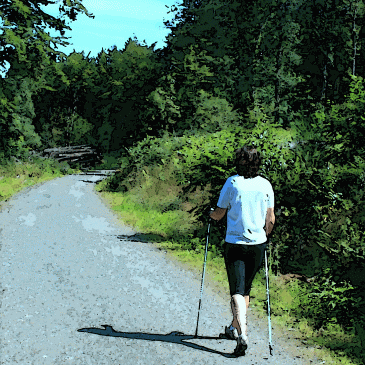
But then spring finally arrived, and I started walking seriously again, and biking, My balance was bad for a while.  I kept at it, and finally this last ten days I have been walking without my Nordic poles; first for half an hour, then for an hour, and for the last two days for two hours each day, on hiking trails with all their ruts, roots, and rocks.  I think I can safely say I don’t need the poles any more, at least on fairly level ground.  This means my core is stronger.  A small but significant victory.

So I’ll put the basket and panniers on my bike, and park in town at the grocery store, and after shopping there plan a circular route that will take me to the specialty poultry store, and the library, and back to the car.  I could walk it, and carry the chicken and the books, but biking works different muscles and I like to do both. If it goes well, then this will be how I run errands in town, at least until snow makes it too dangerous.

There have been times in this past year when I have felt like a tortoise:  slow, ungainly, and dependent on an external support system.  But ‘slow and steady’ did the trick.  I didn’t rush anything; I built on small gains in small increments. Sometimes I did push myself too hard, thinking I was ready for a distance or a difficulty of terrain I wasn’t, but I backed off immediately once I realized I’d misjudged.  I didn’t let either pride or the desire for a quick fix to result in injury, which in turn could have meant more surgery.  (That was quite the incentive to not overdo it, by the way.)

My healthier body means I will drive less, which benefits the environment as well as our gas budget.  I can do my share of the heavier chores, which BD’s bad back will definitely like!  I’m less likely to use (more) health-care resources, more likely to stay creative, happy, and useful in the community, and I’ll be living my life in a manner closer to my ideal.

*****

A later-in-the-day update….the plan worked.  I learned the following:  I have to make sure I have my balance completely right before I take a hand off the handlebars to signal a turn, or I wobble, especially after I had made my purchases and was carrying some weight.  I also learned that choosing to try this out on the hottest and most humid day of the entire summer wasn’t the best choice; normally I bike on rail trails and bike paths, and the additional heat radiating off the paved road surface was more than I had expected…and it was ten-thirty in the morning.  But I did it!

Walking, Health and Wholeness

When I began this post, I wondered how I would tag it:  #health  #mindfulness, #sustainability, #writing #frugal #community.  All those reflect what walking means to me, and all are components of something larger, something I am going to call wholeness.  I am not whole if I do not walk.

From my earliest years I have learned by walking, dreamed of walking, found solace and healing in walking, tapped creativity by walking.  My memories of all the places and countries and continents I have been to are memories of walking, of the way one soil feels different underfoot than another, of the contours and smells of the land around me, the flow of rivers, the flight of birds, the shape of trees.  I learn new places by walking them, and once I have done so I am never lost.

I was the youngest by some years in our family, and was frequently solitary.  But I had fields and woods and farm lanes to roam, and those were different days.  I explored further and further afield, usually on foot, sometimes by bicycle, and with the dog for company.  I learned to look, at wildflowers and trees, at birds and mammals, snakes and frogs, at insects.

Then I went to university a long way from home, choosing the university in part because it was not in a town, but set some miles out of town, on a large expanse of land.  But a new reality faced me there:  girls – women – were warned not to walk alone beyond the lighted and paved campus, and none of my new friends wanted to walk.  I stayed a year, became depressed, gained too much weight, and changed universities.  This one too had a large open area, an arboretum with trails that linked to other trails extending out beyond and through the town, and I met friends who wanted to go walking, to look at trees and rivers and birds.  I lost the weight, stopped being depressed, and fell in love with a man who walks more than I do.

Walking informs almost all my writing, either as a theme (sometimes transmuted into other forms of travel through a landscape) or as how I tapped into whatever it is in my brain or the cosmos that creates fiction.  I will go walking with a problem to solve, one of plot or motivation or background, and after a good walk or two, even if I haven’t been directly chewing over the problem as I walk, the solution will appear.  I find letting the problem swirl around in the back of my mind, not looking at it directly, while I focus on watching birds, or fish, or searching through a stand of milkweed for Monarch butterfly caterpillars, often produces the quickest results.

When I start walking I’m stiff, sometimes sore, depending on the day, the weather, and the vagaries of arthritis.  That will pass after the first ten minutes.  Some days, I’m out of sorts, or worried, but being back in touch, physically and spiritually, with sky and land and wind provides perspective, and calms even my most persistent or serious concerns. Most days I walk for an hour or two; at this time of year, when the mosquitoes and deerfly of summer are still active, I walk at the university arboretum.  As summer winds down, I’ll go back to the conservation area trails that surround us.  Only when the weather is at its worst – heavy snow, torrential rain, extreme humidity – do I resort to indoor walking, either at the local shopping mall, or on my treadmill.

Walking together fosters community, whether its the community of our marriage – BD and I talk best when walking together, and face our most difficult challenges that way; the community of friends you’re sharing a walk with; the more casual community of people met on the shared paths and trails, or the neighbours you meet walking down to the mailbox. It’s also a pretty frugal way to exercise: good shoes are recommended, especially for aging feet, but otherwise there aren’t too many places where you can’t find somewhere to walk without paying an entrance fee.

I wonder, sometimes, who I would be, had I not been that youngest child, free to roam a safe rural environment, touching, tasting, watching the wild world, letting my mind and imagination run freely along conscious and unconscious channels, an experience unstructured and unguided. Would I – could I? write?  How healthy – mentally and physically – would I be? Questions that can’t be answered, because every choice of path, every turn we take or don’t take, every hill we do or don’t attempt, changes us, in ways we can’t begin to imagine.

Serendipity

As I’ve written earlier, I don’t buy a lot of books any more, for reasons of both economy and a concerted effort not to buy what I don’t need. Libraries provide me with most of what I read.  But I will buy a book if I need it for research, and I can’t get it any other way, or, it falls into a category I call ‘contemplative books’:  books I will read several times, books that make me think about my relationship to the world.  Mostly these are books like The Wild Places, by Robert MacFarlane, or Four Fields, by Tim Dee, thoughtful, insightful books written about the relationship between nature and humans.  Mostly British, as this is the country I love best of all the world.

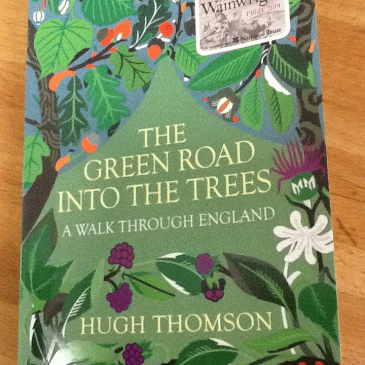
So when Amazon.co.uk sent me their most recently generated list of ‘books recommended for me’, one stood out.  (By the way, I don’t understand the algorithms they use, but they get it right 95% of the time.  I want to buy almost all of them.  I resist.)  The Green Roads into the Trees:  A Walk through England, by Hugh Thomson, ticked enough of the boxes. My libraries didn’t have it  and weren’t interested in getting it – too specialized.  I was pretty certain I would read it more than once.  So it became one of the rare books I bought.

I was busy, so I didn’t look at it for a few day after it arrived.  But when I opened it….call it grace, call it serendipity…but it ticked a box I hadn’t realized it would.  The book is about the author’s walk from Dorset to Norfolk on an ancient trackway called the Icknield Way, a route and an experience I need to research, not for the Empire’s Legacy series, but for another novel which is in the very early planning and research stage.  I was absolutely delighted. And if I know the way of things, there is a good chance that somewhere in this book there will be a line, a comment, that will inform and change that novel in a way I can’t foresee, if I read mindfully, open to what it has to tell me.

This is a shared (and slightly modified) post from my writer’s blog. I don’t plan to overlap the two very often, but this one I felt was appropriate.  

Baking bread, part two.

I debated whether or not to continue writing about baking bread – and decided that I would tell the story about my most recent bread disaster, and, about why it happened.

Picture the kitchen – it’s a galley kitchen, a bit wider than some, and big enough for my husband, BD, and me together if we choreograph it correctly.  It’s the end of the day, and I’m a bit tired; we’re doing some house renovations, I’ve been food shopping and I’ve been biking, and spent a chunk  of the day gardening.

We’re having pizza for dinner (cheeseless, due to BD’s allergies), and I’ve made a double bread recipe and will use part of the dough as the pizza crust, and part for bread.  BD is making oatmeal cookies at one end of a counter – well, he’s using two-thirds of the counter, really – and I’m grilling veggies and chicken for the pizza.  I separate off a third of the dough, add herbs and grilled onions to it, and roll it out.  While it’s rising slightly, I divide the rest of the dough between the two bread pans, and put them on top of the stove, to benefit from the warmth as BD’s cookies bake.

We’re doing all this at the same time so that the oven is on for the shortest period of time possible.  Here in Ontario, where we have time-of-use pricing for electricity, the hours between 5 and 7 pm are mid-peak in the summer – the second most expensive per-unit charge.  We’re sensitive to our electricity use, both for budgeting reasons and for environmental concerns.

BD’s cookies are done, and while the oven changes temperature from the 375 degrees the cookies bake at to the 425 the pizza needs, I throw together a salad while BD cleans up the kitchen.  The pizza only takes 15 minutes.  As I take it out of the oven, I look at the bread – it still needs at least half-an-hour to rise.

“Should I turn the oven down to 350 and leave it, ” I ask BD, “or turn it off completely and then reheat it to 425 in half-an-hour?  Which will use more electricity?”  He considers.

“Turn it off,”  he says.  So I do, and put a timer on to remind me to look at the bread in thirty minutes.

We eat dinner, clean up; the bread still needs a bit more time.  It’s 7:30 p.m., time for Jeopardy!, which we watch every night.  Ten minutes into the show, the buzzer goes off to tell me the bread is ready to go in the oven. With at least half my mind on the show, I go to the kitchen, open the oven – yes, it’s warm – and put the bread in, set the timer for fifty minutes, and go back to Jeopardy!.

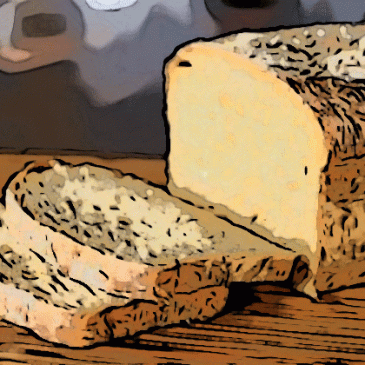
You can see where this is going, can’t you?  Fifty minutes later, the timer goes off, and I open the oven to find the bread dough has continued to rise, overflowed the pans, and dripped down the sides and through the racks and onto the bottom of the oven.  Because, of course, I didn’t turn the oven back on.

I could make lots of excuses  – I was tired, I was distracted by the quiz show – but the real reason is that I was not being mindful.  The bread did not have my attention.  The human brain really isn’t meant to multitask – for a good discussion of this, see Leo Widrich’s blog here.

I’m not one to beat myself up about this.  I said a few choice words, wiped up the worst of the dough, and baked the bread anyway.  Then I couldn’t get it out of the pans in one piece, so it ended up on the bird feeder, in chunks.  The squirrels were happy.  I made bread again the next day, with my mind on the work.  And when we found ourselves in the same situation a week or so later, we didn’t turn the oven off between cooking dinner and baking the bread.