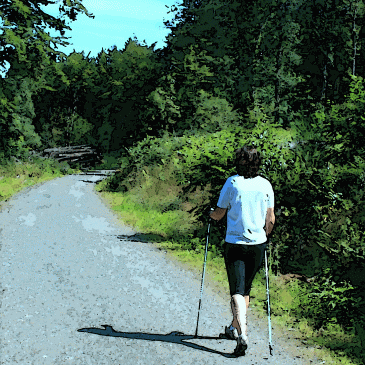
Walking, Health and Wholeness

When I began this post, I wondered how I would tag it:  #health  #mindfulness, #sustainability, #writing #frugal #community.  All those reflect what walking means to me, and all are components of something larger, something I am going to call wholeness.  I am not whole if I do not walk.

From my earliest years I have learned by walking, dreamed of walking, found solace and healing in walking, tapped creativity by walking.  My memories of all the places and countries and continents I have been to are memories of walking, of the way one soil feels different underfoot than another, of the contours and smells of the land around me, the flow of rivers, the flight of birds, the shape of trees.  I learn new places by walking them, and once I have done so I am never lost.

I was the youngest by some years in our family, and was frequently solitary.  But I had fields and woods and farm lanes to roam, and those were different days.  I explored further and further afield, usually on foot, sometimes by bicycle, and with the dog for company.  I learned to look, at wildflowers and trees, at birds and mammals, snakes and frogs, at insects.

Then I went to university a long way from home, choosing the university in part because it was not in a town, but set some miles out of town, on a large expanse of land.  But a new reality faced me there:  girls – women – were warned not to walk alone beyond the lighted and paved campus, and none of my new friends wanted to walk.  I stayed a year, became depressed, gained too much weight, and changed universities.  This one too had a large open area, an arboretum with trails that linked to other trails extending out beyond and through the town, and I met friends who wanted to go walking, to look at trees and rivers and birds.  I lost the weight, stopped being depressed, and fell in love with a man who walks more than I do.

Walking informs almost all my writing, either as a theme (sometimes transmuted into other forms of travel through a landscape) or as how I tapped into whatever it is in my brain or the cosmos that creates fiction.  I will go walking with a problem to solve, one of plot or motivation or background, and after a good walk or two, even if I haven’t been directly chewing over the problem as I walk, the solution will appear.  I find letting the problem swirl around in the back of my mind, not looking at it directly, while I focus on watching birds, or fish, or searching through a stand of milkweed for Monarch butterfly caterpillars, often produces the quickest results.

When I start walking I’m stiff, sometimes sore, depending on the day, the weather, and the vagaries of arthritis.  That will pass after the first ten minutes.  Some days, I’m out of sorts, or worried, but being back in touch, physically and spiritually, with sky and land and wind provides perspective, and calms even my most persistent or serious concerns. Most days I walk for an hour or two; at this time of year, when the mosquitoes and deerfly of summer are still active, I walk at the university arboretum.  As summer winds down, I’ll go back to the conservation area trails that surround us.  Only when the weather is at its worst – heavy snow, torrential rain, extreme humidity – do I resort to indoor walking, either at the local shopping mall, or on my treadmill.

Walking together fosters community, whether its the community of our marriage – BD and I talk best when walking together, and face our most difficult challenges that way; the community of friends you’re sharing a walk with; the more casual community of people met on the shared paths and trails, or the neighbours you meet walking down to the mailbox. It’s also a pretty frugal way to exercise: good shoes are recommended, especially for aging feet, but otherwise there aren’t too many places where you can’t find somewhere to walk without paying an entrance fee.

I wonder, sometimes, who I would be, had I not been that youngest child, free to roam a safe rural environment, touching, tasting, watching the wild world, letting my mind and imagination run freely along conscious and unconscious channels, an experience unstructured and unguided. Would I – could I? write?  How healthy – mentally and physically – would I be? Questions that can’t be answered, because every choice of path, every turn we take or don’t take, every hill we do or don’t attempt, changes us, in ways we can’t begin to imagine.
Considering Diderot, IKEA, and Furniture

Two pieces of ‘mail’ this week got me thinking.  One was e-mail – I subscribe to Joshua Becker’s blog Becoming Minimalist, and an e-mail came in telling me of a new post.  The second was traditional mail – a new IKEA catalogue.  I realize those two things seem pretty unrelated, but bear with me.

Becker’s post, Understanding the Diderot Effect (and How to Overcome It) refers to an essay I read in my late teens by the French philosopher Denis Diderot, about how his comfort with his worn surroundings disappeared when a friend gave him a beautiful new dressing gown, which contrasted with the shabbiness of his rooms.  The IKEA catalogue reminded me of Douglas Copeland’s description of the lives of three ‘twenty-somethings’ in his novel Generation X, which included the term ‘semi-disposable Swedish furniture’, and I thought about how we are pressured to constantly replace things – our dishes, our clothes, our furniture.

And then I took a mental step back, and considered our house and our furnishings.  We bought this place – a four-square built in 1911 – in 1984, as a near-wreck, and after a long weekend doing some basic patching and painting of the interior, we moved in with the furniture from our much smaller previous house, much of which had come from IKEA.

Twenty-one years later (and another coat of paint), we still have that IKEA furniture.  And it’s not in the basement.  It’s in our living room, and our sun-room, and the bedrooms, and the library.  The cushion covers on the three chairs and two couches have been replaced,  three times, I think, in the last thirty years – twice by my amateurish upholstering, and once, most recently, professionally. Over that time we’ve added to our furniture:  some came from one aunt’s house, some from another; some was bought second-hand, a very few things bought new, and the rest built by BD.  It’s often a combo:  BD built the dining room table, but the chairs came from IKEA, and the two china cabinets came, one each, from my aunts’ houses.  He built the desk at which I write, but bookshelves from IKEA line the walls of the library; I bought the library rug at a yard sale, and my desk chair came from Staples.

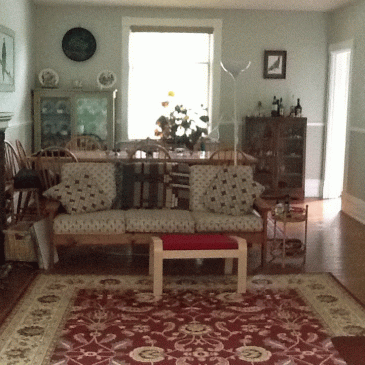
The picture that accompanies this post is a shot into our living/dining room. The rug in this photo is new, bought just last summer, replacing two large hand-braided rugs, made by a friend of my mother’s, that after about seventy years of good service had finally just fallen apart. It’s the piece that could have (should have?) set off the Diderot effect. Everything else – except the footstool and lamp – is at least thirty years old. (You can’t see BD’s armchair, off to the right side, but it’s the same as the couch.)  But somehow, there was no Diderot effect (at least for us – you may think differently!). Perhaps it’s just that I’m comfortable with things not matching, perhaps its the associations I have with each piece of furniture. But whatever the reason(s), I like the way everything looks together.

In the end, furniture is functional, and as long as you like it and it’s comfortable, that should be all that matters.  It doesn’t need to match; it doesn’t matter if some things are more worn than others, and, it’s only ‘semi-disposable’ if you choose to view it that way.  As with just about anything and everything in our lives, if we value our furniture, are mindful of keeping it in a safe and useful state – tightening bolts, working wax into wood, fixing fraying seams – it will serve us well, often for more than one generation.

Baking Bread

Several years ago, my husband developed an unusual food allergy: he is allergic to one specific fatty acid.  When he eats anything containing lauric acid (dodecanoic acid, a saturated fatty acid with a 12-carbon atom chain, if you really want to know), he breaks out in severe hives.  This limits what he can eat, and makes buying many commercial products impossible.  We’ve adapted to this, and as a result probably eat a much healthier diet, as it has eliminated red meat, dairy products, and most fats (with the exception of olive, sunflower and safflower oils) from our meals.

He’s a tall, lean, very physically active man, and needs a lot of calories to maintain a healthy body weight.  (I’m jealous, yes.)  As a result, he eats a lot of bread, but it can’t be just any bread, because many or most commercial breads are made with at least one of the fats he can’t eat.  Luckily, however, there is one artisan-bakery bread widely available here which he can eat, and that’s what we’ve bought for many years.  But…it’s at least $4.00 a loaf, sometimes more, depending on what type we buy, and he goes through the best part of a loaf a day.  When I was preparing for retirement, analyzing our grocery budget, looking for places to reduce spending, this one stood out.

I learned to bake bread as a teenager, and I’ve made it on and off for years, but it’s a time commitment, needing at least three hours and usually more from start to finish.  But we’re home all day now.  I did the math:  I can make two loaves of multi-grain bread, made with nothing else but olive oil, water, and a bit of salt, for about a dollar a loaf.  Plus the electricity. So now, every couple of days, I make bread.  And I love it.

The process begins with the yeast dividing in a half-cup of warm water, scenting the kitchen with promise.  While it’s dividing, which takes about ten minutes, I get out the flour – olive oil and salt sit permanently on our kitchen counter – and the large pizza pan I use to knead the dough on. (It’s easier to clean than the counter-top.) After ten minutes I add a glug of olive oil, a grind or two of sea salt, another 2 cups of water, and three cups of flour.  Then I mix it, with a heavy dinner fork.  At this point, it’s a sticky paste.

Half a cup of flour goes on the pizza pan, and another cup or so into the bowl so that I can start to mix the dough with my hands.  (Before this starts, I put music on – a good reggae song from Max Romeo is ideal.) Then I dump it all out onto the pan, and begin kneading.

The dough feels good under my hands: elastic and alive.  It’s my hands that tell me if I need more flour in the mix, from the feel, silky and resilient, but not stiff.  Usually I end up using between five and six cups of flour to reach the perfect consistency.  I knead for five minutes, hard, pushing the heels of my hands deep into the dough.  When I started doing this, my arms and hands would ache afterwards, but now the muscles have grown stronger.  I dance a little to the music.

After five minutes of kneading I give the dough a last shape into a ball and put the pan either on top of the stove (in the summer) or inside it with the light on (in the winter, when the house is a bit colder) to rise, set the timer for an hour, and leave it to double.  If I’ve got the dough just right, an hour is exactly what it needs; if it’s a touch too stiff, it may need a little longer.

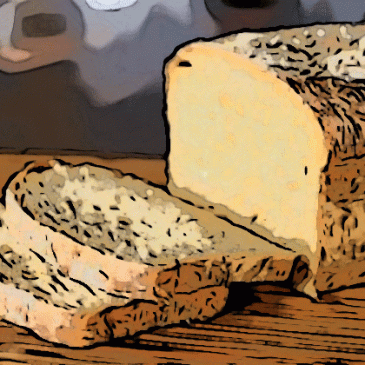
I bake the dough in metal bread tins, well-oiled with safflower oil.  Once the dough has doubled, I give it two or three quick kneads, roll and stretch it out into one long loaf, cut it in half, and put the halves into the tins.  Another hour or so to rise, three shallow cuts on each loaf top, and they go into a 350 degree oven for 50 minutes.  The house smells wonderful.

Of all the cooking I do, there is something elementally satisfying about baking bread, taking a few ingredients to make something so good, whether it’s eaten still warm, dipped in olive oil, or toasted to golden brown and dripping with blueberry jam or honey, knowing that you are participating in an activity that goes back through so many generations.  Sometimes I experiment, adding dried apricots and figs for breakfast bread, or herbs and sauteed onions for a savoury loaf. Occasionally, I have a disaster…and perhaps I’ll tell a story or two about that in another post.

The Love of Libraries

As both a writer and a reader, I love libraries.  I learned to read at a very early age, thanks to my retired-teacher grandmother, who lived with us.  Money was scarce and there was no bookstore in our tiny little town, but there was a library, remarkably well-supplied for rural Ontario.  I read my way through the children’s section, and at about eleven, switched to the adult books. This wasn’t allowed – I was far too young – but my mother fought for my right to read what I wanted, and won.

In high school we swapped books around in a small group of geeky science fiction and fantasy fans, and I read Verne and Lovecraft and Eddison as well as Tolkien and Dunsany and Lewis. Somewhere in my late teens I learned libraries would order books for you, if they didn’t have them, and this opened up another source of new worlds and new thoughts. I read the Beat poets and writers, and Kesey and Tom Wolfe, and Toni Morrison and Alice Walker – new voices for me.  Then I went to university – on student loans and summer wages – and discovered used bookstores, where I spent far too much money.

Meanwhile I continued to use local libraries, reading four or five books a week, fairly indiscriminately.  I’d stopped using the hold or request functions, though, because if I really wanted a book and it wasn’t available, or, I saw one and liked the cover and the blurb, I just bought it.  Bookstores were a destination most weekends, and I rarely came away without at least one book, and as we moved from undergrad to grad school, and then to working, and disposable income increased steadily – I (we, actually) bought more and more books.

During this time, I also came to appreciate the library – in this case the university library – as a place of calm and quiet, a place where I could write.  First my M.Sc. thesis, written on the exceptionally quiet fifth floor, and then, over the years but in the same place, other works – poetry, short stories, and quite a bit of my first novel.   It’s also the same floor and  the same study carrel where I’m writing this blog right now, and where frequently I’m working on Empire’s Hostage, the sequel to Empire’s DaughterIt’s a space both low on distractions – no cats wanting attention, no husband commenting on the game he’s watching, no house or garden chores nagging at me – and high on acquired discipline.  When you’ve been writing in one place for thirty years,  habits of productivity are reinforced by the environment.

While I was working, I only used the university library on weekends.  What little bit of writing I did do during the working week was done at home in my study/library, but in comparison with the university setting I found it hard to work there, even when I was alone in the house.  Gradually I came to realize that the visual distractions in my study – mostly the overflowing shelves of books and the piles of papers on the desk – were in complete counterpoint to the spare and organized university space.  All those books were working against me, love them as I did.  So we culled, donating to book sales, and I moved papers into files on the shelf space freed up.  Suddenly I had a home environment much more conducive to work. (If you are interested in my writer’s blog, please visit it at https://marianlthorpe.wordpress.com/).

But I need new books, for research, for pleasure, for contemplation. Slowly the shelves began to fill up again….and then we retired early, and our income fell by sixty percent.  I looked at what we spent on books each year, and blanched.

These are our book buying parameters now:  first, see if it’s available from the library, including interlibrary loans and purchase requests.  This works about 80% of the time, although there is often a considerable wait.  I once hated waiting for books; now I appreciate the anticipation, the pleasure or learning I know is going to come.  If the library doesn’t have it and can’t get it, look for used, especially on-line when it’s a book I need for research.  Again, waiting a few months often yields the book from these sources.  But if all else fails, and either of us are absolutely certain the book is needed for research OR that it will be read multiple times, as I do with books I buy for contemplation – then it is bought.

And the books I used to buy on impulse, because I liked the cover?  Now I pick those up from the new book shelves at the library.

Habitual Behaviours

Relearning spending patterns, like creating any new behaviour, doesn’t happen overnight.  There are triggers to our spending, especially on things that aren’t necessities. In the downtown of the university town north of us, where I shop, and where we go for films and bookstores, are a few streets of cafes, small interesting shops, a couple of local/organic food stores, two bookshops and an art-house cinema. And the library and an eclectic video rental shop, and the Saturday market. It’s been the cultural and epicurean hub of our lives for the last thirty-five years.  It’s also a spending trigger for me.

On Wednesday this week we were going to see Mr. Holmes at the art-house cinema, along with two friends.  So already there was a ‘treat’, something that didn’t happen every day, waiting for me.  I was making dinner for after the film, and as it’s summer, and warm, I chose to do two salads and cold, sliced chicken breast, along with good bread and olive oil.  I had bought the vegetables for the salads on Tuesday, and I was making the bread, but one of the locally-sourced foodshops downtown does exceptional free-run store-roasted chicken breasts.  So I went to buy them, along with  a few other items needed for later in the week.

I had several other errands to run, and one appointment to keep, and by bad planning it was nearly 1 pm by the time I got to the foodshop, and I hadn’t eaten lunch.  Now, remember, I’ve already said in an earlier post we’d basically blown our entertainment budget for the month by going out for an expensive dinner, plus we were going to a movie the same evening.  But this foodshop also has a little cafe, and makes healthy sandwiches and very good coffee.  So along with my chicken breasts, I bought lunch.  It was a good lunch:  a roasted veggie sandwich with cheese on a store-made wholegrain bun with a cup of coffee.  No guilt about junk food.  But it was $10 I shouldn’t have spent.  Not this month.

It’s not going to send us into debt, of course.  I’m not agonizing over it, but I am analyzing why I did it.  And mostly, it’s the associations of that location.  Yes, I was hungry, but I could (and should) have had a cup of coffee and biscotti – which would have been $3 or so – and eaten when I got home.  It was my last stop.  But this part of downtown is where I went to treat myself when I was working – Saturday morning coffee-and-bagels after the farmers’ market;  pizza and wine after a movie; books browsed and bought.  A good chunk of my novel was written in these coffee shops.  A place of refuge and relaxation from work, and through all my medical treatments last fall and winter.  The sane centre of my world.

So what am I going to do about it?  Three things.  First off, recognize and expect the trigger.  Secondly, plan to not be there at lunchtime on an empty stomach.  And thirdly – keep going!  I don’t need to deny myself the special relationship I have with this neighbourhood, but I do need to go there mindfully.