The New Coffee Maker

Buying anything new in our house is not just a question of going shopping. All purchases of any substance need discussion. If it’s a replacement item, what is wrong with the old one – can it be fixed? Do we actually need it? Can one be found second-hand? If it’s something new to the house, why? What purpose does it serve, and what need does it fill that currently isn’t met? We don’t need more things, and we’re trying to reduce what we have.

I drink coffee. I love coffee. BD hates the stuff. I’ve had a little 4-cup drip coffee maker for years and years…and it was slowly dying, not heating the water to a sufficient temperature. I tried cleaning it. No better. Reluctantly, I decided it really had to be replaced. I need my coffee. Equally reluctantly, BD agreed. ‘Can you get something that doesn’t make the whole house smell like coffee?’ he asked (after the initial ‘Why don’t you give the stuff up?’ followed by ‘Can’t you just drink instant?’ )

Hmmmm. I used to have a French press, many years ago, but cleaning it was a pain, even though it made good coffee. I did some research, and found the AeroPress. Basically a modified French press, the AeroPress sits on top of a mug. You add a filter and coffee to the detachable filter basket, screw it onto the body, add water just a bit below boiling, and press down on the plunger. The on-line reviews were fabulous.

I was fairly sure that my local roast-their-own beans coffee shop would carry it, and I was right. The barrista there raved about it. It was about thirty dollars, twice what a replacement 4-cup drip maker would cost, but it won’t make the house smell like coffee from the pot sitting on the warmer, and will use less water -I almost always made more coffee than I drank, because I could never get small amounts to taste right. (Water use matters – we buy our drinking water, because our well, while safe from a bacterial count viewpoint, has a high manganese and iron content, and tastes unpleasant. So every couple of weeks, BD drives to town with the big reusable bottles and refills them and that’s what we and the cats drink.)

I’ve had it for four days. The verdict? It makes great coffee. It took me a day or two to work out exactly how much coffee and how much water I needed to make it taste just right, not too strong, not too weak. It’s a cinch to clean, the filter and used coffee pop out directly into the compost bin, and it doesn’t take up counter space.

It also means I’m not drinking coffee mindlessly, because it’s in the pot. Already my coffee consumption has dropped because I have to think about whether or not I want to take the three or four minutes it takes to make a cup. I always meant to only drink two cups a day, one in the morning, one after lunch – but it was there on the counter, calling to me. I’m sleeping better, and my stomach is happier. What’s not to like?

The Monthly Menu

In the first months of retirement, it felt good to be able to shop every day or so, especially with the farmer’s markets in full swing. It was a luxury I hadn’t had in my working days.

But over this autumn, as my days of leisure become fuller with the work of my third, chosen, career, it’s becoming a nuisance. The markets are closed, except for the Saturday ones, and the roads are becoming icy, so last month we went back to the monthly menu.

Once a month, we sit down and plan meals. I create a four-column chart: Date, Meal, Prep on Day, Need to Buy. This goes on the fridge, and can be modified as needed – if I only use half a tin of chopped tomatoes in the curry, then a note is made on the next meal that needs them that they’re in the freezer. I use this chart to determine monthly and weekly shopping lists; I tend to buy meat monthly and freeze it, and everything else weekly, with a quick top-up shop half-way to buy milk or yoghurt or eggs, as our fridge isn’t big enough to keep large supplies of these on hand. It also reminds me what to thaw and what other prep is needed on the day.

This works because there are only two of us, and our lives are fairly predictable. If we decide to go out to a movie and dinner with friends, that’s ok -that meal either doesn’t get made, or, it gets moved to the next day, and that meal cancelled, whichever is easier. Meals can be moved around without too much difficulty, and left-overs always have a meal to be included in.

The other advantage is that in six weeks, when we leave for an extended vacation, we’re not leaving behind a freezer and fridge half-full of food. We left once for a two-week holiday over Christmas, only to have our area hit by a vicious ice-storm that meant our house was without power for eight days. All the freezer foods, all the fridge perishables, had to be discarded (luckily our cat sitter is very flexible on what tasks she’ll take on – oh, and the cats went to live with a friend for that time) as we kept in touch by text from England. I’d like not to put her in that situation again, so both fridge and freezer will be empty of anything that could go bad.

Will I keep this up in the summer, when the markets are open again and fresh local food abounds? Probably not….or I’ll modify it a bit…but for the winter months, it works for us.

The Quiet Joy of Enough

Walking today on the snowy trails at our local conservation area, BD expressed once again his sense of disbelief that we are actually retired. Like many – if not most – of our generation, he’d expected to work to 65. ‘But,’ I gently pointed out, ‘many people just wouldn’t be prepared to take the pay cut we did, to retire early.’

‘Enough’ played its role in determining it was time to retire.  Both in it’s negative sense: ‘I’ve had enough of this job.’ and in its positive: ‘We have enough money to retire.’  The latter statement was true only if we kept the positive concept of ‘enough’ in our minds.  ‘What isn’t need is greed’: I don’t know who said that, and I’m not sure I entirely agree with it – but that depends on how you define need. If you acknowledge that the soul has needs as well as the body, then it’s not a bad quote.

‘Enough’ sometimes is difficult.  My health issues have meant I have had to learn what ‘enough’ is with regard to certain foods; that one glass of wine is plenty; that I have physical limitations that must be considered. BD has had similar lessons to learn.  But ‘enough’ is also marvelous: there is enough time now for me to write, to read and review books, to edit for others, to walk every day: all the things that the demands of the salaried job took away from me.  And even better, there is enough money that I can do these things as a true amateur, for the love of them, and not for profit, and so I have only myself to answer to. But this is true because I can say this of so many things: clothes, furnishings, possessions of all sorts –  ‘I have enough’.

I will honestly admit to greed in the past. I had too many clothes; I liked food and wine all too well, and no-one needs the travel experiences we have had, although how can you regret the sight of a tiger hunting along an Indian river, or an Adele penguin standing at your feet, peering up at you? I can’t.  But I can also say, even about that, ‘enough’.  We have the memories.

Our world is smaller now, but our time is…ours.  I wake every morning with quiet joy, knowing I have enough.


Good Fences

Good fences make good neighbors, Robert Frost wrote, in Mending Wall.  Between our property and the neighbours on both sides, a split-rail fence delineates the property lines.  We built the fence ourselves, getting on for twenty years ago, pulling the cedar rails out of the brush of an old farm at the edge of the village, gladly given to us by the elderly farmer. When the fence was done, he walked down one day to see them in their new incarnation. “Good to see them used again,” he said, of the old swamp cedar rails, probably even then well over a hundred years old.

But in a massive thunderstorm earlier this year, with drenching rain and high winds from the east, unusual for here, the young butternut that grows just at the edge of our eastern neighbour’s property shifted just a little, leaning into the fence, and took down three rails. Oddly enough, it didn’t break them: the steady pressure on the fence snapped the wire that held them to the posts. But they couldn’t go back up – the trunk of the butternut was in the way now.

We debated taking the tree down, but I really didn’t want to. Another young butternut, at the edge of the maple swamp behind us, also listed in the storm, but it straightened itself up within a couple of weeks.  I decided to wait. Yesterday, mulching leaves, I took a good look at the tree, and realized it had grown straight again, but from about five feet off the ground, meaning its lower trunk still was an impediment to replacing the rails.

BD and I brainstormed, and decided the simplest thing to do was to add a post directly beside the one north of the tree. This would allow us to run the rails from the new post to the existing one south of the tree, creating a slight zig-zag (or, really, only a zig). We throw almost nothing out in term of wood, so hiding down with the compost bins was a huge old post that had once supported the far end of the washing line. Cut down and wired securely to the existing post, it was the perfect size.

It took us about half an hour to fix the fence, on a glorious November day, sunny, very warm, no wind. Overhead ravens swore at and chased migrating red-tail hawks. The chickadees went back and forth to the feeders, ignoring us, joined by two species of nuthatch and two of woodpeckers. The squirrels – black and red – are happy to have their highway contiguous again, and neighbouring dogs and grandchildren have their limits back. Good fences do, indeed, make good neighbours.

Old, Cold Houses

Yesterday it rained all day, heavily, the last gasp of Hurricane Patricia reaching up into the edge of Canada. Today the winds blew hard, gusting to about 90 km/hr, bringing a cold front with them, and stripping most of the remaining leaves from the trees.

Parts of the house are cold tonight.  A four-square built in 1911, it’s grown a bit from the original; a summer kitchen renovated to a rec room in the sixties; the attic made into living space sometime earlier than that; our own addition of a sunroom.  Insulation didn’t exist originally and was minimal when added sometime later.  The windows aren’t quite sealed.  We’ve added pink fibreglas and vapour barriers in all the places we’ve stripped the walls down to the beams, and in the new sunroom.  The rest of the house had insulation blown into the walls a few years ago.  It helps.  It doesn’t make the house completely airtight, and on a day like this, bits of it are cold.

We’ve grown used to this, over the years.  We wear fleece-lined slippers, and layers of warm clothes. There are throws to snuggle into on the couch of an evening.  I have tea after dinner, reading or watching television.  The new high-efficiency oil furnace (no other choice except electricity, where we are) chugs away, doing its best.

All the heating to the bedroom floor is by convection, open grates in the floors and the wide staircase allowing heat to move upward.  Now we’re both home all day, the bedrooms are much warmer than when we were working, and had the thermostat turned down when we were out. We’re still adjusting to that, both of us liking cold bedrooms to sleep in.  I do wonder how the grandmother who slept in the attic survived, though – it’s just plain COLD up there – no heating at all, ice on the windows in the winter, damp in the spring and fall.  I suspect pneumonia carried her off.

We bought the house from a woman who had been born in it, about seventy-five years earlier.  She told us how the pipes use to freeze in the kitchen, unless the cupboard doors under the sink were left open in the winter. How the drains out to the dry well and the septic tank would freeze, too. The house wasn’t built with a bathroom; it came later.  I imagine going out to the privy on a cold winter’s night, or bathing in the kitchen in a tin tub.  We may only have the one bathroom, and when the winter wind is from the northwest prepare to shiver if you forget to turn the electric heater on – but luxury compared to that.

And that is what I am thinking about, this first windy, cold night of the fall.  What exactly do we need, and when does more become, in the words of a Monty Python skit, “bluddy luxury”? We could warm the house more – it would be simple:  turn the heat up, and turn more of the electric space heaters on. But not only would that cost us money, it would produce more greenhouse gases, more climate change, more pollution. Just because we can have something, should we? Doesn’t the attitude that says ‘sure, have more’ lead to obesity, metabolic disease, debt crises, foreclosures, addiction, and all the sins and symptoms of our material world?

Perhaps that’s an advantage of an old, cold, house.  It makes you think.

Hint-of-Chocolate Pancakes: an Improvisation

Today BD and I had an appointment in the city forty minutes to the west of us at twelve noon. So we decided to have brunch before we went – pancakes and sausages. A good idea, until I went to the freezer and the pantry this morning.

Problem #1? No small containers of soymilk, which I have to use in place of cow’s milk in the pancakes because of BD’s allergies.

Problem #2: No breakfast sausage. Just spicy turkey dinner sausages.

We live 10 miles from town, so it isn’t just a matter of running out to pick things up. But, ok, it’s brunch, spicy dinner sausages will do. But the pancakes? I had two choices: water, or the chocolate soymilk BD drinks. Chocolate pancakes? Why not!

Actually, they were quite good. Just a hint of chocolate, along with the blueberries I always add and the maple syrup on top. Here’s the recipe, in case you want to try it yourself. (I would add walnuts as well, if BD wasn’t allergic to them too!)

Hint-of-chocolate Blueberry Pancakes (recipe makes 6 pancakes)

¾ cup all-purpose whole wheat flour
¾ tsp baking powder
½ cup blueberries (or any other fruit you like – raspberries would be good!)
1 c or a little less chocolate soymilk or milk
1 egg
2 Tbsp light oil – I use safflower.
Mix together the whole wheat flour and baking powder. In a separate cup, mix the egg, soymilk, and oil. Blend the two together, adding more soymilk if necessary to create a fluid batter. Add the blueberries.

Cook on a hot griddle or lightly oiled frying pan until bubbles show throughout the pancake and the top surface looks slightly shiny and set. Flip and cook for another minute or two.

Serve with your preferred toppings – ours is warm maple syrup!

What improv pancakes have you made?

Kitchen Gadgets I Wouldn’t Want to be Without # 1: the Mouli-Julienne

home

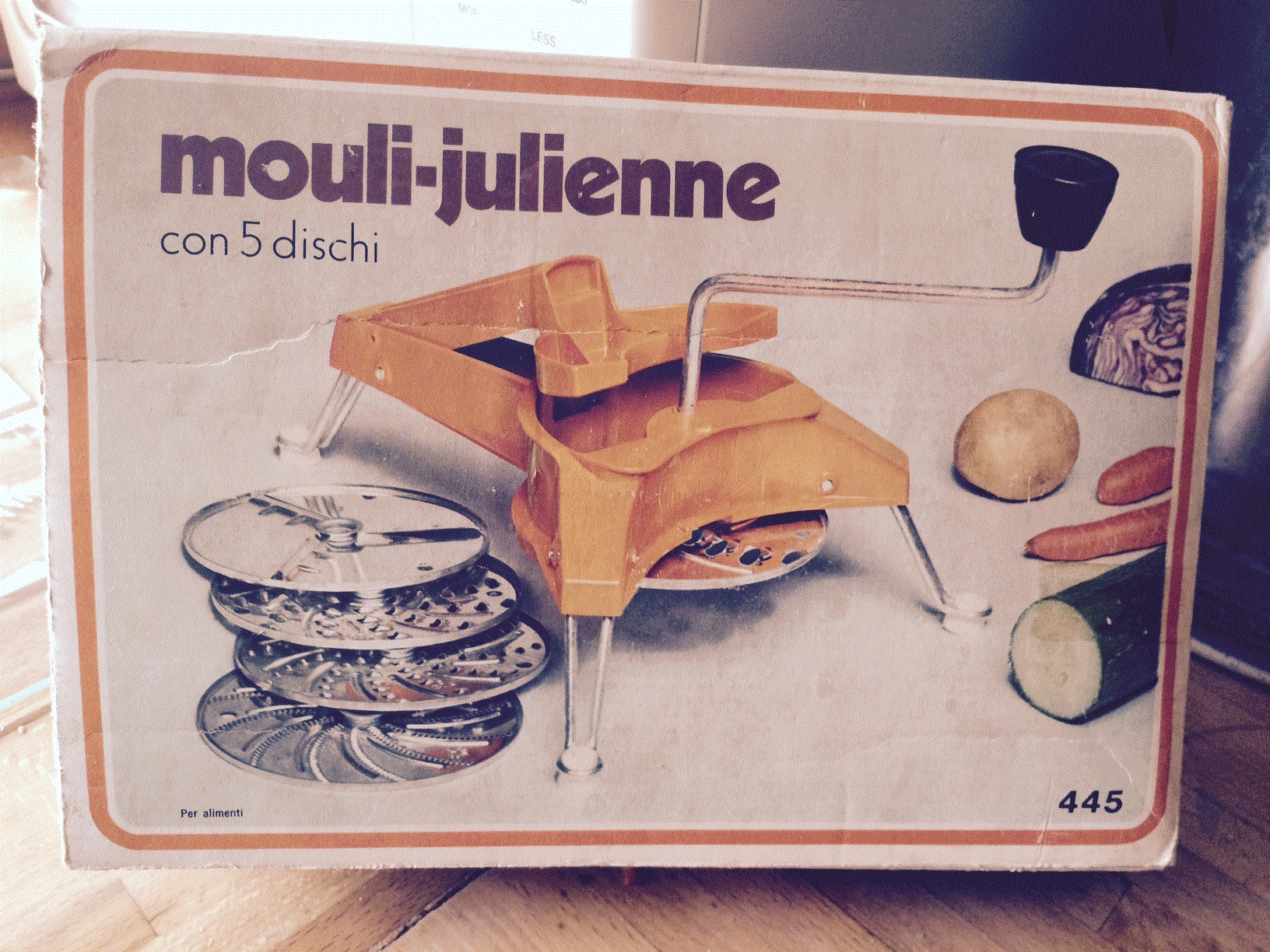
I’ve had this little manual food processor for at least thirty years.  Surprisingly, I still have both the original box and all five of the processing discs, but not the manual – not that it’s needed. It’s only got three parts: the body, the handle, and the disc. This is one of the simplest but effective tools I use in the kitchen.

Today I used it to make just enough carrot-and-broccoli slaw for lunch.  It took two minutes, I used up part of the broccoli stems I’d saved from making a stir-fry earlier in the week, and the slaw was, of course, super-fresh and therefore very tasty.  Stuffed in a kamut wrap with a bit of sliced sharp cheddar, it was a darned good lunch, along with iced green tea and greek yogurt and blueberries.

Over the years I’ve used it to grate cheese, slice radishes, cucumbers, and just about any other sort of vegetable you can think of, shred potatoes for potato cakes…even grate frozen butter for pastry. It cleans up easily:  if I’ve grated cheese, I usually put it in the top shelf of the dishwasher – the whole thing, not just the wheel; if I’ve been doing vegetables, I just hand wash it.  The wheels haven’t rusted or significantly discoloured, and they remain sharp.

I went on-line to see if they are still available; there are a few on e-bay (one described as ‘rare, vintage’ (!)) and a similar product by Westmark on Amazon.  I no longer remember where mine came from; it might have been a present from my parents, as I know they also had one.

It’s easy to use, does what it’s supposed to, has lasted a very long time, and uses no electricity.  Four stars in my book!

What are your favourite kitchen gadgets, the ones you can’t imagine cooking without?

Senior’s (and other) Discounts

Am I a senior?  Well, that depends on whose definition you use.  For some organizations – the American Association of Retired Persons (AARP), for example, it’s 50, so I certainly am.  For some other places, it’s 55, so again, I am.  Sixty is quite common, and sixty-five remains the norm in some place, and I haven’t got there yet!

Due to genetics and nothing else, my hair is still 95% brown at fifty-seven. I had it cut yesterday, and was not offered the senior’s discount! (I don’t qualify, there.)  BD’s had grey hair since his 40’s, and now is almost pure white at fifty-nine.  He gets senior discounts everywhere, no questions asked, so he does the shopping at the bulk food store that offers 10% for seniors on Wednesdays, and the pharmacy that does the same on the last Tuesday of every month.

When we retired, we bought supplemental health insurance – it covers dental and opthamalogical costs, travel insurance, and drugs, plus health services such as physiotherapy and orthotics – and along with that came membership in group that provides discounts on items ranging from fitness club memberships to rental cars.  I’m heading west in a week with a cousin from the UK, to spend ten days in the Rockies, so I thought I’d check it out for the hotels and rental car.  It turned out to be definitely worth it for the rental car, saving me thirty percent of the next-cheapest price I could find through Expedia, Kayak, or anywhere else.  For the hotels, not as much – you’re limited to the ones that participate, which aren’t always in the locations you want.  I’ve used it for one or two sites, but am falling back on the discount offered to Automobile Association (CAA in Canada) members in most places.

Even little things add up.  The buy-ten-coffees-get-one-free cards offered by many coffee shops doesn’t sound like much, but if you get a $2 coffee free every second week, that’s $52 you save over the year.  Which can buy you a reasonable dinner out here at a small bistro.  Gas at the south end of our closest town is generally five cents a litre (twenty cents a US gallon) cheaper than it is at the north end; again, it’s only a couple of dollars at most every fill, but that’s another $50 to $100 a year to spend on something else, and if I use my gas station loyalty card to gain points at every fill-up, I can exchange it for an even greater discount on gas.  But even better is gas at Costco, which is generally ten cents a litre (forty cents a gallon) cheaper, and makes the cost of the membership worthwhile. And as it’s directly across the street from a grocery store I visit once a week, it’s not out of my way.

In Canada, automobile insurers are required by law to offer a discounts to “retirees aged 65 or older, and to younger retirees too, if they are receiving a Canada or Quebec Pension or a pension registered under the Income Tax Act.” so we qualified for that.  Banks, too, offer a reduction in service fees (or waive them completely) for older customers – it appears to vary from bank to bank, and they don’t necessarily advertise it, so ask! I did, and it saved us $132 a year.

Many chain restaurants, from McDonalds onward, have senior’s deals or senior’s meals. I’ve been ordering senior’s meals on road trips for years, since they are almost the only thing on the menu with a reasonable portion size at most chains.

I’m learning just to ask if a shop or service offers a senior’s discount, and many are happy to offer it to me just because I asked.  If they stress the age limit, I’m honest and say I do or don’t qualify. It’s a new mind-set, and like all new things is taking a while to learn, but it’s well on it’s way to becoming a habit.

What senior (or other)  discounts have I missed?   Please share!

Chili and Corn Bread

One of the aftermaths of the surgery and treatment I had last fall and winter was to leave me with what is best described as acquired irritable bowel syndrome. It might pass with time, I was told by my doctor; meanwhile, eat a good sugar-free live-culture yogurt every day, and re-introduce foods high in fibre – especially insoluble fibre – slowly.

This meant a few adjustments to our meal-planning. Legumes – kidney beans, white beans, black beans and lentils – whether in salads, stews, soups, curries or chili – were a large part of our dinners. But the effects of eating them were far too unpleasant to ignore the doctor’s advice!  So for the last eight months they’ve been gone from our dinner table. We just ate more poultry to replace them, and hoped it wouldn’t be a permanent situation.

I went back to eating raw apples, skin and all, and raw cabbage and carrots, in the past six weeks. When there were no ill effects from those, I decided it was time to reintroduce legumes.  So this week I tried black-bean chili, served with corn muffins…and happily, all went well.  It wasn’t quite my usual chili – I used half the beans I normally do, and added some spicy turkey sausage to round out the protein, but next time I’ll add a few more beans, and leave out the meat.

It will be good to get back to eating less meat.  For all our relationship BD and I have tried to eat meat or fish (now because of his allergies only poultry meat) three times a week, choosing eggs, legumes, or cheese-based meals for the other four. Once he could no longer eat cheese, that ratio moved up to four meat-or-fish to three non-meat; and then my issues moved it to six meat-or-fish to one egg-based dinner a week.  It bothered us – there are a myriad of good reasons, for both personal health and the health and sustainability of the planet – to eat less meat.

But now I can start planning legume-based meals again, once a week to start, and we have recently re-introduced small amounts of cheese to BD’s diet without problems.  Home-made vegetarian pizza is on the menu again!  And lentil soup…and dhal…and baked beans.  Just in time for fall!

Black Bean Chili and Cornbread for Two

Two cups de-skinned and chopped Roma tomatoes (or one 19 oz can)

¼ c diced onion

½ c diced red, orange, or yellow pepper

1 c black beans, cooked (or ½ c beans and the meat from one spicy turkey dinner sausage)

½ c corn niblets – fresh or frozen

3 Tbsp chili powder

1 rounded tsp chopped garlic

Oil for browning

Brown the onion and garlic in 1 Tbsp of oil in a heavy frying pan. Add 1 further Tbsp of oil and the chopped pepper, and the sausage meat if using. Cook until the meat is brown throughout.

Put the tomatoes, the onion mix, and the black beans in a oven-proof pot or a slow cooker. Add the chili powder and stir well.

Cook in a 300 degree oven for two hours. If using the slow cooker, I cook on low for 6 hours.

Before serving, taste and adjust chili seasoning. Add the corn a few minutes before serving – it should be cooked but not mushy.

Serve with cornbread/muffins:

1 cup soymilk (or regular milk)

1 egg

2 Tbsp corn oil

¾ c flour

1 ¼ c corn meal

1 Tbsp baking powder

3 Tbsp sugar (optional – I leave it out, especially if I’m using sweetened soymilk.)

1 ½ tsp chili flakes (also optional).

Mix together the milk, egg and oil. Blend the dry ingredients together and add to the liquid. Spoon into either a greased 8″ pan, or greased muffin tins (I use silicon, so no greasing) and bake at 425 for twenty minutes. Makes 8 medium muffins if you use the muffin tins.

Lessons from “Doing it Ourselves”

BD and I started off our relationship with very different skill sets. He had helped do the wiring in his newly-finished basement when he was fourteen, and a bit later helped his parents build a cottage, starting with clearing the lot and ending with the finished cottage. I could cook, sew a bit, and grow just about anything. For my father, horticulture was both a vocation and one of his avocations, and I was helping him in the garden when I was no more than three. I could also hang wallpaper. That’s pretty well where my hands-on skills ended.

When we were first together my lack of construction skills frustrated BD. I didn’t know the names for tools, or how to tell a Robertson screwdriver from a Phillips. (Mind you, he didn’t know a Dutch hoe from a cultivator, either, or a zucchini from a pepper.) But we persevered through two fixer-uppers, and I learned to lay tile and use a caulking gun; to strip hardwood and patch plaster. He’s learned I see the steps in a project better than he does, and can both create the workflow for the job, and be creative when we run into problems. On top of that, I’m ambidextrous with both a hammer and a paintbrush, and can lay roofing shingles better than he can.

We’ve learned to be mindful of each other, respecting knowledge, listening to each other even when the correct vocabulary isn’t necessarily being used. We know each other’s limits, both physical and mental. I know I have to paint ceilings, because it hurts BD’s back too much to do so. He knows I can’t work over my head with an electric screwdriver.

Doing the work ourselves has also increased our sense of belonging in, and to, this house. We are familiar with every square inch of it, from the basement crawl space to the attic rafters. We’ve seen it naked, stripped to the pine beams that run from foundation to attic. We’ve heard it groan when basement support jacks are moved. We’ve patched its wounds and learned its secrets: the burned beams in the old summer kitchen from a stove fire; the potato store uncovered under the kitchen floor when we stripped the old linoleum. We know where the coal chute was, and the original well, and where the stovepipes ran.

The house belongs to this village; it is built from local trees, sawn and finished at the village sawmill. Its foundation is of local fieldstone. We were the incomers, to a house that had been in one family for seventy-five years. But twenty-one years later, we belong here. We’ve earned that belonging in part by respecting our old house. The woman from whom we bought it had been born in the big bedroom upstairs. She wanted to sell it to someone who would love it, not tear it down and build a new house, and when we invited her back to the housewarming a few months later, she was so happy with what we had – and more to the point – hadn’t done to it. We’d respected its character, and that was important to her, and by extension to the village. Without her approval, we’d never had been offered the hundred-year-old cedar rails by the retired farmer down the road; he’d heard we wanted to build a fence, and said they were ours for the taking if we wanted to pull them out of the fence-rows. Our local chimney-sweep and furnace man told us never to worry about our old wonky furnace going out if we were away in the winter; he’d drop by every day to make sure it was on; he knew the furnace well, and he’d been told we were taking good care of “Doris’s” house.

Now when I walk to the community mailbox, or down to Rose’s for a coffee, or on any of my local walks, it’s the people working on their houses I am most often drawn to stop to talk to, the ones with tools in their hands and sweat dripping. I know it’s not completely fair: I know not everyone has the skills, and that employing others to do work for you is important for the economy. But I’m glad there are still young couples who are doing it themselves. Because I do not love the bathroom we contracted out nearly as much as I love the kitchen we tore down to the bare beams and built up again completely by ourselves; nor do I love the floor someone else laid in the sunroom the way I love the old hardwood I scrubbed and sanded and finished in the long living/dining room. There are memories that go with building that kitchen and sanding that floor, that are part of our journey to understanding and respecting not just this house, and not even our place in this community, but each other.