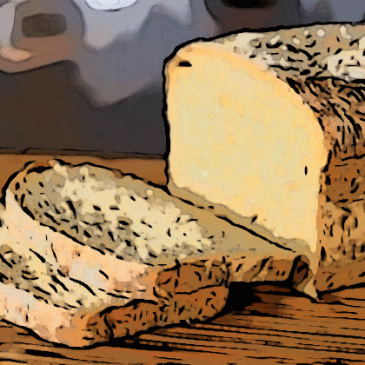
Chili and Corn Bread

One of the aftermaths of the surgery and treatment I had last fall and winter was to leave me with what is best described as acquired irritable bowel syndrome. It might pass with time, I was told by my doctor; meanwhile, eat a good sugar-free live-culture yogurt every day, and re-introduce foods high in fibre – especially insoluble fibre – slowly.

This meant a few adjustments to our meal-planning. Legumes – kidney beans, white beans, black beans and lentils – whether in salads, stews, soups, curries or chili – were a large part of our dinners. But the effects of eating them were far too unpleasant to ignore the doctor’s advice!  So for the last eight months they’ve been gone from our dinner table. We just ate more poultry to replace them, and hoped it wouldn’t be a permanent situation.

I went back to eating raw apples, skin and all, and raw cabbage and carrots, in the past six weeks. When there were no ill effects from those, I decided it was time to reintroduce legumes.  So this week I tried black-bean chili, served with corn muffins…and happily, all went well.  It wasn’t quite my usual chili – I used half the beans I normally do, and added some spicy turkey sausage to round out the protein, but next time I’ll add a few more beans, and leave out the meat.

It will be good to get back to eating less meat.  For all our relationship BD and I have tried to eat meat or fish (now because of his allergies only poultry meat) three times a week, choosing eggs, legumes, or cheese-based meals for the other four. Once he could no longer eat cheese, that ratio moved up to four meat-or-fish to three non-meat; and then my issues moved it to six meat-or-fish to one egg-based dinner a week.  It bothered us – there are a myriad of good reasons, for both personal health and the health and sustainability of the planet – to eat less meat.

But now I can start planning legume-based meals again, once a week to start, and we have recently re-introduced small amounts of cheese to BD’s diet without problems.  Home-made vegetarian pizza is on the menu again!  And lentil soup…and dhal…and baked beans.  Just in time for fall!

Black Bean Chili and Cornbread for Two

Two cups de-skinned and chopped Roma tomatoes (or one 19 oz can)

¼ c diced onion

½ c diced red, orange, or yellow pepper

1 c black beans, cooked (or ½ c beans and the meat from one spicy turkey dinner sausage)

½ c corn niblets – fresh or frozen

3 Tbsp chili powder

1 rounded tsp chopped garlic

Oil for browning

Brown the onion and garlic in 1 Tbsp of oil in a heavy frying pan. Add 1 further Tbsp of oil and the chopped pepper, and the sausage meat if using. Cook until the meat is brown throughout.

Put the tomatoes, the onion mix, and the black beans in a oven-proof pot or a slow cooker. Add the chili powder and stir well.

Cook in a 300 degree oven for two hours. If using the slow cooker, I cook on low for 6 hours.

Before serving, taste and adjust chili seasoning. Add the corn a few minutes before serving – it should be cooked but not mushy.

Serve with cornbread/muffins:

1 cup soymilk (or regular milk)

1 egg

2 Tbsp corn oil

¾ c flour

1 ¼ c corn meal

1 Tbsp baking powder

3 Tbsp sugar (optional – I leave it out, especially if I’m using sweetened soymilk.)

1 ½ tsp chili flakes (also optional).

Mix together the milk, egg and oil. Blend the dry ingredients together and add to the liquid. Spoon into either a greased 8″ pan, or greased muffin tins (I use silicon, so no greasing) and bake at 425 for twenty minutes. Makes 8 medium muffins if you use the muffin tins.

Loving Leftovers, with a bit of help

Leftovers don’t happen to often in our house, because we plan menus in advance and buy only what we need, but on occasion we do misjudge – usually vegetables – this week it’s too many Brussels sprouts and carrots.  Both keep well, so I’ll likely just work them into next week’s menu.  But an article in yesterday’s newspaper caught my attention, making reference to a web-based tool for planning meals around left-overs.  Intrigued, I went looking for more, and found one other that is specific to using leftovers, not just ‘recipe by ingredients’.  Then I tried them out.

The first one I tried is part of the Tesco (a British grocery store chain) website.  It’s a very simple tool to use – you can enter up to three ingredients and it generates recipes.  It couldn’t, however, generate a recipe that used both carrots and Brussels sprouts; it gave me one for the Brussels sprouts, similar to the recipe I buy them for (penne with Brussels sprouts, broccoli and cheese) and many more than incorporated the carrots, from salads to soups to sandwiches and stews.  When I added chicken to the list, the tool focused on the chicken, giving me lots of good-looking chicken recipes but not really helping with the vegetables.

Then I tried Big Oven’s leftover tool. It uses pretty much the same format – you enter up to three ingredients.  I started with just the two vegetables, as before – and got far better results.  It even sorts them into main dishes, side dishes, etc.  One recipe:  for apple-kielbasa bake – will be tried out almost immediately, using turkey sausage.  When I added chicken to the list of ingredients, the site let me choose to be very specific about the chicken, offering me ‘cubed, wings, broth, whole chicken’  which generated more recipes for me to try…I really liked the look of chicken with winter vegetables. (I’d leave the ‘chicken’ choice as just chicken – narrowing it down to ‘cubed chicken’ really limited the recipes, and I can adapt the recipe as needed.)

Another British grocery store chain, Sainsbury’s, has a leftover tool in development.  It would seem that the UK is taking food waste seriously and attempting to address it right from the suppliers.

I’m not really sure that these ‘leftover’ tools differ from the ‘recipe by ingredient’ tools that are out there – I rather think they’ve just been packaged differently.  But if they help with combatting food waste, I’m all for them.  And they gave me two new recipes to try..so that alone was worth the half-hour I spent testing them!

I’m sure there are more tools out there…which ones have you used and found useful?  Please share!

One chicken, four meals.

When we were both working, most Friday night dinners were completely predictable:  rotisserie chicken.  According to a recent article in the Toronto Star, “rotisserie chickens are as ubiquitous as burgers or tacos without falling victim to being dubbed trendy” – at least here in the “Greater Toronto Area”. (As an aside, I can’t help but laugh about that sobriquet – technically my tiny crossroads hamlet is part of the GTA, but what we have in common with the ‘mega-city’ to the east of us continues to elude me.)

Unless it’s a love of food.  Because I’m not talking about the rotisserie chickens drying out under lights at the back of the grocery store.  For $12, I would buy a free-run, clean-fed chicken, rubbed with herbs and olive oil, moist and tender.  They were simply better than any roast chicken I’ve ever made, and at the end of a long week they were satisfying and fast.

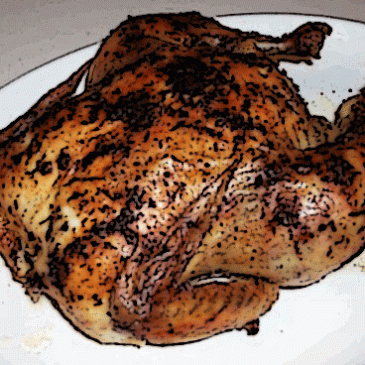
One chicken, a bit over a kg in weight (2.5 lb. more or less) gave us four meals.  The first dinner would be just roast chicken:  the leg and thigh for BD, who prefers dark meat; the breast for me. Served with cranberry chutney from Rose’s, a salad and oven fries (BD makes great oven fries, potato chunks tossed in olive oil, black pepper and rosemary, and roasted at 360 degrees for 45 – 50 minutes) that used, roughly, a bit less than half the chicken.

The equivalent pieces – the other leg and thigh, and the other breast, went into the freezer, to be gently reheated over a pan of water in a slow oven another time.  But at this point there was still a lot of meat on the carcass.  I’d chill it overnight, and then on Saturday strip the rest of the meat from the bones, chopping it into small pieces.

These smaller pieces of meat were destined for either ‘poulterer’s pie’: our version of shepherd’s pie created once BD couldn’t eat red meat, or chicken curry.  I’ve never actually written the recipe for poulterer’s pie down, but basically it’s a mix of chicken and vegetables, herbs and spices, in a thickened chicken broth, topped with a mash- I’ve used potatoes, sweet potatoes, a combination of the two, or a combination that includes parsnips; all work – and baked in the oven until bubbly.  It’s a great cold-weather meal.

Once I’d removed the meat from the bones, the carcass is destined to make chicken broth.  Roasting the bones in a slow oven for a while – 45 minutes or so – before making broth does give a richer flavour but it isn’t necessary if you’re using the carcass of a cooked chicken.  I put the bones, a chunk of chopped onion, and a bit of garlic in my slow cooker, fill it with water, and let it cook all day on low.

Once it’s cooked down to about half of the amount of water originally put in, I strain it and let it cool.  The bones are destined for the compost at this point (we have a municipal kitchen-waste composting pick-up here – the town takes it away once a week, composts it at the waste management site, and gives it away in the spring. When we did back-yard composting of kitchen waste, I stopped composting bones because there is a feed mill in the village…and feed mills attract rats…which like bones and meat scraps.  And I don’t like rats.)

I may do one of two or three things with the broth:  make soup immediately; freeze it in mason jars for later use, or, freeze it in ice-cube trays to give me chunks of broth to use when a recipe needs a small amount.  Mostly I make soup, which served with warm bread and pickles from Rose’s often make up Sunday suppers.  We’ve likely had pancakes and sausage for brunch, so a small evening meal is all we need.  And there is usually enough soup left over for at least one lunch.

So there it is:  one chicken, four meals. BD likes these chickens better than the one’s I’ve roasted (I’m not insulted, because I agree with him) so I think we’ll probably continue buying them, once the cool weather returns.  They fit our food ethics – they are locally raised, and I’m supporting a local small business by buying them, and I’m pretty happy with four meals for two from a twelve-dollar chicken.

The weather forecast calls for highs of 19 degrees C (66 F) later this week.  I think that’s cool enough for roast chicken, don’t you?

Garbage Loaf

A week or two ago we had friends over for dinner, a simple post-movie meal of cold chicken and salads, followed by local raspberries, fruit loaf and ice cream.  After everyone had finished, there were a few raspberries left.  “Eat them, BD,” one of our friends said, “otherwise, they’ll just go to waste.”

As I assured her they would most certainly not go to waste, but be eaten the next day, probably as part of my breakfast, I reflected on the amount of food that is thrown away.  According to The Guardian, thirty percent of all food produced in the world is wasted, and in western countries a large portion of that waste is in the home – food we buy, don’t eat, and throw out.

Why?  Well, a very small bit of spoiled food occurs – the tomato sauce that gets shoved to the back of the fridge and forgotten, and has grown a lovely blue mold when you do find it, the cracked egg in the dozen. But those are not that common in the western world of refrigeration and freezers.  I think food is thrown out because of a lack of planning; a lack of cooking skills in some cases, and because we don’t value food enough.  We want it to be cheap and easy.  We forget the purpose of food – to transform the light and warmth of the sun, the nutrients of the earth, the molecules of water – into nourishment for our bodies, through the labour of many hands.  When something is that fundamental, that miraculous – and can I say it, as a secular person? – that sacred – how dare we waste it?

We try to be mindful about food, and that means planning.  Once a week or so, we draw up a menu, and from that menu a shopping list.  And then we stick to it.  This takes time, every week, but it’s time well worth it, and not just because it will mean less money spent; it means BD and I talk about what we’re eating, what recipes to try, how long we’ll need to make supper, where to buy the produce. We are, as a result, perhaps more conscious – more mindful – of what food is in the house, and what it’s for.

I shop twice a week for grocery-store perishables like milk and yogurt, in part because our fridge just isn’t that big.  (Which in itself is a good thing, since it does mean that there is less chance that half-jar of tomato sauce will get shoved to the back and forgotten.)  I shop almost daily for fruit and vegetables during the summer, when the farm stands are open and the produce is freshly picked.  But for meats, I shop, roughly,  monthly, or perhaps every six weeks, buy in moderately large quantities, divide into portion sizes, and freeze.  All this significantly reduces the chances that food will be overlooked or wasted.

But don’t think I’m a paragon of planning.  I keep a freezer inventory, and I mean to cross off what is used, but it doesn’t always happen.  And so, yes, every so often I find some chicken in the freezer that’s looking a bit freezer-burned. Sometimes the only zucchini I can get at the farm stand is too big for just the meal I want it for.  Sometimes one of the apples has too many bruises, or BD forgets to eat his raw carrots and they go soft.  So what then? I can’t bring myself to throw out food unless it’s truly gone off.

Freezer-burned chicken, like the carcass when we have a roast chicken, is saved to make soup, a mainstay of colder-weather meals.  (I’ll wait until the colder weather arrives before writing more about that – I can’t get excited about soup recipes in the summer.)    Soft, over-ripe, or just plain excess fruits and vegetables that don’t freeze well, though, go into ‘garbage loaf’, basically an adaptation of a banana loaf recipe with the same amount of just about any vegetable substituted for the banana.  I even mix them – but be sensible about that:  tomato and zucchini work together, as do apples and carrots, but I wouldn’t do strawberries and tomato.  BD will eat almost any baking, but even he’d draw the line at the last one!

So here’s the recipe for ‘Garbage Loaf’ as I make it. (I probably should have called it Leftovers Loaf, but at least in our house, it’s too late now – Garbage Loaf it is.)

Wet ingredients:

1 cup just about any fruit or vegetable, diced, shredded, or cooked and mashed..  If using carrots or parsnips, grate and steam slightly first.

1/4 cup applesauce (to reduce the fat; if you don’t have it, or don’t want to use it, double the amount of oil.)

1/4 cup light oil – I use safflower, but sunflower, corn or soy works too.

2 eggs, beaten

1 tsp vanilla

4 Tbsp fruit juice (not tomato juice)

Dry Ingredients:

1/2 c brown sugar (this suits us; you may like it sweeter.  It also depends on whether or not you add chocolate chips or dried fruit.)

1 and 3/4 cups flour:  I use whole wheat.

1 tsp baking powder, rounded

1 tsp baking soda

Optional Ingredients 

1/2 cup of any of:

nuts

chocolate chips

raisins or other dried fruits

Preheat your oven to 375 degrees.  If using a glass or metal loaf tin, grease it; a silicon one should not need it.

In a bowl, combine the fruit or vegetable mash, oil, eggs, sugar, vanilla and fruit juice.  Mix with a heavy fork or a hand mixer until well blended.

In a separate bowl, combine the flour, baking powder, and baking soda, and any optional ingredients you are using.

Pour the liquid ingredients into the dry, and mix with a heavy fork or a hand mixer on low; do not over-mix.

Spoon into the loaf pan and bake for 55 minutes or until a skewer inserted into the centre comes out clean.

As I’ve said in an earlier post, BD is a tall and highly-active man, so this loaf doesn’t tend to last long – but it freezes well, and, if by some miracle there is a slice or two left after a couple of days, it also toasts well.

I’ve also added shredded carrots and apple to bread:  it makes a denser, moist bread that won’t keep as long – after the first day we slice it and freeze it, and toast the slices; but it’s good with cheese (for me) or hummus.

And dessert at that dinner that prompted this post?  The fruit loaf was indeed Garbage Loaf, made with over-ripe bananas and a slightly suspect apple, and it complemented the raspberries and ice cream very well.

Sustainable or frugal?

Living on roughly half of our previous income, even though we are not by any stretch of the imagination impoverished, still presents some challenges. In the months previous to retiring, I analyzed our spending each month down to the penny, to ensure that we would continue to have a decent quality of life.  For us, quality of life includes being true to our belief in buying local, ethical, and sustainable food whenever possible.

But such food is not inexpensive.  I can buy a dozen factory-farmed eggs for just about half what I pay for eggs from traceable, ethically housed, local free-run chickens.  California greens, even with their drought , are still currently cheaper than the ones from the organic farm up the road.  Food is our biggest single monthly expense, and were I to further change my buying habits, I probably could reduce it by about thirty percent.

I’m not going to, though.  The value of buying the food we do goes well beyond satisfying our own tastes.  A much larger percentage of the money I spend goes directly to the local economy, into the pockets of my neighbours, than if I bought the equivalent products at grocery store.  Animal welfare is improved.  Farming remains viable, which means land remaining productive, and supporting, in the field margins and fence-lines, a healthier bird and wildlife population than would exist if the same land became a housing development.  I can ask the producers of my eggs and meat what they feed their animals, which matters not just in terms of general health for both the animals and us, but because of BD’s allergies.

I am fortunate to be able to afford to buy food like this.  I am fortunate to live in a place that supports, within a ten-mile radius, five seasonal farmers’ markets and one year-round, and innumerable farm stands.  Local food maps are published yearly.  Later today I will go out to buy sweet corn and tomatoes for tonight’s dinner from a farm stand up the road, which sits among the fields where the corn and tomatoes grow.

Frugality has a different meaning for us, when it comes to food.  It means ensuring food is not wasted – broth is made from chicken bones, older fruits and vegetables go into baking (I’ll write about my ‘garbage loaf’ at another time), portion sizes of meats are small.  Vegetarian meals make up half our dinners.  We buy almost nothing prepared; we have the luxury of time, and the skills, to cook from scratch (for which I perpetually thank my parents, who, living through both the depression and the rationing of WWII in Britain, were both frugal and creative with food).

And that sweet corn, tonight, lightly steamed and brushed with olive oil, then sprinkled with salt and pepper, will taste like the essence of earth, water, and summer sunshine in every bite.

Pickles, Salsa, Coffee and Community

pickles

The tiny crossroads hamlet in which we live boasts two retail outlets – the feed store, where we buy birdseed in the winter, and a bakery.  More than a bakery, the shop – I’ll call it Rose’s – supplies not just bread, pies, tarts and the best cider donuts for miles, but pickles, salsa and jams.  And coffee. Rose works harder than anyone I know – the bakery opens at 6 a.m. to provide coffee and breakfast fare and closes at 6 p.m., and it’s Rose who is baking, pickling, and providing counter service for all those hours, six days a week.

I used to stop every morning for coffee before I drove to work, and Rose’s donuts and butter tarts were the highlight of many a department meeting.  Over the years, Rose and I became friends, although she has a reputation for being irascible. She’s also the hub for village news – when BD found a grey-and-white kitten in our garage early one summer’s morning five years ago, it was to Rose’s we went to see if anyone had reported her lost.  (They hadn’t, and Pye, all grown up now, is currently sitting on my desk watching me type.)  We tell her when we’re going away, so she’ll keep an eye on the house.  When I was buying coffee at seven a.m. weekday mornings, we’d talk about the fox cubs being reared in the old graveyard; the coyote family Rose saw every morning at five a.m. when she walked her dogs; the sandhill cranes which have returned to the area.  She’s told me who to hire to plough the snow, fix our furnace, pump the septic tank.

But in retirement, I have the leisure to make my own coffee in the morning, and I also needed to consider the money I spent – the coffee was all too frequently combined with a muffin, or a breakfast sandwich – depleting my purse and expanding my waistline.  But I miss going.  I miss our chats, I miss being greeted by her two Labradors, and her coffee is better than mine. Frankly, I miss seeing my friend, and finding out what’s happening in the village.  Dropping in every couple of weeks when we’ve run out of salsa or pickles or cranberry chutney isn’t enough.

So I will return to buying a morning coffee two or three times a week, but now I’ll walk or bike down, or stop in on my way to town for groceries.  It  will cost me a few dollars, but can you put a price on community?

Baking Bread

Several years ago, my husband developed an unusual food allergy: he is allergic to one specific fatty acid.  When he eats anything containing lauric acid (dodecanoic acid, a saturated fatty acid with a 12-carbon atom chain, if you really want to know), he breaks out in severe hives.  This limits what he can eat, and makes buying many commercial products impossible.  We’ve adapted to this, and as a result probably eat a much healthier diet, as it has eliminated red meat, dairy products, and most fats (with the exception of olive, sunflower and safflower oils) from our meals.

He’s a tall, lean, very physically active man, and needs a lot of calories to maintain a healthy body weight.  (I’m jealous, yes.)  As a result, he eats a lot of bread, but it can’t be just any bread, because many or most commercial breads are made with at least one of the fats he can’t eat.  Luckily, however, there is one artisan-bakery bread widely available here which he can eat, and that’s what we’ve bought for many years.  But…it’s at least $4.00 a loaf, sometimes more, depending on what type we buy, and he goes through the best part of a loaf a day.  When I was preparing for retirement, analyzing our grocery budget, looking for places to reduce spending, this one stood out.

I learned to bake bread as a teenager, and I’ve made it on and off for years, but it’s a time commitment, needing at least three hours and usually more from start to finish.  But we’re home all day now.  I did the math:  I can make two loaves of multi-grain bread, made with nothing else but olive oil, water, and a bit of salt, for about a dollar a loaf.  Plus the electricity. So now, every couple of days, I make bread.  And I love it.

The process begins with the yeast dividing in a half-cup of warm water, scenting the kitchen with promise.  While it’s dividing, which takes about ten minutes, I get out the flour – olive oil and salt sit permanently on our kitchen counter – and the large pizza pan I use to knead the dough on. (It’s easier to clean than the counter-top.) After ten minutes I add a glug of olive oil, a grind or two of sea salt, another 2 cups of water, and three cups of flour.  Then I mix it, with a heavy dinner fork.  At this point, it’s a sticky paste.

Half a cup of flour goes on the pizza pan, and another cup or so into the bowl so that I can start to mix the dough with my hands.  (Before this starts, I put music on – a good reggae song from Max Romeo is ideal.) Then I dump it all out onto the pan, and begin kneading.

The dough feels good under my hands: elastic and alive.  It’s my hands that tell me if I need more flour in the mix, from the feel, silky and resilient, but not stiff.  Usually I end up using between five and six cups of flour to reach the perfect consistency.  I knead for five minutes, hard, pushing the heels of my hands deep into the dough.  When I started doing this, my arms and hands would ache afterwards, but now the muscles have grown stronger.  I dance a little to the music.

After five minutes of kneading I give the dough a last shape into a ball and put the pan either on top of the stove (in the summer) or inside it with the light on (in the winter, when the house is a bit colder) to rise, set the timer for an hour, and leave it to double.  If I’ve got the dough just right, an hour is exactly what it needs; if it’s a touch too stiff, it may need a little longer.

I bake the dough in metal bread tins, well-oiled with safflower oil.  Once the dough has doubled, I give it two or three quick kneads, roll and stretch it out into one long loaf, cut it in half, and put the halves into the tins.  Another hour or so to rise, three shallow cuts on each loaf top, and they go into a 350 degree oven for 50 minutes.  The house smells wonderful.

Of all the cooking I do, there is something elementally satisfying about baking bread, taking a few ingredients to make something so good, whether it’s eaten still warm, dipped in olive oil, or toasted to golden brown and dripping with blueberry jam or honey, knowing that you are participating in an activity that goes back through so many generations.  Sometimes I experiment, adding dried apricots and figs for breakfast bread, or herbs and sauteed onions for a savoury loaf. Occasionally, I have a disaster…and perhaps I’ll tell a story or two about that in another post.

Habitual Behaviours

Relearning spending patterns, like creating any new behaviour, doesn’t happen overnight.  There are triggers to our spending, especially on things that aren’t necessities. In the downtown of the university town north of us, where I shop, and where we go for films and bookstores, are a few streets of cafes, small interesting shops, a couple of local/organic food stores, two bookshops and an art-house cinema. And the library and an eclectic video rental shop, and the Saturday market. It’s been the cultural and epicurean hub of our lives for the last thirty-five years.  It’s also a spending trigger for me.

On Wednesday this week we were going to see Mr. Holmes at the art-house cinema, along with two friends.  So already there was a ‘treat’, something that didn’t happen every day, waiting for me.  I was making dinner for after the film, and as it’s summer, and warm, I chose to do two salads and cold, sliced chicken breast, along with good bread and olive oil.  I had bought the vegetables for the salads on Tuesday, and I was making the bread, but one of the locally-sourced foodshops downtown does exceptional free-run store-roasted chicken breasts.  So I went to buy them, along with  a few other items needed for later in the week.

I had several other errands to run, and one appointment to keep, and by bad planning it was nearly 1 pm by the time I got to the foodshop, and I hadn’t eaten lunch.  Now, remember, I’ve already said in an earlier post we’d basically blown our entertainment budget for the month by going out for an expensive dinner, plus we were going to a movie the same evening.  But this foodshop also has a little cafe, and makes healthy sandwiches and very good coffee.  So along with my chicken breasts, I bought lunch.  It was a good lunch:  a roasted veggie sandwich with cheese on a store-made wholegrain bun with a cup of coffee.  No guilt about junk food.  But it was $10 I shouldn’t have spent.  Not this month.

It’s not going to send us into debt, of course.  I’m not agonizing over it, but I am analyzing why I did it.  And mostly, it’s the associations of that location.  Yes, I was hungry, but I could (and should) have had a cup of coffee and biscotti – which would have been $3 or so – and eaten when I got home.  It was my last stop.  But this part of downtown is where I went to treat myself when I was working – Saturday morning coffee-and-bagels after the farmers’ market;  pizza and wine after a movie; books browsed and bought.  A good chunk of my novel was written in these coffee shops.  A place of refuge and relaxation from work, and through all my medical treatments last fall and winter.  The sane centre of my world.

So what am I going to do about it?  Three things.  First off, recognize and expect the trigger.  Secondly, plan to not be there at lunchtime on an empty stomach.  And thirdly – keep going!  I don’t need to deny myself the special relationship I have with this neighbourhood, but I do need to go there mindfully.

Choosing Wisely

A few nights ago, we had dinner with two couples at a fairly expensive restaurant.  At first glance, this seemed both unwise – the meal would cost most of our entertainment budget for the month – and contrary to our desire to live simply.  But let’s examine this more closely.

Both of us enjoy and appreciate very good food, and this particular restaurant is very good, consistently featured in Where to Eat in Canada.  It also serves locally sourced foods, which is important to us.  The night was perfect for our patio table, and the company and conversation of our friends delightful.  We had a memorable meal – I ate caesar salad, a quail appetizer, and frites, followed by coffee and a whiskey; my husband had quail and pickerel- and the meal and tip came to about $120.00, as we expected.

As we left the restaurant, our friends asked to join us there again in about three weeks.  And – this is the important part – I declined, explaining honestly that we can’t afford it that often, which they understood.

But as I have reflected on that meal this week, I realized I declined not just because of the cost, but because I really don’t want to eat like that too often.  Not because it was expensive, or we overate (we didn’t), but because it was an experience I want to savour and remember as something exceptional.  Treats are not treats if they happen too often.  Good food is important, something we take seriously in our meal planning, preparation and shopping, but there is a difference between everyday good food and a very special meal.

Adjustments will be made to this month’s spending to accommodate this meal, money cut from both the entertainment and grocery budgets.  We’ve traded a couple of movies at our local art-house cinema and some more-expensive foods and beverages for those few hours on the patio.

But, for us, this meal was a wise choice, because of the quality of time shared with our friends, the immediate appreciation of the food, and the on-going pleasure of the memories engendered.  It was also a considered choice, discussed and planned for, the costs, not just financial but in our quality of life for the rest of the month, analyzed.  Did we choose wisely?  We believe we did.