The Shepherd

Lost Aviator Coffee was started a few years ago by two pandemic-grounded pilots. They occupy a small repurposed space in the Ward, an originally working-class, primarily Italian-immigrant, section of Guelph. I used to live in the Ward, in a tiny post WWI bungalow. It was the first place we looked for houses when we returned to Guelph. It’s not where we ended up, but I still bike through it almost every day of biking weather, and Lost Aviator is where I buy my ground coffee. Their holiday blend – ‘The Shepherd’ – is what took me there originally.

The seasonal blend isn’t named for the story of the shepherds who saw a star, but for a much newer story: Frederick Forsyth’s The Shepherd, a story that’s been part of my midwinter celebrations for most of my adult life. In the Victorian tradition, it’s a Christmas ghost story: a post WWII tale of a young pilot flying at night in fog across the North Sea, his fuel down to fumes, his instruments useless – and the impossible rescue that ensues.
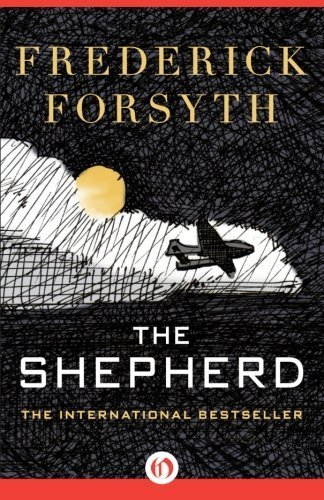
It’s a classic story, its writing spare, perfectly paced, understated. Every Christmas Eve – its setting – we light the fire, turn off the lights, and listen to the audio version produced many years ago by the Canadian Broadcasting Corporation, read by the man who was, for many years, the co-host of As it Happens, the CBC’s national evening current affairs program: Alan Maitland. He was also my godfather.

Not that I really knew him; he’d been a friend of my parents, but had moved away to do greater things at CBC-Toronto than he could accomplish in the little CBC station in Windsor, I suppose. Nor did he do the ‘godfathery’ things some people in that role do. But I do remember meeting him at least once, and so that tenuous connection was there. But ‘Fireside Al’ read a lot of stories on the CBC over the years, and The Shepherd is the only one I listen to, for another, much less tenuous (now) connection. The Shepherd is set over the flat fields of Norfolk – and Norfolk is my second home, a place I know and love. (It was also home to more WWII airfields than any other county of the UK, due to both its proximity to Europe and its flatness.)

There’s not a central point to this little essay, really, except that it’s about connections. Were we playing the ‘six degrees of separation’ game, the folks at Lost Aviator could claim a three-point connection to Alan Maitland — and perhaps a four-point to Frederick Forsyth, if my godfather ever met him. (I wouldn’t be surprised if he had.) In naming their holiday blend after Forstyth’s story, they gained a regular customer. Little things that bring people together, make connections across time and space, from the power of words and imagination: from the power of stories. Which, as the 11th Doctor said, is all any of are, in the end. So make it a good one.

Writing Beowulf

A portion of the Beowulf manuscript. Public Domain, via Wikimedia Commons

“I need a challenge,” I told my husband the other day. I’ve not long finished my newest book, I’m not ready to start the next one, and I was rather at loose ends. Until I remembered a project I’d half-considered earlier: an adaptation of Beowulf.

In Empire’s Heir, my sixth book, the character Sorley hears a tale new to him, and, because he is a bard with all the responsibility that title carries: historian, poet, cultural custodian– he puts the tale into verse and music. The conceit is that the poem he writes is Beowulf – but as no one knows who wrote it, why not Sorley?

Half an hour later, Sorley had finished singing about Hrothgar and heroes and monsters, and I could stand without too much pain.

“That is not a danta* for children,” I commented, as Apulo slipped a fresh tunic over my head.

“Not unless nightmares are called for,” Sorley agreed. “It’s interesting; there are other danta about Hrothgar, and others with dragons, but nothing else I know with these monsters of the deep. I wonder what traditions are behind it?”

Empire’s Heir

In front of me I have three translations of Beowulf: Seamus Heaney’s, JRR Tolkien’s, and John Lesslie Hall’s, from the Gutenberg Project. The goal is to glean meaning from these – my Old English was never great, and is now so rusty I can only pick out a word here and there – and create my own, or rather Sorley’s – version. Not of the whole poem (I don’t think), but an excerpt or two. Unless, of course, the challenge spurs me on!

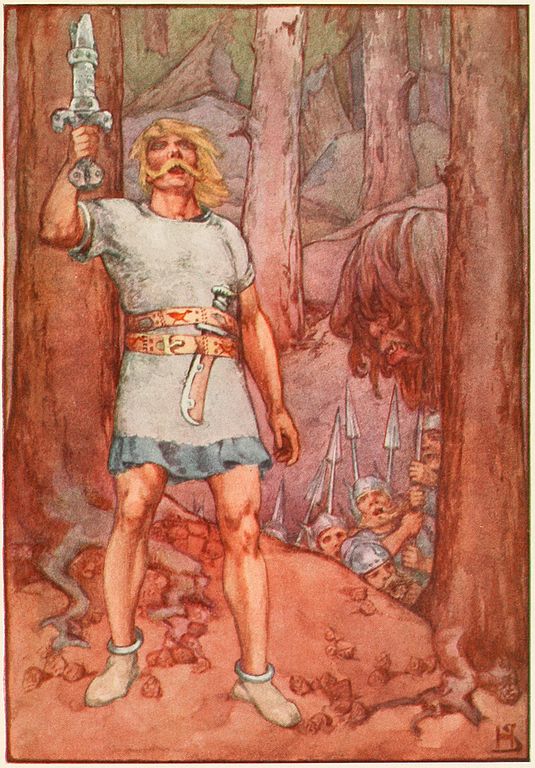
Helen Stratton, Public domain, via Wikimedia Commons

*A danta, in my parallel, not-quite-historical, world, is a story-song.

A free book!

I’ve been neglecting this blog, but sometimes there just aren’t enough hours in the day. Spinnings ARC coverWhat I have been doing is preparing my next book for publication, although to call it a ‘book’ might be misleading: it’s actually two short stories and one related poem.  It’s a quick read, and right now I’m offering an e-book version to anyone who is willing to add a rating or a review to Goodreads.
So, if you’d like an advanced review copy, send me an e-mail at marianlthorpe at gmail.com, or reply to this post here, or on Facebook or Twitter.  I’ll need your email, and whether you want an e-pub (for iBooks) or a Kindle file. Indie authors depend on reviews and ratings on Amazon and Goodreads, and every one helps.

I’ll post the real cover soon…it should be available to me in a few days.

Thanks for considering!


Reviewers Wanted!

This may be an odd request from someone who reviews books regularly, but I’m having a very hard time finding people to review my young adult/new adult e-book, Empire’s Daughter. In part, this may be because it doesn’t fit into any major genre and is difficult to classify. It takes place in a world inspired by Britain after the fall of Rome, but is not historically, geographically, or socially a direct copy. There is no magic. Human relationships cover all pairings, but there is no explicit sex.

You can check it out here:

http://www.amazon.com/Empires-Daughter-Legacy-Book-ebook/dp/B00TXFTZ3G/ref=asap_bc?ie=UTF8

https://www.goodreads.com/book/show/24979052-empire-s-daughter?from_search=true

If you’d like to give it a try in exchange for an honest review on Amazon and/or Goodreads, let me know and I’ll send you the electronic file of your choice for Kindle, iBooks, or Kobo (basically, any of .mobi, e-pub, or PDF).

Thanks,

Marian

The Two Books I Wish I’d Kept

A year or so ago we culled the library bookshelves. We had to; they were overflowing. Books can take over this house very easily.

I thought I’d done a mindful, considered cull. I really thought about each book. But it’s now clear I culled two books I should have kept.  They were both books that fall into my ‘contemplation’ category: books I read, think about, read again, think some more. Books that have changed, and continue to change, how I see the world. In the case of these two books, they were among the first – one was the first – to do that for me.

The first book, the one that first made me look at the world differently, is Annie Dillard’s Pilgrim at Tinker Creek. I read it for the first time at sixteen or seventeen: it was published in 1974, the year I turned sixteen, so I must have found it (how?) shortly after. A deeply personal and sometimes mystical narrative of the writer’s relationship with the natural world that surrounds her home, it spoke to me at many levels. Dillard’s understanding of the natural world and the appreciation of the rhythms and cycles of life were key to my love affair with the book, but the fact it was also written by a woman was immensely important. I’d read Aldo Leopold and Thoreau and others, but there was always a small disconnect; I couldn’t project myself into them. With Dillard, I could.

I re-read the book several times in my twenties, each time understanding more, recognizing more of the spiritual aspect of it. Then I left it alone for a long time, before reading it again about a decade ago. By then I was on my second copy of it – I’d read my paperback to pieces, and when I found a hardback at a used book store, I bought it. And then last year I gave it away.

The second book is Robert Pirsig’s Zen and the Art of Motorcycle Maintenance. I suspect no other book has influenced my own approach to life as much as this one. I didn’t tackle it until my early to mid twenties, and it was the first book I read (other than my calculus textbook) where I remember recognizing as I read it that I really didn’t understand all of it, not in depth. So I read it again…and again…and again, over the next ten years. Finally, I thought I did understand it, how the search for understanding the elusive definition of quality, of what is good or not good, had become entwined with the author’s mental illness, and how recovery entailed learning to embrace and balance both the romantic and the rational. But again, my paperback was in tatters, and I thought I’d learned all I needed from it.

I wonder now why I thought I was done with them; where that hubris arose from. I have written elsewhere about how I understand the world through walking; in doing so, I create mental maps both real and unreal. The real mental maps mean that once I walk a place mindfully, I cannot get lost there, unless a very long time goes by before I am there again. The unreal are dreamt maps, dreamt walks, that overlay the real world, are different from it but always echo it. These books have been guidebooks for both my conscious and unconscious journeys. And I thought I could give them away?

I can either buy them again – they won’t break the budget, and both are still in print, and easily available used – or I can get them from the library. I think I’ll buy them. And at some level, ask their forgiveness for thinking I could navigate through this life without them.

Bedtime Stories

For about a decade between the years 2000 and 2010, I drove (roughly every third weekend) a round trip of about 650 km (400 miles) to visit my aging parents.  The drive – and I love to drive – is not very interesting, to say the least, and the truck traffic heavy for about the first half of the trip.  After that, it improves, and I can pay less attention to the road and more to the passing countryside, but even then….

So I started to listen to books on CD.  My library had – and has – a good supply, and they relieved the tedium of the drive considerably.  I listened to almost anything:  thrillers, westerns, horror, classics – drawing the line only at romances, which just aren’t my cup of tea.

After 2010 my sister and her husband retired from the big city to the little town one east of my parents’ home, and I didn’t need to make the trip as often.  But by then, I was totally hooked on audiobooks, and not just for driving.  They are my bedtime stories.

In the same decade I was doing those long drives I also entered my mid-forties, and all the related mid-life changes that entails.  Sleep became an issue, both from the joys of waking up too hot, too cold, needing the loo, etc., plus I’d changed jobs to one where there were a lot of problems to solve, and I’d lie awake thinking about work issues, too.

BD is extremely light-sensitive, so reading, even with a little book light, disturbed him.  And it didn’t really work anyhow – I’d get sleepy, but then as soon as I put the book down it was back to thinking.  So I tried audiobooks – in those days, using a Discman portable CD player.  Most of the time, I’d be asleep in ten minutes, the ‘thinking’ part of my mind distracted by the story.

It wasn’t perfect.  I had to guess where I’d fallen asleep on the CD and backtrack every time.  But I slept better.  And time and technology moved on; my library started to offer down-loadable audiobooks through a service called Overdrive.  I bought an iPOD, and began to use the service, but it too had issues – a limited number of copies of books, long wait times, many titles I wasn’t the slightest bit interested in.

Then I discovered Audible and its thousands of titles.  Sure, I had to pay for them, but that wasn’t an issue then and sleeping was!  With a subscription, and buying credits in bulk on special offers, I figured I was spending about $5 a week on audiobooks, and that was a small price to pay for better sleep.  And that is pretty well what I continued to use, up until retirement and the need to spend less.

I looked at the library downloads again – they now have two services, Overdrive and the 3M library.  I am using those to some extent.  But my preferred service now is the completely free Librivox.org. These are all public domain titles (titles whose copyright has expired) and they are read by volunteers. And there is a small ‘commercial’ at the beginning of each chapter for the service. Small annoyances – I’ve learned to tune out the commercial (I seriously don’t hear it anymore) and you can search the site for books read by your preferred readers, or to avoid those read by people whose voice just grates on you.

And what a world it has opened up to me! My father was a reader of Victoriana – the Brontes, Dickens, Trollope. I could never read them – too wordy, too convoluted – but I can listen to them with pleasure. One Anthony Trollope novel generally translates to between fifty and sixty hours of audiobook.  That’s a lot of bedtime storytelling, especially now I sleep better, work worries being a thing of the past.

My greatest epiphany was Moby-Dick.  This was the first book I never finished; we took it in grade 11, I think, and I just couldn’t read it.  But listening to it was an absolute delight, the differing pacing and topics and voices of chapters like the movements of a symphony. I am now convinced that many nineteenth-century books were written to be read out loud, and are best heard rather than read.

Now my biggest issue are the books that are just too interesting – instead of making me sleepy, I want to keep listening!  I save those for that long drive…my parents are gone now, but I have a sister to visit, and the road doesn’t get any more exciting.  So I plug my iPhone into the auxiliary jack, adjust the volume, and I’m off.

PS:  It’s possible some of you saw part of this post appear and disappear from WordPress…that was thanks to Pye-the-cat, who walked over the keyboard, pressing the right buttons to Publish, while I was in the middle of writing it.

Serendipity

As I’ve written earlier, I don’t buy a lot of books any more, for reasons of both economy and a concerted effort not to buy what I don’t need. Libraries provide me with most of what I read.  But I will buy a book if I need it for research, and I can’t get it any other way, or, it falls into a category I call ‘contemplative books’:  books I will read several times, books that make me think about my relationship to the world.  Mostly these are books like The Wild Places, by Robert MacFarlane, or Four Fields, by Tim Dee, thoughtful, insightful books written about the relationship between nature and humans.  Mostly British, as this is the country I love best of all the world.

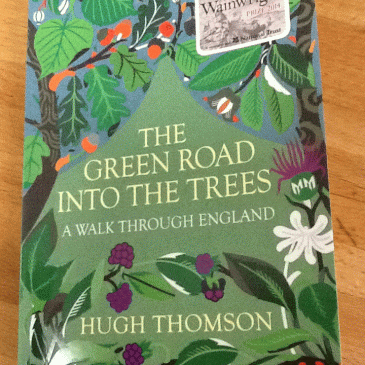
So when Amazon.co.uk sent me their most recently generated list of ‘books recommended for me’, one stood out.  (By the way, I don’t understand the algorithms they use, but they get it right 95% of the time.  I want to buy almost all of them.  I resist.)  The Green Roads into the Trees:  A Walk through England, by Hugh Thomson, ticked enough of the boxes. My libraries didn’t have it  and weren’t interested in getting it – too specialized.  I was pretty certain I would read it more than once.  So it became one of the rare books I bought.

I was busy, so I didn’t look at it for a few day after it arrived.  But when I opened it….call it grace, call it serendipity…but it ticked a box I hadn’t realized it would.  The book is about the author’s walk from Dorset to Norfolk on an ancient trackway called the Icknield Way, a route and an experience I need to research, not for the Empire’s Legacy series, but for another novel which is in the very early planning and research stage.  I was absolutely delighted. And if I know the way of things, there is a good chance that somewhere in this book there will be a line, a comment, that will inform and change that novel in a way I can’t foresee, if I read mindfully, open to what it has to tell me.

This is a shared (and slightly modified) post from my writer’s blog. I don’t plan to overlap the two very often, but this one I felt was appropriate.  

The Love of Libraries

As both a writer and a reader, I love libraries.  I learned to read at a very early age, thanks to my retired-teacher grandmother, who lived with us.  Money was scarce and there was no bookstore in our tiny little town, but there was a library, remarkably well-supplied for rural Ontario.  I read my way through the children’s section, and at about eleven, switched to the adult books. This wasn’t allowed – I was far too young – but my mother fought for my right to read what I wanted, and won.

In high school we swapped books around in a small group of geeky science fiction and fantasy fans, and I read Verne and Lovecraft and Eddison as well as Tolkien and Dunsany and Lewis. Somewhere in my late teens I learned libraries would order books for you, if they didn’t have them, and this opened up another source of new worlds and new thoughts. I read the Beat poets and writers, and Kesey and Tom Wolfe, and Toni Morrison and Alice Walker – new voices for me.  Then I went to university – on student loans and summer wages – and discovered used bookstores, where I spent far too much money.

Meanwhile I continued to use local libraries, reading four or five books a week, fairly indiscriminately.  I’d stopped using the hold or request functions, though, because if I really wanted a book and it wasn’t available, or, I saw one and liked the cover and the blurb, I just bought it.  Bookstores were a destination most weekends, and I rarely came away without at least one book, and as we moved from undergrad to grad school, and then to working, and disposable income increased steadily – I (we, actually) bought more and more books.

During this time, I also came to appreciate the library – in this case the university library – as a place of calm and quiet, a place where I could write.  First my M.Sc. thesis, written on the exceptionally quiet fifth floor, and then, over the years but in the same place, other works – poetry, short stories, and quite a bit of my first novel.   It’s also the same floor and  the same study carrel where I’m writing this blog right now, and where frequently I’m working on Empire’s Hostage, the sequel to Empire’s DaughterIt’s a space both low on distractions – no cats wanting attention, no husband commenting on the game he’s watching, no house or garden chores nagging at me – and high on acquired discipline.  When you’ve been writing in one place for thirty years,  habits of productivity are reinforced by the environment.

While I was working, I only used the university library on weekends.  What little bit of writing I did do during the working week was done at home in my study/library, but in comparison with the university setting I found it hard to work there, even when I was alone in the house.  Gradually I came to realize that the visual distractions in my study – mostly the overflowing shelves of books and the piles of papers on the desk – were in complete counterpoint to the spare and organized university space.  All those books were working against me, love them as I did.  So we culled, donating to book sales, and I moved papers into files on the shelf space freed up.  Suddenly I had a home environment much more conducive to work. (If you are interested in my writer’s blog, please visit it at https://marianlthorpe.wordpress.com/).

But I need new books, for research, for pleasure, for contemplation. Slowly the shelves began to fill up again….and then we retired early, and our income fell by sixty percent.  I looked at what we spent on books each year, and blanched.

These are our book buying parameters now:  first, see if it’s available from the library, including interlibrary loans and purchase requests.  This works about 80% of the time, although there is often a considerable wait.  I once hated waiting for books; now I appreciate the anticipation, the pleasure or learning I know is going to come.  If the library doesn’t have it and can’t get it, look for used, especially on-line when it’s a book I need for research.  Again, waiting a few months often yields the book from these sources.  But if all else fails, and either of us are absolutely certain the book is needed for research OR that it will be read multiple times, as I do with books I buy for contemplation – then it is bought.

And the books I used to buy on impulse, because I liked the cover?  Now I pick those up from the new book shelves at the library.